HERB · SUN (CULPEPER) · FIRE
Angelica
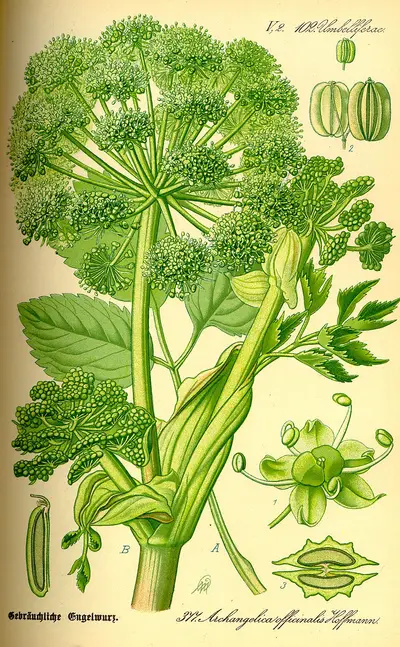
Angelica archangelica
USE WITH CARE
Safe for most external use, but has real cautions — read the note. Makes skin sensitive to sunlight. Avoid in pregnancy. In the wild it is easily confused with deadly hemlock and water dropwort — never forage it.
IN MAGIC
Protection and blessing; hung in the house or carried.
LORE
Said to have been revealed by the archangel Michael as a remedy for plague, and nicknamed 'root of the Holy Ghost'.
WHAT IS USED
Root, stems and seeds
WHEN
Flowers or is gathered in Britain from May to September.
USED FOR
ProtectionSpirits & the OtherworldHealing & blessing
In Culpeper's words
From his herbal of 1653, under “Angelica”. Culpeper was a physician of his day, and many of his remedies are now known to be useless or dangerous: read him as history, never as medical advice.
GOVERNMENT AND VIRTUESIt is an herb of the Sun in Leo; let it be gathered when he is there, the Moon applying to his good aspect; let it be gathered either in his hour, or in the hour of Jupiter, let Sol be angular; observe the like in gathering the herbs of other planets, and you may happen to do wonders. In all epidemical diseases caused by Saturn, that is as good a preservative as grows: It resists poison, by defending and comforting the heart, blood, and spirits; it doth the like against the plague and all epidemical diseases, if the root be taken in powder to the weight of half a dram at a time, with some good treacle in Carduus water, and the party thereupon laid to sweat in his bed; if treacle be not to be had take it alone in Carduus or Angelica-water. The stalks or roots candied and eaten fasting, are good preservatives in time of infection; and at other times to warm and comfort a cold stomach. The root also steeped in vinegar, and a little of that vinegar taken sometimes fasting, and the root smelled unto, is good for the same purpose.
Read the rest
A water distilled from the root simply, as steeped in wine, and distilled in a glass, is much more effectual than the water of the leaves; and this water, drank two or three spoonfuls at a time, easeth all pains and torments coming of cold and wind, so that the body be not bound; and taken with some of the root in powder at the beginning, helpeth the pleurisy, as also all other diseases of the lungs and breast, as coughs, phthysic, and shortness of breath; and a syrup of the stalks do the like. It helps pains of the cholic, the stranguary and stoppage of the urine, procureth womens’ courses, and expelleth the after-birth, openeth the stoppings of the liver and spleen, and briefly easeth and discusseth all windiness and inward swellings. The decoction drank before the fit of an ague, that they may sweat (if possible) before the fit comes, will, in two or three times taking, rid it quite away; it helps digestion and is a remedy for a surfeit. The juice or the water, being dropped into the eyes or ears, helps dimness of sight and deafness; the juice put into the hollow teeth, easeth their pains. The root in powder, made up into a plaster with a little pitch, and laid on the biting of mad dogs, or any other venomous creature, doth wonderfully help. The juice or the waters dropped, or tent wet therein, and put into filthy dead ulcers, or the powder of the root (in want of either) doth cleanse and cause them to heal quickly, by covering the naked bones with flesh; the distilled water applied to places pained with the gout, or sciatica, doth give a great deal of ease. The wild Angelica is not so effectual as the garden; although it may be safely used to all the purposes aforesaid.
Nicholas Culpeper, The Complete Herbal (London: Thomas Kelly, 1850), reprinting The English Physitian Enlarged (1653).
