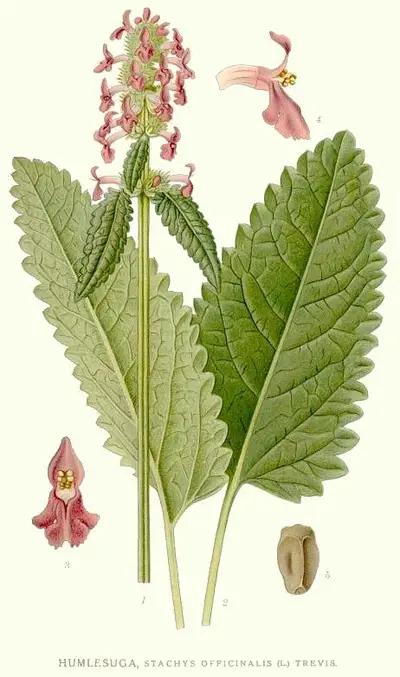
HERB · JUPITER (CULPEPER) · FIRE
Betony
Betonica officinalis
Also called wood betony
KITCHEN-SAFE
A common food or tea plant in normal amounts.
IN MAGIC
Protection against nightmares and evil spirits; planted in churchyards.
LORE
The Old English Herbarium praises it above almost every plant, as good for both soul and body and a shield against monstrous night-visitors and terrifying dreams.
WHAT IS USED
Leaves and flowering tops
WHEN
Flowers or is gathered in Britain from June to September.
USED FOR
ProtectionSpirits & the OtherworldPeace & sleep
In Culpeper's words
From his herbal of 1653, under “Wood Betony”. Culpeper was a physician of his day, and many of his remedies are now known to be useless or dangerous: read him as history, never as medical advice.
PLACEIt grows frequently in woods, and delights in shady places.
TIMEAnd it flowers in July; after which the seed is quickly ripe, yet in its prime in May.
GOVERNMENT AND VIRTUESThe herb is appropriated to the planet Jupiter, and the sign Aries. Antonius Musa, physician to the Emperor Augustus Cæsar, wrote a peculiar book of the virtues of this herb; and among other virtues saith of it, that it preserves the liver and bodies of men from the danger of epidemical diseases, and from witchcraft also; it helps those that loath and cannot digest their meat, those that have weak stomachs and sour belchings, or continual rising in their stomachs, using it familiarly either green or dry; either the herb, or root, or the flowers, in broth, drink, or meat, or made into conserve, syrup, water, electuary, or powder, as every one may best frame themselves unto, or as the time and season requires; taken any of the aforesaid ways, it helps the jaundice, falling sickness, the palsy, convulsions, or shrinking of the sinews, the gout and those that are inclined to dropsy, those that have continual pains in their heads, although it turn to phrensy.
Read the rest
The powder mixed with pure honey is no less available for all sorts of coughs or colds, wheesing, or shortness of breath, distillations of thin rheum upon the lungs, which causes consumptions. The decoction made with Mead, and a little Pennyroyal, is good for those that are troubled with putrid agues, whether quotidian, tertian, or quartan, and to draw down and evacuate the blood and humours, that by falling into the eyes, do hinder the sight; the decoction thereof made in wine and taken, kills the worms in the belly, opens obstructions both of the spleen and liver; cures stitches, and pains in the back and sides, the torments and griping pains in the bowels, and the wind cholic; and mixed with honey purges the belly, helps to bring down women’s courses, and is of special use for those that are troubled with the falling down of the mother, and pains thereof, and causes an easy and speedy delivery of women in child-birth. It helps also to break and expel the stone, either in the bladder or kidneys. The decoction with wine gargled in the mouth, eases the tooth-ache. It is commended against the stinging and biting of venomous serpents, or mad dogs, being used inwardly and applied outwardly to the place. A dram of the powder of Betony taken with a little honey in some vinegar, does wonderfully refresh those that are over wearied by travelling. It stays bleeding at the mouth or nose, and helps those that void or spit blood, and those that are bursten or have a rupture, and is good for such as are bruised by any fall or otherwise. The green herb bruised, or the juice applied to any inward hurt, or outward green wound in the head or body, will quickly heal and close it up; as also any vein or sinews that are cut, and will draw forth any broken bone or splinter, thorn or other things got into the flesh. It is no less profitable for old sores or filthy ulcers, yea, tho’ they be fistulous and hollow. But some do advise to put a little salt for this purpose, being applied with a little hog’s lard, it helps a plague sore, and other boils and pushes. The fumes of the decoction while it is warm, received by a funnel into the ears, eases the pains of them, destroys the worms and cures the running sores in them. The juice dropped into them does the same. The root of Betony is displeasing both to the taste and stomach, whereas the leaves and flowers, by their sweet and spicy taste, are comfortable both to meat and medicine. These are some of the many virtues Anthony Muse, an expert physician (for it was not the practice of Octavius Cæsar to keep fools about him), appropriates to Betony; it is a very precious herb, that is certain, and most fitting to be kept in a man’s house, both in syrup, conserve, oil, ointment and plaister. The flowers are usually conserved.
Nicholas Culpeper, The Complete Herbal (London: Thomas Kelly, 1850), reprinting The English Physitian Enlarged (1653).