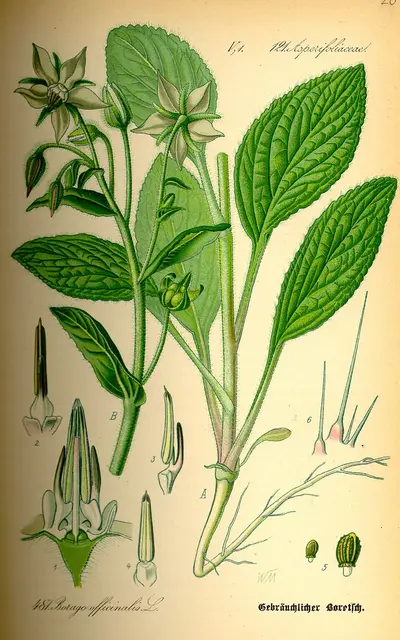
HERB · JUPITER (CULPEPER) · AIR
Borage
Borago officinalis
USE WITH CARE
Safe for most external use, but has real cautions — read the note. Contains alkaloids harmful to the liver; don't take it regularly as a tea or supplement.
IN MAGIC
Courage and cheer; flowers floated in drinks for a feast or carried before a hard task.
LORE
An old Latin tag has the plant say 'I, borage, always bring courage'. Pliny thought it banished sadness.
WHAT IS USED
Blue flowers
WHEN
Flowers or is gathered in Britain from June to September.
USED FOR
Courage & strength
In Culpeper's words
From his herbal of 1653, under “Borage and Bugloss”. Culpeper was a physician of his day, and many of his remedies are now known to be useless or dangerous: read him as history, never as medical advice.
PLACEIt grows wild in many places of this land, and may be plentifully found near London, as between Rotherhithe and Deptford, by the ditch side. Its virtues are held to be the same with Borage and Bugloss, only this is somewhat hotter.
TIMEThey flower in June and July, and the seed is ripe shortly after.
GOVERNMENT AND VIRTUESThey are all three herbs of Jupiter and under Leo, all great cordials, and great strengtheners of nature. The leaves and roots are to very good purpose used in putrid and pestilential fevers, to defend the heart, and help to resist and expel the poison, or the venom of other creatures: the seed is of the like effect; and the seed and leaves are good to increase milk in women’s breasts; the leaves, flowers, and seed, all or any of them, are good to expel pensiveness and melancholy; it helps to clarify the blood, and mitigate heat in fevers. The juice made into a syrup prevails much to all the purposes aforesaid, and is put, with other cooling, opening and cleansing herbs to open obstructions, and help the yellow jaundice, and mixed with Fumitory, to cool, cleanse, and temper the blood thereby; it helps the itch, ringworms and tetters, or other spreading scabs or sores. The flowers candied or made into a conserve, are helpful in the former cases, but are chiefly used as a cordial, and are good for those that are weak in long sickness, and to comfort the heart and spirits of those that are in a consumption, or troubled with often swoonings, or passions of the heart.
Read the rest
The distilled water is no less effectual to all the purposes aforesaid, and helps the redness and inflammations of the eyes, being washed therewith; the herb dried is never used, but the green; yet the ashes thereof boiled in mead, or honied water, is available against the inflammations and ulcers in the mouth or throat, to gargle it therewith; the roots of Bugloss are effectual, being made into a licking electuary for the cough, and to condensate thick phlegm, and the rheumatic distillations upon the lungs.
Nicholas Culpeper, The Complete Herbal (London: Thomas Kelly, 1850), reprinting The English Physitian Enlarged (1653).