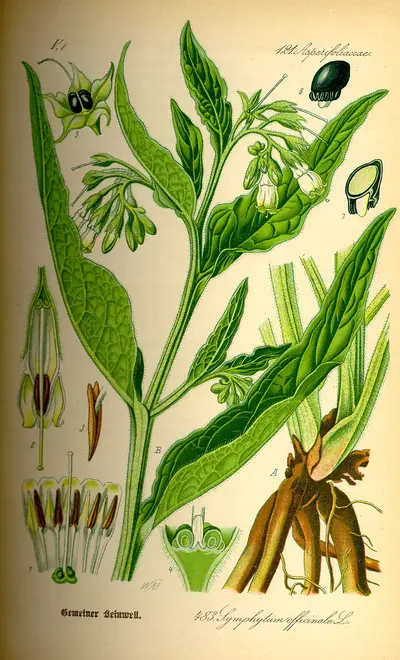
HERB · SATURN (CULPEPER) · WATER
Comfrey
Symphytum officinale
POISONOUS
Do not eat or drink. Wash hands after handling. Contains alkaloids that damage the liver. Not to be eaten or drunk; external use only, and not on broken skin.
IN MAGIC
A leaf tucked in luggage to protect travellers and their belongings.
LORE
Called 'knitbone': its leaves were wrapped around broken limbs.
WHAT IS USED
Leaves (external only)
WHEN
Flowers or is gathered in Britain from May to September.
USED FOR
ProtectionHealing & blessing
In Culpeper's words
From his herbal of 1653, under “Comfrey”. Culpeper was a physician of his day, and many of his remedies are now known to be useless or dangerous: read him as history, never as medical advice.
PLACEThey grow by ditches and water-sides, and in divers fields that are moist, for therein they chiefly delight to grow. The first generally through all the land, and the other but in some places. By the leave of my authors, I know the first grows in dry places.
TIMEThey flower in June or July, and give their seed in August.
GOVERNMENT AND VIRTUESThis is an herb of Saturn, and I suppose under the sign Capricorn, cold, dry, and earthy in quality. What was spoken of Clown’s Woundwort may be said of this. The Great Comfrey helps those that spit blood, or make a bloody urine. The root boiled in water or wine, and the decoction drank, helps all inward hurts, bruises, wounds, and ulcer of the lungs, and causes the phlegm that oppresses them to be easily spit forth: It helps the defluction of rheum from the head upon the lungs, the fluxes of blood or humours by the belly, women’s immoderate courses, as well the reds as the whites, and the running of the reins happening by what cause soever. A syrup made thereof is very effectual for all those inward griefs and hurts, and the distilled water for the same purpose also, and for outward wounds and sores in the fleshy or sinewy part of the body whatsoever, as also to take away the fits of agues, and to allay the sharpness of humours.
Read the rest
A decoction of the leaves hereof is available to all the purposes, though not so effectual as the roots. The roots being outwardly applied, help fresh wounds or cuts immediately, being bruised and laid thereto; and is special good for ruptures and broken bones; yea, it is said to be so powerful to consolidate and knit together, that if they be boiled with dissevered pieces of flesh in a pot, it will join them together again. It is good to be applied to women’s breasts that grow sore by the abundance of milk coming into them; also to repress the over much bleeding of the hæmorrhoids, to cool the inflammation of the parts thereabouts, and to give ease of pains. The roots of Comfrey taken fresh, beaten small, and spread upon leather, and laid upon any place troubled with the gout, doth presently give ease of the pains; and applied in the same manner, gives ease to pained joints, and profits very much for running and moist ulcers, gangrenes, mortifications, and the like, for which it hath by often experience been found helpful.
Nicholas Culpeper, The Complete Herbal (London: Thomas Kelly, 1850), reprinting The English Physitian Enlarged (1653).
