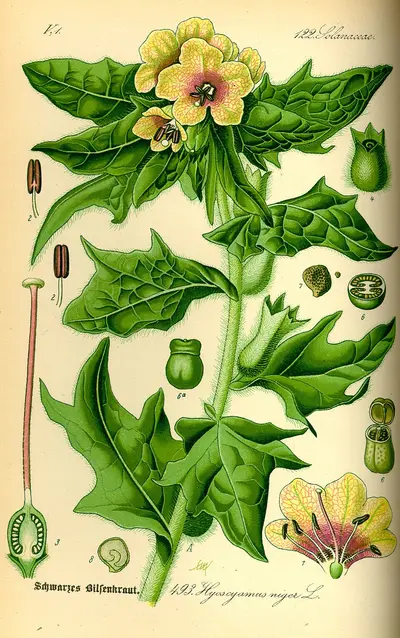
HERB · SATURN (CULPEPER) · WATER
Henbane
Hyoscyamus niger
DEADLY
Can kill. Do not eat, drink or burn; handle only with gloves, if at all. Poisonous in every part; causes delirium and can kill.
IN MAGIC
Studied for its history only.
LORE
Brewed into medieval beer before hops, and named in witch-trial and flying-ointment accounts. Its seeds were burned in some ancient divination.
WHAT IS USED
None — study only
WHEN
Flowers or is gathered in Britain from June to August.
USED FOR
Spirits & the Otherworld
In Culpeper's words
From his herbal of 1653, under “Henbane”. Culpeper was a physician of his day, and many of his remedies are now known to be useless or dangerous: read him as history, never as medical advice.
PLACEIt commonly grows by the way-sides, and under hedge-sides and walls.
TIMEIt flowers in July, and springs again yearly of its own seed. I doubt my authors mistook July for June, if not for May.
GOVERNMENT AND VIRTUESI wonder how astrologers could take on them to make this an herb of Jupiter; and yet Mizaldus, a man of a penetrating brain, was of that opinion as well as the rest; the herb is indeed under the dominion of Saturn, and I prove it by this argument: All the herbs which delight most to grow in saturnine places, are saturnine herbs. Both Henbane delights most to grow in saturnine places, and whole cart loads of it may be found near the places where they empty the common Jakes, and scarce a ditch to be found without it growing by it. Ergo, it is an herb of Saturn. The leaves of Henbane do cool all hot inflammations in the eyes, or any other part of the body; and are good to assuage all manner of swellings of the privities, or women’s breast, or elsewhere, if they be boiled in wine, and either applied themselves, or the fomentation warm; it also assuages the pain of the gout, the sciatica, and other pains in the joints which arise from a hot cause.
Read the rest
And applied with vinegar to the forehead and temples, helps the head-ache and want of sleep in hot fevers. The juice of the herb or seed, or the oil drawn from the seed, does the like. The oil of the seed is helpful for deafness, noise, and worms in the ears, being dropped therein; the juice of the herb or root doth the same. The decoction of the herb or seed, or both, kills lice in man or beast. The fume of the dried herb, stalks and seed, burned, quickly heals swellings, chilblains or kibes in the hands or feet, by holding them in the fume thereof. The remedy to help those that have taken Henbane is to drink goat’s milk, honeyed water, or pine kernels, with sweet wine; or, in the absence of these, Fennel seed, Nettle seed, the seed of Cresses, Mustard, or Radish; as also Onions or Garlic taken in wine, do all help to free them from danger, and restore them to their due temper again. Take notice, that this herb must never be taken inwardly; outwardly, an oil ointment, or plaister of it, is most admirable for the gout, to cool the veneral heat of the reins in the French pox; to stop the toothache, being applied to the aching side: to allay all inflammations, and to help the diseases before premised.
Nicholas Culpeper, The Complete Herbal (London: Thomas Kelly, 1850), reprinting The English Physitian Enlarged (1653).
Learn more in the lessons
- The Poison Garden — Baneful Herbs in History · 14 min
- Ethics, Safety & a Sound Mind · 8 min · free
- The Northern Sources · 14 min · free