HERB · VENUS (CULPEPER) · WATER
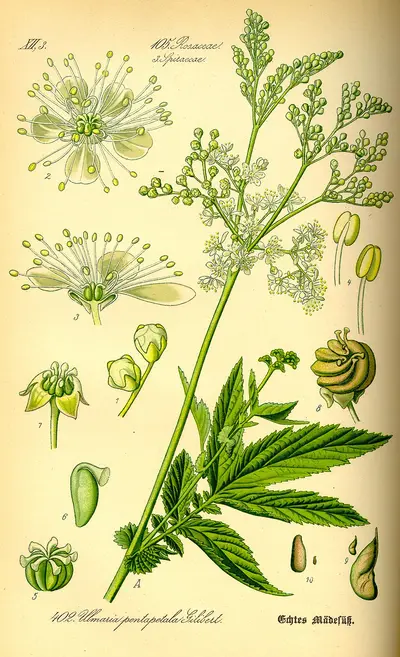
Meadowsweet
Filipendula ulmaria
USE WITH CARE
Safe for most external use, but has real cautions — read the note. Contains salicylates; not for anyone allergic to aspirin.
IN MAGIC
Love and peace; strewn for weddings and handfastings.
LORE
In the Welsh Mabinogion the magicians make Blodeuwedd from the flowers of oak, broom and meadowsweet. Elizabeth I liked it strewn in her rooms.
WHAT IS USED
Flowers
WHEN
Flowers or is gathered in Britain from June to August.
USED FOR
LoveHealing & blessingPeace & sleep
In Culpeper's words
From his herbal of 1653, under “Queen of the Meadows, Meadow Sweet, or Mead Sweet”. Culpeper was a physician of his day, and many of his remedies are now known to be useless or dangerous: read him as history, never as medical advice.
PLACEIt grows in moist meadows that lie mostly wet, or near the courses of water.
TIMEIt flowers in some places or other all the three Summer months, that is, June, July, and August, and the seed is ripe soon after.
GOVERNMENT AND VIRTUESVenus claims dominion over the herb. It is used to stay all manner of bleedings, fluxes, vomitings, and women’s courses, also their whites: It is said to alter and take away the fits of the quartan agues, and to make a merry heart, for which purpose some use the flowers, and some the leaves. It helps speedily those that are troubled with the cholic; being boiled in wine, and with a little honey, taken warm, it opens the belly; but boiled in red wine, and drank, it stays the flux of the belly. Outwardly applied, it helps old ulcers that are cankerous, or hollow fistulous, for which it is by many much commended, as also for the sores in the mouth or secret parts. The leaves when they are full grown, being laid on the skin, will, in a short time, raise blisters thereon, as Tragus saith. The water thereof helps the heat and inflammation in the eyes.
Nicholas Culpeper, The Complete Herbal (London: Thomas Kelly, 1850), reprinting The English Physitian Enlarged (1653).
Learn more in the lessons
- The Otherworld and the Gods · 16 min
- Herbal Allies · 15 min
- Planetary Herbs & the Doctrine of Signatures · 16 min