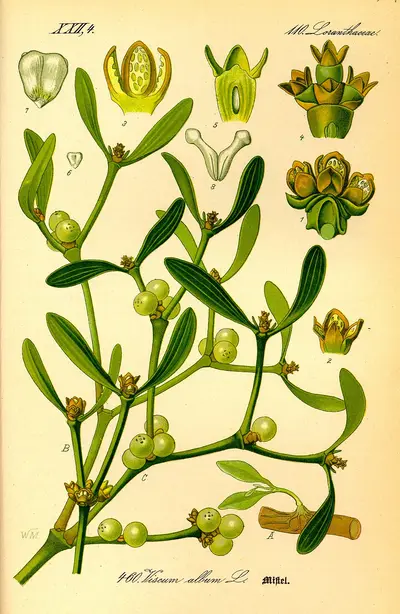
HERB · SUN (CULPEPER) · AIR
Mistletoe
Viscum album
POISONOUS
Do not eat or drink. Wash hands after handling. The berries and leaves are poisonous.
IN MAGIC
Hung for peace and love at midwinter; a protective charm.
LORE
Pliny describes druids in white cutting it from an oak with a golden sickle. In Norse myth Baldur was killed by a mistletoe dart.
WHAT IS USED
Sprigs (keep berries away from children)
WHEN
Flowers or is gathered in Britain from November to February.
USED FOR
ProtectionLoveHealing & blessing
In Culpeper's words
From his herbal of 1653, under “Misselto”. Culpeper was a physician of his day, and many of his remedies are now known to be useless or dangerous: read him as history, never as medical advice.
PLACEIt grows very rarely on oaks with us; but upon sundry others as well timber as fruit trees, plentifully in woody groves, and the like, through all this land.
TIMEIt flowers in the Spring-time, but the berries are not ripe until October, and abides on the branches all the Winter, unless the blackbirds, and other birds, do devour them.
GOVERNMENT AND VIRTUESThis is under the dominion of the Sun, I do not question; and can also take for granted, that which grows upon oaks, participates something of the nature of Jupiter, because an oak is one of his trees; as also that which grows upon pear trees, and apple trees, participates something of his nature, because he rules the tree it grows upon, having no root of its own. But why that should have most virtues that grows upon oaks I know not, unless because it is rarest and hardest to come by; and our college’s opinion is in this contrary to scripture, which saith, God’s tender mercies are over all his works; and so it is, let the college of physicians walk as contrary to him as they please, and that is as contrary as the east to the west. Clusius affirms that which grows upon pear trees to be as prevalent, and gives order, that it should not touch the ground after it is gathered; and also saith, that, being hung about the neck, it remedies witchcraft.
Read the rest
Both the leaves and berries of Misselto do heat and dry, and are of subtle parts; the birdlime doth molify hard knots, tumours, and imposthumes; ripens and discusses them, and draws forth thick as well as thin humours from the remote parts of the body, digesting and separating them. And being mixed with equal parts of rozin and wax, doth molify the hardness of the spleen, and helps old ulcers and sores. Being mixed with Sandaric and Orpiment, it helps to draw off foul nails; and if quick-lime and wine lees be added thereunto, it works the stronger. The Misselto itself of the oak (as the best) made into powder, and given in drink to those that have the falling sickness, does assuredly heal them, as Matthiolus saith: but it is fit to use it for forty days together. Some have so highly esteemed it for the virtues thereof, that they have called it Lignum Sanctiæ Crucis, Wood of the Holy Cross, believing it helps the falling sickness, apoplexy and palsy very speedily, not only to be inwardly taken, but to be hung at their neck. Tragus saith, that the fresh wood of any Misselto bruised, and the juice drawn forth and dropped in the ears that have imposthumes in them, doth help and ease them within a few days.
Nicholas Culpeper, The Complete Herbal (London: Thomas Kelly, 1850), reprinting The English Physitian Enlarged (1653).
Learn more in the lessons
- The Druids of the Ancient Writers · 16 min · free
- The Poison Garden — Baneful Herbs in History · 14 min
- Herbal Allies · 15 min