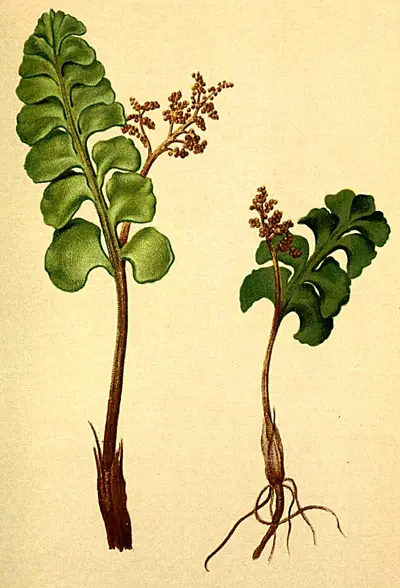
HERB · MOON (CULPEPER) · WATER
Moonwort
Botrychium lunaria
USE WITH CARE
Safe for most external use, but has real cautions — read the note. Rare and declining; never pick it.
IN MAGIC
A Moon emblem; drawn or pictured rather than picked.
LORE
Its leaflets are shaped like half-moons. Culpeper repeats the old belief that it could open locks and pull the shoes from horses that trod on it.
WHAT IS USED
None — a rare fern; leave it be
WHEN
Flowers or is gathered in Britain from May to July.
USED FOR
Money & luckSpirits & the Otherworld
In Culpeper's words
From his herbal of 1653, under “Moonwort”. Culpeper was a physician of his day, and many of his remedies are now known to be useless or dangerous: read him as history, never as medical advice.
PLACEIt grows on hills and heaths, yet where there is much grass, for therein it delights to grow.
TIMEIt is to be found only in April and May; for in June, when any hot weather comes, for the most part it is withered and gone.
GOVERNMENT AND VIRTUESThe Moon owns the herb. Moonwort is cold and drying more than Adder’s Tongue, and is therefore held to be more available for all wounds both inward and outward. The leaves boiled in red wine, and drank, stay the immoderate flux of women’s courses, and the whites. It also stays bleeding, vomiting, and other fluxes. It helps all blows and bruises, and to consolidate all fractures and dislocations. It is good for ruptures, but is chiefly used, by most with other herbs, to make oils or balsams to heal fresh or green wounds (as I said before) either inward or outward, for which it is excellently good. Moonwort is an herb which (they say) will open locks, and unshoe such horses as tread upon it: This some laugh to scorn, and those no small fools neither; but country people, that I know, call it Unshoe the Horse. Besides I have heard commanders say, that on White Down in Devonshire, near Tiverton, there were found thirty horse shoes, pulled off from the feet of the Earl of Essex’s horses, being there drawn up in a body, many of them being but newly shod, and no reason known, which caused much admiration: the herb described usually grows upon heaths.
Nicholas Culpeper, The Complete Herbal (London: Thomas Kelly, 1850), reprinting The English Physitian Enlarged (1653).