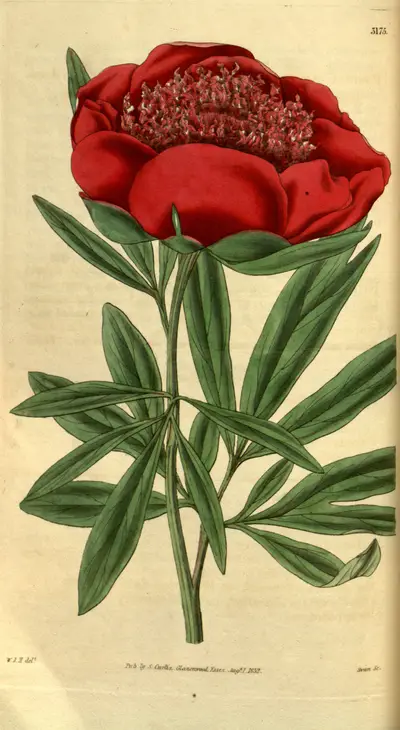
HERB · SUN (CULPEPER) · FIRE
Peony
Paeonia officinalis
POISONOUS
Do not eat or drink. Wash hands after handling. Roots and seeds are poisonous to swallow.
IN MAGIC
Protection against nightmares and evil spirits; seed necklaces were hung on children.
LORE
Named after Paeon, physician of the gods. Ancient writers warned to dig it at night, lest a woodpecker peck out the digger's eyes.
WHAT IS USED
Dried flowers and seeds (as a charm, not eaten)
WHEN
Flowers or is gathered in Britain from May to June.
USED FOR
ProtectionHealing & blessing
In Culpeper's words
From his herbal of 1653, under “Male and Female Peony”. Culpeper was a physician of his day, and many of his remedies are now known to be useless or dangerous: read him as history, never as medical advice.
GOVERNMENT AND VIRTUESIt is an herb of the Sun, and under the Lion. Physicians say, Male Peony roots are best; but Dr. Reason told me Male Peony was best for men, and Female Peony for women, and he desires to be judged by his brother Dr. Experience. The roots are held to be of more virtue than the seed; next the flowers; and, last of all, the leaves. The roots of the Male Peony, fresh gathered, having been found by experience to cure the falling sickness; but the surest way is, besides hanging it about the neck, by which children have been cured, to take the root of the Male Peony washed clean, and stamped somewhat small, and laid to infuse in sack for 24 hours at the least, afterwards strain it, and take it first and last, morning and evening, a good draught for sundry days together, before and after a full moon: and this will also cure old persons, if the disease be not grown too old, and past cure, especially if there be a due and orderly preparation of the body with posset-drink made of Betony, &c.
Read the rest
The root is also effectual for women that are not sufficiently cleansed after child-birth, and such as are troubled with the mother; for which likewise the black seed beaten to powder, and given in wine, is also available. The black seed also taken before bed-time, and in the morning, is very effectual for such as in their sleep are troubled with the disease called Ephialtes, or Incubus, but we do commonly call it the Night-mare: a disease which melancholy persons are subject unto: It is also good against melancholy dreams. The distilled water or syrup made of the flowers, works the same effects that the root and seed do, although more weakly. The Female’s is often used for the purpose aforesaid, by reason the Male is so scarce a plant, that it is possessed by few, and those great lovers of rarities in this kind.
Nicholas Culpeper, The Complete Herbal (London: Thomas Kelly, 1850), reprinting The English Physitian Enlarged (1653).
Learn more in the lessons
- The Poison Garden — Baneful Herbs in History · 14 min
- Herbal Allies · 15 min
- Planetary Herbs & the Doctrine of Signatures · 16 min