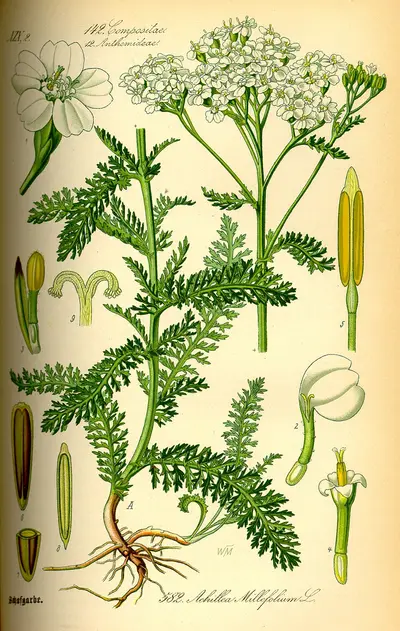
HERB · VENUS (CULPEPER) · WATER
Yarrow
Achillea millefolium
USE WITH CARE
Safe for most external use, but has real cautions — read the note. Avoid in pregnancy; can cause skin allergy.
IN MAGIC
Love divination under the pillow; the stalks of the I Ching; courage.
LORE
Achilles used it to heal his soldiers' wounds. An English charm: 'Thou pretty herb of Venus' tree, / Thy true name it is yarrow…'
WHAT IS USED
Flowers and stalks
WHEN
Flowers or is gathered in Britain from June to September.
USED FOR
Divination & dreamsLoveCourage & strength
In Culpeper's words
From his herbal of 1653, under “Yarrow, Called Nose-Bleed, Milfoil and Thousand-Leaf”. Culpeper was a physician of his day, and many of his remedies are now known to be useless or dangerous: read him as history, never as medical advice.
PLACEIt is frequent in all pastures.
TIMEIt flowers late, even in the latter end of August.
GOVERNMENT AND VIRTUESIt is under the influence of Venus. An ointment of them cures wounds, and is most fit for such as have inflammations, it being an herb of Dame Venus; it stops the terms in women, being boiled in white wine, and the decoction drank; as also the bloody flux; the ointment of it is not only good for green wounds, but also for ulcers and fistulas, especially such as abound with moisture. It stays the shedding of hair, the head being bathed with the decoction of it; inwardly taken it helps the retentive faculty of the stomach: it helps the gonorrhea in men, and the whites in women, and helps such as cannot hold their water; and the leaves chewed in the mouth eases the tooth-ache, and these virtues being put together, shew the herb to be drying and binding. Achilles is supposed to be the first that left the virtues of this herb to posterity, having learned them of this master Chiron, the Centaur; and certainly a very profitable herb it is in cramps, and therefore called Militaris.
Nicholas Culpeper, The Complete Herbal (London: Thomas Kelly, 1850), reprinting The English Physitian Enlarged (1653).
Learn more in the lessons
- Herbal Allies · 15 min
- The Book of Changes · 18 min
- Planetary Herbs & the Doctrine of Signatures · 16 min