IN THIS LESSON
Western Ceremonial Magic · Lesson 4 of 13
One Planet, Worked Through — Venus
The seven planets' tables are everywhere, but where do they come from? Venus followed through Agrippa's list of her things, the Heptameron's Friday and its hours, Culpeper's herbal, and one real hour from the Magical Timing tool — with the places where the sources agree, part and change in translation.
Every book on magic has a table of the seven planets: a day, a metal, a colour, an angel, a handful of herbs and stones for each. Tables are useful, but they hide where each entry came from and what the sources actually say. This lesson takes one planet, Venus, and follows her through three kinds of source and one real hour, so that you can see how a correspondence is built, and where the sources agree, part and change in translation. The Seven Planets & Their Squares gives the whole table; this is one row of it, read slowly.
Agrippa's list of her things
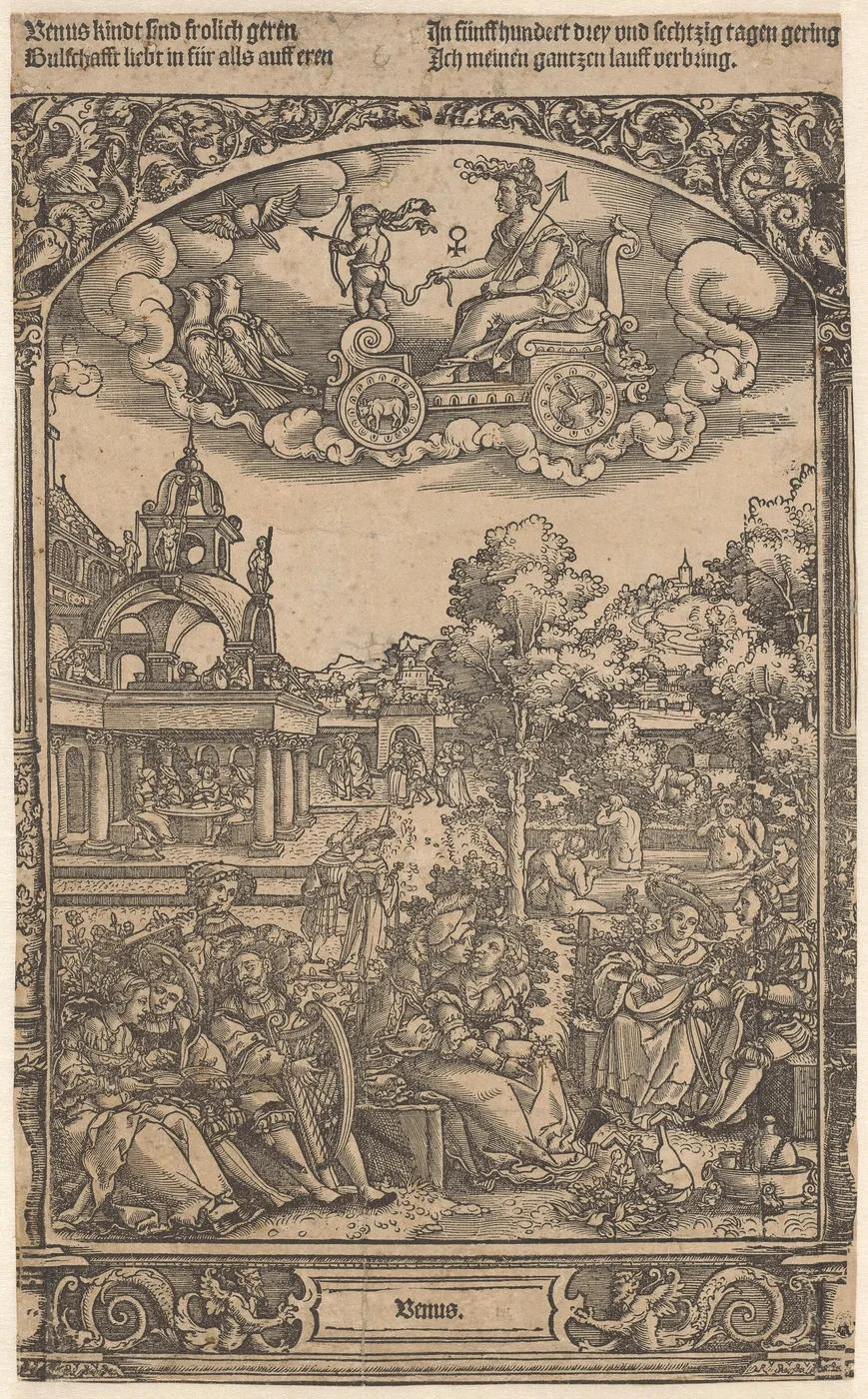
Book I, chapter 28 of Agrippa's Three Books, "What things are under the power of Venus, and are called Venereall", is a list of the world sorted by likeness. Among the elements Venus has air and water; among tastes, "those which are sweet, unctuous, and delectable"; among metals, "Silver, and Brass, both yellow, and red", that is, brass and copper. Her stones are beryl, chrysolite, emerald, sapphire, green jasper, carnelian, the eagle-stone, lapis lazuli and coral. Her plants begin with vervain, violet, maidenhair and valerian, and go on through thyme, ladanum, ambergris, musk, sandalwood and coriander to "all sweet perfumes" and sweet fruits: pears, figs and pomegranates, with the rose and the myrtle. Her birds include the dove, the sparrow, the swan and the turtle-dove.
The reasoning is the one Agrippa sets out in chapter 15: things move towards their like. The planet of love and pleasure gathers the sweet, the fragrant, the fertile and the fond.
Two entries are worth a second look. Silver is here, though chapter 24 also gives silver to the Moon. And vervain, first among Venus's plants here, is also listed among the Sun's in chapter 23. A single book can place one thing under two planets. When a modern table gives vervain to the Sun, or to Venus, it may be quoting Agrippa either way.
Lesson 4 of 13 · 15 min