Part I · Chapter IV: The Rituals of Black Magic
Talismans of the Sage of the Pyramids, XIX–XX and Conclusion
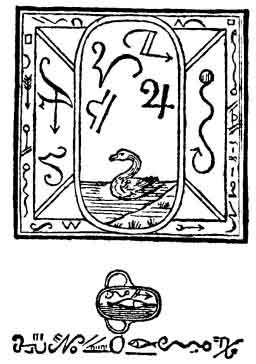
The characters should be graven on the outer side of the Ring.
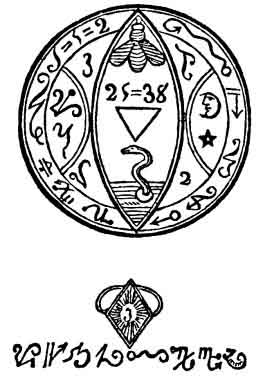
The characters should be graven on the outer side of the Ring.
XIX. Gives the power of directing all the infernal hosts against the enemies of its possessor. The talisman is of greyish-white satin, shaded. It may be worn in any manner, and the words are: OSTHARIMAN, VISANTIPAROS, NOCTATUR.
XX. Gives the knowledge of the counsels of Infernus and the means of rendering its projects abortive, but whether for the ultimate health and weal of the operator's soul there is no guarantee offered. The talisman is of red satin, with the centre embroidered in gold, the border in silver and the figures in black and white silk. It should be worn upon the breast and the ring on the first joint of the little finger of the left hand. The words are: ACTATOS, CATIPTA, BEJOURAN, ITAPAN, MARNUTUS.
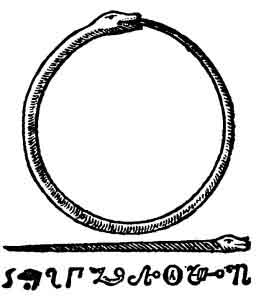
The characters should be graven on the Rod with Chinese Ink.
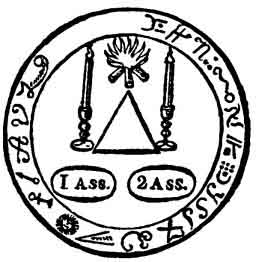
The range of human ambition recognised by Ceremonial Magic being always somewhat restricted, it is not surprising that the offices of these talismans frequently overlap one another, or that some of them correspond very closely to the powers ascribed to the Magus by the transcendental science of the Arbatel. The talismans are preceded in the original by the figure of a magical rod, stained, says the letterpress which accompanies it, with the blood of a lamb and having the form of a serpent. The description is somewhat obscure, but the wand must be apparently flexible, so that it can be bent at need, and the mouth and tail joined by means of a golden chain, thus forming a circle. It will be observed that it is the old symbol, the great and mystic symbol, but in what strange company has it fallen! The wand should be six feet long and when bent can be used as a circle of evocation. There is also a figure of the grand magical circle, but it is not described in the text. There are thus twenty-two figures in all, and the inclusion of the word TAROT in the list of evoking terms is not without significance in this connection. A certain correspondence between the talismans and the Tarot Trumps is indeed unmistakable, at least in some instances, and seems to indicate that the work has a more definite occult aspect than would appear at first sight. It is the symbolism of the Trumps Major redirected towards the Powers of the Deep.
The end of Talismans of the Sage of the Pyramids, XIX–XX and Conclusion.
Turn the page for The Gold-Finding Hen.
Tap or click the right-hand side of the book to turn the page, the left to turn back; or use the arrow keys, or swipe. Press F for full screen.
Part I · Chapter IV: The Rituals of Black Magic
Talismans of the Sage of the Pyramids, XIX–XX and Conclusion
The characters should be graven on the outer side of the Ring.
The characters should be graven on the outer side of the Ring.
XIX. Gives the power of directing all the infernal hosts against the enemies of its possessor. The talisman is of greyish-white satin, shaded. It may be worn in any manner, and the words are: OSTHARIMAN, VISANTIPAROS, NOCTATUR.
XX. Gives the knowledge of the counsels of Infernus and the means of rendering its projects abortive, but whether for the ultimate health and weal of the operator's soul there is no guarantee offered. The talisman is of red satin, with the centre embroidered in gold, the border in silver and the figures in black and white silk. It should be worn upon the breast and the ring on the first joint of the little finger of the left hand. The words are: ACTATOS, CATIPTA, BEJOURAN, ITAPAN, MARNUTUS.
The characters should be graven on the Rod with Chinese Ink.
The range of human ambition recognised by Ceremonial Magic being always somewhat restricted, it is not surprising that the offices of these talismans frequently overlap one another, or that some of them correspond very closely to the powers ascribed to the Magus by the transcendental science of the Arbatel. The talismans are preceded in the original by the figure of a magical rod, stained, says the letterpress which accompanies it, with the blood of a lamb and having the form of a serpent. The description is somewhat obscure, but the wand must be apparently flexible, so that it can be bent at need, and the mouth and tail joined by means of a golden chain, thus forming a circle. It will be observed that it is the old symbol, the great and mystic symbol, but in what strange company has it fallen! The wand should be six feet long and when bent can be used as a circle of evocation. There is also a figure of the grand magical circle, but it is not described in the text. There are thus twenty-two figures in all, and the inclusion of the word TAROT in the list of evoking terms is not without significance in this connection. A certain correspondence between the talismans and the Tarot Trumps is indeed unmistakable, at least in some instances, and seems to indicate that the work has a more definite occult aspect than would appear at first sight. It is the symbolism of the Trumps Major redirected towards the Powers of the Deep.
34 of 79 · 2 min read
