Chapter III: On the Talismanic Use of Special Stones
Agate
See also the writer’s pamphlet: “The Folk-Lore of Precious Stones,” Chicago, 1894; a paper read before the Folk-Lore Congress held at the World’s Columbian Exhibition, and describing the Kunz Collection exhibited in the Anthropological Building there. This collection is now in the Field Museum, Chicago.
The author of “Lithica” celebrates the merits of the agate in the following lines:37
This idea is elaborated by Marbodus, Bishop of Rennes, in the eleventh century, who declares that agates make the wearers agreeable and persuasive and also give them the favor of God.38 Still other virtues are recounted by Camillo Leonardo, who claims that these stones give victory and strength to their owners and avert tempests and lightning.39
The agate possessed some wonderful virtues, for its wearer was guarded from all dangers, was enabled to vanquish all terrestrial obstacles and was endowed with a bold heart; this latter prerogative was presumably the secret of his success. Some of these wonder-working agates were black with white veins, while others again were entirely white.40
The wearing of agate ornaments was even believed to be a cure for insomnia and was thought to insure pleasant dreams. In spite of these supposed advantages, Cardano asserts that while wearing this stone he had many misfortunes which he could not trace to any fault or error of his own. He, therefore, abandoned its use; although he states that it made the wearer more prudent in his actions.41 Indeed, Cardano appears to have tested the talismanic worth of gems according to a plan of his own,—namely, by wearing them in turn and noting the degree of good or ill fortune he experienced. By this method he apparently arrived at positive results based on actual experience; but he quite failed to appreciate the fact that no real connection of any kind existed between the stones and their supposed effects. In another treatise this author takes a somewhat more favorable view of the agate, and proclaims that all varieties render those who wear them “temperate, continent, and cautious; therefore they are all useful for acquiring riches.”42
According to the text accompanying a curious print published in Vienna in 1709, the attractive qualities of the so-called coral-agate were to be utilized in an air-ship, the invention of a Brazilian priest. Over the head of the aviator, as he sat in the air-ship, there was a network of iron to which large coral-agates were attached. These were expected to help in drawing up the ship, when, through the heat of the sun’s rays, the stones had acquired magnetic power. The main lifting force was provided by powerful magnets enclosed in two metal spheres; how the magnets themselves were to be raised is not explained.43
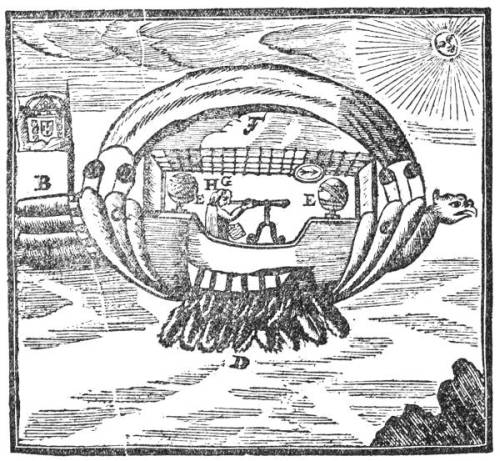
In the network above the figure were to be set coral-agates, supposed to possess such magnetic powers as to keep the craft aloft. From Valentini, “Museum Museorum,” Pt. III, Franckfurt am Mayn, 1714, p.35. Author’s library.
About the middle of the past century, the demand for agate amulets was so great in the Soudan that the extensive agate-cutting establishments at Idar and Oberstein in Germany were almost exclusively busied with filling orders for this trade. Brown or black agates having a white ring in the centre were chiefly used for the fabrication of these amulets, the white ring being regarded as a symbol of the eye. Hence the amulets were supposed to neutralize the power of the Evil Eye, or else to be emblematic of the watchfulness of a guardian spirit. The demand for these amulets has fallen off greatly, but when it was at its height single firms exported them to the value of 40,000 thalers ($30,000) annually, the total export amounting to hundreds of thousands of thalers. Even at present a considerable trade in these objects is still carried on. That there is a fashion in amulets is shown by the fact that, while red, white, and green amulets are in demand on the west coast of Africa, only white stones are favored for this use in Northern Africa.
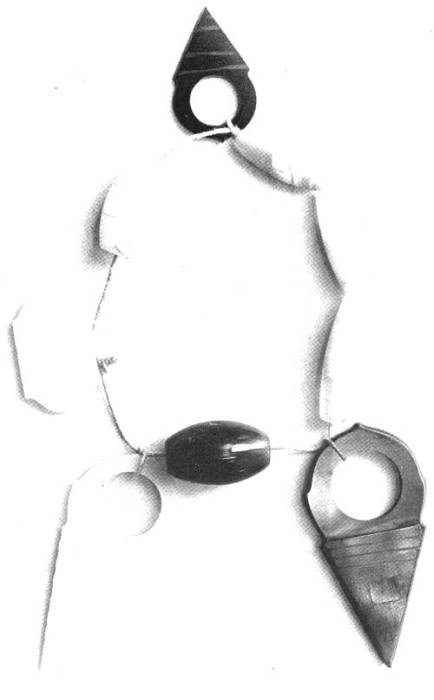
Made of Brazilian agate at Oberstein, Germany, for African trade. Field Museum, Chicago.
The end of Agate.
Turn the page for Alexandrite.
Tap or click the right-hand side of the book to turn the page, the left to turn back; or use the arrow keys, or swipe. Press F for full screen.
Chapter III: On the Talismanic Use of Special Stones
Agate
See also the writer’s pamphlet: “The Folk-Lore of Precious Stones,” Chicago, 1894; a paper read before the Folk-Lore Congress held at the World’s Columbian Exhibition, and describing the Kunz Collection exhibited in the Anthropological Building there. This collection is now in the Field Museum, Chicago.
The author of “Lithica” celebrates the merits of the agate in the following lines:37
This idea is elaborated by Marbodus, Bishop of Rennes, in the eleventh century, who declares that agates make the wearers agreeable and persuasive and also give them the favor of God.38 Still other virtues are recounted by Camillo Leonardo, who claims that these stones give victory and strength to their owners and avert tempests and lightning.39
The agate possessed some wonderful virtues, for its wearer was guarded from all dangers, was enabled to vanquish all terrestrial obstacles and was endowed with a bold heart; this latter prerogative was presumably the secret of his success. Some of these wonder-working agates were black with white veins, while others again were entirely white.40
The wearing of agate ornaments was even believed to be a cure for insomnia and was thought to insure pleasant dreams. In spite of these supposed advantages, Cardano asserts that while wearing this stone he had many misfortunes which he could not trace to any fault or error of his own. He, therefore, abandoned its use; although he states that it made the wearer more prudent in his actions.41 Indeed, Cardano appears to have tested the talismanic worth of gems according to a plan of his own,—namely, by wearing them in turn and noting the degree of good or ill fortune he experienced. By this method he apparently arrived at positive results based on actual experience; but he quite failed to appreciate the fact that no real connection of any kind existed between the stones and their supposed effects. In another treatise this author takes a somewhat more favorable view of the agate, and proclaims that all varieties render those who wear them “temperate, continent, and cautious; therefore they are all useful for acquiring riches.”42
According to the text accompanying a curious print published in Vienna in 1709, the attractive qualities of the so-called coral-agate were to be utilized in an air-ship, the invention of a Brazilian priest. Over the head of the aviator, as he sat in the air-ship, there was a network of iron to which large coral-agates were attached. These were expected to help in drawing up the ship, when, through the heat of the sun’s rays, the stones had acquired magnetic power. The main lifting force was provided by powerful magnets enclosed in two metal spheres; how the magnets themselves were to be raised is not explained.43
In the network above the figure were to be set coral-agates, supposed to possess such magnetic powers as to keep the craft aloft. From Valentini, “Museum Museorum,” Pt. III, Franckfurt am Mayn, 1714, p.35. Author’s library.
About the middle of the past century, the demand for agate amulets was so great in the Soudan that the extensive agate-cutting establishments at Idar and Oberstein in Germany were almost exclusively busied with filling orders for this trade. Brown or black agates having a white ring in the centre were chiefly used for the fabrication of these amulets, the white ring being regarded as a symbol of the eye. Hence the amulets were supposed to neutralize the power of the Evil Eye, or else to be emblematic of the watchfulness of a guardian spirit. The demand for these amulets has fallen off greatly, but when it was at its height single firms exported them to the value of 40,000 thalers ($30,000) annually, the total export amounting to hundreds of thousands of thalers. Even at present a considerable trade in these objects is still carried on. That there is a fashion in amulets is shown by the fact that, while red, white, and green amulets are in demand on the west coast of Africa, only white stones are favored for this use in Northern Africa.
Made of Brazilian agate at Oberstein, Germany, for African trade. Field Museum, Chicago.
4 of 44 · 3 min read
