Chapter III: On the Talismanic Use of Special Stones
Carnelian
The wearing of carnelians is recommended by the Lapidario of Alfonso X60 to those who have a weak voice or are timid in speech, for the warm-colored stone will give them the courage they lack, so that they will speak both boldly and well. This is in accord with the general belief in the stimulating and animating effects produced by red stones.
On a carnelian is engraved in Arabic characters a prayer to keep away evil and to deliver the wearer from all the tricks of the devil and from the envious. The inscription reads in translation:
Throughout all the East people are afraid of the envious. They believe that if you envy a person for his health or his wealth or any good thing he may have, he will lose it in a short time, and it is the devil who incites the envy of some people against others. So it is supposed that by wearing this stone, bearing this prayer against the envious, their envy will cease to do you harm.
The popularity of the carnelian as a talismanic stone among Mohammedan peoples is said to be due to the fact that the Prophet himself wore, on the little finger of his right hand, a silver ring set with a carnelian engraved for use as a seal. One of the most famous of the imâms, Jafar, lent the weight of his authority to the belief in the virtue of the carnelian, for he declared that all the desires of any man who wore this stone would be gratified. Hence in Persia the name of one of the twelve imâms, comprising Ali and his successors, is frequently engraved on this stone.61
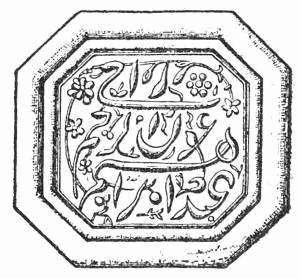
This most interesting seal is described by the Rev. C. W. King, the writer on Antique Gems. It is carnelian, octagonal-shaped, and upon it is engraved the legend: “The slave Abraham relying upon the Merciful (God).” Napoleon III wore it on his watch-chain. He said about it: “The First Consul picked it up with his own hands during the campaign in Egypt and always carried it about him, as his nephew did later.” The Prince Imperial received it with the following message: “As regards my son, I desire that he will keep, as a talisman, the Seal which I used to wear attached to my watch.” He carried the seal upon a string fastened about his neck in obedience to the injunction of his father. At the time of his lamentable death it must have been carried off in South Africa by the Zulus, when they stripped his body, and it has never been recovered.
An Armenian writer of the seventeenth century reports that in India the lâl or balas-ruby, if powdered and taken in a potion was believed to banish all dark forebodings and to excite joyous emotions. To the carnelian was attributed a virtue somewhat analogous to that ascribed to the turquoise, as anyone wearing a carnelian was proof against injury from falling houses or walls; the writer emphasizes this by stating that “no man who wore a carnelian was ever found in a collapsed house or beneath a fallen wall.”62
The end of Carnelian.
Turn the page for Chalcedony.
Tap or click the right-hand side of the book to turn the page, the left to turn back; or use the arrow keys, or swipe. Press F for full screen.
Chapter III: On the Talismanic Use of Special Stones
Carnelian
The wearing of carnelians is recommended by the Lapidario of Alfonso X60 to those who have a weak voice or are timid in speech, for the warm-colored stone will give them the courage they lack, so that they will speak both boldly and well. This is in accord with the general belief in the stimulating and animating effects produced by red stones.
On a carnelian is engraved in Arabic characters a prayer to keep away evil and to deliver the wearer from all the tricks of the devil and from the envious. The inscription reads in translation:
Throughout all the East people are afraid of the envious. They believe that if you envy a person for his health or his wealth or any good thing he may have, he will lose it in a short time, and it is the devil who incites the envy of some people against others. So it is supposed that by wearing this stone, bearing this prayer against the envious, their envy will cease to do you harm.
The popularity of the carnelian as a talismanic stone among Mohammedan peoples is said to be due to the fact that the Prophet himself wore, on the little finger of his right hand, a silver ring set with a carnelian engraved for use as a seal. One of the most famous of the imâms, Jafar, lent the weight of his authority to the belief in the virtue of the carnelian, for he declared that all the desires of any man who wore this stone would be gratified. Hence in Persia the name of one of the twelve imâms, comprising Ali and his successors, is frequently engraved on this stone.61
This most interesting seal is described by the Rev. C. W. King, the writer on Antique Gems. It is carnelian, octagonal-shaped, and upon it is engraved the legend: “The slave Abraham relying upon the Merciful (God).” Napoleon III wore it on his watch-chain. He said about it: “The First Consul picked it up with his own hands during the campaign in Egypt and always carried it about him, as his nephew did later.” The Prince Imperial received it with the following message: “As regards my son, I desire that he will keep, as a talisman, the Seal which I used to wear attached to my watch.” He carried the seal upon a string fastened about his neck in obedience to the injunction of his father. At the time of his lamentable death it must have been carried off in South Africa by the Zulus, when they stripped his body, and it has never been recovered.
An Armenian writer of the seventeenth century reports that in India the lâl or balas-ruby, if powdered and taken in a potion was believed to banish all dark forebodings and to excite joyous emotions. To the carnelian was attributed a virtue somewhat analogous to that ascribed to the turquoise, as anyone wearing a carnelian was proof against injury from falling houses or walls; the writer emphasizes this by stating that “no man who wore a carnelian was ever found in a collapsed house or beneath a fallen wall.”62
11 of 44 · 3 min read