Chapter III: On the Talismanic Use of Special Stones
Pyrites
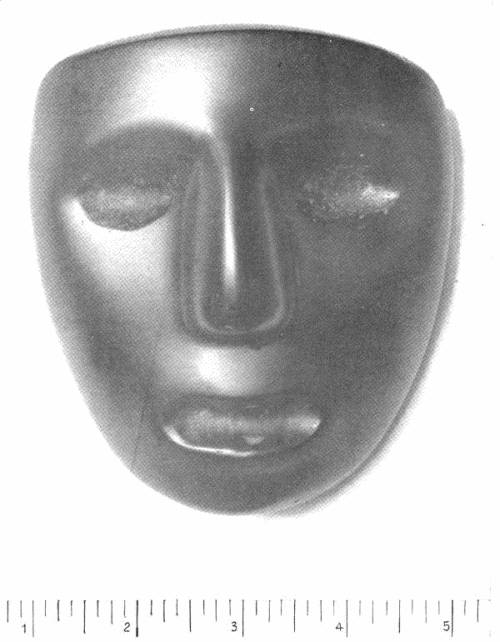
Twelfth Dynasty. Late De Lesseps Collection. Collection of Mrs. Henry Draper. The obsidian is the typical stone of Mexico.
Crystals of iron pyrites (pyrite, native iron disulphide) are sometimes used as amulets by the North American Indians, and the belief in their magic power is attested by their presence in the outfit of miscellaneous objects which the medicine-men use in the course of their incantations. Because these gleaming yellow crystals are occasionally mistaken for gold, the name “fool’s gold” has been popularly bestowed upon them.136
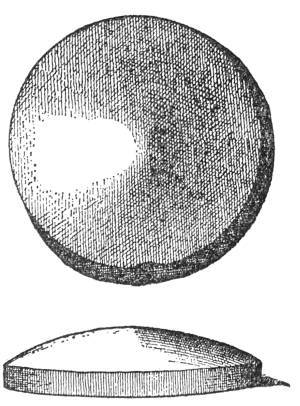
See “Gems and Precious Stones of North America,” by George Frederick Kunz, New York, 1890, p. 299.
Of this material the ancient Mexicans made wonderful mirrors, one side being usually polished flat, while the other side was strongly convex. Frequently this side was curiously carved with some symbolic representation as appears in the case of a pyrite mirror of the Pinard collection in the Trocadéro, Paris.137
The end of Pyrites.
Turn the page for Rock-crystal.
Tap or click the right-hand side of the book to turn the page, the left to turn back; or use the arrow keys, or swipe. Press F for full screen.
Chapter III: On the Talismanic Use of Special Stones
Pyrites
Twelfth Dynasty. Late De Lesseps Collection. Collection of Mrs. Henry Draper. The obsidian is the typical stone of Mexico.
Crystals of iron pyrites (pyrite, native iron disulphide) are sometimes used as amulets by the North American Indians, and the belief in their magic power is attested by their presence in the outfit of miscellaneous objects which the medicine-men use in the course of their incantations. Because these gleaming yellow crystals are occasionally mistaken for gold, the name “fool’s gold” has been popularly bestowed upon them.136
See “Gems and Precious Stones of North America,” by George Frederick Kunz, New York, 1890, p. 299.
Of this material the ancient Mexicans made wonderful mirrors, one side being usually polished flat, while the other side was strongly convex. Frequently this side was curiously carved with some symbolic representation as appears in the case of a pyrite mirror of the Pinard collection in the Trocadéro, Paris.137
30 of 44 · 1 min read