Chapter XI: On the Therapeutic Use of Precious and Semi-Precious Stones
Chapter XI
On the Therapeutic Use of Precious and Semi-Precious Stones
❦
The medicinal use of precious stones may be traced
back to very ancient times. It has been conjectured
that their employment for such purposes was introduced
to Europe from India, whence many of the stones were
derived. Nevertheless, the earliest evidence we have
rather points to Egypt as the source, and, indeed, it appears
that in early Egyptian times the chemical constituents
of the stones were much more rationally considered
than at a later period in Europe. The Ebers Papyrus,
for instance, recommends the use of certain astringent
substances, such as lapis-lazuli, as ingredients of eye-salves,
and hematite, an iron oxide, was used for checking
hemorrhages and for reducing inflammations. Little by
little, however, superstition associated certain special
virtues with the color and quality of precious stones,
and their virtues were thought to be greatly enhanced
by engraving on them the image of some god, or of some
object symbolizing certain of the activities of nature.
Later still, the science of astrology, most highly developed
in Assyria and Babylonia, was brought into combination
with the various superstitions above indicated, so
that the image was believed to have much greater efficacy
if the engraving were executed when the sun was in a
certain constellation or when the moon or some one of
the planets was in the ascendant at the time.
If we exclude certain fragmentary notices in Egyptian
literature—notably the statements in the Ebers
Papyrus—and the very uncertain sources in Hindu literature,
the earliest authority for this branch of the subject
is the Natural History of Pliny. In this connection, however,
it is only just to call attention to a fact which has
been often ignored—namely, that Pliny himself had very
little faith in the teachings of the “magi,” as he calls
them, in regard to the superstitious use of gems for the
prevention or cure of diseases; indeed, he seems to have
been almost as sceptical in his attitude as many modern
writers, for certain quite recent authorities still credit
amber and a few other mineral substances with therapeutic
effects other than those which can be explained by
the known action of their chemical constituents. Still,
Pliny yielded so far to the taste of his time as to preserve
for us many of the statements of earlier writers on the
subject, naming them in most cases and so enabling us to
form some idea of the character of this pseudo-science in
the Roman world in the first century of our era. With
the gradual decay of ancient learning, the less valuable
elements of popular belief came more and more into the
foreground, and the old superstitions were freely copied
by successive authors, each of whom felt called upon to
add something new on his own account. This explains
much of the confusion that reigns in regard to the attribution
of special virtues to the different stones, for the
wider the reading of the author the greater became the
number of virtues attributed to each separate stone, until,
at last, we might almost say that each and every precious
stone could be used for the cure of all diseases. Nevertheless,
it is comparatively easy to see that either the
color or constitution of the stone originally indicated its
use for this or that disease.
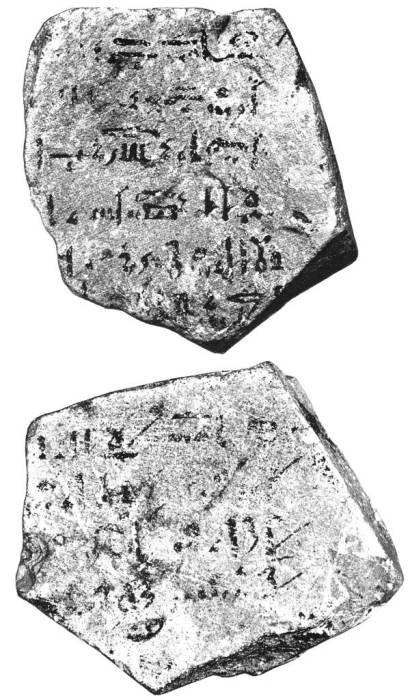
Inscription on a Small Piece of Limestone, in Cursive Egyptian Writing.
It dates from about 1600 B.C., the period of the Ebers Papyrus, and gives directions for
preparing certain remedies from precious stones. While the interpretation of this text
offers considerable difficulty, one version finds in it the statement that lapis-lazuli—the
“sapphire” of the ancients—was used for the wealthy, and malachite for those of limited
means. Professor Oefele conjectures that the disease to be treated was hysteria. Munch
Collection, Metropolitan Museum of Art, New York.
A distinction is often made between the talismanic
qualities of precious stones for the cure or prevention
of disease and the properly medicinal use of them as
mineral substances. In the former case the effect was
attained by merely wearing them on the person, while
in the latter case they were reduced to a powder, which
was dissolved as far as possible in water or some other
liquid and then taken internally. As, however, the end
to be attained is the same whether the stone be worn or
taken internally as a powder or liquid, it seems more
logical to treat of both these methods of therapeutic use
together, reserving for the chapter on the talismanic use
of gems only their employment to avert misfortunes
other than those caused by disease, and their influence
in the procuring of wealth, honors, and happiness for
their wearers.
The belief in the curative properties of precious stones
was at one time universal among all those to whom gems
were known. When we read to-day of the various ills
that were supposed to be cured by the use of these gems,
we find it difficult to understand what process of thought
could have suggested the idea of employing such ineffectual
remedies. It is true that the constituents of certain
stones can be absorbed by the human body and have
a definite effect upon it, but the greater part of the elements
are so combined that they cannot be assimilated,
and they pass through the system without producing any
apparent effect.
In ancient and medieval times, however, other than
chemical agencies were supposed to be efficient in the cure
of diseases, and the primitive animistic conception of the
cause of illness, and hence of the therapeutics of disease,
long held sway among those who practised the medical
art. Remedies were prized because of their rarity, and
also because it was believed that certain spiritual or
planetary influences had aided in their production and
were latent in them. Besides this, the symbolism of color
played a very important part in recommending the use
of particular stones for special diseases. This may be
noted in the case of the red or reddish stones, such as
the ruby, spinel, garnet, carnelian, bloodstone, etc. These
were thought to be sovereign remedies for hemorrhages
of all kinds, as well as for all inflammatory diseases;
they were also believed to exercise a calming influence
and to remove anger and discord. The red hue of these
stones was supposed to indicate their fitness for such
use, upon the principle similia similibus curantur. In the
same way yellow stones were prescribed for the cure of
bilious disorders, for jaundice in all its forms and for
other diseases of the liver.
The use of green stones to relieve diseases of the
eye was evidently suggested by the beneficial influence
exerted by this color upon the sight. The verdant
emerald represented the beautiful green fields, upon
which the tired eye rests so willingly, and which exert
such a soothing influence upon the sight when it has been
unduly strained or fatigued. One of the earliest, probably
the very earliest reference in Greek writings to the
therapeutic value of gems, appears in the works of Theophrastus,
who wrote in the third century before Christ.
Here we are told of the beneficial effect exercised by the
emerald upon the eyes.
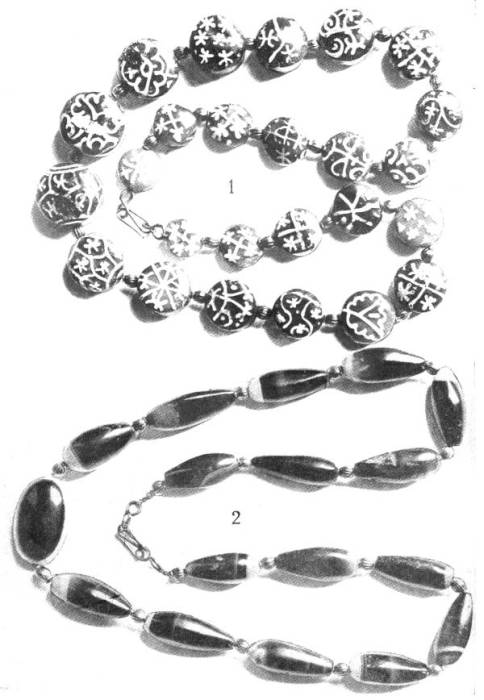
1. Necklace of carnelian beads. Persian. The decoration is made with carbonate of lime and fixed by firing. Charms against the Evil Eye. 2. Necklace of onyx beads. Early Christian.
The sapphire, the lapis-lazuli, and other blue stones,
with a hue resembling the blue of the heavens, were believed
to exert a tonic influence, and were supposed to
counteract the wiles of the spirits of darkness and procure
the aid and favor of the spirits of light and wisdom.
These gems were usually looked upon as emblems of
chastity, and for this reason the sapphire came to be
regarded as especially appropriate for use in ecclesiastical
rings. Among purple stones, the amethyst is particularly
noteworthy. The well-known belief that this
gem counteracted the effects of undue indulgence in intoxicating
beverages is indicated by its name, derived
from μεθύω—“to be intoxicated,” and the privative α,
the name thus signifying the “sobering” gem. It is not
unlikely that a fancied resemblance between the prevailing
hue of these stones and that of certain kinds of
wine first gave rise to the name and to the idea of the
peculiar virtues of the amethyst.
We have mentioned only a few of the more obvious
analogies suggested by the color of gems, and we might
be tempted to cite many others were it not that symbolism
is always treacherous ground, since there is practically
no limit to the correspondences that may be found between
sensuous impressions and ideas.
One great difficulty which besets any one who is trying
to find a clue to guide him through the labyrinth of
the medical affinities of gems is the fact that there was,
from an early period, a tendency to attribute the virtues
of one gem to another, probably owing to the commercial
instinct which urged the dealer to praise his wares in
every possible way, so that no part of his stock should
fail to find a purchaser. This tendency is especially
marked in the old Hindu Lapidaries, wherein it is almost
impossible to find any differentiation of the stones in
respect to their curative or talismanic virtues. Only the
condition and perfection of the gems are made the criterion
of their worth. Any given stone, if perfect, was a
source of all blessings to the wearer and possessed all
remedial powers, while a defective stone, or one lacking
the proper lustre or color, was destined to be a source of
untold misfortune to the owner.
The European writers on the medical properties of
precious stones were influenced by quite different considerations;
their chief aim was to represent each stone,
regarded simply as a mineral substance, as being the
abode of the greatest possible number of curative properties.
Indeed, many of the most highly recommended
electuaries contained all kinds of stones, as though the
effect to be produced did not depend upon the qualities
of any single stone, or class of stones, but rather upon
the quantity used. In Arnobio’s “Tesoro delle Gioie,”464
we have a receipt for the composition of “the most noble
electuary of jacinth.” This contains jacinth, emerald,
sapphire, topaz, garnet, pearl, ruby, white and red coral,
and amber, as well as many animal and vegetable substances,
in all, thirty-four ingredients. It would indeed
seem that a good dose of such a mixture should have
provided a cure for “all the ills that flesh is heir to,” by
the simple and effective means of removing the unhappy
patient to a better world.
Treating of the metallic affinities of precious stones,
Paracelsus (1493-1541) affirmed that the emerald was a
copper stone; the carbuncle and the jasper were golden
stones; the ruby and the chalcedony, silver stones. The
“white sapphire” (corundum) was a stone of Jupiter,
while the jacinth was a mercurial stone. Powdered
jacinth mixed with an equal quantity of laudanum was
recommended as a remedy for fevers resulting from
“putrefaction of the air or water.” This illustrates
the custom of combining an inefficacious material, such
as the powder of a precious stone, with another possessing
genuine remedial virtue, the name of the stone appealing
to the popular superstitions regarding its therapeutic
powers, and thus rendering the preparation more
acceptable.465
It is related by Plutarch that when Pericles was dying
of the plague, he showed to one of his friends, who was
visiting him, an amulet suspended from his neck. This
had been given to Pericles by the women of his household,
and Plutarch cites the instance as a proof that even
the strongest minds will at certain times yield to the
influence of superstition.466
There were sceptics in ancient times who put no faith
in the popular superstitions as to the curative powers
of precious stones. Eusebius (ca. 264-ca. 349), in his
oration on the Emperor Constantine the Great (272-337),
says:467
He held that the varieties of stones so greatly admired were useless
and ineffective things. They possessed no other qualities than their
natural ones, and hence no efficacy to hold evils aloof; for what power
can such things have either to cure disease or to avert death? Nevertheless,
although he well knew this, he was in no wise opposed to
their use simply as ornaments by his subjects.
The Middle High German didactic poem on precious
stones, composed by Volmar, or Volamar, about 1250,
appears to have been written as a rejoinder to a satirical
poem, the work of a writer called the “Stricker” (rascal).
What chiefly aroused Volmar’s wrath was the fact that
this irreverent personage dared to assert that a piece of
colored glass set in a ring looked just as well and possessed
the same virtues as a genuine precious stone of the
same color. Volmar does not mince matters, and roundly
declares that whoever should kill the man who wrote
thus would do no sinful act. While we can scarcely recommend
such drastic action, we must admit that we feel
a little sympathy with the medieval champion of genuine
stones against imitations.
A most interesting item recording one phase of a
great tyrant’s character is reported by Sir Jerome Horsey,
who was entrusted with messages to and from Elizabeth
of England and Ivan the Terrible of Russia. He
gives, in his “Travels,” a graphic recital of an interview
with Ivan just before the latter’s death in 1584. We retain
the archaic spelling as it is reproduced in the Hakluyt
publication from the original manuscript. Writing
of Ivan, Horsey says:468
Carried every daye in his chair into his treasure. One daye the
prince beckoned me to follow. I strode emonge the rest venturously,
and heard him call for som precious stones and jewells. Told the
prince and nobles present before and aboute him the virtue of such and
such, which I observed, and do pray I may a littell degress to declare
for my own memorie sake.
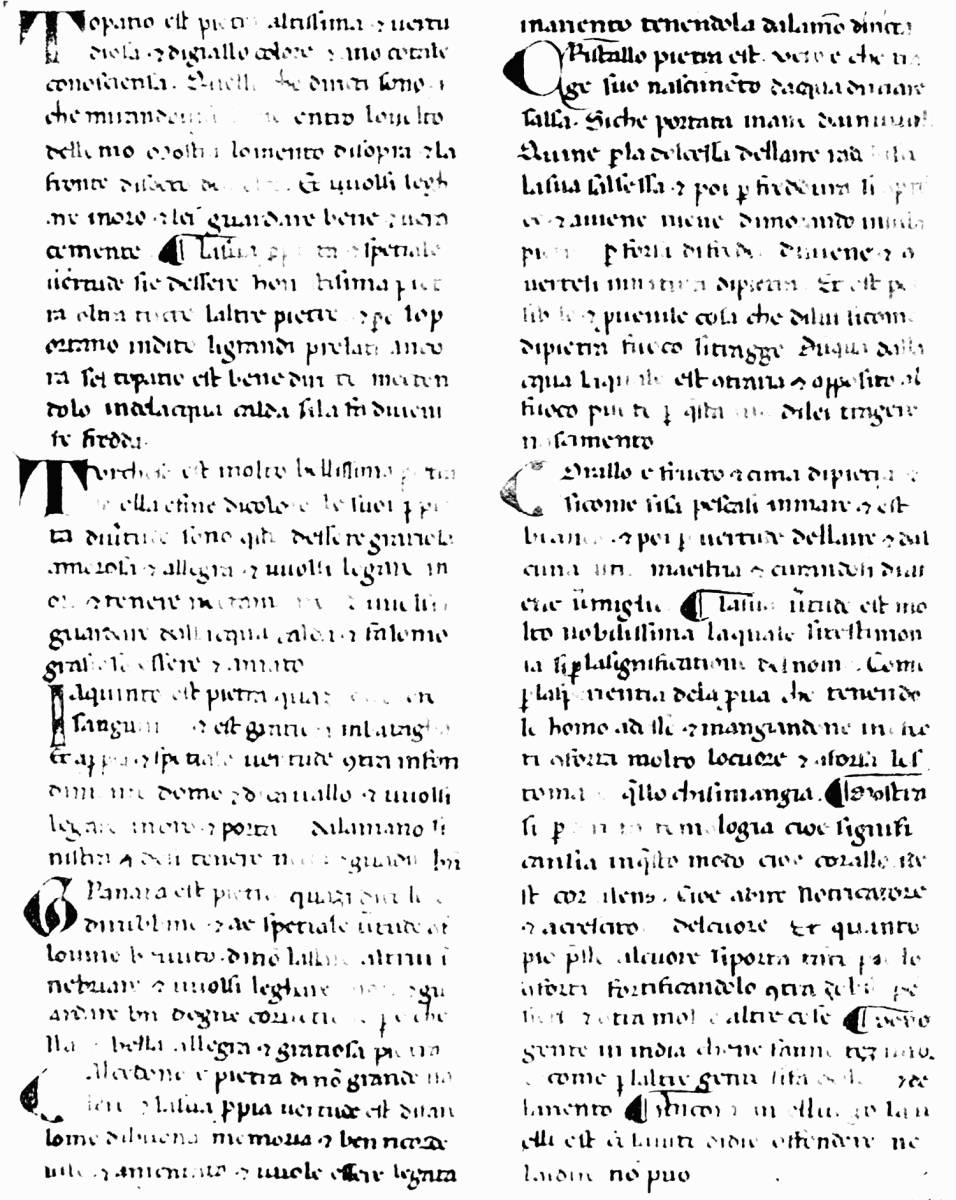
Facsimile page of Italian vellum manuscript treatise of the virtues of gems. Italian MS. of the Fourteenth Century in author’s library. Treating of Topaz, Turquoise, Jacinth, Garnet, Chalcedony, Rock-crystal, Coral.
“The load-stone you all know hath great and hidden vertue, without
which the seas that compas the world ar not navigable, nor the
bounds nor circles of the earth cannot be knowen. Mahomett, the
Percians proffit, his tombe of steell hangs in their Repatta at Darbent
most miraculously”—Caused the waiters to bringe a chaine of nedells
towched by his load-stone, hanged all one by the other.—“This faire
currell (coral) and this faire turcas you see; take in your hand; of
his natur arr orient coullers; put them on my hand and arm. I am
poisoned with disease: you see they shewe their virtue by the chainge
of their pure culler into pall: declares my death. Reach owt my staff
roiall; an unicorns horn garnished with verie fare diomondes, rubies,
saphiers, emeralls and other precious stones that ar rich in vallew;
cost 70 thousand marckes sterlinge of David Gower from the fowlkers
of Ousborghe.469 Seek owt for som spiders.” Caused his phiziccians,
Johannes Lloff, to scrape a circle thereof upon the tabell; putt within
it one spider and so one other and died, and some other without that
ran alive apace from it.—“It is too late, it will not preserve me.
Behold these precious stones. This diomond is the orients richest and
most precious of all other. I never affected it; yt restreyns furie and
luxurie and abstinacie and chasticie; the least parcell of it in powder
will poysen a horse geaven to drinck, much more a man.” Poynts at
the ruby. “Oh! this is most comfortable to the hart, braine, vigar and
memorie of man, clarifies congelled and corrupt bloud.”—Then at the
emerald.—“The natur of the reyn-bowe; this precious stone is an
enemye to uncleanness. The saphier I greatlie delight in; yt preserves
and increaseth courage, joies the hart, pleasinge to all the vitall sensis,
precious and verie soveraigne for the eys, clears the sight, takes awaye
bloudshott and streingthens the mussells and strings thereof.”—Then
takes the onex in hand.—“All these are Gods wonderfull guifts,
secreats in natur, and yet revells [reveals] them to mans use and contemplacion,
as frendes to grace and vertue and enymies to vice. I
fainte, carie me awaye till an other tyme.”
Some believed that when precious stones were worn
to relieve or prevent disease, it was important that the
different stones should be worn on different parts of the
body. According to one authority, the jacinth should be
worn on the neck; the diamond, on the left arm; the sapphire,
on the ring-finger; the emerald, or the jacinth, on
the index-finger; and the ruby or turquoise, on either the
index-finger or the little finger.470 There is, however, little
reason to assume that these rules were generally known
and observed.
That precious stones not only appealed to the eye by
their beautiful colors, but also possessed a fragrant odor,
was one of the many fanciful ideas regarding them. If
we could believe the following circumstantial account,
this was once experimentally proved:471
When precious stones are to be used in medicine, they must be
pulverized until they are reduced to a powder so fine that it will not
grate under the teeth, or, in the words of Galen, this powder must
be as impalpable “as that which is blown into the eyes.” Since this
trituration is not usually operated with sufficient care by the apothecaries,
I begged a medical student, who was lodging with me, to pass
an entire month in grinding some of these stones. I gave him
emeralds, jacinths, sapphires, rubies, and pearls, an ounce of each
kind. As these stones were rough and whole, he first crushed them a
little in a well-polished iron mortar, using a pestle of the same metal;
afterward he employed a pestle and mortar of glass, devoting several
hours each day to this work. At the end of about three weeks, his
room, which was rather large, became redolent with a perfume, agreeable
both from its variety and sweetness. This odor, which much
resembled that of March violets, lingered in the room for more than
three days. There was nothing in the room to produce it, so that it
certainly proceeded from the powder of precious stones.
Diamond
Of the many medicinal virtues attributed to the diamond,
one of the most noteworthy is that of an antidote
for poisons. Strangely enough, the belief in its efficacy
in this respect was coupled with the idea that the stone
in itself was a deadly poison. The origin of this latter
fancy must be sought in the tradition that the place
wherein the diamonds were generated—“in the land
where it is six months day and six months night”—was
guarded by venomous creatures who, in passing over the
stones, were wounded by the sharp points of the crystals,
and thus embued the stones with some of their venom.472
The attribution of curative properties in case of poisoning
arose from association of ideas. The Lapidario of
Alfonso X recommends the diamond for diseases of the
bladder; it adds, however, that this stone should be used
only in desperate cases.
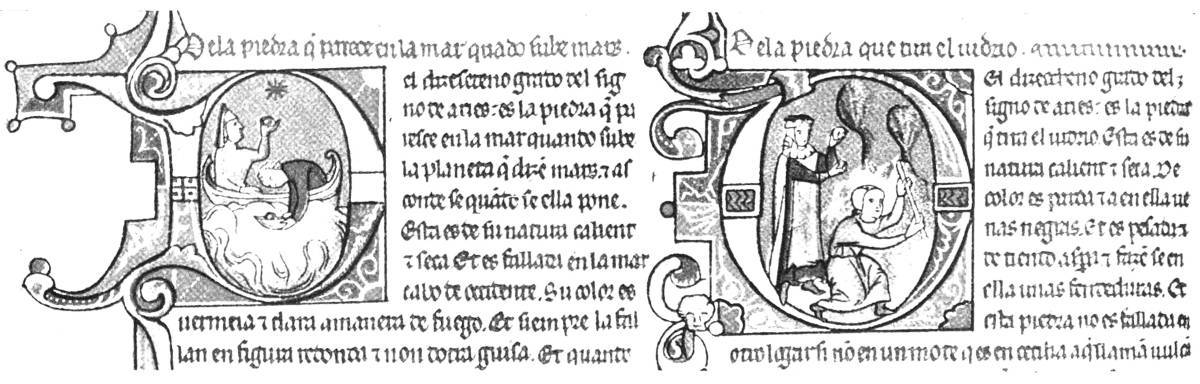
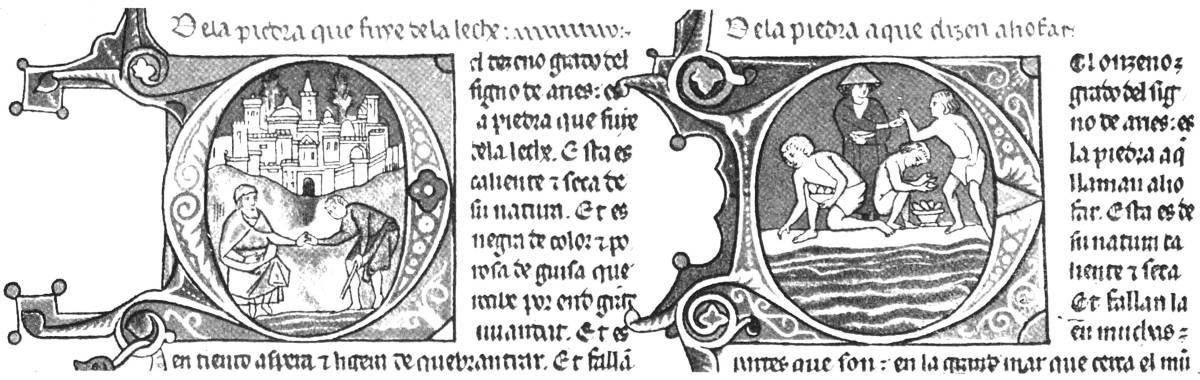
Initials from the Lapidario de Alfonso X (XIII Century). Codice Original (fol. 6), published in Madrid, 1881. That on the left figures “the stone found in the sea when the planet Mars rises”; that on the right, “the stone that attracts glass.” Author’s libraryInitials from the Lapidario de Alfonso X. Codice Original (fol. 4), published in Madrid, 1881. On the left, “the stone that recoils from milk”; on the right, pearl-fishers.
The diamond was also believed to afford protection
from plague or pestilence, and a proof of its powers in
this direction was found in the fact that the plague first
attacked the poorer classes, sparing the rich, who could
afford to adorn themselves with diamonds. Naturally,
in common with other precious stones, this brilliant gem
was supposed to cure many diseases. Marbodus473 tells
us that it was even a cure for insanity.
In the Babylonian Talmud we read of a marvellous
precious stone belonging to Abraham. This was perhaps
a diamond, or possibly a pearl; the accounts vary, and
the same word is often used to designate “precious stone”
and “pearl.” The following version represents it to be
a diamond:474
R. Simeon, ben Johanan said: “A diamond was hanging
on Abraham’s neck, and when a sick man looked upon
it he was cured. And when Abraham passed away, the
Lord sealed it in the planet of the sun.”
The Hindus believed that it was extremely dangerous
to use diamonds of inferior quality for curative purposes,
as they would not only fail to remedy the disease for
which they were prescribed, but might cause lameness,
jaundice, pleurisy, and even leprosy. As to the use of
diamonds of good quality, very explicit directions are
given. On some day regarded as auspicious for the
operation, the stone was to be dipped in the juice of the
kantakára (Solanum jaquiri) and subjected for a whole
night to the heat of a fire made by dried pieces of the
dung of a cow or of a buffalo. In the morning it was to
be immersed in cow’s urine and again subjected to fire.
These processes were to be repeated for seven days, at
the end of which term the diamond could be regarded as
purified. After this the stone was to be buried in a paste
of certain leguminous seeds mixed with asafœtida and
rock salt. Herein it was to be heated twenty-one successive
times, when it would be reduced to ashes. If
these ashes were then dissolved in some liquid, the potion
would “conduce to longevity, general development of the
body, strength, energy, beauty of complexion, and happiness,”
giving an adamantine strength to the limbs.475
An Austrian nobleman, who for a long time had not
been able to sleep without having terrible dreams, was
immediately cured by wearing a small diamond set in
gold on his arm, so that the stone came in contact with
his skin.476
The fact that in this case, as in many others, the stone
was required to touch the skin, proves that the effect
supposed to be produced was not altogether magical, but
in the nature of a physical emanation from the stone to
the body of the wearer.
We are told that when Pope Clement VII was seized
by his last illness, in 1534, his physicians resorted to
powders composed of various precious stones. In the
space of fourteen days they are asserted to have given
the pope forty thousand ducats’ worth of these stones,
a single dose costing as much as three thousand ducats.
The most costly remedy of all was a diamond administered
to him at Marseilles. Unfortunately, this lavish
expenditure was of no avail; indeed, according to our
modern science, the remedies might have sufficed to end
the pope’s life, without the help of his disease.477
The old fancy that the diamond grew dark in the presence
of poison is explained by the Italian physician
Gonelli as caused by minute and tenuous particles which
emanated from the poison, impinged upon the surface of
the diamond, and, unable to penetrate its dense mass,
accumulated on the surface, thus producing a superficial
discoloration. The diamond, being a cold substance,
may have condensed moisture from the body, and the one
suffering from the poison may have emitted exudations.
But this elaborate explanation of a phenomenon which
never existed except in the imagination of those who
related it is characteristic of Gonelli, who was always
ready to elucidate in some similar way any of the marvels
recounted in regard to precious stones.478
Emerald
The emerald was employed as an antidote for poisons
and for poisoned wounds, as well as against demoniacal
possession.479 If worn on the neck it was said to cure the
“semitertian” fever and epilepsy.480 The use of the
emerald to rest and relieve the eye is the only remedial
use of a precious stone mentioned by Theophrastus in his
treatise on gems, written in the third century B.C. Alluding
to its powers as an antidote for poisons, Rueus asserts481
that if the weight of eighty barley-corns of its
powder were given to one dying from the effects of
poison, the dose would save his life. The Arabs prized
emeralds highly for this purpose, and Abenzoar states
that, having once taken a poisonous herb, he placed an
emerald in his mouth and applied another to his stomach,
whereupon he was entirely cured.482
A certain cure for dysentery also was to wear an
emerald suspended so that it touched the abdomen and
to place another emerald in the mouth. Michaele Paschali,
a learned Spanish physician of the sixteenth century,
declared that he had effected a cure of the disease
by means of the emerald in the case of Juan de Mendoza,
a Spanish grandee, and Wolfgang Gabelchover, of Calw,
in Würtemberg, writing in 1603, asserts that he had often
tested the virtues of the emerald in cases of dysentery
and with invariable success.483
It speaks not a little for the beauty of the emerald that
so good a judge of precious stones as Pliny should have
pronounced this gem to be the only one that delighted the
eye without fatiguing it, adding that when the vision was
wearied by gazing intently at other objects, it gained
renewed strength by viewing an emerald. So general
in the early centuries of our era was the persuasion that
the pure green hue of emeralds aided the eyesight, that
gem engravers are said to have kept some of them on
their work-tables, so as to be able to look at the stones
from time to time and thus relieve the eye-strain caused
by close application to their delicate task.484
Psellus says that a cataplasm made of emeralds was
of help to those suffering from leprosy; he adds that if
pulverized and taken in water they would check hemorrhages.485
They were especially commended for use as
amulets to be hung on the necks of children, as they
were believed to ward off and prevent epilepsy. If,
however, the violence of the disease was such that it
could not be overcome by the stone, the latter would
break.486 Hermes Trismegistus says the emerald cures
ophthalmia and hemorrhages. The great Hermes must
have had a special preference for this stone, since his
treatise on chemistry (peri chemeias) is said to have
been found inscribed on an emerald.487
By the Hindu physicians of the thirteenth century the
emerald was considered to be a good laxative. It cured
dysentery, diminished the secretion of bile, and stimulated
the appetite. In short, it promoted bodily health
and destroyed demoniacal influences. In the curious
phrase of the school the emerald was “cold and
sweet.”488
Teifashi (1242 A.D.) believed that the emerald was a
cure for hæmoptysis and for dysentery if it were worn
over the liver of the person affected; to cure gastric
troubles, the stone was to be laid upon the stomach.
Furthermore, the wearer was protected from the attacks
of venomous creatures, and evil spirits were driven from
the place where emeralds were kept.489 The direction to
place the stone on the affected part, a recommendation
often met with in the treatises on the therapeutic use of
ornamental stones, shows that these were believed to send
forth emanations of subtle power. Probably enough, the
brilliant play of reflected light which proceeds from
many of these gems suggested the idea that they radiated
a certain curative energy. This theory need not surprise
us, for, although it is altogether fanciful in the case
of the diamond, ruby, emerald, etc., the newly discovered
substance, radium, really possesses the active properties
ascribed by old writers to precious stones.
Jade
A stone the therapeutic quality of which was specialized
is the jade or nephrite. Strange to say, although
there are very few places where this mineral can now
be obtained,—the chief sources of supply being the province
of Khotan in Turkistan and New Zealand,—in prehistoric
times the stone must have been found in many
different localities, since axe-heads and other artefacts
of jade have been discovered in many lands both of the
old and new world.
When the Spaniards discovered and explored the
southern part of the American continent, they came
across numerous native ornaments and amulets made of
jade (jadeite) and brought many of these with them to
Europe. The name jade is derived from the Spanish
designation, piedra de hijada, meaning literally “stone
of the flank,” which is said to have been bestowed on the
stone because the Indians used it for all diseases of the
kidneys. The name nephrite owes its origin to the same
idea. In ancient times jade appears to have been looked
upon as a great aid in parturition, and many ingenious
conjectures have been advanced as to the connection between
this belief and the form of some of the prehistoric
objects made of this material. Whether the Spaniards
really learned from the Indians that the stone was especially
adapted to cure renal diseases, or whether they
only suggested this special and peculiar virtue in order
to give an enhanced value to their jade ornaments, is a
question not easily answered.
An early notice of jade as a remedial agent appears
in Sir Walter Raleigh’s account of his travels in Guiana.
Treating of a people of “Amazons” said to dwell in the
interior of the country, Raleigh says:490
These Amazones have likewise great store of these plates of golde,
which they recover by exchange, chiefly for a kinde of greene stone,
which the Spaniards call Piedras Hijadas, and we use for spleene
stones and for the disease of the stone we also esteeme them: of these
I saw divers in Guiana, and commonly every King or Casique hath
one, which theire wives for the most part weare, and they esteeme them
as great jewels.
By the middle of the seventeenth century the curative
powers of jade for the various forms of calculi was very
generally admitted. A singular instance is offered us in
one of Voiture’s letters. He was a great sufferer from
“the stone” and he had received, from a Mademoiselle
Paulet, a beautiful jade bracelet. Gratefully acknowledging
the receipt of this peculiar gift, he expresses himself
in the following frank way, a mixture of indelicacy
and gallantry that seems strange to us: “If the stones
you have given me do not break mine, they will at least
make me bear my sufferings patiently; and it seems to
me that I ought not to complain of my colic, since it has
procured me this happiness.” The name used for jade
by Voiture, “l’éjade,” supplied a missing link in the
derivation of our name jade from the Spanish hijada.
When the lady’s gift was received by Voiture, some
friends chanced to be present, and they were disposed to
regard it as a token of love until he assured them that it
was only a remedy. It appears that Mlle. Paulet was a
fellow sufferer, and, alluding to this, Voiture writes:
“On this occasion the jade had for you an effect you did
not expect from it, and its virtue defended your own.”491
Renal calculi and poetry do not seem to have much in
common, but the following lines freely rendered from
an old Italian poem on the subject by Ciri de Pers show
that even this unpromising theme is susceptible of poetic
treatment:492
“Other white stones serve to mark happy days,
But mine do mark days full of pain and gloom.
To build a palace, or a temple fair,
Stones should be used; but mine do serve
To wreck the fleshly temple of my soul.
Well do I know that Death doth whet his glaive
Upon these stones, and that the marble white
That grows in me is there to form my tomb.”
As jade was and still is the most favored stone in
China, although never found within the boundaries of
China proper, it was very naturally accorded wonderful
medical virtues. An old Chinese encyclopedia, the work
of Li She Chan, and presented by him to the emperor
Wan Lih of the Ming dynasty, in 1596, contains many
interesting notices of jade. When reduced to a powder
of the size of rice grains it strengthened the lungs, the
heart, and the vocal organs, and prolonged life, more
especially if gold and silver were added to the jade
powder. Another, and certainly a pleasanter way of
absorbing this precious mineral, was to drink what was
enthusiastically called the “divine liquor of jade.” To
concoct this elixir equal parts of jade, rice, and dew-water
were put into a copper pot and boiled, the resultant
liquid being carefully filtered. This mixture was
said to strengthen the muscles and make them supple,
to harden the bones, to calm the mind, to enrich the
flesh, and to purify the blood. Whoever took it for a
long space of time ceased to suffer from either heat or
cold and no longer felt either hunger or thirst.
Galen (b. ca. 130 A.D.) wrote thus of the green
jasper:493
Some have testified to a virtue in certain stones, and this is true
of the green jasper, that is to say, this stone aids the stomach and
navel by contact. And some, therefore, set the stone in rings and
engrave on it a dragon surrounded by rays, according to what King
Nechepsos has transmitted to posterity in the fourteenth book (of his
works). Indeed, I myself have thoroughly tested this stone, for I
hung a necklace composed of them about my neck so that they touched
the navel, and I received not less benefit from them than I would had
they borne the engraving of which Nechepsos wrote.
Ruby
Sanskrit medical literature as represented by Naharari,
a physician of Cashmere, who wrote in the thirteenth
century, finds in the ruby a valuable remedy for
flatulency and biliousness. Moreover, aside from these
special uses, an elixir of great potency could be made
from rubies by those who properly understood the employment
of precious stones in the compounding of medicines.494
This famous “ruby elixir” may have had little
in common with the stone except its color, as such remedies
were generally said to have been made by some
secret and mysterious process, in the course of which all
material evidence of the presence of any precious stone
or stones completely disappeared.
Sapphire
One of the earliest specimens of English literature,
William Langley’s “Vision of William concerning Piers
the Plowman” (written about 1377), contains a mention
of the sapphire as a cure for disease:495
And diamants of derrest pris, and double manere safferes,
Orientales and ewages500 enuenymes501 to destroye.
Among the rich gifts offered at the shrine of St.
Erkinwald, in Old Saint Paul’s, was a sapphire given in
1391 by Richard Preston, “a citizen and grocer of London.”
He stipulated that the stone should be kept at
the shrine for the cure of diseases of the eyes, and that
proclamation should be made of its remedial virtues. St.
Erkinwald was the son of Offa, King of the East Saxons,
and was converted to Christianity by Melittus, the first
bishop of London. In 675 A.D. he himself became bishop
of London, being the third to attain that rank after the
death of Melittus. His body was interred in the cathedral,
and his shrine, which was richly embellished during
the reign of Edward III (1327-1377), received many
valuable donations.502
The usefulness of the sapphire as an eyestone for the
removal of all impurities or foreign bodies from the eye
is noted by Albertus Magnus, who writes that he had seen
it employed for this purpose. He adds that when a sapphire
was used in this way it should be dipped in cold
water both before and after the operation.503 This was
probably not so much to make the stone colder to the
touch as to cleanse it, certainly a very necessary proceeding
when the same stone was used by many persons
suffering from contagious diseases of the eyes.
Richard Preston’s sapphire appears to have been
only one of a class regarded as having special virtue to
cure diseased eyes, as is shown by the existence of various
other similar sapphires in different parts of Europe. It
is not very easy to determine the precise reason—if there
be one—which rendered any single sapphire more useful
than another in this respect. An entry in the inventory
of Charles V notes “an oval Oriental sapphire for touching
the eyes, set in a band of gold.”504 Possibly the fact
that a particular gem of this kind was used remedially,
and was not set for wear as an ornament, may have been
the only cause for a belief in its special virtue.
That the sapphire should have been regarded as especially
valuable for the cure of eye diseases serves to illustrate
the wide-reaching and persistent influence of
Egyptian thought, and the curious transformations
through which an originally reasonable idea may pass in
the course of time. We have already noted that the
sapphire of the ancients was our lapis-lazuli, and in the
Ebers Papyrus lapis-lazuli is given as one of the ingredients
of an eye-wash. This ingredient is believed to have
originally been the oxide of copper sometimes called
lapis Armenus, a material possessing marked astringent
properties, and which might be used to advantage in certain
morbid conditions of the eye. Lapis-lazuli, another
blue stone, was later substituted because of its greater
intrinsic value, its similarity of color rendering it equally
efficacious according to primitive ideas on this subject.
When, however, in medieval times, the name sapphire
came to signify the blue corundum gem known to us by
this designation, the special curative virtues of the lapis-lazuli
were transferred to this still more valuable stone.
The proper method of applying a sapphire to cure
plague boils is given at some length by Van Helmont. A
gem of a fine, deep color was to be selected and rubbed
gently and slowly around the pestilential tumor. During
and immediately after this operation, the patient would
feel but little alleviation; but a good while after the removal
of the stone, favorable symptoms would appear,
provided the malady were not too far advanced. This
Van Helmont attributes to a magnetic force in the sapphire
by means of which the absent gem continued to
extract “the pestilential virulency and contagious poyson
from the infected part.”505
Topaz
The use of a topaz to cure dimness of vision is strongly
recommended by St. Hildegard. To attain the desired
end the stone was to be placed in wine and left there for
three days and three nights. When retiring to sleep, the
patient should rub his eyes with the moistened topaz, so
that this moisture lightly touched the eyeball. After the
stone had been removed, the wine could be used for five
days.506
A Roman physician of the fifteenth century was reputed
to have wrought many wonderful cures of those
stricken by the plague, through touching the plague sores
with a topaz which had belonged to two popes, Clement
VI and Gregory II. The fact that this particular topaz
had been in the hands of two supreme pontiffs must have
added much to the faith reposed in the curative powers
of the stone by those upon whom it was used, and this
faith may really have helped to hasten their recovery.507
Bloodstone
A historical instance of the use of the bloodstone to
check a hemorrhage is recorded in the case of Giorgio
Vasari (1514-1578), the author of the lives of the Italian
painters of the Renaissance period. On a certain occasion,
when the painter Luca Signorelli (1439-1521) was
placing one of his pictures in a church at Arezzo, Vasari,
who was present, was seized with a violent hemorrhage
and fainted away. Without a moment’s hesitation, Signorelli
took from his pocket a bloodstone amulet and
slipped it down between Vasari’s shoulder-blades. The
hemorrhage is said to have ceased immediately.508
The bloodstone was used as a remedy by the Indians
of New Spain, and Monardes notes that they often cut
the material into the shape of hearts. This seems a very
appropriate form for an object used to check hemorrhages.
The best effect was attained when the stone was
first dipped in cold water and then held by the patient
in his right hand. Of course the application of any cold
object would serve to congeal the blood, but the connection
with the heart vanishes in the direction to place the
stone in the right hand. Monardes states that both Spaniards
and Indians used the bloodstone in this way.509
The Franciscan friar Bernardino de Sahagun, a missionary
to the Mexican Indians, shortly after the Spanish
Conquest, writes that in 1576 he cured many natives who
were at the point of death from hemorrhage, a result of
the plague, by causing them to hold in the hand a piece
of bloodstone. By this means he claims to have saved
many lives.510
Robert Boyle, in his “Essay about the Origin and
Virtues of Gems” (London, 1672, pp. 177-78), tells of
a gentleman of his acquaintance who was “of a complexion
extraordinary sanguin,” and was much afflicted with
bleeding of the nose. A gentlewoman sent to him a bloodstone,
directing him to wear it suspended from his neck,
and from the time he put it on he was no longer troubled
with his malady. It recurred, however, if he removed
the stone. When Boyle objected that this might be a
result of imagination, his friend disposed of his objection
by relating the instance of a woman to whom the
stone had been applied when she was unconscious from
loss of blood. Nevertheless, as soon as it touched her,
the flow of blood was checked. Boyle states that this
stone did not seem to him to resemble a true bloodstone.
It may have been that the cold of the stone congealed
the blood, or that the flow was checked by exhaustion.
465. “The Hermetic and Alchemical writings of Aureolus Philippus
Theophrastus Bombast of Hohenheim, called Paracelsus the Great,”
trans. by Arthur Edward Waite, London, 1894, Vol. I, pp. 14, 225,
Vol. II, p. 218.
474. New edition of the Babylonian Talmud, ed. and trans. by
Michael L. Rodkinson, vol. v (xiii), Baba Barat, New York, 1902, p.
53. See also Beer, “Leben Abraham’s,” Leipzig, 1859, p. 79.
475. Surindro Mohun Tagore, “Mani Málá,” Pt. I, Calcutta, 1879,
pp. 137, 139, 141.
476. Andrea Spigello, “De semitert.”; cited in Gimma, “Della Storia
naturale delle gemme,” Napoli, 1730, vol. i, p. 208.
477. Raumer, “Historisches Taschenbuch,” I Ser., vol. vi, Leipzig,
1835, p. 370.
478. Josephi Gonelli, “Thesaurus philosophicus, seu de gemmis,”
Neapoli, 1702, pp. 76, 77.
479. Lapidario del Rey D. Alfonso X, Codice Original, Madrid, 1881,
f. xv.
489. Teifashi, “Fior di pensieri sulle pietre preziose,” Ital. trans.
by Antonio Raineri, Firenzi, 1818, p. 20.
490. “The Discovery of the Large, Rich, and Beautiful Empire of
Guiana,” London, 1848, p. 29, Hakluyt Pub. Originally published in
1596.
491. Lettres de Voiture, ed. by Octave Uzanne, Paris, 1880, vol. i,
p. 66, Letter XXIII.
492. Josephi Gonnelli, “Thesaurus philosophicus, seu de gemmis,” Neapoli,
1702, pp. 157, 158.
493. Claudii Galeni, “De simplic. medicament., etc.,” lib. ix, cap. 19.
“Opera Omnia,” ed. C. G. Kühn, Lipsiæ, 1826, vol. xii, p. 207. See
also Duffield Osborne, “Engraved Gems,” New York, 1912, pp. 138, 139.
495. The Vision of William Concerning Piers the Plowman, by William
Langley (or Langland). Ed. by Rev. Walter W. Skeat, Oxford,
1881, p. 16. Passus II, lines 8-15.
504. Labarte, “Inventaire du mobilier de Charles V,” Paris, 1879,
p. 308, No. 2937.
505. “A Ternary of Paradoxes, written originally by Joh. Bapt. Van
Helmont and translated, illustrated, and amplicated by Walter Charleton,”
London, 1650, p. 17.
506. S. Hildegardæ, “Opera omnia,” in Pat. Lat. ed. by J. P. Migne,
vol. cxcvii, Parisiis, 1855, col. 1255.
507. Arnobio, “Il tesoro delle gioie,” Venice, 1602, p. 21.
508. Bellucci, “Il feticismo in Italia,” Perugia, 1907, p. 91, note.
509. Monardes, Semplicium medicamentorum ex novo orbe delatorum
historia (Latin version by Clusius), Antverpiæ, 1579, p. 51.
510. Sahagun, “Historia general de las cosas de Nueva España,” vol. iii.
Mexico, 1830, pp. 300, 301; lib. xi, cap. viii.
❦
The end of Chapter XI: On the Therapeutic Use of Precious and Semi-Precious Stones.
Page 1–1 of 1Chapter 44 of 44 · 100% of the book · the end of the chapter
Tap or click the right-hand side of the book to turn the page, the left to turn back; or use the arrow keys, or swipe. Press F for full screen.
The Curious Lore of Precious StonesChapter XI: On the Therapeutic Use of Precious and Semi-Precious Stones
Chapter XI
On the Therapeutic Use of Precious and Semi-Precious Stones
❦
The medicinal use of precious stones may be traced
back to very ancient times. It has been conjectured
that their employment for such purposes was introduced
to Europe from India, whence many of the stones were
derived. Nevertheless, the earliest evidence we have
rather points to Egypt as the source, and, indeed, it appears
that in early Egyptian times the chemical constituents
of the stones were much more rationally considered
than at a later period in Europe. The Ebers Papyrus,
for instance, recommends the use of certain astringent
substances, such as lapis-lazuli, as ingredients of eye-salves,
and hematite, an iron oxide, was used for checking
hemorrhages and for reducing inflammations. Little by
little, however, superstition associated certain special
virtues with the color and quality of precious stones,
and their virtues were thought to be greatly enhanced
by engraving on them the image of some god, or of some
object symbolizing certain of the activities of nature.
Later still, the science of astrology, most highly developed
in Assyria and Babylonia, was brought into combination
with the various superstitions above indicated, so
that the image was believed to have much greater efficacy
if the engraving were executed when the sun was in a
certain constellation or when the moon or some one of
the planets was in the ascendant at the time.
If we exclude certain fragmentary notices in Egyptian
literature—notably the statements in the Ebers
Papyrus—and the very uncertain sources in Hindu literature,
the earliest authority for this branch of the subject
is the Natural History of Pliny. In this connection, however,
it is only just to call attention to a fact which has
been often ignored—namely, that Pliny himself had very
little faith in the teachings of the “magi,” as he calls
them, in regard to the superstitious use of gems for the
prevention or cure of diseases; indeed, he seems to have
been almost as sceptical in his attitude as many modern
writers, for certain quite recent authorities still credit
amber and a few other mineral substances with therapeutic
effects other than those which can be explained by
the known action of their chemical constituents. Still,
Pliny yielded so far to the taste of his time as to preserve
for us many of the statements of earlier writers on the
subject, naming them in most cases and so enabling us to
form some idea of the character of this pseudo-science in
the Roman world in the first century of our era. With
the gradual decay of ancient learning, the less valuable
elements of popular belief came more and more into the
foreground, and the old superstitions were freely copied
by successive authors, each of whom felt called upon to
add something new on his own account. This explains
much of the confusion that reigns in regard to the attribution
of special virtues to the different stones, for the
wider the reading of the author the greater became the
number of virtues attributed to each separate stone, until,
at last, we might almost say that each and every precious
stone could be used for the cure of all diseases. Nevertheless,
it is comparatively easy to see that either the
color or constitution of the stone originally indicated its
use for this or that disease.
Inscription on a Small Piece of Limestone, in Cursive Egyptian Writing.
It dates from about 1600 B.C., the period of the Ebers Papyrus, and gives directions for
preparing certain remedies from precious stones. While the interpretation of this text
offers considerable difficulty, one version finds in it the statement that lapis-lazuli—the
“sapphire” of the ancients—was used for the wealthy, and malachite for those of limited
means. Professor Oefele conjectures that the disease to be treated was hysteria. Munch
Collection, Metropolitan Museum of Art, New York.
A distinction is often made between the talismanic
qualities of precious stones for the cure or prevention
of disease and the properly medicinal use of them as
mineral substances. In the former case the effect was
attained by merely wearing them on the person, while
in the latter case they were reduced to a powder, which
was dissolved as far as possible in water or some other
liquid and then taken internally. As, however, the end
to be attained is the same whether the stone be worn or
taken internally as a powder or liquid, it seems more
logical to treat of both these methods of therapeutic use
together, reserving for the chapter on the talismanic use
of gems only their employment to avert misfortunes
other than those caused by disease, and their influence
in the procuring of wealth, honors, and happiness for
their wearers.
The belief in the curative properties of precious stones
was at one time universal among all those to whom gems
were known. When we read to-day of the various ills
that were supposed to be cured by the use of these gems,
we find it difficult to understand what process of thought
could have suggested the idea of employing such ineffectual
remedies. It is true that the constituents of certain
stones can be absorbed by the human body and have
a definite effect upon it, but the greater part of the elements
are so combined that they cannot be assimilated,
and they pass through the system without producing any
apparent effect.
In ancient and medieval times, however, other than
chemical agencies were supposed to be efficient in the cure
of diseases, and the primitive animistic conception of the
cause of illness, and hence of the therapeutics of disease,
long held sway among those who practised the medical
art. Remedies were prized because of their rarity, and
also because it was believed that certain spiritual or
planetary influences had aided in their production and
were latent in them. Besides this, the symbolism of color
played a very important part in recommending the use
of particular stones for special diseases. This may be
noted in the case of the red or reddish stones, such as
the ruby, spinel, garnet, carnelian, bloodstone, etc. These
were thought to be sovereign remedies for hemorrhages
of all kinds, as well as for all inflammatory diseases;
they were also believed to exercise a calming influence
and to remove anger and discord. The red hue of these
stones was supposed to indicate their fitness for such
use, upon the principle similia similibus curantur. In the
same way yellow stones were prescribed for the cure of
bilious disorders, for jaundice in all its forms and for
other diseases of the liver.
The use of green stones to relieve diseases of the
eye was evidently suggested by the beneficial influence
exerted by this color upon the sight. The verdant
emerald represented the beautiful green fields, upon
which the tired eye rests so willingly, and which exert
such a soothing influence upon the sight when it has been
unduly strained or fatigued. One of the earliest, probably
the very earliest reference in Greek writings to the
therapeutic value of gems, appears in the works of Theophrastus,
who wrote in the third century before Christ.
Here we are told of the beneficial effect exercised by the
emerald upon the eyes.
1. Necklace of carnelian beads. Persian. The decoration is made with carbonate of lime and fixed by firing. Charms against the Evil Eye. 2. Necklace of onyx beads. Early Christian.
The sapphire, the lapis-lazuli, and other blue stones,
with a hue resembling the blue of the heavens, were believed
to exert a tonic influence, and were supposed to
counteract the wiles of the spirits of darkness and procure
the aid and favor of the spirits of light and wisdom.
These gems were usually looked upon as emblems of
chastity, and for this reason the sapphire came to be
regarded as especially appropriate for use in ecclesiastical
rings. Among purple stones, the amethyst is particularly
noteworthy. The well-known belief that this
gem counteracted the effects of undue indulgence in intoxicating
beverages is indicated by its name, derived
from μεθύω—“to be intoxicated,” and the privative α,
the name thus signifying the “sobering” gem. It is not
unlikely that a fancied resemblance between the prevailing
hue of these stones and that of certain kinds of
wine first gave rise to the name and to the idea of the
peculiar virtues of the amethyst.
We have mentioned only a few of the more obvious
analogies suggested by the color of gems, and we might
be tempted to cite many others were it not that symbolism
is always treacherous ground, since there is practically
no limit to the correspondences that may be found between
sensuous impressions and ideas.
One great difficulty which besets any one who is trying
to find a clue to guide him through the labyrinth of
the medical affinities of gems is the fact that there was,
from an early period, a tendency to attribute the virtues
of one gem to another, probably owing to the commercial
instinct which urged the dealer to praise his wares in
every possible way, so that no part of his stock should
fail to find a purchaser. This tendency is especially
marked in the old Hindu Lapidaries, wherein it is almost
impossible to find any differentiation of the stones in
respect to their curative or talismanic virtues. Only the
condition and perfection of the gems are made the criterion
of their worth. Any given stone, if perfect, was a
source of all blessings to the wearer and possessed all
remedial powers, while a defective stone, or one lacking
the proper lustre or color, was destined to be a source of
untold misfortune to the owner.
The European writers on the medical properties of
precious stones were influenced by quite different considerations;
their chief aim was to represent each stone,
regarded simply as a mineral substance, as being the
abode of the greatest possible number of curative properties.
Indeed, many of the most highly recommended
electuaries contained all kinds of stones, as though the
effect to be produced did not depend upon the qualities
of any single stone, or class of stones, but rather upon
the quantity used. In Arnobio’s “Tesoro delle Gioie,”464
we have a receipt for the composition of “the most noble
electuary of jacinth.” This contains jacinth, emerald,
sapphire, topaz, garnet, pearl, ruby, white and red coral,
and amber, as well as many animal and vegetable substances,
in all, thirty-four ingredients. It would indeed
seem that a good dose of such a mixture should have
provided a cure for “all the ills that flesh is heir to,” by
the simple and effective means of removing the unhappy
patient to a better world.
Treating of the metallic affinities of precious stones,
Paracelsus (1493-1541) affirmed that the emerald was a
copper stone; the carbuncle and the jasper were golden
stones; the ruby and the chalcedony, silver stones. The
“white sapphire” (corundum) was a stone of Jupiter,
while the jacinth was a mercurial stone. Powdered
jacinth mixed with an equal quantity of laudanum was
recommended as a remedy for fevers resulting from
“putrefaction of the air or water.” This illustrates
the custom of combining an inefficacious material, such
as the powder of a precious stone, with another possessing
genuine remedial virtue, the name of the stone appealing
to the popular superstitions regarding its therapeutic
powers, and thus rendering the preparation more
acceptable.465
It is related by Plutarch that when Pericles was dying
of the plague, he showed to one of his friends, who was
visiting him, an amulet suspended from his neck. This
had been given to Pericles by the women of his household,
and Plutarch cites the instance as a proof that even
the strongest minds will at certain times yield to the
influence of superstition.466
There were sceptics in ancient times who put no faith
in the popular superstitions as to the curative powers
of precious stones. Eusebius (ca. 264-ca. 349), in his
oration on the Emperor Constantine the Great (272-337),
says:467
He held that the varieties of stones so greatly admired were useless
and ineffective things. They possessed no other qualities than their
natural ones, and hence no efficacy to hold evils aloof; for what power
can such things have either to cure disease or to avert death? Nevertheless,
although he well knew this, he was in no wise opposed to
their use simply as ornaments by his subjects.
The Middle High German didactic poem on precious
stones, composed by Volmar, or Volamar, about 1250,
appears to have been written as a rejoinder to a satirical
poem, the work of a writer called the “Stricker” (rascal).
What chiefly aroused Volmar’s wrath was the fact that
this irreverent personage dared to assert that a piece of
colored glass set in a ring looked just as well and possessed
the same virtues as a genuine precious stone of the
same color. Volmar does not mince matters, and roundly
declares that whoever should kill the man who wrote
thus would do no sinful act. While we can scarcely recommend
such drastic action, we must admit that we feel
a little sympathy with the medieval champion of genuine
stones against imitations.
A most interesting item recording one phase of a
great tyrant’s character is reported by Sir Jerome Horsey,
who was entrusted with messages to and from Elizabeth
of England and Ivan the Terrible of Russia. He
gives, in his “Travels,” a graphic recital of an interview
with Ivan just before the latter’s death in 1584. We retain
the archaic spelling as it is reproduced in the Hakluyt
publication from the original manuscript. Writing
of Ivan, Horsey says:468
Carried every daye in his chair into his treasure. One daye the
prince beckoned me to follow. I strode emonge the rest venturously,
and heard him call for som precious stones and jewells. Told the
prince and nobles present before and aboute him the virtue of such and
such, which I observed, and do pray I may a littell degress to declare
for my own memorie sake.
Facsimile page of Italian vellum manuscript treatise of the virtues of gems. Italian MS. of the Fourteenth Century in author’s library. Treating of Topaz, Turquoise, Jacinth, Garnet, Chalcedony, Rock-crystal, Coral.
“The load-stone you all know hath great and hidden vertue, without
which the seas that compas the world ar not navigable, nor the
bounds nor circles of the earth cannot be knowen. Mahomett, the
Percians proffit, his tombe of steell hangs in their Repatta at Darbent
most miraculously”—Caused the waiters to bringe a chaine of nedells
towched by his load-stone, hanged all one by the other.—“This faire
currell (coral) and this faire turcas you see; take in your hand; of
his natur arr orient coullers; put them on my hand and arm. I am
poisoned with disease: you see they shewe their virtue by the chainge
of their pure culler into pall: declares my death. Reach owt my staff
roiall; an unicorns horn garnished with verie fare diomondes, rubies,
saphiers, emeralls and other precious stones that ar rich in vallew;
cost 70 thousand marckes sterlinge of David Gower from the fowlkers
of Ousborghe.469 Seek owt for som spiders.” Caused his phiziccians,
Johannes Lloff, to scrape a circle thereof upon the tabell; putt within
it one spider and so one other and died, and some other without that
ran alive apace from it.—“It is too late, it will not preserve me.
Behold these precious stones. This diomond is the orients richest and
most precious of all other. I never affected it; yt restreyns furie and
luxurie and abstinacie and chasticie; the least parcell of it in powder
will poysen a horse geaven to drinck, much more a man.” Poynts at
the ruby. “Oh! this is most comfortable to the hart, braine, vigar and
memorie of man, clarifies congelled and corrupt bloud.”—Then at the
emerald.—“The natur of the reyn-bowe; this precious stone is an
enemye to uncleanness. The saphier I greatlie delight in; yt preserves
and increaseth courage, joies the hart, pleasinge to all the vitall sensis,
precious and verie soveraigne for the eys, clears the sight, takes awaye
bloudshott and streingthens the mussells and strings thereof.”—Then
takes the onex in hand.—“All these are Gods wonderfull guifts,
secreats in natur, and yet revells [reveals] them to mans use and contemplacion,
as frendes to grace and vertue and enymies to vice. I
fainte, carie me awaye till an other tyme.”
Some believed that when precious stones were worn
to relieve or prevent disease, it was important that the
different stones should be worn on different parts of the
body. According to one authority, the jacinth should be
worn on the neck; the diamond, on the left arm; the sapphire,
on the ring-finger; the emerald, or the jacinth, on
the index-finger; and the ruby or turquoise, on either the
index-finger or the little finger.470 There is, however, little
reason to assume that these rules were generally known
and observed.
That precious stones not only appealed to the eye by
their beautiful colors, but also possessed a fragrant odor,
was one of the many fanciful ideas regarding them. If
we could believe the following circumstantial account,
this was once experimentally proved:471
When precious stones are to be used in medicine, they must be
pulverized until they are reduced to a powder so fine that it will not
grate under the teeth, or, in the words of Galen, this powder must
be as impalpable “as that which is blown into the eyes.” Since this
trituration is not usually operated with sufficient care by the apothecaries,
I begged a medical student, who was lodging with me, to pass
an entire month in grinding some of these stones. I gave him
emeralds, jacinths, sapphires, rubies, and pearls, an ounce of each
kind. As these stones were rough and whole, he first crushed them a
little in a well-polished iron mortar, using a pestle of the same metal;
afterward he employed a pestle and mortar of glass, devoting several
hours each day to this work. At the end of about three weeks, his
room, which was rather large, became redolent with a perfume, agreeable
both from its variety and sweetness. This odor, which much
resembled that of March violets, lingered in the room for more than
three days. There was nothing in the room to produce it, so that it
certainly proceeded from the powder of precious stones.
Diamond
Of the many medicinal virtues attributed to the diamond,
one of the most noteworthy is that of an antidote
for poisons. Strangely enough, the belief in its efficacy
in this respect was coupled with the idea that the stone
in itself was a deadly poison. The origin of this latter
fancy must be sought in the tradition that the place
wherein the diamonds were generated—“in the land
where it is six months day and six months night”—was
guarded by venomous creatures who, in passing over the
stones, were wounded by the sharp points of the crystals,
and thus embued the stones with some of their venom.472
The attribution of curative properties in case of poisoning
arose from association of ideas. The Lapidario of
Alfonso X recommends the diamond for diseases of the
bladder; it adds, however, that this stone should be used
only in desperate cases.
Initials from the Lapidario de Alfonso X (XIII Century). Codice Original (fol. 6), published in Madrid, 1881. That on the left figures “the stone found in the sea when the planet Mars rises”; that on the right, “the stone that attracts glass.” Author’s libraryInitials from the Lapidario de Alfonso X. Codice Original (fol. 4), published in Madrid, 1881. On the left, “the stone that recoils from milk”; on the right, pearl-fishers.
The diamond was also believed to afford protection
from plague or pestilence, and a proof of its powers in
this direction was found in the fact that the plague first
attacked the poorer classes, sparing the rich, who could
afford to adorn themselves with diamonds. Naturally,
in common with other precious stones, this brilliant gem
was supposed to cure many diseases. Marbodus473 tells
us that it was even a cure for insanity.
In the Babylonian Talmud we read of a marvellous
precious stone belonging to Abraham. This was perhaps
a diamond, or possibly a pearl; the accounts vary, and
the same word is often used to designate “precious stone”
and “pearl.” The following version represents it to be
a diamond:474
R. Simeon, ben Johanan said: “A diamond was hanging
on Abraham’s neck, and when a sick man looked upon
it he was cured. And when Abraham passed away, the
Lord sealed it in the planet of the sun.”
The Hindus believed that it was extremely dangerous
to use diamonds of inferior quality for curative purposes,
as they would not only fail to remedy the disease for
which they were prescribed, but might cause lameness,
jaundice, pleurisy, and even leprosy. As to the use of
diamonds of good quality, very explicit directions are
given. On some day regarded as auspicious for the
operation, the stone was to be dipped in the juice of the
kantakára (Solanum jaquiri) and subjected for a whole
night to the heat of a fire made by dried pieces of the
dung of a cow or of a buffalo. In the morning it was to
be immersed in cow’s urine and again subjected to fire.
These processes were to be repeated for seven days, at
the end of which term the diamond could be regarded as
purified. After this the stone was to be buried in a paste
of certain leguminous seeds mixed with asafœtida and
rock salt. Herein it was to be heated twenty-one successive
times, when it would be reduced to ashes. If
these ashes were then dissolved in some liquid, the potion
would “conduce to longevity, general development of the
body, strength, energy, beauty of complexion, and happiness,”
giving an adamantine strength to the limbs.475
An Austrian nobleman, who for a long time had not
been able to sleep without having terrible dreams, was
immediately cured by wearing a small diamond set in
gold on his arm, so that the stone came in contact with
his skin.476
The fact that in this case, as in many others, the stone
was required to touch the skin, proves that the effect
supposed to be produced was not altogether magical, but
in the nature of a physical emanation from the stone to
the body of the wearer.
We are told that when Pope Clement VII was seized
by his last illness, in 1534, his physicians resorted to
powders composed of various precious stones. In the
space of fourteen days they are asserted to have given
the pope forty thousand ducats’ worth of these stones,
a single dose costing as much as three thousand ducats.
The most costly remedy of all was a diamond administered
to him at Marseilles. Unfortunately, this lavish
expenditure was of no avail; indeed, according to our
modern science, the remedies might have sufficed to end
the pope’s life, without the help of his disease.477
The old fancy that the diamond grew dark in the presence
of poison is explained by the Italian physician
Gonelli as caused by minute and tenuous particles which
emanated from the poison, impinged upon the surface of
the diamond, and, unable to penetrate its dense mass,
accumulated on the surface, thus producing a superficial
discoloration. The diamond, being a cold substance,
may have condensed moisture from the body, and the one
suffering from the poison may have emitted exudations.
But this elaborate explanation of a phenomenon which
never existed except in the imagination of those who
related it is characteristic of Gonelli, who was always
ready to elucidate in some similar way any of the marvels
recounted in regard to precious stones.478
Emerald
The emerald was employed as an antidote for poisons
and for poisoned wounds, as well as against demoniacal
possession.479 If worn on the neck it was said to cure the
“semitertian” fever and epilepsy.480 The use of the
emerald to rest and relieve the eye is the only remedial
use of a precious stone mentioned by Theophrastus in his
treatise on gems, written in the third century B.C. Alluding
to its powers as an antidote for poisons, Rueus asserts481
that if the weight of eighty barley-corns of its
powder were given to one dying from the effects of
poison, the dose would save his life. The Arabs prized
emeralds highly for this purpose, and Abenzoar states
that, having once taken a poisonous herb, he placed an
emerald in his mouth and applied another to his stomach,
whereupon he was entirely cured.482
A certain cure for dysentery also was to wear an
emerald suspended so that it touched the abdomen and
to place another emerald in the mouth. Michaele Paschali,
a learned Spanish physician of the sixteenth century,
declared that he had effected a cure of the disease
by means of the emerald in the case of Juan de Mendoza,
a Spanish grandee, and Wolfgang Gabelchover, of Calw,
in Würtemberg, writing in 1603, asserts that he had often
tested the virtues of the emerald in cases of dysentery
and with invariable success.483
It speaks not a little for the beauty of the emerald that
so good a judge of precious stones as Pliny should have
pronounced this gem to be the only one that delighted the
eye without fatiguing it, adding that when the vision was
wearied by gazing intently at other objects, it gained
renewed strength by viewing an emerald. So general
in the early centuries of our era was the persuasion that
the pure green hue of emeralds aided the eyesight, that
gem engravers are said to have kept some of them on
their work-tables, so as to be able to look at the stones
from time to time and thus relieve the eye-strain caused
by close application to their delicate task.484
Psellus says that a cataplasm made of emeralds was
of help to those suffering from leprosy; he adds that if
pulverized and taken in water they would check hemorrhages.485
They were especially commended for use as
amulets to be hung on the necks of children, as they
were believed to ward off and prevent epilepsy. If,
however, the violence of the disease was such that it
could not be overcome by the stone, the latter would
break.486 Hermes Trismegistus says the emerald cures
ophthalmia and hemorrhages. The great Hermes must
have had a special preference for this stone, since his
treatise on chemistry (peri chemeias) is said to have
been found inscribed on an emerald.487
By the Hindu physicians of the thirteenth century the
emerald was considered to be a good laxative. It cured
dysentery, diminished the secretion of bile, and stimulated
the appetite. In short, it promoted bodily health
and destroyed demoniacal influences. In the curious
phrase of the school the emerald was “cold and
sweet.”488
Teifashi (1242 A.D.) believed that the emerald was a
cure for hæmoptysis and for dysentery if it were worn
over the liver of the person affected; to cure gastric
troubles, the stone was to be laid upon the stomach.
Furthermore, the wearer was protected from the attacks
of venomous creatures, and evil spirits were driven from
the place where emeralds were kept.489 The direction to
place the stone on the affected part, a recommendation
often met with in the treatises on the therapeutic use of
ornamental stones, shows that these were believed to send
forth emanations of subtle power. Probably enough, the
brilliant play of reflected light which proceeds from
many of these gems suggested the idea that they radiated
a certain curative energy. This theory need not surprise
us, for, although it is altogether fanciful in the case
of the diamond, ruby, emerald, etc., the newly discovered
substance, radium, really possesses the active properties
ascribed by old writers to precious stones.
Jade
A stone the therapeutic quality of which was specialized
is the jade or nephrite. Strange to say, although
there are very few places where this mineral can now
be obtained,—the chief sources of supply being the province
of Khotan in Turkistan and New Zealand,—in prehistoric
times the stone must have been found in many
different localities, since axe-heads and other artefacts
of jade have been discovered in many lands both of the
old and new world.
When the Spaniards discovered and explored the
southern part of the American continent, they came
across numerous native ornaments and amulets made of
jade (jadeite) and brought many of these with them to
Europe. The name jade is derived from the Spanish
designation, piedra de hijada, meaning literally “stone
of the flank,” which is said to have been bestowed on the
stone because the Indians used it for all diseases of the
kidneys. The name nephrite owes its origin to the same
idea. In ancient times jade appears to have been looked
upon as a great aid in parturition, and many ingenious
conjectures have been advanced as to the connection between
this belief and the form of some of the prehistoric
objects made of this material. Whether the Spaniards
really learned from the Indians that the stone was especially
adapted to cure renal diseases, or whether they
only suggested this special and peculiar virtue in order
to give an enhanced value to their jade ornaments, is a
question not easily answered.
An early notice of jade as a remedial agent appears
in Sir Walter Raleigh’s account of his travels in Guiana.
Treating of a people of “Amazons” said to dwell in the
interior of the country, Raleigh says:490
These Amazones have likewise great store of these plates of golde,
which they recover by exchange, chiefly for a kinde of greene stone,
which the Spaniards call Piedras Hijadas, and we use for spleene
stones and for the disease of the stone we also esteeme them: of these
I saw divers in Guiana, and commonly every King or Casique hath
one, which theire wives for the most part weare, and they esteeme them
as great jewels.
By the middle of the seventeenth century the curative
powers of jade for the various forms of calculi was very
generally admitted. A singular instance is offered us in
one of Voiture’s letters. He was a great sufferer from
“the stone” and he had received, from a Mademoiselle
Paulet, a beautiful jade bracelet. Gratefully acknowledging
the receipt of this peculiar gift, he expresses himself
in the following frank way, a mixture of indelicacy
and gallantry that seems strange to us: “If the stones
you have given me do not break mine, they will at least
make me bear my sufferings patiently; and it seems to
me that I ought not to complain of my colic, since it has
procured me this happiness.” The name used for jade
by Voiture, “l’éjade,” supplied a missing link in the
derivation of our name jade from the Spanish hijada.
When the lady’s gift was received by Voiture, some
friends chanced to be present, and they were disposed to
regard it as a token of love until he assured them that it
was only a remedy. It appears that Mlle. Paulet was a
fellow sufferer, and, alluding to this, Voiture writes:
“On this occasion the jade had for you an effect you did
not expect from it, and its virtue defended your own.”491
Renal calculi and poetry do not seem to have much in
common, but the following lines freely rendered from
an old Italian poem on the subject by Ciri de Pers show
that even this unpromising theme is susceptible of poetic
treatment:492
“Other white stones serve to mark happy days,
But mine do mark days full of pain and gloom.
To build a palace, or a temple fair,
Stones should be used; but mine do serve
To wreck the fleshly temple of my soul.
Well do I know that Death doth whet his glaive
Upon these stones, and that the marble white
That grows in me is there to form my tomb.”
As jade was and still is the most favored stone in
China, although never found within the boundaries of
China proper, it was very naturally accorded wonderful
medical virtues. An old Chinese encyclopedia, the work
of Li She Chan, and presented by him to the emperor
Wan Lih of the Ming dynasty, in 1596, contains many
interesting notices of jade. When reduced to a powder
of the size of rice grains it strengthened the lungs, the
heart, and the vocal organs, and prolonged life, more
especially if gold and silver were added to the jade
powder. Another, and certainly a pleasanter way of
absorbing this precious mineral, was to drink what was
enthusiastically called the “divine liquor of jade.” To
concoct this elixir equal parts of jade, rice, and dew-water
were put into a copper pot and boiled, the resultant
liquid being carefully filtered. This mixture was
said to strengthen the muscles and make them supple,
to harden the bones, to calm the mind, to enrich the
flesh, and to purify the blood. Whoever took it for a
long space of time ceased to suffer from either heat or
cold and no longer felt either hunger or thirst.
Galen (b. ca. 130 A.D.) wrote thus of the green
jasper:493
Some have testified to a virtue in certain stones, and this is true
of the green jasper, that is to say, this stone aids the stomach and
navel by contact. And some, therefore, set the stone in rings and
engrave on it a dragon surrounded by rays, according to what King
Nechepsos has transmitted to posterity in the fourteenth book (of his
works). Indeed, I myself have thoroughly tested this stone, for I
hung a necklace composed of them about my neck so that they touched
the navel, and I received not less benefit from them than I would had
they borne the engraving of which Nechepsos wrote.
Ruby
Sanskrit medical literature as represented by Naharari,
a physician of Cashmere, who wrote in the thirteenth
century, finds in the ruby a valuable remedy for
flatulency and biliousness. Moreover, aside from these
special uses, an elixir of great potency could be made
from rubies by those who properly understood the employment
of precious stones in the compounding of medicines.494
This famous “ruby elixir” may have had little
in common with the stone except its color, as such remedies
were generally said to have been made by some
secret and mysterious process, in the course of which all
material evidence of the presence of any precious stone
or stones completely disappeared.
Sapphire
One of the earliest specimens of English literature,
William Langley’s “Vision of William concerning Piers
the Plowman” (written about 1377), contains a mention
of the sapphire as a cure for disease:495
And diamants of derrest pris, and double manere safferes,
Orientales and ewages500 enuenymes501 to destroye.
Among the rich gifts offered at the shrine of St.
Erkinwald, in Old Saint Paul’s, was a sapphire given in
1391 by Richard Preston, “a citizen and grocer of London.”
He stipulated that the stone should be kept at
the shrine for the cure of diseases of the eyes, and that
proclamation should be made of its remedial virtues. St.
Erkinwald was the son of Offa, King of the East Saxons,
and was converted to Christianity by Melittus, the first
bishop of London. In 675 A.D. he himself became bishop
of London, being the third to attain that rank after the
death of Melittus. His body was interred in the cathedral,
and his shrine, which was richly embellished during
the reign of Edward III (1327-1377), received many
valuable donations.502
The usefulness of the sapphire as an eyestone for the
removal of all impurities or foreign bodies from the eye
is noted by Albertus Magnus, who writes that he had seen
it employed for this purpose. He adds that when a sapphire
was used in this way it should be dipped in cold
water both before and after the operation.503 This was
probably not so much to make the stone colder to the
touch as to cleanse it, certainly a very necessary proceeding
when the same stone was used by many persons
suffering from contagious diseases of the eyes.
Richard Preston’s sapphire appears to have been
only one of a class regarded as having special virtue to
cure diseased eyes, as is shown by the existence of various
other similar sapphires in different parts of Europe. It
is not very easy to determine the precise reason—if there
be one—which rendered any single sapphire more useful
than another in this respect. An entry in the inventory
of Charles V notes “an oval Oriental sapphire for touching
the eyes, set in a band of gold.”504 Possibly the fact
that a particular gem of this kind was used remedially,
and was not set for wear as an ornament, may have been
the only cause for a belief in its special virtue.
That the sapphire should have been regarded as especially
valuable for the cure of eye diseases serves to illustrate
the wide-reaching and persistent influence of
Egyptian thought, and the curious transformations
through which an originally reasonable idea may pass in
the course of time. We have already noted that the
sapphire of the ancients was our lapis-lazuli, and in the
Ebers Papyrus lapis-lazuli is given as one of the ingredients
of an eye-wash. This ingredient is believed to have
originally been the oxide of copper sometimes called
lapis Armenus, a material possessing marked astringent
properties, and which might be used to advantage in certain
morbid conditions of the eye. Lapis-lazuli, another
blue stone, was later substituted because of its greater
intrinsic value, its similarity of color rendering it equally
efficacious according to primitive ideas on this subject.
When, however, in medieval times, the name sapphire
came to signify the blue corundum gem known to us by
this designation, the special curative virtues of the lapis-lazuli
were transferred to this still more valuable stone.
The proper method of applying a sapphire to cure
plague boils is given at some length by Van Helmont. A
gem of a fine, deep color was to be selected and rubbed
gently and slowly around the pestilential tumor. During
and immediately after this operation, the patient would
feel but little alleviation; but a good while after the removal
of the stone, favorable symptoms would appear,
provided the malady were not too far advanced. This
Van Helmont attributes to a magnetic force in the sapphire
by means of which the absent gem continued to
extract “the pestilential virulency and contagious poyson
from the infected part.”505
Topaz
The use of a topaz to cure dimness of vision is strongly
recommended by St. Hildegard. To attain the desired
end the stone was to be placed in wine and left there for
three days and three nights. When retiring to sleep, the
patient should rub his eyes with the moistened topaz, so
that this moisture lightly touched the eyeball. After the
stone had been removed, the wine could be used for five
days.506
A Roman physician of the fifteenth century was reputed
to have wrought many wonderful cures of those
stricken by the plague, through touching the plague sores
with a topaz which had belonged to two popes, Clement
VI and Gregory II. The fact that this particular topaz
had been in the hands of two supreme pontiffs must have
added much to the faith reposed in the curative powers
of the stone by those upon whom it was used, and this
faith may really have helped to hasten their recovery.507
Bloodstone
A historical instance of the use of the bloodstone to
check a hemorrhage is recorded in the case of Giorgio
Vasari (1514-1578), the author of the lives of the Italian
painters of the Renaissance period. On a certain occasion,
when the painter Luca Signorelli (1439-1521) was
placing one of his pictures in a church at Arezzo, Vasari,
who was present, was seized with a violent hemorrhage
and fainted away. Without a moment’s hesitation, Signorelli
took from his pocket a bloodstone amulet and
slipped it down between Vasari’s shoulder-blades. The
hemorrhage is said to have ceased immediately.508
The bloodstone was used as a remedy by the Indians
of New Spain, and Monardes notes that they often cut
the material into the shape of hearts. This seems a very
appropriate form for an object used to check hemorrhages.
The best effect was attained when the stone was
first dipped in cold water and then held by the patient
in his right hand. Of course the application of any cold
object would serve to congeal the blood, but the connection
with the heart vanishes in the direction to place the
stone in the right hand. Monardes states that both Spaniards
and Indians used the bloodstone in this way.509
The Franciscan friar Bernardino de Sahagun, a missionary
to the Mexican Indians, shortly after the Spanish
Conquest, writes that in 1576 he cured many natives who
were at the point of death from hemorrhage, a result of
the plague, by causing them to hold in the hand a piece
of bloodstone. By this means he claims to have saved
many lives.510
Robert Boyle, in his “Essay about the Origin and
Virtues of Gems” (London, 1672, pp. 177-78), tells of
a gentleman of his acquaintance who was “of a complexion
extraordinary sanguin,” and was much afflicted with
bleeding of the nose. A gentlewoman sent to him a bloodstone,
directing him to wear it suspended from his neck,
and from the time he put it on he was no longer troubled
with his malady. It recurred, however, if he removed
the stone. When Boyle objected that this might be a
result of imagination, his friend disposed of his objection
by relating the instance of a woman to whom the
stone had been applied when she was unconscious from
loss of blood. Nevertheless, as soon as it touched her,
the flow of blood was checked. Boyle states that this
stone did not seem to him to resemble a true bloodstone.
It may have been that the cold of the stone congealed
the blood, or that the flow was checked by exhaustion.
465. “The Hermetic and Alchemical writings of Aureolus Philippus
Theophrastus Bombast of Hohenheim, called Paracelsus the Great,”
trans. by Arthur Edward Waite, London, 1894, Vol. I, pp. 14, 225,
Vol. II, p. 218.
474. New edition of the Babylonian Talmud, ed. and trans. by
Michael L. Rodkinson, vol. v (xiii), Baba Barat, New York, 1902, p.
53. See also Beer, “Leben Abraham’s,” Leipzig, 1859, p. 79.
475. Surindro Mohun Tagore, “Mani Málá,” Pt. I, Calcutta, 1879,
pp. 137, 139, 141.
476. Andrea Spigello, “De semitert.”; cited in Gimma, “Della Storia
naturale delle gemme,” Napoli, 1730, vol. i, p. 208.
477. Raumer, “Historisches Taschenbuch,” I Ser., vol. vi, Leipzig,
1835, p. 370.
478. Josephi Gonelli, “Thesaurus philosophicus, seu de gemmis,”
Neapoli, 1702, pp. 76, 77.
479. Lapidario del Rey D. Alfonso X, Codice Original, Madrid, 1881,
f. xv.
489. Teifashi, “Fior di pensieri sulle pietre preziose,” Ital. trans.
by Antonio Raineri, Firenzi, 1818, p. 20.
490. “The Discovery of the Large, Rich, and Beautiful Empire of
Guiana,” London, 1848, p. 29, Hakluyt Pub. Originally published in
1596.
491. Lettres de Voiture, ed. by Octave Uzanne, Paris, 1880, vol. i,
p. 66, Letter XXIII.
492. Josephi Gonnelli, “Thesaurus philosophicus, seu de gemmis,” Neapoli,
1702, pp. 157, 158.
493. Claudii Galeni, “De simplic. medicament., etc.,” lib. ix, cap. 19.
“Opera Omnia,” ed. C. G. Kühn, Lipsiæ, 1826, vol. xii, p. 207. See
also Duffield Osborne, “Engraved Gems,” New York, 1912, pp. 138, 139.
495. The Vision of William Concerning Piers the Plowman, by William
Langley (or Langland). Ed. by Rev. Walter W. Skeat, Oxford,
1881, p. 16. Passus II, lines 8-15.
504. Labarte, “Inventaire du mobilier de Charles V,” Paris, 1879,
p. 308, No. 2937.
505. “A Ternary of Paradoxes, written originally by Joh. Bapt. Van
Helmont and translated, illustrated, and amplicated by Walter Charleton,”
London, 1650, p. 17.
506. S. Hildegardæ, “Opera omnia,” in Pat. Lat. ed. by J. P. Migne,
vol. cxcvii, Parisiis, 1855, col. 1255.
507. Arnobio, “Il tesoro delle gioie,” Venice, 1602, p. 21.
508. Bellucci, “Il feticismo in Italia,” Perugia, 1907, p. 91, note.
509. Monardes, Semplicium medicamentorum ex novo orbe delatorum
historia (Latin version by Clusius), Antverpiæ, 1579, p. 51.
510. Sahagun, “Historia general de las cosas de Nueva España,” vol. iii.
Mexico, 1830, pp. 300, 301; lib. xi, cap. viii.
44 of 44 · 33 min read
❦
You have reached the end of The Curious Lore of Precious Stones.
The letter at dawn. Original AI illustration created for Occultum.
This week in magic
One email each Thursday morning: the Moon and the festivals of the week, the angel of each day, and a free lesson to read. Free, and you can stop it in one click.
We use your address only for this email. See our privacy policy.
Or create a free account, with no password and no card. It keeps your journal, readings and progress on every device.