The Lesser Key of Solomon: Goetia
The Circle, the Triangle and the Other Requisites
This is the Form of the Magical Circle of King Solomon, the which he made that he might preserve himself therein from the malice of these Evil Spirits. (See Frontispiece, Figure 153) This Magical Circle is to be made 9 feet across, and the Divine Names are to be written around it, beginning at EHYEH, and ending at LEVANAH, Luna.
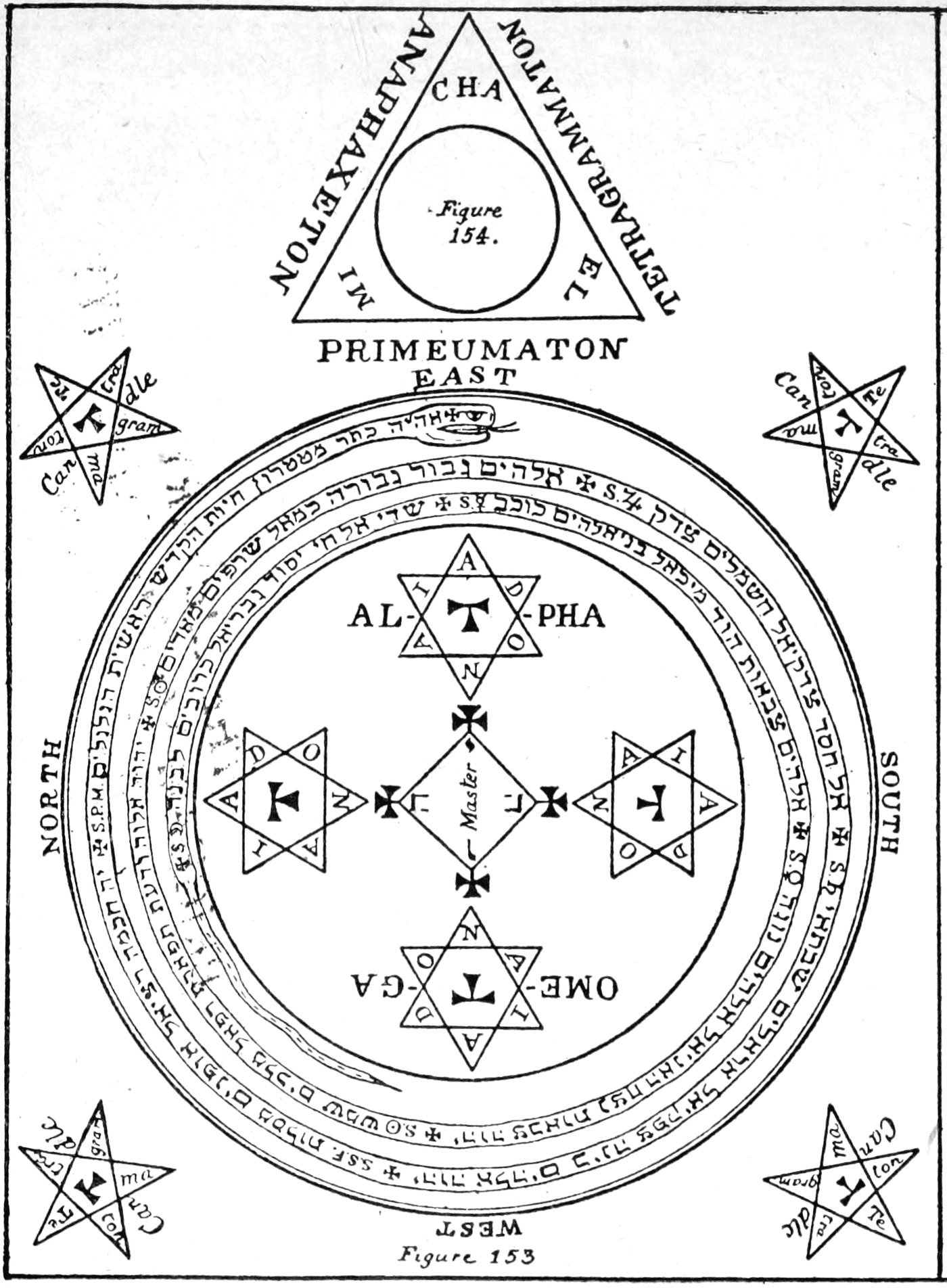
(Colours.--The space between the outer and inner circles, where the serpent is coiled, with the Hebrew names written along his body, is bright deep yellow. The square in the centre of the circle, where the word "Master" is written, is filled in with red. All names and letters are in black. In the Hexagrams the outer triangles where the letters A, D, O, N, A, I, appear are filled in with bright yellow, the centres, where the T-shaped crosses are, blue or green. In the Pentagrams outside the circle, the outer triangles where "Te, tra, gram, ma, ton," is written, are filled in bright yellow, and the centres with the T crosses written therein are red.1)
The Magical Triangle of Solomon
This is the Form of the Magical Triangle, into the which Solomon did command the Evil Spirits. It is to be made at 2 feet distance from the Magical Circle and it is 3 feet across. (See Frontispiece Figure 154.) Note that this triangle is to be placed toward that quarter whereunto the Spirit belongeth. And the base of the triangle is to be nearest unto the Circle, the apex pointing in the direction of the quarter of the Spirit. Observe thou also the Moon in thy working, as aforesaid, etc. Anaphaxeton is sometimes written Anepheneton.
(Colours.--Triangle outlined in black; name of Michael black on white ground; the three Names without the triangle written in red; circle in centre entirely filled in in dark green.)
The Hexagram of Solomon
THIS is the Form of the Hexagram of Solomon, the figure whereof is to be made on parchment of a calf's skin, and worn at the skirt of thy white vestment, and covered with a cloth of fine linen white and pure, the which is to be shown unto the Spirits when they do appear, so that they be compelled to take human shape upon them and be obedient.
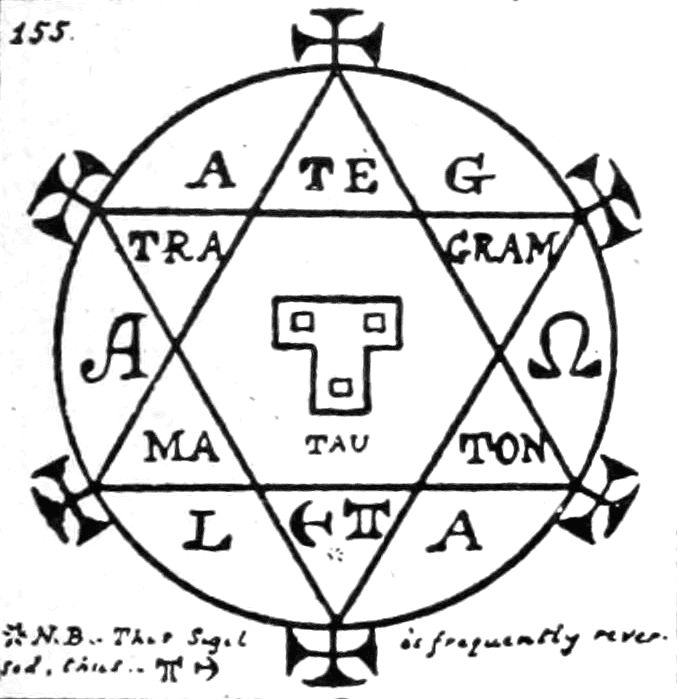
(Colours.--Circle, Hexagon, and T cross in centre outlined in black, Maltese crosses black; the five exterior triangles of the Hexagram where Te, tra, gram, ma, ton, is written, are filled in with bright yellow; the T cross in centre is red, with the three little squares therein in black. The lower exterior triangle, where the Sigil is drawn in black, is left white. The words "Tetragrammaton" and "Tau" are in black letters; and AGLA with Alpha and Omega in red letters.)
The Pentagram of Solomon
THIS is the Form of Pentagram of Solomon, the figure whereof is to be made in Sol or Luna (Gold or Silver), and worn upon thy breast; having the Seal of the Spirit required upon the other side thereof. It is to preserve thee from danger, and also to command the Spirits by.
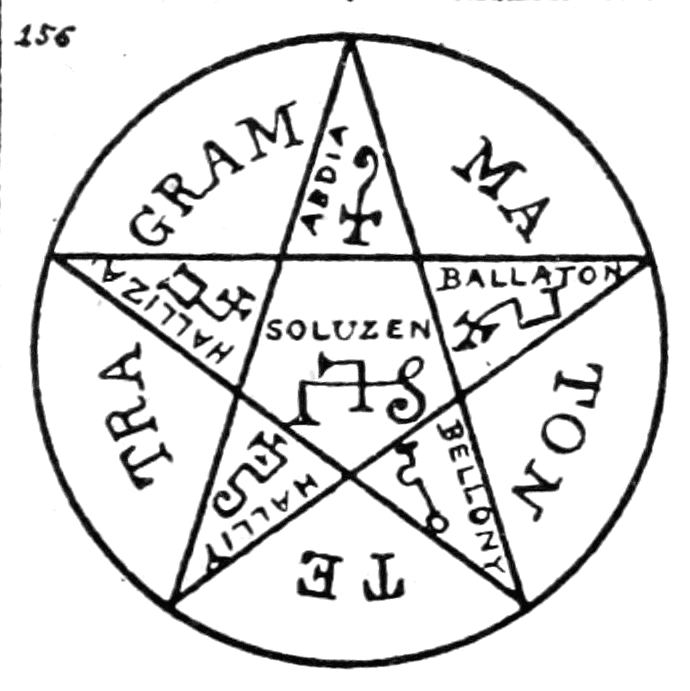
(Colours.--Circle and pentagram outlined in black. Names and Sigils within Pentagram black also. "Tetragrammaton" in red letters. Ground of centre of Pentagram, where "Soluzen" is written, green. External angles of Pentagram where "Abdia", "Ballaton," "Halliza," etc., are written, blue.)
The Magic Ring or Disc of Solomon
THIS is the Form of the Magic Ring, or rather Disc, of Solomon, the figure whereof is to be made in gold or silver. It is to be held before the face of the exorcist to preserve him from the stinking sulphurous fumes and flaming breath of the Evil Spirits.
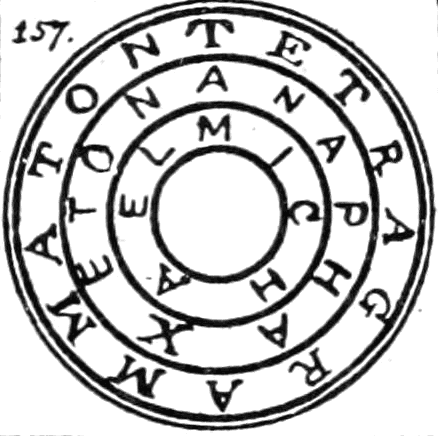
(Colour.--Bright yellow. Letters, black.)
The Vessel of Brass
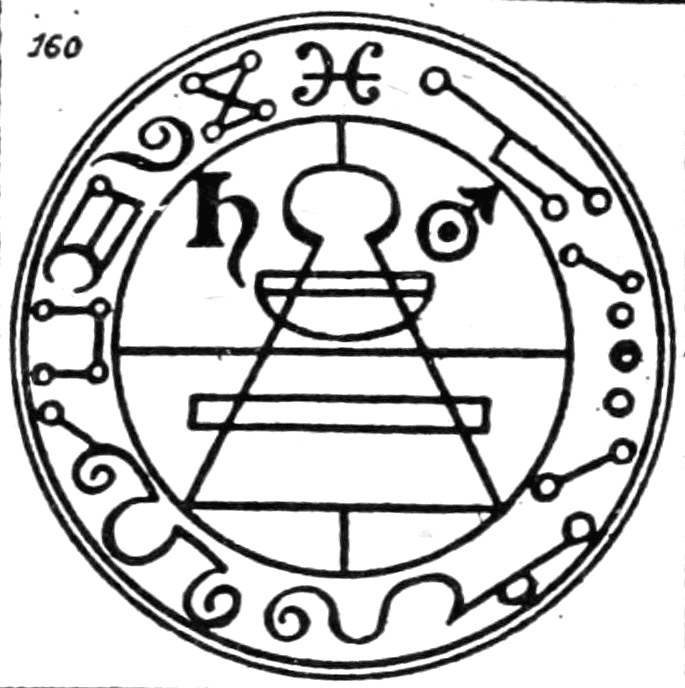
THIS is the Form of the Vessel of Brass wherein King Solomon did shut up the Evil Spirits, etc. (See Figures 158 and 159.) (Somewhat different forms are given in the various codices. The seal in Figure 160 was made in brass to cover this vessel with at the top. This history of the genii shut up in the brazen vessel by King Solomon recalls the story of "The Fisherman and the Jinni" in "The Arabian Nights." In this tale, however, there was only one jinni shut up in a vessel of yellow brass the which was covered at the top with a leaden seal. This jinni tells the fisherman that his name is Sakhr, or Sacar.)
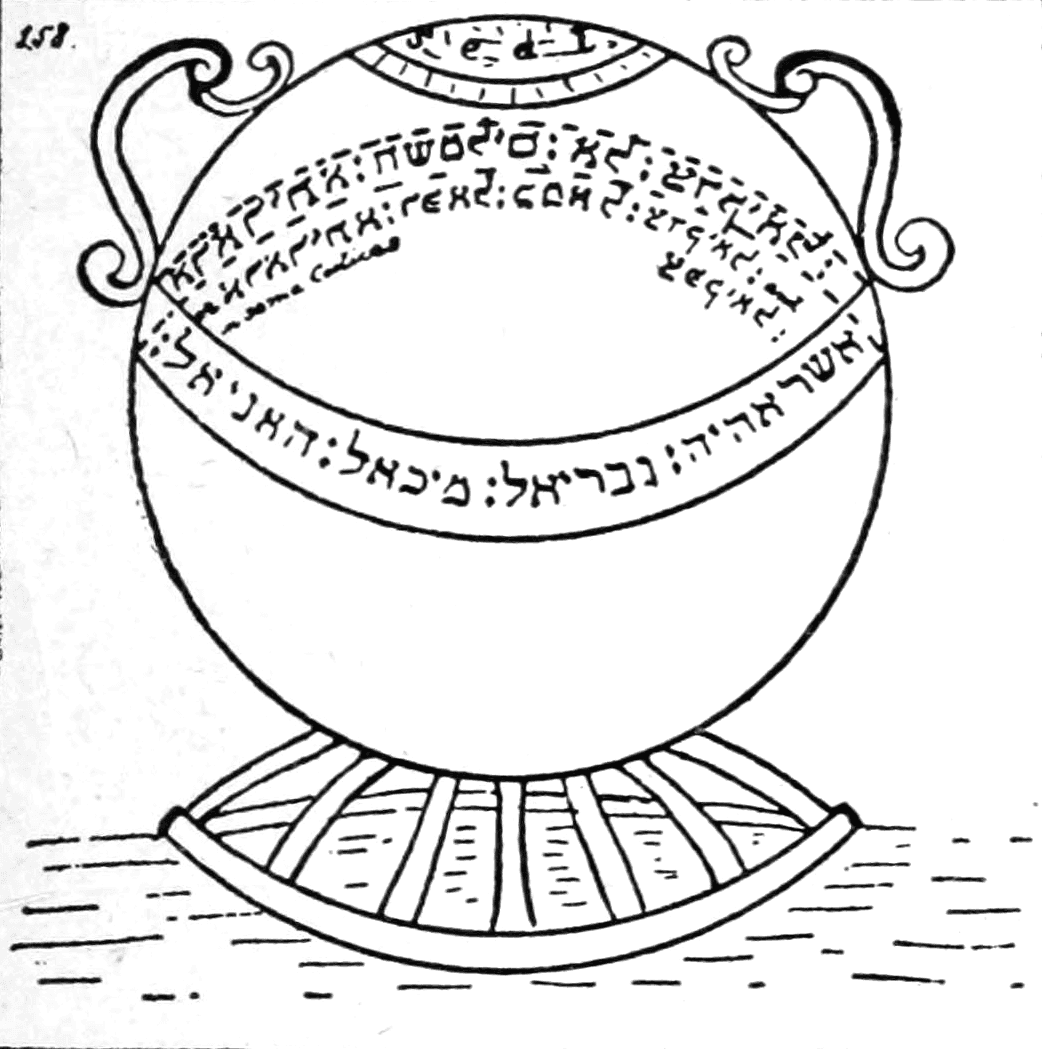
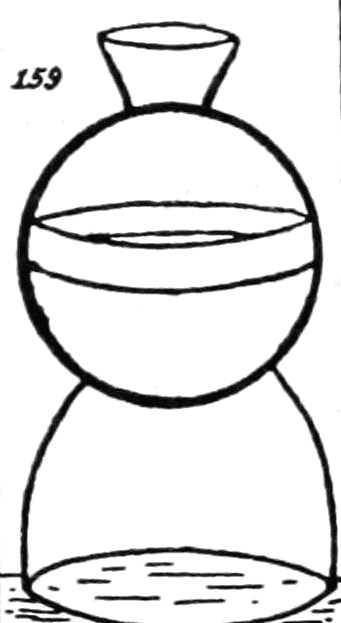
(Colour.--Bronze. Letters.--Black on a red band.)
The Secret Seal of Solomon
THIS is the Form of the Secret Seal of Solomon, wherewith he did bind and seal up the aforesaid Spirits with their legions in the Vessel of Brass.
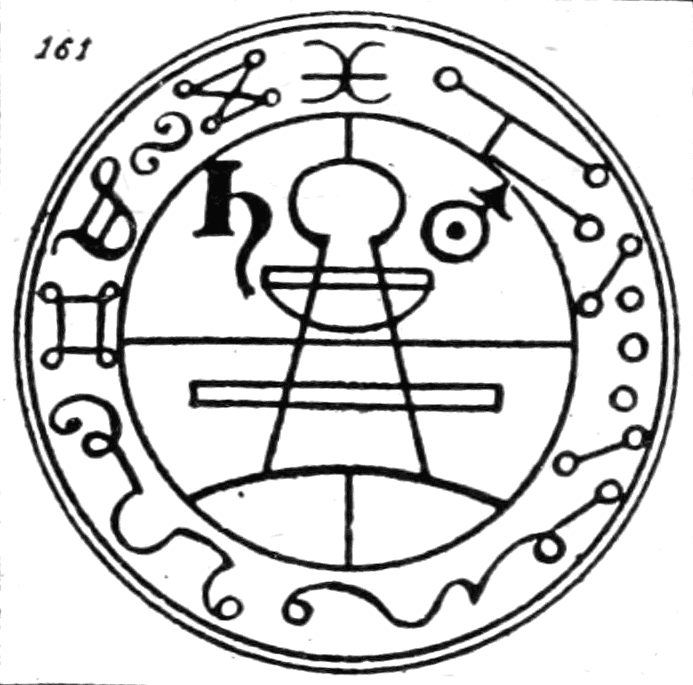
This seal is to be made by one that is clean both inwardly and outwardly, and that hath not defiled himself by any woman in the space of a month, but hath in prayer and fasting desired of God to forgive him all his sins, etc.
It is to be made on the day of Mars or Saturn (Tuesday or Saturday) at night at 12 o'clock, and written upon virgin parchment with the blood of a black cock that never trode hen. Note that on this night the moon must be increasing in light (i.e., going from new to full) and in the Zodiacal Sign of Virgo. And when the seal is so made thou shalt perfume it with alum, raisins dried in the sun, dates, cedar and lignum aloes.
Also, by this seal King Solomon did command all the aforesaid Spirits in the Vessel of Brass, and did seal it up with this same seal. He by it gained the love of all manner of persons, and overcame in battle, for neither weapons, nor fire, nor water could hurt him. And this privy seal was made to cover the vessel at the top withal, etc.
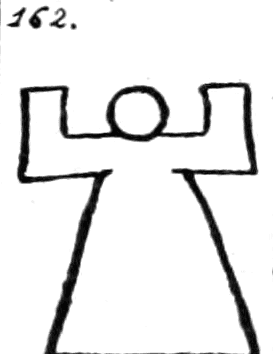
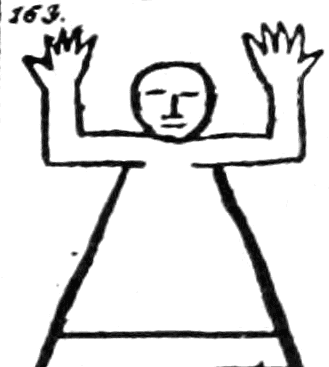
Note: Figures 162 to 174 inclusive are interesting as showing a marked resemblance to the central design of the Secret Seal. It will be observed that the evident desire is to represent hieroglyphically a person raising his or her hands in adoration. Nearly all are stone sepulchral steles, and the execution of them is rough and primitive in the extreme. Most are in the Musëe du Louvre at Paris.
Figures 162 and 163 are from the district of Constantine and show a figure raising its arms in adoration.
In Figure 164, also from Constantine, the person bears a palm branch in the right hand. Above is a hieroglyphic representing either the Lunar Disc or the Sun in the heavens; but more probably the former.
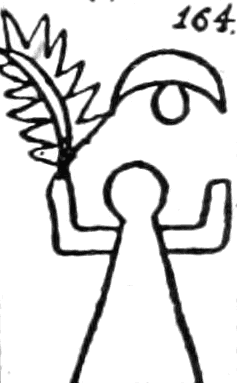
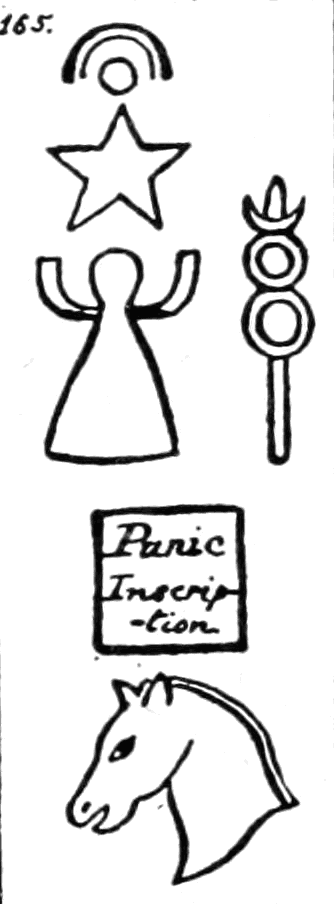
Figure 165 is a more complicated stele. Above is the symbol already mentioned, then comes the sign of the Pentagram, represented by a five-pointed star, towards which the person raises his or her hands. Besides the latter is a rude form of caduceus. A brief inscription follows in the Punic character. The Punic or Carthaginian language is usually considered to have been a dialect. of Phœnician, and Carthage was of course a colony of Tyre. Beneath the Tunic inscription is a horse's head in better drawing than the sculpture of the rest of the stele, which would seem to imply that the rudeness of the representation of the human figure is intentional. This and the following stele are also from Constantine.
In Figure 166 again, the horse is best delineated by far. In addition to the other symbols there is either a hand or a foot, for it is almost impossible to distinguish which, at the head of the stele, followed by an egg-and-tongue moulding. The figure of the person with the arms raised is treated as a pure hieroglyphic and is placed between two rude caducei. The Lunar or Solar Symbol follows.
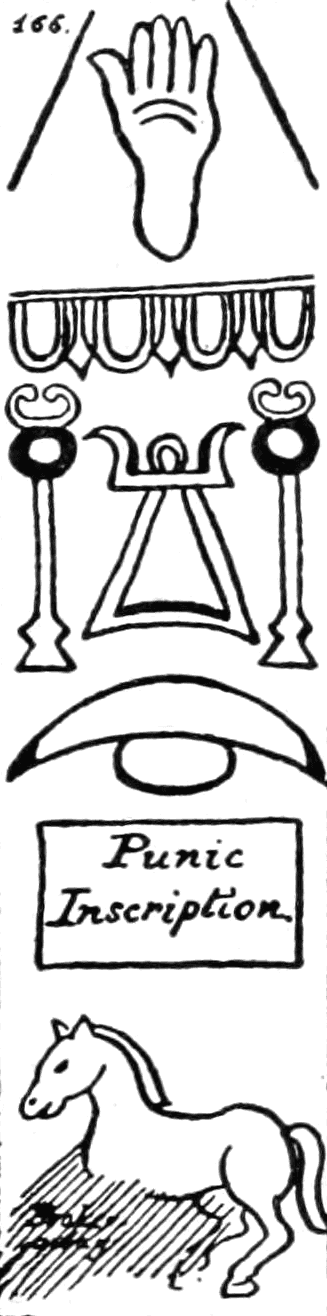
Figure 167, also from Constantine, shows the last-mentioned symbol above. The figure with the arms raised is simply a hieroglyph, and is placed between an arm and hand on the one side, and a rude caduceus on the other.
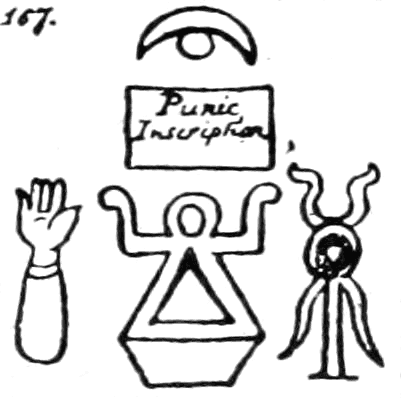
Figure 168 shows the person holding a rude caduceus in the right hand, and standing above a dolphin. This latter, as in the case of the horse in 165 and 166, is by far the best delineated.
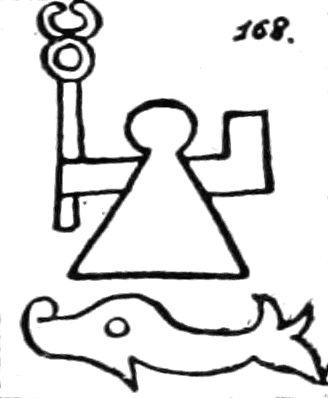
Figure 169, this also being from Constantine, shows the usual human hieroglyph between a caduceus and a crescent.
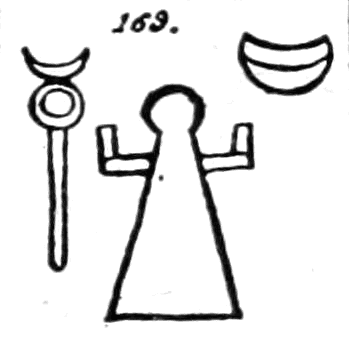
Figure 170 is from the site of ancient Carthage. It is very rough in workmanship, and the designs are mere scratchings on the stone. The ensemble has the effect of an evil Sigil.
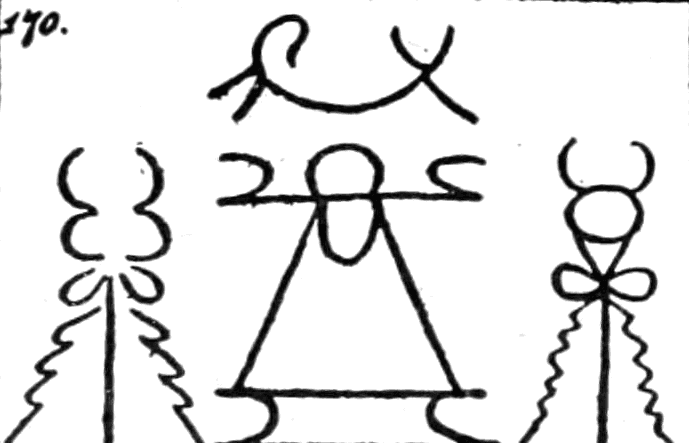
Figure 171 is also from Carthage and the various symbols appear to have become compressed into and synthesised in the form of a peculiarly evil-looking caduceus.
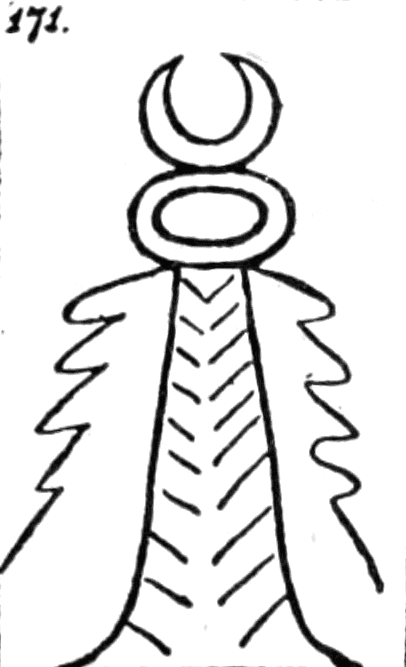
Figure 172 is from the decoration of a sepulchral urn found at Oldenburgh in Germany. It is remarkable as showing the same hieroglyphic human form with the crescent above; the latter in the Secret Seal of Solomon has a flattened top, and is therefore more like a bowl, and is placed across the hieroglyph.
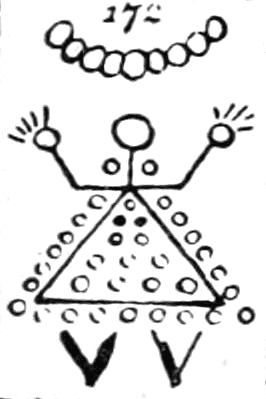
Figure 173 is an Egyptian design which would show an analogy between the symbol and the idea of the force of the creation.
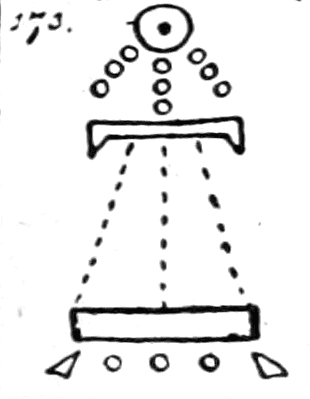
Figure 174 is a stele from Phœnicia somewhat similar to the others, except that the rudimentary caducei in Figures 166 and 170 are here replaced by two roughly drawn Ionic columns.
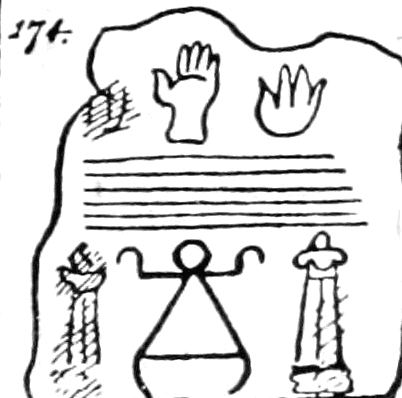
These last three designs are taken from the work of the Chevalier Emile Soldi-Colbert de Beaulieu, on the "Langue Sacrée."
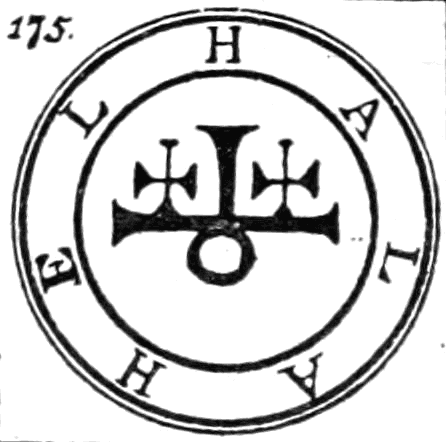
In Figure 175 is given the Seal of the Spirit HALAHEL. This Spirit is said to be under the rule of BAEL, and to be of a mixed nature, partly good and partly evil, like the spirits of Theurgia-Goetia which follow in the second book of the Lemegeton.
The Other Magical Requisites
THE other magical requisites are: a sceptre, a sword, a mitre, a cap, a long white robe of linen, and other garments for the purpose;2 also a girdle of lion's skin three inches broad, with all the names written about it which be round the outmost part of the Magical Circle. Also perfumes, and a chafing-dish of charcoal kindled to put the fumes on, to smoke or perfume the place appointed for action; also anointing oil to anoint thy temples and thine eyes with; and fair water to wash thyself in. And in so doing, thou shalt say as David said:
The Adoration at the Bath
"Thou shalt purge me with hyssop, O Lord! and I shall be clean: Thou shalt wash me, and I shall be whiter than snow."
And at the putting on of thy garments thou shalt say: THE ADORATION AT THE INDUING OF THE VESTMENTS.
"By the figurative mystery of these holy vestures (or of this holy vestment) I will clothe me with the armour of salvation in the strength of the Most High, ANCHOR; AMACOR; AMIDES; THEODINIAS; ANITOR; that my desired end may be effected through Thy strength, O ADONAI! unto Whom the praise and glory will for ever and ever belong! Amen!"
After thou hast so done, make prayers unto God according unto thy work, as Solomon hath commanded.
The end of The Circle, the Triangle and the Other Requisites.
Turn the page for The Conjurations.
Tap or click the right-hand side of the book to turn the page, the left to turn back; or use the arrow keys, or swipe. Press F for full screen.
The Lesser Key of Solomon: Goetia
The Circle, the Triangle and the Other Requisites
This is the Form of the Magical Circle of King Solomon, the which he made that he might preserve himself therein from the malice of these Evil Spirits. (See Frontispiece, Figure 153) This Magical Circle is to be made 9 feet across, and the Divine Names are to be written around it, beginning at EHYEH, and ending at LEVANAH, Luna.
(Colours.--The space between the outer and inner circles, where the serpent is coiled, with the Hebrew names written along his body, is bright deep yellow. The square in the centre of the circle, where the word "Master" is written, is filled in with red. All names and letters are in black. In the Hexagrams the outer triangles where the letters A, D, O, N, A, I, appear are filled in with bright yellow, the centres, where the T-shaped crosses are, blue or green. In the Pentagrams outside the circle, the outer triangles where "Te, tra, gram, ma, ton," is written, are filled in bright yellow, and the centres with the T crosses written therein are red.1)
The Magical Triangle of Solomon
This is the Form of the Magical Triangle, into the which Solomon did command the Evil Spirits. It is to be made at 2 feet distance from the Magical Circle and it is 3 feet across. (See Frontispiece Figure 154.) Note that this triangle is to be placed toward that quarter whereunto the Spirit belongeth. And the base of the triangle is to be nearest unto the Circle, the apex pointing in the direction of the quarter of the Spirit. Observe thou also the Moon in thy working, as aforesaid, etc. Anaphaxeton is sometimes written Anepheneton.
(Colours.--Triangle outlined in black; name of Michael black on white ground; the three Names without the triangle written in red; circle in centre entirely filled in in dark green.)
The Hexagram of Solomon
THIS is the Form of the Hexagram of Solomon, the figure whereof is to be made on parchment of a calf's skin, and worn at the skirt of thy white vestment, and covered with a cloth of fine linen white and pure, the which is to be shown unto the Spirits when they do appear, so that they be compelled to take human shape upon them and be obedient.
(Colours.--Circle, Hexagon, and T cross in centre outlined in black, Maltese crosses black; the five exterior triangles of the Hexagram where Te, tra, gram, ma, ton, is written, are filled in with bright yellow; the T cross in centre is red, with the three little squares therein in black. The lower exterior triangle, where the Sigil is drawn in black, is left white. The words "Tetragrammaton" and "Tau" are in black letters; and AGLA with Alpha and Omega in red letters.)
The Pentagram of Solomon
THIS is the Form of Pentagram of Solomon, the figure whereof is to be made in Sol or Luna (Gold or Silver), and worn upon thy breast; having the Seal of the Spirit required upon the other side thereof. It is to preserve thee from danger, and also to command the Spirits by.
(Colours.--Circle and pentagram outlined in black. Names and Sigils within Pentagram black also. "Tetragrammaton" in red letters. Ground of centre of Pentagram, where "Soluzen" is written, green. External angles of Pentagram where "Abdia", "Ballaton," "Halliza," etc., are written, blue.)
The Magic Ring or Disc of Solomon
THIS is the Form of the Magic Ring, or rather Disc, of Solomon, the figure whereof is to be made in gold or silver. It is to be held before the face of the exorcist to preserve him from the stinking sulphurous fumes and flaming breath of the Evil Spirits.
(Colour.--Bright yellow. Letters, black.)
The Vessel of Brass
THIS is the Form of the Vessel of Brass wherein King Solomon did shut up the Evil Spirits, etc. (See Figures 158 and 159.) (Somewhat different forms are given in the various codices. The seal in Figure 160 was made in brass to cover this vessel with at the top. This history of the genii shut up in the brazen vessel by King Solomon recalls the story of "The Fisherman and the Jinni" in "The Arabian Nights." In this tale, however, there was only one jinni shut up in a vessel of yellow brass the which was covered at the top with a leaden seal. This jinni tells the fisherman that his name is Sakhr, or Sacar.)
(Colour.--Bronze. Letters.--Black on a red band.)
The Secret Seal of Solomon
THIS is the Form of the Secret Seal of Solomon, wherewith he did bind and seal up the aforesaid Spirits with their legions in the Vessel of Brass.
This seal is to be made by one that is clean both inwardly and outwardly, and that hath not defiled himself by any woman in the space of a month, but hath in prayer and fasting desired of God to forgive him all his sins, etc.
It is to be made on the day of Mars or Saturn (Tuesday or Saturday) at night at 12 o'clock, and written upon virgin parchment with the blood of a black cock that never trode hen. Note that on this night the moon must be increasing in light (i.e., going from new to full) and in the Zodiacal Sign of Virgo. And when the seal is so made thou shalt perfume it with alum, raisins dried in the sun, dates, cedar and lignum aloes.
Also, by this seal King Solomon did command all the aforesaid Spirits in the Vessel of Brass, and did seal it up with this same seal. He by it gained the love of all manner of persons, and overcame in battle, for neither weapons, nor fire, nor water could hurt him. And this privy seal was made to cover the vessel at the top withal, etc.
Note: Figures 162 to 174 inclusive are interesting as showing a marked resemblance to the central design of the Secret Seal. It will be observed that the evident desire is to represent hieroglyphically a person raising his or her hands in adoration. Nearly all are stone sepulchral steles, and the execution of them is rough and primitive in the extreme. Most are in the Musëe du Louvre at Paris.
Figures 162 and 163 are from the district of Constantine and show a figure raising its arms in adoration.
In Figure 164, also from Constantine, the person bears a palm branch in the right hand. Above is a hieroglyphic representing either the Lunar Disc or the Sun in the heavens; but more probably the former.
Figure 165 is a more complicated stele. Above is the symbol already mentioned, then comes the sign of the Pentagram, represented by a five-pointed star, towards which the person raises his or her hands. Besides the latter is a rude form of caduceus. A brief inscription follows in the Punic character. The Punic or Carthaginian language is usually considered to have been a dialect. of Phœnician, and Carthage was of course a colony of Tyre. Beneath the Tunic inscription is a horse's head in better drawing than the sculpture of the rest of the stele, which would seem to imply that the rudeness of the representation of the human figure is intentional. This and the following stele are also from Constantine.
In Figure 166 again, the horse is best delineated by far. In addition to the other symbols there is either a hand or a foot, for it is almost impossible to distinguish which, at the head of the stele, followed by an egg-and-tongue moulding. The figure of the person with the arms raised is treated as a pure hieroglyphic and is placed between two rude caducei. The Lunar or Solar Symbol follows.
Figure 167, also from Constantine, shows the last-mentioned symbol above. The figure with the arms raised is simply a hieroglyph, and is placed between an arm and hand on the one side, and a rude caduceus on the other.
Figure 168 shows the person holding a rude caduceus in the right hand, and standing above a dolphin. This latter, as in the case of the horse in 165 and 166, is by far the best delineated.
Figure 169, this also being from Constantine, shows the usual human hieroglyph between a caduceus and a crescent.
Figure 170 is from the site of ancient Carthage. It is very rough in workmanship, and the designs are mere scratchings on the stone. The ensemble has the effect of an evil Sigil.
Figure 171 is also from Carthage and the various symbols appear to have become compressed into and synthesised in the form of a peculiarly evil-looking caduceus.
Figure 172 is from the decoration of a sepulchral urn found at Oldenburgh in Germany. It is remarkable as showing the same hieroglyphic human form with the crescent above; the latter in the Secret Seal of Solomon has a flattened top, and is therefore more like a bowl, and is placed across the hieroglyph.
Figure 173 is an Egyptian design which would show an analogy between the symbol and the idea of the force of the creation.
Figure 174 is a stele from Phœnicia somewhat similar to the others, except that the rudimentary caducei in Figures 166 and 170 are here replaced by two roughly drawn Ionic columns.
These last three designs are taken from the work of the Chevalier Emile Soldi-Colbert de Beaulieu, on the "Langue Sacrée."
In Figure 175 is given the Seal of the Spirit HALAHEL. This Spirit is said to be under the rule of BAEL, and to be of a mixed nature, partly good and partly evil, like the spirits of Theurgia-Goetia which follow in the second book of the Lemegeton.
The Other Magical Requisites
THE other magical requisites are: a sceptre, a sword, a mitre, a cap, a long white robe of linen, and other garments for the purpose;2 also a girdle of lion's skin three inches broad, with all the names written about it which be round the outmost part of the Magical Circle. Also perfumes, and a chafing-dish of charcoal kindled to put the fumes on, to smoke or perfume the place appointed for action; also anointing oil to anoint thy temples and thine eyes with; and fair water to wash thyself in. And in so doing, thou shalt say as David said:
The Adoration at the Bath
"Thou shalt purge me with hyssop, O Lord! and I shall be clean: Thou shalt wash me, and I shall be whiter than snow."
And at the putting on of thy garments thou shalt say: THE ADORATION AT THE INDUING OF THE VESTMENTS.
"By the figurative mystery of these holy vestures (or of this holy vestment) I will clothe me with the armour of salvation in the strength of the Most High, ANCHOR; AMACOR; AMIDES; THEODINIAS; ANITOR; that my desired end may be effected through Thy strength, O ADONAI! unto Whom the praise and glory will for ever and ever belong! Amen!"
After thou hast so done, make prayers unto God according unto thy work, as Solomon hath commanded.
7 of 10 · 9 min read
