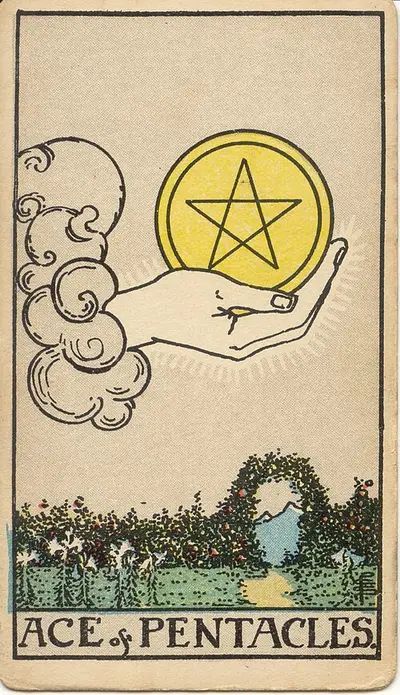
MINOR ARCANA · PENTACLES · EARTH
Ace of Pentacles
Tarot card meaning
UPRIGHT
New financial or material opportunity, prosperity.
REVERSED
Missed opportunity, poor planning, scarcity mindset.
The card
The Ace of Pentacles is the first card of Pentacles, the suit of Earth: money, work and the body.
As the ace it is the root of its element: the Golden Dawn called it the Root of the Powers of Earth.
In Aleister Crowley's Thoth tarot: Ace of Disks, with the title and the zodiac decan from the Golden Dawn, as shown above.
In Waite's words
Arthur Edward Waite designed the deck that Pamela Colman Smith drew, and explained it in The Pictorial Key to the Tarot (1911). His text, with his spelling:
A hand—issuing, as usual, from a cloud—holds up a pentacle. DIVINATORY MEANINGS Perfect contentment, felicity, ecstasy; also speedy intelligence; gold. REVERSED The evil side of wealth, bad intelligence; also great riches. In any case it shews prosperity, comfortable material conditions, but whether these are of advantage to the possessor will depend on whether the card is reversed or not.
Such are the intimations of the Lesser Arcana in respect of divinatory art, the veridic nature of which seems to depend on an alternative that it may be serviceable to express briefly. The records of the art are ex hypothesi the records of findings in the past based upon experience; as such, they are a guide to memory, and those who can master the elements may—still ex hypothesi—give interpretations on their basis. It is an official and automatic working. On the other hand, those who have gifts of intuition, of second sight, of clairvoyance—call it as we choose and may—will supplement the experience of the past by the findings of their own faculty, and will speak of that which they have seen in the pretexts of the oracles. It remains to give, also briefly, the divinatory significance allocated by the same art to the Trumps Major.
FURTHER MEANINGS The most favourable of all cards. REVERSED A share in the finding of treasure.
A. E. Waite, The Pictorial Key to the Tarot (London: William Rider & Son, 1911), Part III §§ 2 and 4. Public domain; text from the 1922 printing on Wikisource.
Related cards
The same card in the other suits
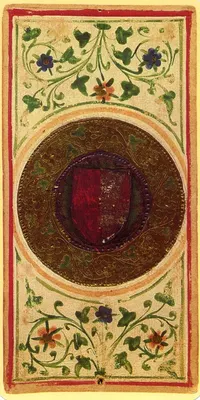
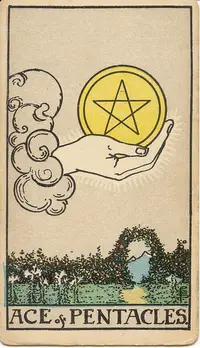
In three historical decks
The same card as it was painted in fifteenth-century Milan, printed in the French pattern of the Tarot de Marseille, and drawn by Pamela Colman Smith for the Rider–Waite–Smith deck.
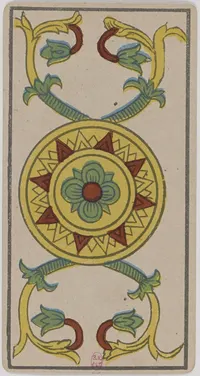
In the Tarot de Marseille: Ace of Deniers (coins). The numbered cards carry no scene, only the suit's symbols arranged as on a playing card, so they are read from the number and the pattern.
Learn more in the lessons
- The Structure of the Tarot · 14 min · free
- The Tarot & the Stars — Decans, Pips & Courts · 16 min
- Reading the Cards · 16 min
Images: Pamela Colman Smith, 1909 (public domain); the RWS1909 scans on Wikimedia Commons. Lequart, Paris, c. 1890 (public domain); scans from the Bibliothèque nationale de France (Gallica), via Wikimedia Commons. Attributed to Bonifacio Bembo, mid-15th century (public domain); scans by David Madore, via Wikimedia Commons.