HERB · MERCURY (CULPEPER) · AIR
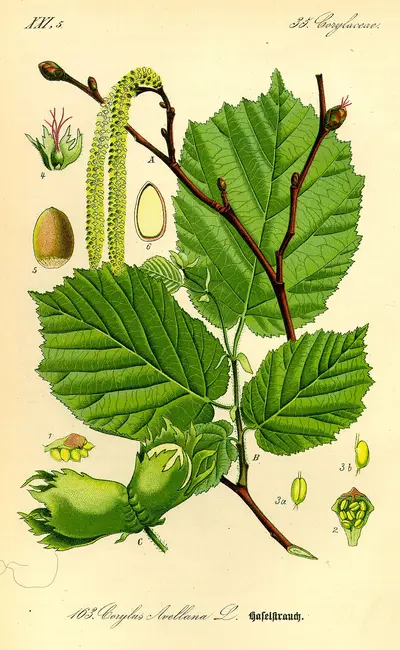
Hazel
Corylus avellana
KITCHEN-SAFE
A common food or tea plant in normal amounts. Nut allergy.
IN MAGIC
Wands and divining rods; nuts for wisdom and Samhain love divination.
LORE
In Irish myth nine hazels drop their nuts into the well of wisdom, where the salmon of knowledge eats them.
WHAT IS USED
Nuts and wood
WHEN
Flowers or is gathered in Britain from February, and September to October.
USED FOR
Divination & dreamsProtection
In Culpeper's words
From his herbal of 1653, under “Hazel-Nut”. Culpeper was a physician of his day, and many of his remedies are now known to be useless or dangerous: read him as history, never as medical advice.
GOVERNMENT AND VIRTUESThey are under the dominion of Mercury. The parted kernels made into an electuary, or the milk drawn from the kernels with mead or honeyed water, is very good to help an old cough; and being parched, and a little pepper put to them and drank, digests the distillations of rheum from the head. The dried husks and shells, to the weight of two drams, taken in red wine, stays lasks and women’s courses, and so doth the red skin that covers the kernels, which is more effectual to stay women’s courses. And if this be true, as it is, then why should the vulgar so familiarly affirm, that eating nuts causes shortness of breath, than which nothing is falser? For, how can that which strengthens the lungs, cause shortness of breath? I confess, the opinion is far older than I am; I knew tradition was a friend to error before, but never that he was the father of slander; Or are men’s tongues so given to slander one another, that they must slander Nuts too, to keep their tongues in use? If any part of the Hazel Nut be stopping, it is the husks and shells, and no one is so mad as to eat them unless physically; and the red skin which covers the kernel, you may easily pull off And so thus have I made an apology for Nuts, which cannot speak for themselves.
Nicholas Culpeper, The Complete Herbal (London: Thomas Kelly, 1850), reprinting The English Physitian Enlarged (1653).
Learn more in the lessons
- The Ogham · 15 min
- Herbal Allies · 15 min
- Planetary Herbs & the Doctrine of Signatures · 16 min