HERB · MARS (CULPEPER) · FIRE
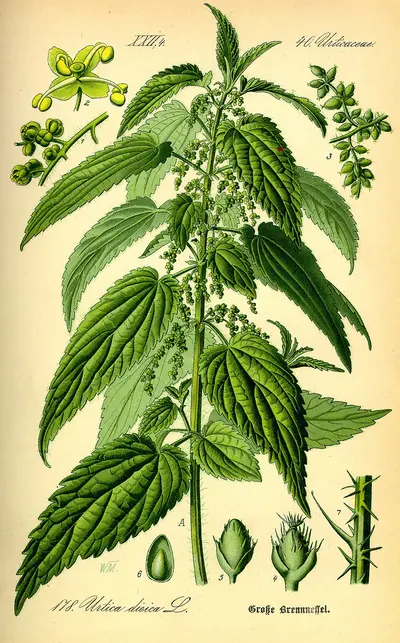
Nettle
Urtica dioica
KITCHEN-SAFE
A common food or tea plant in normal amounts. Stings when fresh; cooking or drying removes the sting.
IN MAGIC
Returning ill will to its sender; carried for courage.
LORE
In the fairy tale, the sister weaves nettle shirts to free her brothers from an enchantment.
WHAT IS USED
Young leaves and seeds
WHEN
Flowers or is gathered in Britain from March to June, and August to September.
USED FOR
ProtectionBanishingCourage & strength
In Culpeper's words
From his herbal of 1653, under “Nettles”. Culpeper was a physician of his day, and many of his remedies are now known to be useless or dangerous: read him as history, never as medical advice.
GOVERNMENT AND VIRTUESThis is also an herb Mars claims dominion over. You know Mars is hot and dry, and you know as well that Winter is cold and moist; then you may know as well the reason why Nettle-tops eaten in the Spring consume the phlegmatic superfluities in the body of man, that the coldness and moistness of Winter hath left behind. The roots or leaves boiled, or the juice of either of them, or both made into an electuary with honey and sugar, is a safe and sure medicine to open the pipes and passages of the lungs, which is the cause of wheezing and shortness of breath, and helps to expectorate tough phlegm, as also to raise the imposthumed pleurisy; and spend it by spitting; the same helps the swelling of the almonds of the throat, the mouth and throat being gargled therewith. The juice is also effectual to settle the palate of the mouth in its place, and to heal and temper the inflammations and soreness of the mouth and throat.
Read the rest
The decoction of the leaves in wine, being drank, is singularly good to provoke women’s courses, and settle the suffocation, strangling of the mother, and all other diseases thereof; it is also applied outwardly with a little myrrh. The same also, or the seed provokes urine, and expels the gravel and stone in the reins or bladder, often proved to be effectual in many that have taken it. The same kills the worms in children, eases pains in the sides, and dissolves the windiness in the spleen, as also in the body, although others think it only powerful to provoke venery. The juice of the leaves taken two or three days together, stays bleeding at the mouth. The seed being drank, is a remedy against the stinging of venomous creatures, the biting of mad dogs, the poisonous qualities of Hemlock, Henbane, Nightshade, Mandrake, or other such like herbs that stupify or dull the senses; as also the lethargy, especially to use it outwardly, to rub the forehead or temples in the lethargy, and the places stung or bitten with beasts, with a little salt. The distilled water of the herb is also effectual (though not so powerful) for the diseases aforesaid; as for outward wounds and sores to wash them, and to cleanse the skin from morphew, leprosy, and other discolourings thereof. The seed or leaves bruised, and put into the nostrils, stays the bleeding of them, and takes away the flesh growing in them called polypus. The juice of the leaves, or the decoction of them, or of the root, is singularly good to wash either old, rotten, or stinking sores or fistulous, and gangrenes, and such as fretting, eating, or corroding scabs, manginess, and itch, in any part of the body, as also green wounds, by washing them therewith, or applying the green herb bruised thereunto, yea, although the flesh were separated from the bones; the same applied to our wearied members, refresh them, or to place those that have been out of joint, being first set up again, strengthens, dries, and comforts them, as also those places troubled with aches and gouts, and the defluxion of humours upon the joints or sinews; it eases the pains, and dries or dissolves the defluctions. An ointment made of the juice, oil, and a little wax, is singularly good to rub cold and benumbed members. An handful of the leaves of green Nettles, and another of Wallwort, or Deanwort, bruised and applied simply themselves to the gout, sciatica, or joint aches in any part, hath been found to be an admirable help thereunto.
Nicholas Culpeper, The Complete Herbal (London: Thomas Kelly, 1850), reprinting The English Physitian Enlarged (1653).