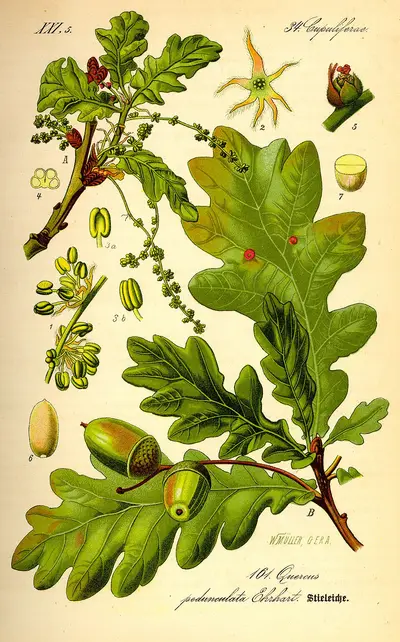
HERB · JUPITER (CULPEPER) · FIRE
Oak
Quercus robur
KITCHEN-SAFE
A common food or tea plant in normal amounts. Raw acorns are toxic to livestock and unpleasant to people.
IN MAGIC
Acorns carried for strength and luck; oak wood for wands and Midsummer fires.
LORE
Sacred to Zeus, Jupiter and Thor, and the tree of the druids — whose name may mean 'oak-knower'.
WHAT IS USED
Acorns, leaves and fallen wood
WHEN
Flowers or is gathered in Britain from May, and September to October.
USED FOR
Courage & strengthProtectionHealing & blessing
In Culpeper's words
From his herbal of 1653, under “The Oak”. Culpeper was a physician of his day, and many of his remedies are now known to be useless or dangerous: read him as history, never as medical advice.
GOVERNMENT AND VIRTUESJupiter owns the tree. The leaves and bark of the Oak, and the acorn cups, do bind and dry very much. The inner bark of the tree, and the thin skin that covers the acorn, are most used to stay the spitting of blood, and the bloody-flux. The decoction of that bark, and the powder of the cups, do stay vomitings, spitting of blood, bleeding at the mouth, or other fluxes of blood, in men or women; lasks also, and the nocturnal involuntary flux of men. The acorn in powder taken in wine, provokes urine, and resists the poison of venomous creatures. The decoction of acorns and the bark made in milk and taken, resists the force of poisonous herbs and medicines, as also the virulency of cantharides, when one by eating them hath his bladder exulcerated, and voids bloody urine. Hippocrates saith, he used the fumes of Oak leaves to women that were troubled with the strangling of the mother; and Galen applied them, being bruised, to cure green wounds.
Read the rest
The distilled water of the Oaken bud, before they break out into leaves is good to be used either inwardly or outwardly, to assuage inflammations, and to stop all manner of fluxes in man or woman. The same is singularly good in pestilential and hot burning fevers; for it resists the force of the infection, and allays the heat: It cools the heat of the liver, breaking the stone in the kidneys, and stays women’s courses. The decoction of the leaves works the same effects. The water that is found in the hollow places of old Oaks, is very effectual against any foul or spreading scabs. The distilled water (or concoction, which is better) of the leaves, is one of the best remedies that I know of for the whites in women.
Nicholas Culpeper, The Complete Herbal (London: Thomas Kelly, 1850), reprinting The English Physitian Enlarged (1653).
Learn more in the lessons
- The Druids of the Ancient Writers · 16 min · free
- The Ogham · 15 min
- Ogham in the Stones and the Manuscripts · 17 min
- Planetary Herbs & the Doctrine of Signatures · 16 min
- The Otherworld and the Gods · 16 min
- The Goddess, the God and the Turning Year · 15 min