HERB · SATURN (CULPEPER) · WATER
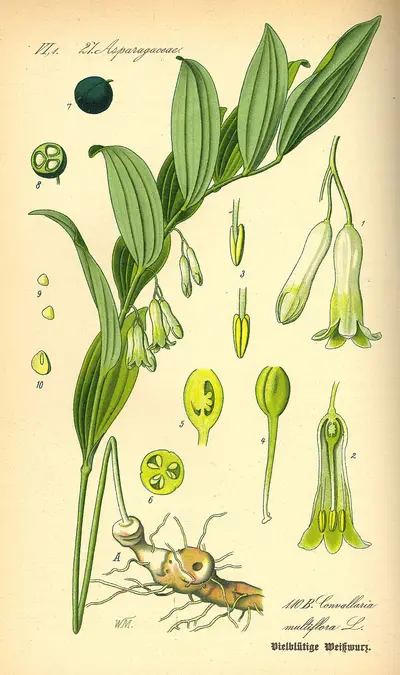
Solomon's seal
Polygonatum multiflorum
POISONOUS
Do not eat or drink. Wash hands after handling. The berries are poisonous.
IN MAGIC
Sealing, binding and protection; the root kept as a charm.
LORE
Cut the root and the scars look like seals, said to be King Solomon's mark on the plant.
WHAT IS USED
Root, as a charm (not eaten)
WHEN
Flowers or is gathered in Britain from May to June.
USED FOR
ProtectionBanishing
In Culpeper's words
From his herbal of 1653, under “Solomon’s Seal”. Culpeper was a physician of his day, and many of his remedies are now known to be useless or dangerous: read him as history, never as medical advice.
PLACEIt is frequent in divers places of this land; as, namely in a wood two miles from Canterbury, by Fish-Pool Hill, as also in Bushy Close belonging to the parsonage of Alderbury, near Clarendon, two miles from Salisbury: in Cheffon wood, on Chesson Hill, between Newington and Sittingbourn in Kent, and divers other places in Essex, and other counties.
TIMEIt flowers about May: The root abides and shoots a-new every year.
GOVERNMENT AND VIRTUESSaturn owns the plant, for he loves his bones well. The root of Solomon’s Seal is found by experience to be available in wounds, hurts, and outward sores, to heal and close up the lips of those that are green, and to dry up and restrain the flux of humours to those that are old. It is singularly good to stay vomitings and bleeding wheresoever, as also all fluxes in man or woman; also, to knit any joint, which by weakness uses to be often out of place, or will not stay in long when it is set; also to knit and join broken bones in any part of the body, the roots being bruised and applied to the places; yea, it hath been found by experience, and the decoction of the root in wine, or the bruised root put into wine or other drink, and after a night’s infusion, strained forth hard and drank, hath helped both man and beast, whose bones hath been broken by any occasion, which is the most assured refuge of help to people of divers counties of the land that they can have.
Read the rest
It is no less effectual to help ruptures and burstings, the decoction in wine, or the powder in broth or drink, being inwardly taken, and outwardly applied to the place. The same is also available for inward or outward bruises, falls or blows, both to dispel the congealed blood, and to take away both the pains and the black and blue marks that abide after the hurt. The same also, or the distilled water of the whole plant, used to the face, or other parts of the skin, cleanses it from morphew, freckles, spots, or marks whatsoever, leaving the place fresh, fair, and lovely; for which purpose it is much used by the Italian Dames.
Nicholas Culpeper, The Complete Herbal (London: Thomas Kelly, 1850), reprinting The English Physitian Enlarged (1653).
Learn more in the lessons
- The Poison Garden — Baneful Herbs in History · 14 min
- Herbal Allies · 15 min
- Planetary Herbs & the Doctrine of Signatures · 16 min