HERB · MERCURY (CULPEPER) · AIR
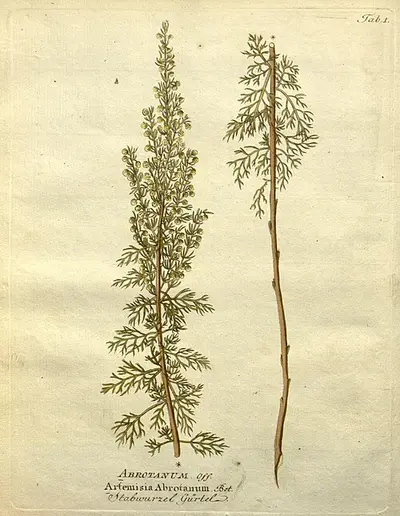
Southernwood
Artemisia abrotanum
USE WITH CARE
Safe for most external use, but has real cautions — read the note. Contains thujone; don't ingest it.
IN MAGIC
Love posies; hung in wardrobes against moths.
LORE
Called 'lad's love': young men put it in posies for sweethearts. The French call it garde-robe, 'guard the clothes'.
WHAT IS USED
Leaves
WHEN
Flowers or is gathered in Britain from June to September.
USED FOR
LoveProtection
In Culpeper's words
From his herbal of 1653, under “Southern Wood”. Culpeper was a physician of his day, and many of his remedies are now known to be useless or dangerous: read him as history, never as medical advice.
TIMEIt flowers for the most part in July and August.
GOVERNMENT AND VIRTUESIt is a gallant mercurial plant, worthy of more esteem than it hath. Dioscorides saith, That the seed bruised, heated in warm water, and drank, helps those that are bursten, or troubled with cramps or convulsions of the sinews, the sciatica, or difficulty in making water, and bringing down women’s courses. The same taken in wine is an antidote, or counter-poison against all deadly poison, and drives away serpents and other venomous creatures; as also the smell of the herb, being burnt, doth the same. The oil thereof anointed on the back-bone before the fits of agues come, takes them away: It takes away inflammations in the eyes, if it be put with some part of a roasted quince, and boiled with a few crumbs of bread, and applied. Boiled with barley-meal it takes away pimples, pushes or wheals that arise in the face, or other parts of the body. The seed as well as the dried herb, is often given to kill the worms in children: The herb bruised and laid to, helps to draw forth splinters and thorns out of the flesh.
Read the rest
The ashes thereof dries up and heals old ulcers, that are without inflammation, although by the sharpness thereof it bites sore, and puts them to sore pains; as also the sores in the privy parts of man or woman. The ashes mingled with old sallad oil, helps those that have hair fallen, and are bald, causing the hair to grow again either on the head or beard. Daranters saith, That the oil made of Southern-wood, and put among the ointments that are used against the French disease, is very effectual, and likewise kills lice in the head. The distilled water of the herb is said to help them much that are troubled with the stone, as also for the diseases of the spleen and mother. The Germans commend it for a singular wound herb, and therefore call it Stabwort. It is held by all writers, ancient and modern, to be more offensive to the stomach than worm-wood.
Nicholas Culpeper, The Complete Herbal (London: Thomas Kelly, 1850), reprinting The English Physitian Enlarged (1653).