IN THIS LESSON
Celtic Magic & Druidry · Lesson 2 of 7
Gaul and Britain: Curses, Springs and the Calendar
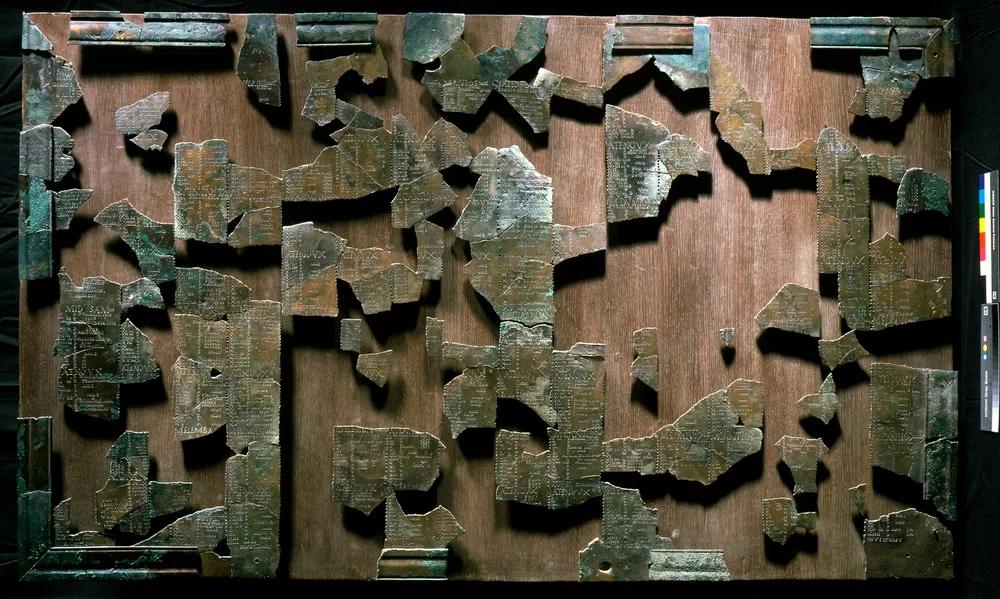
What the Celts left in their own words — the lead tablets of Chamalières and Larzac with their "magic of women", the wooden offerings in the sacred springs, the curses thrown into the spring of Sulis at Bath, and the bronze calendar of Coligny with its good and not-good months and the three nights of Samonios.
The druids did not write their teaching down, but the Gauls and Britons did write. Under Roman rule they learned the Latin alphabet, and a handful of texts in Gaulish, their own Celtic language, survive on lead, stone and bronze. With the offerings people left at their holy places, they let us see Celtic magic at first hand, not through Roman eyes.
Words on lead
Chamalières. In January 1971, at a sacred spring called the Source des Roches near Clermont-Ferrand, archaeologists found thousands of carved wooden offerings — whole figures, heads, limbs, eyes and organs, left by people hoping to be healed — and among them a small lead tablet about the size of a playing card. Written in Gaulish in Roman cursive letters, from around the turn of the eras, its forty-seven words call on the gods below and on Maponos, the divine son or youth, and name several men, Gauls with Roman names. Whether it binds them by magic or asks healing for them is argued over. One of its words is brixtia, magic or spell.
Larzac. In 1983, in a cemetery at L'Hospitalet-du-Larzac in southern France, a lead tablet of about 100 CE turned up in a grave, broken in two, perhaps deliberately. At more than 160 words it is the longest text in Gaulish. Written by two hands, it names a dozen or so women, each by her relation to another — daughter of, mother of — with one Severa Tertionicna at their head, and speaks of bnanom brictom, which seems to mean the magic of women. Most read it as a curse laid by one group of women against a rival group of women who worked magic too, invoking a goddess called Adsagsona. It is the earliest witness, in a Celtic language, to women practising magic together.
Lesson 2 of 7 · 15 min
READ THE SOURCE
- Ancient Legends, Mystic Charms and Superstitions of Ireland · Lady Wilde, 1887; this edition 1919 · free in the Reading Room