Western Ceremonial MagicWhat Natural Magic Meant to Agrippa
Western Ceremonial Magic · Lesson 2 of 13 · Free
What Natural Magic Meant to Agrippa
❦
Book I of the Three Books of Occult Philosophy read closely — what Agrippa meant by natural magic, where he thought the hidden virtues of plants and stones came from, how he said to find them, and the marigold and vervain as a worked example.
"Natural magic" is the phrase many people now reach for when they mean plants, stones and the turning year, what is sometimes called green magic. For Heinrich Cornelius Agrippa (1486–1535) it meant something more exact: the first degree of a single art, with a theory of why a herb or a stone should have powers at all, and a method for finding out which powers it has. This lesson reads Book I of his Three Books of Occult Philosophy closely, in the English of 1651, to see what he claimed, how he argued it, and where a modern list of correspondences quietly departs from him.
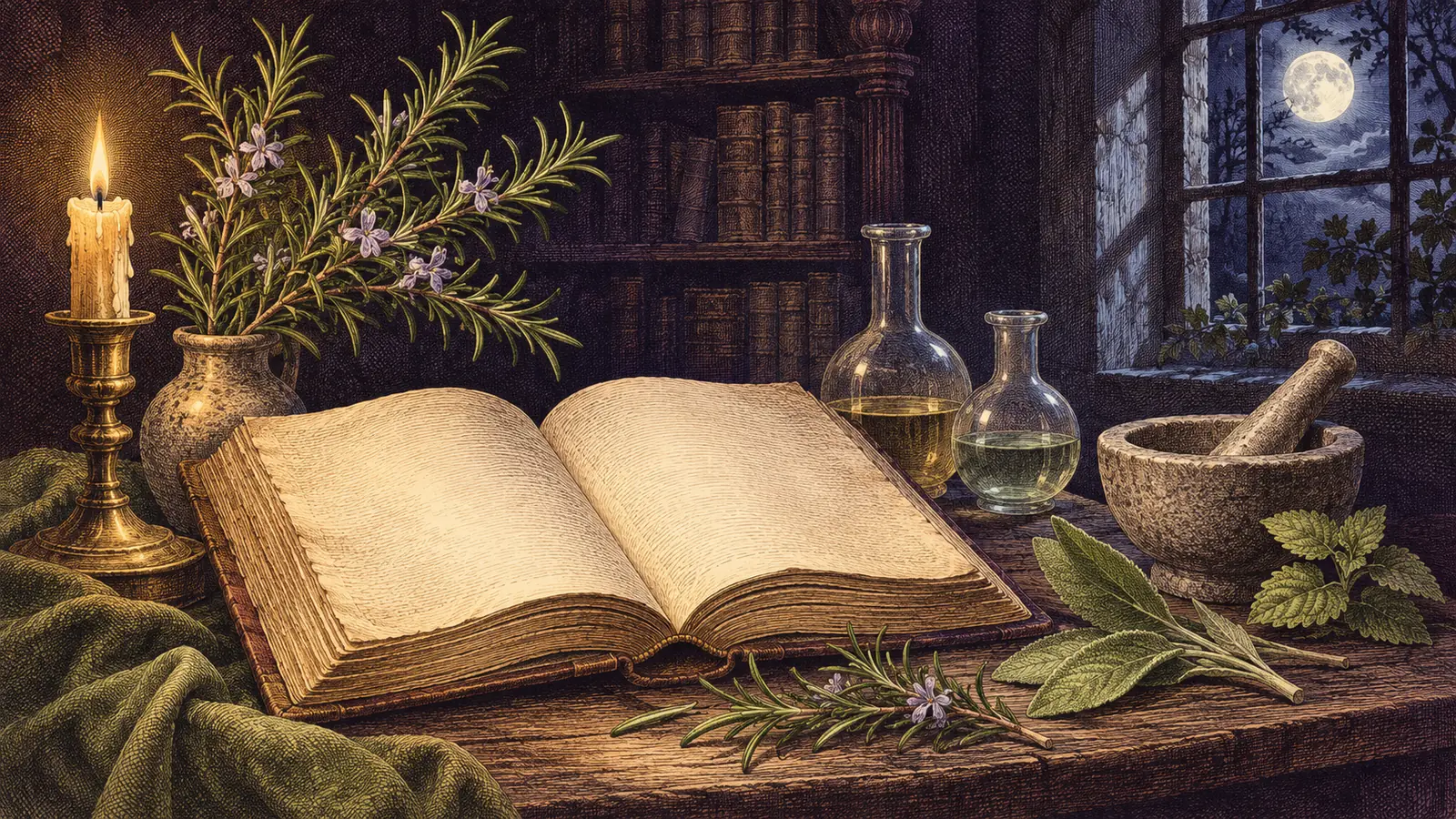
Original AI illustration created for Occultum: a scene, not a plate from Agrippa.Heinrich Cornelius Agrippa (1486–1535), engraved by Theodor de Bry for Boissard’s Icones (1597–99). · Wellcome Collection, CC BY 4.0 · Source
The first of three worlds
Agrippa opens (Book I, chapter 1) with a threefold world: elementary, celestial and intellectual, each lower world receiving its virtues from the one above. The wise, he says, seek the virtues of the elementary world through medicine and natural philosophy, those of the heavens through astrology and mathematics, and confirm both through the ceremonies of religion. His three books follow that order: natural magic first, then celestial, then ceremonial. Agrippa's Three Worlds shows the whole building; this lesson stays on its ground floor.
Chapter 2 defines magic itself as knowledge of "the differing, and agreement of things amongst themselves", which works "by uniting the vertues of things through the application of them one to the other". Natural magic, then, is natural philosophy put to work: knowing what things are and what they do to one another, and joining them.
The letter at dawn. Original AI illustration created for Occultum.
This week in magic
One email each Thursday morning: the Moon and the festivals of the week, the angel of each day, and a free lesson to read. Free, and you can stop it in one click.
We use your address only for this email. See our privacy policy.
"Natural magic" is the phrase many people now reach for when they mean plants, stones and the turning year, what is sometimes called green magic. For Heinrich Cornelius Agrippa (1486–1535) it meant something more exact: the first degree of a single art, with a theory of why a herb or a stone should have powers at all, and a method for finding out which powers it has. This lesson reads Book I of his Three Books of Occult Philosophy closely, in the English of 1651, to see what he claimed, how he argued it, and where a modern list of correspondences quietly departs from him.
Original AI illustration created for Occultum: a scene, not a plate from Agrippa.Heinrich Cornelius Agrippa (1486–1535), engraved by Theodor de Bry for Boissard’s Icones (1597–99). · Wellcome Collection, CC BY 4.0 · Source
The first of three worlds
Agrippa opens (Book I, chapter 1) with a threefold world: elementary, celestial and intellectual, each lower world receiving its virtues from the one above. The wise, he says, seek the virtues of the elementary world through medicine and natural philosophy, those of the heavens through astrology and mathematics, and confirm both through the ceremonies of religion. His three books follow that order: natural magic first, then celestial, then ceremonial. Agrippa's Three Worlds shows the whole building; this lesson stays on its ground floor.
Chapter 2 defines magic itself as knowledge of "the differing, and agreement of things amongst themselves", which works "by uniting the vertues of things through the application of them one to the other". Natural magic, then, is natural philosophy put to work: knowing what things are and what they do to one another, and joining them.
Hidden virtues
Much of what a plant does, for Agrippa, is explained by its elements: it is hot or cold, moist or dry. Chapter 10 turns to the rest, "other vertues in things, which are not from any Element", such as the lodestone's pull on iron or a remedy's power against poison. "And they are called occult qualities, because their Causes lie hid, and mans intellect cannot in any way reach, and find them out."
Two things are worth noticing. Occult here means hidden, not sinister. And Agrippa says these virtues were found by philosophers "by long experience, rather then by the search of reason": they were observed and handed down, not deduced.
Five answers, and a way of keeping them all
Chapter 13 asks where the hidden virtues come from, and Agrippa answers by reporting the authorities rather than choosing one. Alexander of Aphrodisias traced them to the elements and their qualities; Plato and his followers to the Ideas; Avicenna to the Intelligences; Hermes to the stars; Albertus Magnus to the specific forms of things. Then he keeps them all: none of them, he says, "if they be rightly understood, goes beside the truth". God sets the seal of the Ideas on the Intelligences, they pass it through the heavens, and the heavens stamp it on things below, so that each answer names one link of the same chain.
That move matters, because most later correspondence tables make it silently. A table that says "vervain: Venus" or "vervain: the Sun" rarely tells you which authority it follows, or that the authorities were already arguing when Agrippa wrote.
How to find a virtue
If the causes are hidden, how can anyone know which star rules which plant? Chapter 15 gives the principle. The hidden properties are "hid from our senses, and scarce at last known by our reason", and can be found only "by experience, and conjecture". The guide to conjecture is likeness: "every thing moves, and turns it self to its like". Fire moves to fire; physicians, he notes, use brain to help the brain and lungs the lungs.
Chapter 23 applies the principle to the stars, and begins with a frank admission: "Now it is very hard to know, what Star, or Signe every thing is under". Yet it can be known, he goes on, through a thing's "imitation of their rayes, or motion, or figure", through its colours and smells, and through its effects. Chapter 22 adds the body: "Solary things respect the heart, & head", because Leo, the sign of the heart, is the Sun's house, and Aries, the sign of the head, its exaltation.
A worked example: the marigold and vervain
Take the first plant in Agrippa's list of the Sun's things: "Amongst plants also and trees, those are Solary, which turn towards the Sun, as the Marygold" (chapter 23). This is the motion test of the same chapter: the flower follows the Sun across the sky, so it belongs to the Sun. (The 1651 English says Marygold; whether Agrippa's plant is the pot marigold of a modern garden is a question of translation, which the English alone cannot settle.)
A century later Nicholas Culpeper agreed, by a physician's route. Of marigolds he writes, "It is an herb of the Sun, and under Leo", and he gives them to strengthening the heart, the Sun's organ. Two sources, one verdict.
Now vervain. In the same chapter Agrippa counts "Vervin" among the Sun's plants, "of use in prophecying, and expiations, as also driving away evill spirits". Yet five chapters later, in his list of the things of Venus (chapter 28), vervain comes first. Culpeper takes the second view: "This is an herb of Venus". Occultum's Herbarium gives Culpeper's ruler wherever he names one, so it gives vervain to Venus.
Plant
Agrippa (1533; English 1651), Book I
Culpeper (1652)
The Herbarium
Marigold
The Sun (ch. 23): it turns towards the Sun
The Sun, under Leo
The Sun
Vervain
The Sun (ch. 23: for prophecy, expiation and driving off evil spirits), and Venus (ch. 28)
Venus
Venus, after Culpeper
Nothing here is simply wrong. Agrippa gathered his lists from older books and reasoned from likeness, so one plant could fall under two planets; Culpeper gave each herb one ruler. A table that gives vervain to the Sun and one that gives it to Venus can both cite Agrippa, and the list you happen to meet decides which you inherit. One Planet, Worked Through follows Venus's whole list in the same way.
Attribution, reason and reading
When you meet a correspondence, separate three things:
The attribution: what a named source says. Agrippa: the marigold is the Sun's.
The reason given, if the source gives one. It turns towards the Sun.
A reading: what you, or a modern writer, make of it. A marigold on the altar for confidence and warmth.
The third may be useful, but it is not the source's claim. On Occultum, readings and practices written for the site are labelled as such, and the sources' own words are cited by book and chapter.
Exercise
Trace one correspondence. Choose a plant in the Herbarium or a stone in Crystals & Stones and note the planet the tool gives it. Then look for it in Agrippa's lists of the planets' things, Book I chapters 23 to 29 (the 1651 English is on the Grimoire Shelf). In your journal, write the attribution, the reason if one is given, and your own reading, each on its own line. If the sources disagree, record both and leave the question open.
Reading once is not remembering. Study Cards bring each fact back just before you would forget it, until it is yours.
☉This lesson's 5 questionsNot practised yet · they join your daily review when you mark the lesson completeQuiz me on them →
Ask the tutor
Members can ask questions about any lesson and get an answer grounded in the lesson and its sources — explanations, practical guidance and what to study next.