The power the creator made the world with; Heka the god, Isis great of magic and Thoth lord of the god's words; the lector priest and his book, the wise woman of the tomb-builders' village, and the magicians of the old tales.
The History of Magic course gave Egypt a single lesson. This course goes in: through the papyri, the amulets and the tomb walls, to what the Egyptians themselves meant by magic, and then out again to the Egypt that later magicians imagined.
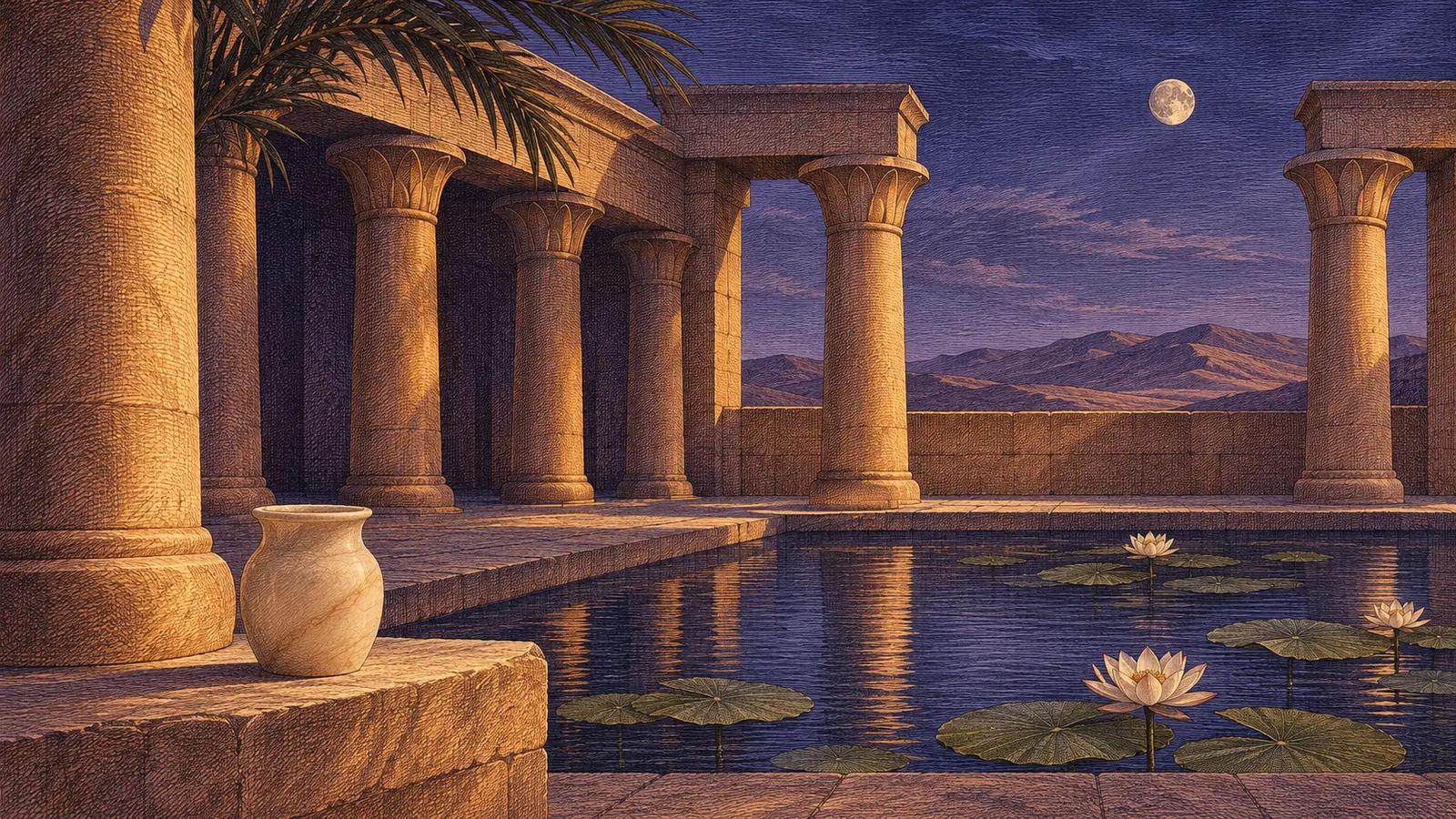
Original AI illustration created for Occultum: an imagined courtyard, not any particular temple.An apotropaic wand of hippopotamus ivory, Middle Kingdom (c. 1981–1640 BC), carved with protective beings to guard mother and child. Metropolitan Museum of Art. · CC0 · Source
Heka, the first power
The Egyptian word was heka, written with the twisted wick that spells ḥ and the two raised arms of the ka. It was not something set apart from religion: it was the power by which the world was made and is kept going, and it was a god. In Coffin Text 261, a spell for the dead to become Heka, he speaks for himself: the creator, the Sole Lord, made him before there were two things in the world — before any division at all. Heka sails in the sun's boat beside Hu, the creative word, and Sia, perception: Egyptologists often read the three as the creator's powers, to understand, to command and to make it happen.
Heka was also a gift. In the Instruction for King Merikare, a Middle Kingdom book of advice, the creator is said to have made heka for people as a weapon to ward off the blows of events. Magic was the ordinary means by which people protected themselves, like a boat or a wall, and the gods used it too. What the Egyptians condemned was not magic but its abuse: magic that harmed others, and above all magic against the king.
Lesson 1 of 7 · 15 min
READ THE SOURCE
Egyptian Magic · E. A. Wallis Budge, 1899 · free in the Reading Room
The letter at dawn. Original AI illustration created for Occultum.
This week in magic
One email each Thursday morning: the Moon and the festivals of the week, the angel of each day, and a free lesson to read. Free, and you can stop it in one click.
We use your address only for this email. See our privacy policy.
The History of Magic course gave Egypt a single lesson. This course goes in: through the papyri, the amulets and the tomb walls, to what the Egyptians themselves meant by magic, and then out again to the Egypt that later magicians imagined.
Original AI illustration created for Occultum: an imagined courtyard, not any particular temple.An apotropaic wand of hippopotamus ivory, Middle Kingdom (c. 1981–1640 BC), carved with protective beings to guard mother and child. Metropolitan Museum of Art. · CC0 · Source
Heka, the first power
The Egyptian word was heka, written with the twisted wick that spells ḥ and the two raised arms of the ka. It was not something set apart from religion: it was the power by which the world was made and is kept going, and it was a god. In Coffin Text 261, a spell for the dead to become Heka, he speaks for himself: the creator, the Sole Lord, made him before there were two things in the world — before any division at all. Heka sails in the sun's boat beside Hu, the creative word, and Sia, perception: Egyptologists often read the three as the creator's powers, to understand, to command and to make it happen.
Heka was also a gift. In the Instruction for King Merikare, a Middle Kingdom book of advice, the creator is said to have made heka for people as a weapon to ward off the blows of events. Magic was the ordinary means by which people protected themselves, like a boat or a wall, and the gods used it too. What the Egyptians condemned was not magic but its abuse: magic that harmed others, and above all magic against the king.
Isis and Thoth
Two gods stand behind most spells.
Isis, called Weret-hekau, "great of magic". She gathered the scattered body of Osiris and conceived Horus from him; she hid the child in the marshes and healed him when a scorpion stung him; and she tricked the sun god Ra into giving her his secret name. Her stories are told inside the spells themselves, as you will see in The Name, the Ka and the Ba.
Thoth, the ibis or the baboon, lord of medu netjer, "the god's words" — the hieroglyphs — scribe of the gods and keeper of their books. He writes the verdict at the weighing of the heart, and the Greeks would make him their Hermes.
Who used it
The lector priest. His title, kheri-heb, means "he who carries the ritual book". He read the words aloud in temple rites and at funerals, and the magicians of the tales are almost all lector priests. The chief lector priest, kheri-heb heri-tep, was shortened to heri-tep, and that word became the usual Egyptian name for a magician. Most scholars think it lies behind the Hebrew ḥarṭummîm, the magicians of Pharaoh in Genesis and Exodus who turned their staffs into serpents.
The books themselves were copied and kept in the House of Life (per-ankh), the scriptorium beside the great temples. One magician's own collection survives: a shaft tomb found in 1896 beneath the Ramesseum at Thebes held a wooden box of papyri from about 1700 BCE — spells, medical texts and literature — with an ivory wand, a bronze serpent staff and the figure of a woman in a lion mask holding snakes.
The wise woman. A handful of ostraca from Deir el-Medina, the village of the workmen who cut the royal tombs, mention ta rekhet, "the one who knows": a woman people went to when a child died or an illness came, to learn which god or which of the dead was behind it.
Everyone else. Ordinary people wore amulets, laid protective figures by the bed and called in a specialist for snakebite or scorpion sting (Healing, Scorpions and the Statues of Horus). There was no line between the magic of priests and the magic of the home, only between more learning and less.
Words to be spoken
A spell (ra, literally "utterance", from the word for mouth) usually has three parts. A title says what it is for: spell for driving off a scorpion. Then come the words, often a little story of the gods and then a command. Then the rubric, written in red, gives the instructions: words to be spoken over a figure of wax, a knotted thread, an amulet of red stone, to be done so many times; and sometimes the boast that the spell has been proved true a million times. Where a spell named a dangerous being — the serpent Apep, the god Seth — the scribe often wrote the name in red as well.
So Egyptian magic joined three things: words spoken aloud, a rite done with things — licking, spitting, tying, breaking, drinking ink washed off a written spell — and an image, drawn, modelled or worn. The spell named the person it was for as "N born of N", so-and-so born of so-and-so, filled in with the client's own name and their mother's.
The magicians of the tales
Papyrus Westcar, copied in the 17th or 16th century BCE but set at the court of Khufu, builder of the Great Pyramid, is a chain of stories told by the king's sons. In one, the lector priest Djadjaemankh folds back the water of a lake, laying one half upon the other, so that a girl rowing the king can pick up the fish-shaped pendant she dropped. In another, the lector Webaoner makes a crocodile of wax that comes alive and seizes his wife's lover. The old magician Djedi puts back the severed head of a goose, and it stands up and cackles — but he refuses to try it on a prisoner, since such a thing is not to be done to people.
A thousand years later the demotic Tale of Setne Khamwas made a real man a magician. Khaemwaset, a son of Ramesses II and high priest of Ptah, had restored the old monuments; in the story he breaks into the tomb of Naneferkaptah to take the Book of Thoth, written by the god himself. Naneferkaptah had found it in a nest of boxes, iron, bronze, wood, ivory, silver and gold, at the bottom of the river at Coptos, guarded by serpents; he copied it onto new papyrus, soaked the copy in beer, dissolved it in water and drank it, to know all that was in it; and it cost him his wife and son. Setne too must give it back. It is the first story of a book of magic too dangerous to own, and it would not be the last.
The crime of magic
Heka was lawful, but not against the king. Around 1155 BCE a conspiracy in the women's quarters of the palace of Ramesses III tried to kill him and put another son on the throne. The trial records (the Judicial Papyrus of Turin and the papyri Lee and Rollin) say that some of the plotters obtained a magic book from the king's own library and made figures of wax and written charms to bewitch the people of the palace. They were condemned to die. One of the forty-two declarations of the Book of the Dead says the same in one line: I have not worked witchcraft against the king, which you can answer for yourself in the Weighing of the Heart.
Exercise
Write a spell in the Egyptian form for something ordinary, the safety of the house or of a journey. Give it a title (spell for…); write the words, beginning with a short story of a god who met the same danger and came through it; and add the rubric, words to be spoken over…, saying what is to be done and with what. Then write your name in the Hieroglyphs tool and put it where the papyrus put "N born of N". Notice how much of the spell is word, how much is rite and how much is image.
TRY IT NOW
Write your name in hieroglyphs and read the signs back.
Reading once is not remembering. Study Cards bring each fact back just before you would forget it, until it is yours.
☉This lesson's 5 questionsNot practised yet · they join your daily review when you mark the lesson completeQuiz me on them →
Ask the tutor
Members can ask questions about any lesson and get an answer grounded in the lesson and its sources — explanations, practical guidance and what to study next.