MINOR ARCANA · CUPS · WATER
Seven of Cups
Tarot card meaning · Lord of Illusionary Success
UPRIGHT
Choices, fantasy, wishful thinking.
REVERSED
Clarity, making a decision, illusions dispelled.
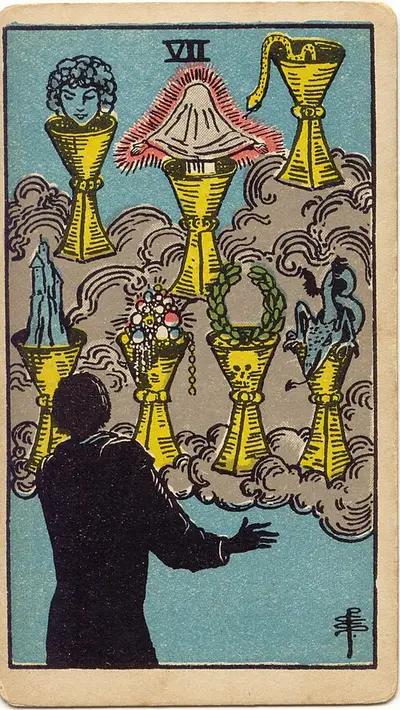
The card
The Seven of Cups is the seventh card of Cups, the suit of Water: emotion, love and intuition.
The Golden Dawn named it the Lord of Illusionary Success and gave it Venus in Scorpio, the decan of 20°–30° Scorpio, which the Sun passes through each year from about 12 to 22 November.
In Aleister Crowley's Thoth tarot: Seven of Cups, with the title and the zodiac decan from the Golden Dawn, as shown above.
In Waite's words
Arthur Edward Waite designed the deck that Pamela Colman Smith drew, and explained it in The Pictorial Key to the Tarot (1911). His text, with his spelling:
Strange chalices of vision, but the images are more especially those of the fantastic spirit. DIVINATORY MEANINGS Fairy favours, images of reflection, sentiment, imagination, things seen in the glass of contemplation; some attainment in these degrees, but nothing permanent or substantial is suggested. REVERSED Desire, will, determination, project.
FURTHER MEANINGS Fair child; idea, design, resolve, movement. REVERSED Success, if accompanied by the Three of Cups.
A. E. Waite, The Pictorial Key to the Tarot (London: William Rider & Son, 1911), Part III §§ 2 and 4. Public domain; text from the 1922 printing on Wikisource.
Related cards
The same card in the other suits
In three historical decks
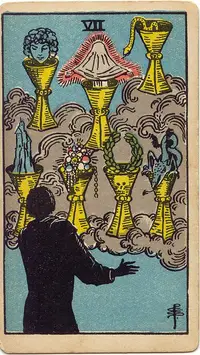
The same card as it was painted in fifteenth-century Milan, printed in the French pattern of the Tarot de Marseille, and drawn by Pamela Colman Smith for the Rider–Waite–Smith deck.
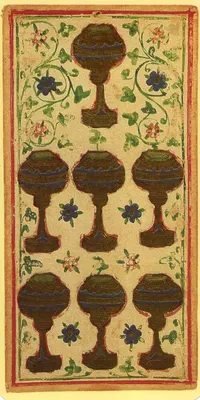
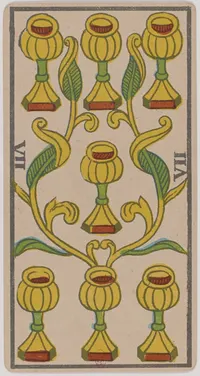
In the Tarot de Marseille: Seven of Coupes (cups). The numbered cards carry no scene, only the suit's symbols arranged as on a playing card, so they are read from the number and the pattern.
Learn more in the lessons
- The Tarot & the Stars — Decans, Pips & Courts · 16 min
- The Structure of the Tarot · 14 min · free
- Reading the Cards · 16 min
Images: Pamela Colman Smith, 1909 (public domain); the RWS1909 scans on Wikimedia Commons. Lequart, Paris, c. 1890 (public domain); scans from the Bibliothèque nationale de France (Gallica), via Wikimedia Commons. Attributed to Bonifacio Bembo, mid-15th century (public domain); scans by David Madore, via Wikimedia Commons.