MAJOR ARCANA · TRUMP III
The Empress
Tarot card meaning
UPRIGHT
Abundance, nurture, creativity, the fertile body and earth.
REVERSED
Creative block, smothering, neglect of self-care.
The card
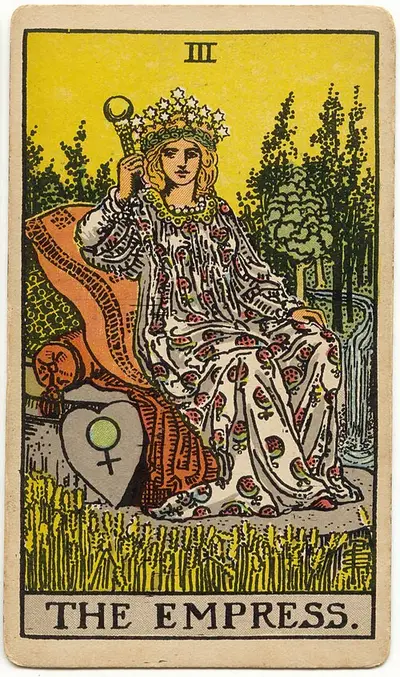
A crowned woman sits on cushions in a field of ripening wheat beside a flowing stream. Her shield bears the sign of Venus; her crown has twelve stars.
The Empress is trump III of the twenty-two trumps of the Major Arcana.
In the Golden Dawn's attributions it carries the Hebrew letter Daleth (ד), “door”, and the planet Venus. On the Tree of Life it is path 14, joining Chokmah and Binah.
In Aleister Crowley's Thoth tarot: The Empress, III.
In Waite's words
Arthur Edward Waite designed the deck that Pamela Colman Smith drew, and explained it in The Pictorial Key to the Tarot (1911). His text, with his spelling:
DIVINATORY MEANINGS Fruitfulness, action, initiative, length of days; the unknown, clandestine; also difficulty, doubt, ignorance.
REVERSED Light, truth, the unravelling of involved matters, public rejoicings; according to another reading, vacillation.
The picture and its symbolism
A stately figure, seated, having rich vestments and royal aspect, as of a daughter of heaven and earth. Her diadem is of twelve stars, gathered in a cluster. The symbol of Venus is on the shield which rests near her. A field of corn is ripening in front of her, and beyond there is a fall of water. The sceptre which she bears is surmounted by the globe of this world. She is the inferior Garden of Eden, the Earthly Paradise, all that is symbolized by the visible house of man. She is not Regina coeli, but she is still refugium peccatorum, the fruitful mother of thousands. There are also certain aspects in which she has been correctly described as desire and the wings thereof, as the woman clothed with the sun, as Gloria Mundi and the veil of the Sanctum Sanctorum; but she is not, I may add, the soul that has attained wings, unless all the symbolism is counted up another and unusual way. She is above all things universal
fecundity and the outer sense of the Word. This is obvious, because there is no direct message which has been given to man like that which is borne by woman; but she does not herself carry its interpretation.
In another order of ideas, the card of the Empress signifies the door or gate by which an entrance is obtained into this life, as into the Garden of Venus; and then the way which leads out therefrom, into that which is beyond, is the secret known to the High Priestess: it is communicated by her to the elect. Most old attributions of this card are completely wrong on the symbolism—as, for example, its identification with the Word, Divine Nature, the Triad, and so forth.
A. E. Waite, The Pictorial Key to the Tarot (London: William Rider & Son, 1911), Part II § 2 and Part III § 3. Public domain; text from the 1922 printing on Wikisource.
Related cards
The numbered cards it governs
Four of Wands: a decan ruled by Venus · Two of Cups: a decan ruled by Venus · Seven of Cups: a decan ruled by Venus · Five of Swords: a decan ruled by Venus · Nine of Pentacles: a decan ruled by Venus
In three historical decks
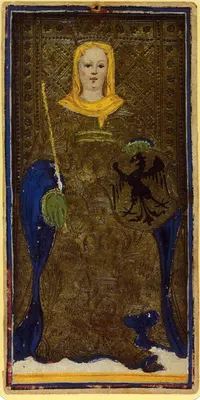
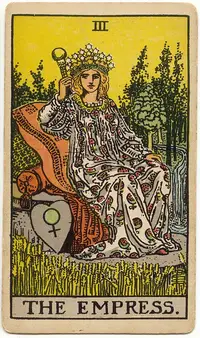
The same card as it was painted in fifteenth-century Milan, printed in the French pattern of the Tarot de Marseille, and drawn by Pamela Colman Smith for the Rider–Waite–Smith deck.
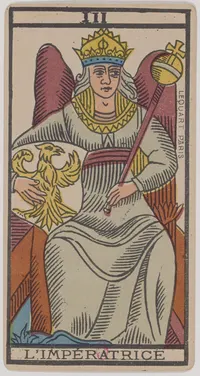
In the Tarot de Marseille: L'Impératrice, III.
Learn more in the lessons
- The Twenty-Two Paths & the Tarot · 18 min
- The Major Arcana Journey · 18 min
- The Structure of the Tarot · 14 min · free
Images: Pamela Colman Smith, 1909 (public domain); the RWS1909 scans on Wikimedia Commons. Lequart, Paris, c. 1890 (public domain); scans from the Bibliothèque nationale de France (Gallica), via Wikimedia Commons. Attributed to Bonifacio Bembo, mid-15th century (public domain); scans by David Madore, via Wikimedia Commons.