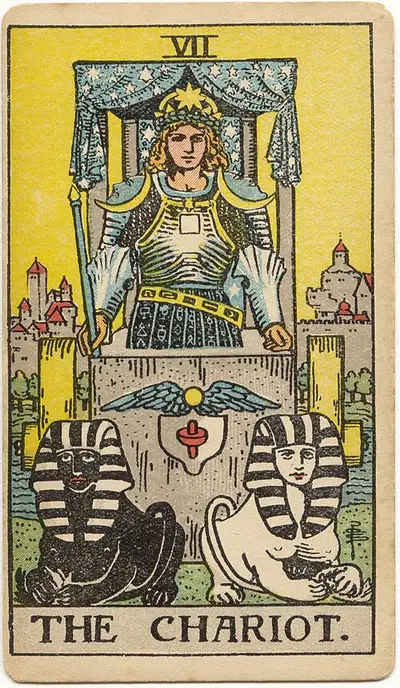
MAJOR ARCANA · TRUMP VII
The Chariot
Tarot card meaning
UPRIGHT
Determination, control, victory through focus.
REVERSED
Loss of direction, opposing forces, aggression.
The card
A crowned charioteer stands in a canopied chariot drawn by a black and a white sphinx, steering them by will alone — there are no reins.
The Chariot is trump VII of the twenty-two trumps of the Major Arcana.
In the Golden Dawn's attributions it carries the Hebrew letter Cheth (ח), “fence, enclosure”, and the sign of Cancer. On the Tree of Life it is path 18, joining Binah and Geburah.
In Aleister Crowley's Thoth tarot: The Chariot, VII.
In Waite's words
Arthur Edward Waite designed the deck that Pamela Colman Smith drew, and explained it in The Pictorial Key to the Tarot (1911). His text, with his spelling:
DIVINATORY MEANINGS Succour, providence; also war, triumph, presumption, vengeance, trouble.
REVERSED Riot, quarrel, dispute, litigation, defeat.
The picture and its symbolism
An erect and princely figure carrying a drawn sword and corresponding, broadly speaking, to the traditional description which I have given in the first part. On the shoulders of the victorious hero are supposed to be the Urim and Thummim. He has led captivity captive; he is conquest on all planes—in the mind, in science, in progress, in certain trials of initiation. He has thus replied to the sphinx, and it is on this account that I have accepted the variation of Éliphas Lévi; two sphinxes thus draw his chariot. He is above all things triumph in the mind.
It is to be understood for this reason (a) that the question of the sphinx is concerned with a Mystery of Nature and not of the world of Grace, to which the charioteer could offer no answer; (b) that the planes of his conquest are manifest or external and not within himself; (c) that the liberation which he effects may leave himself in
the bondage of the logical understanding; (d) that the tests of initiation through which he has passed in triumph are to be understood physically or rationally; and (e) that if he came to the pillars of that Temple between which the High Priestess is seated, he could not open the scroll called Tora, nor if she questioned him could he answer. He is not hereditary royalty and he is not priesthood.
A. E. Waite, The Pictorial Key to the Tarot (London: William Rider & Son, 1911), Part II § 2 and Part III § 3. Public domain; text from the 1922 printing on Wikisource.
Related cards
The numbered cards it governs
Two of Cups: a decan of Cancer · Three of Cups: a decan of Cancer · Four of Cups: a decan of Cancer
In three historical decks
The same card as it was painted in fifteenth-century Milan, printed in the French pattern of the Tarot de Marseille, and drawn by Pamela Colman Smith for the Rider–Waite–Smith deck.
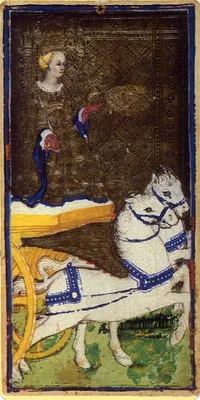
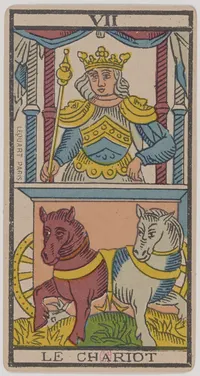
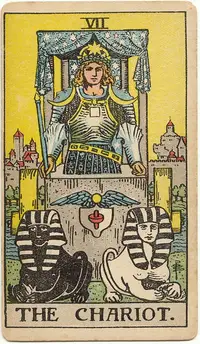
In the Tarot de Marseille: Le Chariot, VII.
Learn more in the lessons
- The Twenty-Two Paths & the Tarot · 18 min
- The Major Arcana Journey · 18 min
- The Structure of the Tarot · 14 min · free
Images: Pamela Colman Smith, 1909 (public domain); the RWS1909 scans on Wikimedia Commons. Lequart, Paris, c. 1890 (public domain); scans from the Bibliothèque nationale de France (Gallica), via Wikimedia Commons. Attributed to Bonifacio Bembo, mid-15th century (public domain); scans by David Madore, via Wikimedia Commons.