MAJOR ARCANA · TRUMP VIII
Strength
Tarot card meaning
UPRIGHT
Courage, gentle power, patience, compassion.
REVERSED
Self-doubt, raw emotion, insecurity.
The card
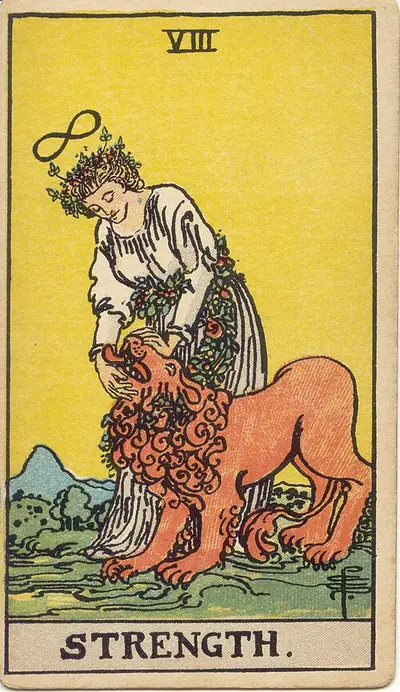
A woman crowned with flowers calmly closes a lion's jaws; the lemniscate floats above her head. Mastery through gentleness, not force.
Strength is trump VIII of the twenty-two trumps of the Major Arcana.
In the Golden Dawn's attributions it carries the Hebrew letter Teth (ט), “serpent”, and the sign of Leo. On the Tree of Life it is path 19, joining Chesed and Geburah.
In Aleister Crowley's Thoth tarot: Lust, XI. It has the same order as the Marseille.
In Waite's words
Arthur Edward Waite designed the deck that Pamela Colman Smith drew, and explained it in The Pictorial Key to the Tarot (1911). His text, with his spelling:
DIVINATORY MEANINGS Power, energy, action, courage, magnanimity; also complete success and honours.
REVERSED Despotism, abuse of power, weakness, discord, sometimes even disgrace.
The picture and its symbolism
A woman, over whose head there broods the same symbol of life which we have seen in the card of the Hierophant, is closing the jaws of a lion. The only point in which this design differs from the conventional presentations is that her beneficent fortitude has already subdued the lion, which is being led by a chain of flowers. For reasons which satisfy myself, this card has been interchanged with that of Justice, which is usually numbered eight. As the variation carries nothing with it which will signify to the reader, there is no cause for explanation. Fortitude, in one of its most exalted aspects, is connected with the Divine Mystery of Union; the virtue, of course, operates in all planes, and hence draws on all in its symbolism. It connects also with innocentia inviolata, and with the strength which resides in contemplation.
These higher meanings are, however, matters of inference, and I do not suggest that they are transparent on the surface of the
card. They are intimated in a concealed manner by the chain of flowers, which signifies, among many other things, the sweet yoke and the light burden of Divine Law, when it has been taken into the heart of hearts. The card has nothing to do with self-confidence in the ordinary sense, though this has been suggested—but it concerns the confidence of those whose strength is God, who have found their refuge in Him. There is one aspect in which the lion signifies the passions, and she who is called Strength is the higher nature in its liberation. It has walked upon the asp and the basilisk and has trodden down the lion and the dragon.
A. E. Waite, The Pictorial Key to the Tarot (London: William Rider & Son, 1911), Part II § 2 and Part III § 3. Public domain; text from the 1922 printing on Wikisource.
Related cards
The numbered cards it governs
Five of Wands: a decan of Leo · Six of Wands: a decan of Leo · Seven of Wands: a decan of Leo
In three historical decks
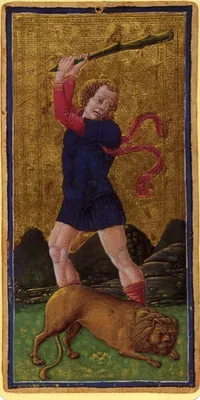
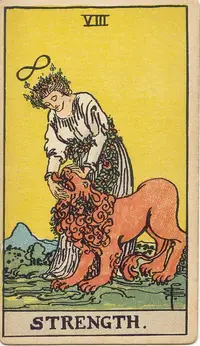
The same card as it was painted in fifteenth-century Milan, printed in the French pattern of the Tarot de Marseille, and drawn by Pamela Colman Smith for the Rider–Waite–Smith deck.
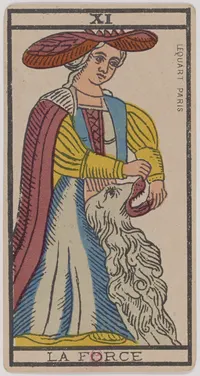
In the Tarot de Marseille: La Force, XI. The number differs from this deck's VIII: the older order, and Crowley's, put Justice at VIII and Strength at XI.
Learn more in the lessons
- The Twenty-Two Paths & the Tarot · 18 min
- The Major Arcana Journey · 18 min
- The Tarot & the Stars — Decans, Pips & Courts · 16 min
- The Thoth Tarot · 12 min
Images: Pamela Colman Smith, 1909 (public domain); the RWS1909 scans on Wikimedia Commons. Lequart, Paris, c. 1890 (public domain); scans from the Bibliothèque nationale de France (Gallica), via Wikimedia Commons. Attributed to Bonifacio Bembo, mid-15th century (public domain); scans by David Madore, via Wikimedia Commons.