MAJOR ARCANA · TRUMP XV
The Devil
Tarot card meaning
UPRIGHT
Attachment, temptation, material bondage, shadow.
REVERSED
Release, breaking free, reclaiming power.
The card
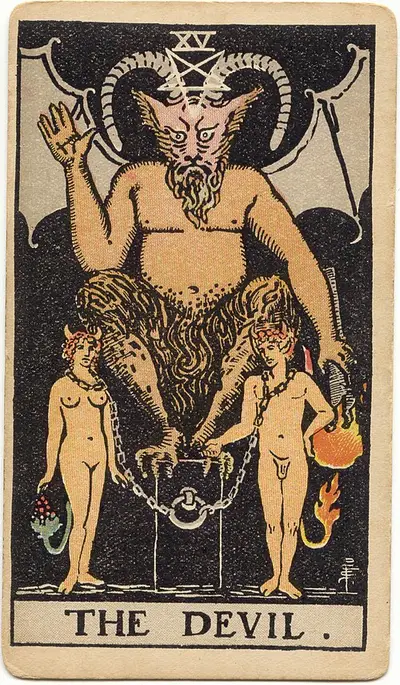
A horned figure crouches on a pedestal above a naked man and woman chained by the neck — but the chains are loose enough to lift off.
The Devil is trump XV of the twenty-two trumps of the Major Arcana.
In the Golden Dawn's attributions it carries the Hebrew letter Ayin (ע), “eye”, and the sign of Capricorn. On the Tree of Life it is path 26, joining Tiphareth and Hod.
In Aleister Crowley's Thoth tarot: The Devil, XV.
In Waite's words
Arthur Edward Waite designed the deck that Pamela Colman Smith drew, and explained it in The Pictorial Key to the Tarot (1911). His text, with his spelling:
DIVINATORY MEANINGS Ravage, violence, vehemence, extraordinary efforts, force, fatality; that which is predestined but is not for this reason evil.
REVERSED Evil fatality, weakness, pettiness, blindness.
The picture and its symbolism
The design is an accommodation, mean or harmony, between several motives mentioned in the first part. The Horned Goat of Mendes, with wings like those of a bat, is standing on an altar. At the pit of the stomach there is the sign of Mercury. The right hand is upraised and extended, being the reverse of that benediction which is given by the Hierophant in the fifth card. In the left hand there is a great flaming torch, inverted towards the earth. A reversed pentagram is on the forehead. There is a ring in front of the altar, from which two chains are carried to the necks of two figures, male and female. These are analogous with those of the fifth card, as if Adam and Eve after the Fall. Hereof is the chain and fatality of the material life.
The figures are tailed, to signify the animal nature, but there is human intelligence in the faces, and he who is exalted above them is not
to be their master for ever. Even now, he is also a bondsman, sustained by the evil that is in him and blind to the liberty of service. With more than his usual derision for the arts which he pretended to respect and interpret as a master therein, Éliphas Lévi affirms that the Baphometic figure is occult science and magic. Another commentator says that in the Divine world it signifies predestination, but there is no correspondence in that world with the things which below are of the brute. What it does signify is the Dweller on the Threshold without the Mystical Garden when those are driven forth therefrom who have eaten the forbidden fruit.
A. E. Waite, The Pictorial Key to the Tarot (London: William Rider & Son, 1911), Part II § 2 and Part III § 3. Public domain; text from the 1922 printing on Wikisource.
Related cards
The numbered cards it governs
Two of Pentacles: a decan of Capricorn · Three of Pentacles: a decan of Capricorn · Four of Pentacles: a decan of Capricorn
In three historical decks
The same card as it was painted in fifteenth-century Milan, printed in the French pattern of the Tarot de Marseille, and drawn by Pamela Colman Smith for the Rider–Waite–Smith deck.
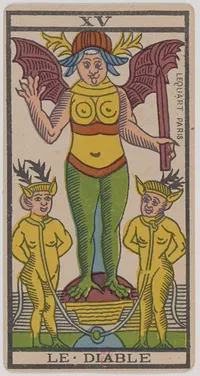
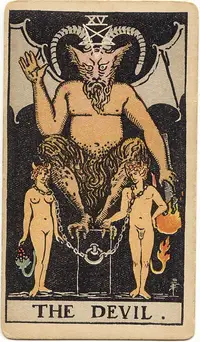
In the Tarot de Marseille: Le Diable, XV.
Learn more in the lessons
- The Twenty-Two Paths & the Tarot · 18 min
- The Major Arcana Journey · 18 min
- The Structure of the Tarot · 14 min · free
Images: Pamela Colman Smith, 1909 (public domain); the RWS1909 scans on Wikimedia Commons. Lequart, Paris, c. 1890 (public domain); scans from the Bibliothèque nationale de France (Gallica), via Wikimedia Commons. Attributed to Bonifacio Bembo, mid-15th century (public domain); scans by David Madore, via Wikimedia Commons.