MAJOR ARCANA · TRUMP XVIII
The Moon
Tarot card meaning
UPRIGHT
Illusion, dreams, the unconscious, uncertainty.
REVERSED
Confusion lifting, repressed fears surfacing.
The card
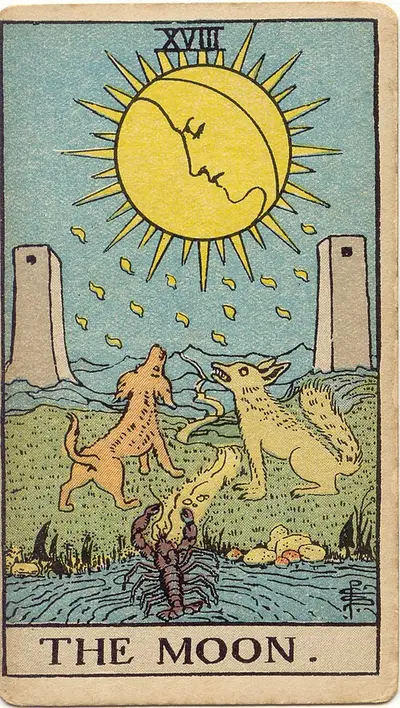
A moon with a face shines between two towers. A dog and a wolf howl at it, and a crayfish crawls from a pool onto a winding path.
The Moon is trump XVIII of the twenty-two trumps of the Major Arcana.
In the Golden Dawn's attributions it carries the Hebrew letter Qoph (ק), “back of the head”, and the sign of Pisces. On the Tree of Life it is path 29, joining Netzach and Malkuth.
In Aleister Crowley's Thoth tarot: The Moon, XVIII.
In Waite's words
Arthur Edward Waite designed the deck that Pamela Colman Smith drew, and explained it in The Pictorial Key to the Tarot (1911). His text, with his spelling:
DIVINATORY MEANINGS Hidden enemies, danger, calumny, darkness, terror, deception, occult forces, error.
REVERSED Instability, inconstancy, silence, lesser degrees of deception and error.
The picture and its symbolism
The distinction between this card and some of the conventional types is that the moon is increasing on what is called the side of mercy, to the right of the observer. It has sixteen chief and sixteen secondary rays. The card represents life of the imagination apart from life of the spirit. The path between the towers is the issue into the unknown. The dog and wolf are the fears of the natural mind in the presence of that place of exit, when there is only reflected light to guide it.
The last reference is a key to another form of symbolism. The intellectual light is a reflection and beyond it is the unknown mystery which it cannot shew forth. It illuminates our animal nature, types of which are represented below—the dog, the wolf and that which comes up out of the deeps, the nameless and hideous tendency which is lower than the savage beast. It strives to
attain manifestation, symbolized by crawling from the abyss of water to the land, but as a rule it sinks back whence it came. The face of the mind directs a calm gaze upon the unrest below; the dew of thought falls; the message is: Peace, be still; and it may be that there shall come a calm upon the animal nature, while the abyss beneath shall cease from giving up a form.
A. E. Waite, The Pictorial Key to the Tarot (London: William Rider & Son, 1911), Part II § 2 and Part III § 3. Public domain; text from the 1922 printing on Wikisource.
Related cards
The numbered cards it governs
Eight of Cups: a decan of Pisces · Nine of Cups: a decan of Pisces · Ten of Cups: a decan of Pisces
In three historical decks
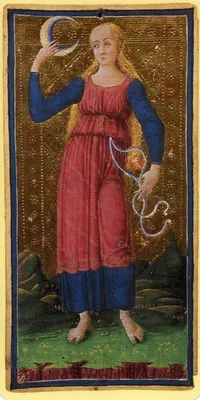
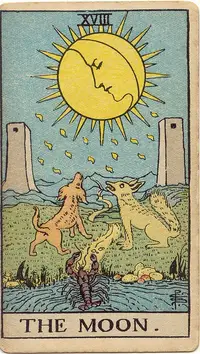
The same card as it was painted in fifteenth-century Milan, printed in the French pattern of the Tarot de Marseille, and drawn by Pamela Colman Smith for the Rider–Waite–Smith deck.
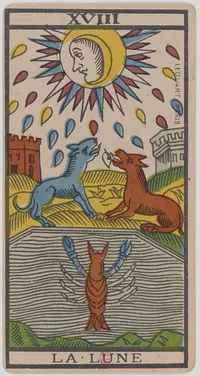
In the Tarot de Marseille: La Lune, XVIII.
Learn more in the lessons
- The Twenty-Two Paths & the Tarot · 18 min
- The Major Arcana Journey · 18 min
- Liber E and the Magical Record · 15 min
Images: Pamela Colman Smith, 1909 (public domain); the RWS1909 scans on Wikimedia Commons. Lequart, Paris, c. 1890 (public domain); scans from the Bibliothèque nationale de France (Gallica), via Wikimedia Commons. Attributed to Bonifacio Bembo, mid-15th century (public domain); scans by David Madore, via Wikimedia Commons.