MAJOR ARCANA · TRUMP X
Wheel of Fortune
Tarot card meaning
UPRIGHT
Cycles, fate, turning points, luck changing.
REVERSED
Resistance to change, bad luck, breaking cycles.
The card
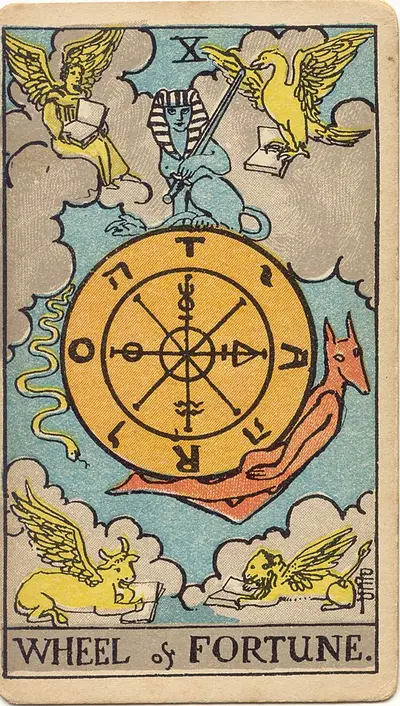
A great wheel marked with letters and alchemical symbols turns in the sky; a sphinx sits on top, a serpent descends, and the four winged creatures read books in the corners.
Wheel of Fortune is trump X of the twenty-two trumps of the Major Arcana.
In the Golden Dawn's attributions it carries the Hebrew letter Kaph (כ), “palm of the hand”, and the planet Jupiter. On the Tree of Life it is path 21, joining Chesed and Netzach.
In Aleister Crowley's Thoth tarot: Fortune, X.
In Waite's words
Arthur Edward Waite designed the deck that Pamela Colman Smith drew, and explained it in The Pictorial Key to the Tarot (1911). His text, with his spelling:
DIVINATORY MEANINGS Destiny, for tune, success, elevation, luck, felicity.
REVERSED Increase, abundance, superfluity.
The picture and its symbolism
In this symbol I have again followed the reconstruction of Éliphas Lévi, who has furnished several variants. It is legitimate—as I have intimated—to use Egyptian symbolism when this serves our purpose, provided that no theory of origin is implied therein. I have, however, presented Typhon in his serpent form. The symbolism is, of course, not exclusively Egyptian, as the four Living Creatures of Ezekiel occupy the angles of the card, and the wheel itself follows other indications of Lévi in respect of Ezekiel's vision, as illustrative of the particular Tarot Key. With the French occultist, and in the design itself, the symbolic picture stands for the perpetual motion of a fluidic universe and for the flux of human life. The Sphinx is the equilibrium therein. The transliteration of Taro as Rota is inscribed on the wheel, counterchanged with the letters of the Divine Name—to shew that Providence is implied through all. But this is the Divine intention
within, and the similar intention without is exemplified by the four Living Creatures. Sometimes the sphinx is represented couchant on a pedestal above, which defrauds the symbolism by stultifying the essential idea of stability amidst movement.
Behind the general notion expressed in the symbol there lies the denial of chance and the fatality which is implied therein. It may be added that, from the days of Lévi onward, the occult explanations of this card are—even for occultism itself—of a singularly fatuous kind. It has been said to mean principle, fecundity, virile honour, ruling authority, etc. The findings of common fortune-telling are better than this on their own plane.
A. E. Waite, The Pictorial Key to the Tarot (London: William Rider & Son, 1911), Part II § 2 and Part III § 3. Public domain; text from the 1922 printing on Wikisource.
Related cards
The numbered cards it governs
Six of Wands: a decan ruled by Jupiter · Nine of Cups: a decan ruled by Jupiter · Four of Swords: a decan ruled by Jupiter · Eight of Swords: a decan ruled by Jupiter · Two of Pentacles: a decan ruled by Jupiter
In three historical decks
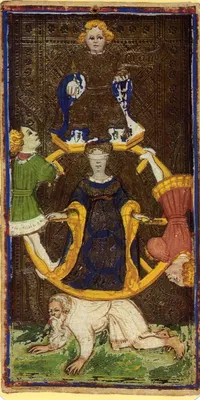
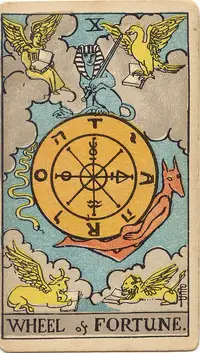
The same card as it was painted in fifteenth-century Milan, printed in the French pattern of the Tarot de Marseille, and drawn by Pamela Colman Smith for the Rider–Waite–Smith deck.
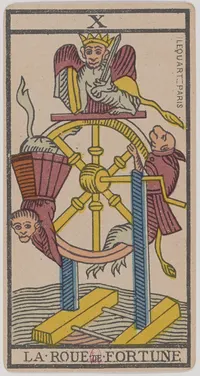
In the Tarot de Marseille: La Roue de Fortune, X.
Learn more in the lessons
- The Twenty-Two Paths & the Tarot · 18 min
- The Major Arcana Journey · 18 min
- The Thoth Tarot · 12 min
Images: Pamela Colman Smith, 1909 (public domain); the RWS1909 scans on Wikimedia Commons. Lequart, Paris, c. 1890 (public domain); scans from the Bibliothèque nationale de France (Gallica), via Wikimedia Commons. Attributed to Bonifacio Bembo, mid-15th century (public domain); scans by David Madore, via Wikimedia Commons.