IN THIS LESSON
Deep Study · Lesson 6 of 6
The Witch Trials in Their Own Words — King James and the Witchfinder
Newes from Scotland, Daemonologie and The Discovery of Witches read side by side: what the hunters believed, how they built their proofs, and what their own words reveal about the people they accused.
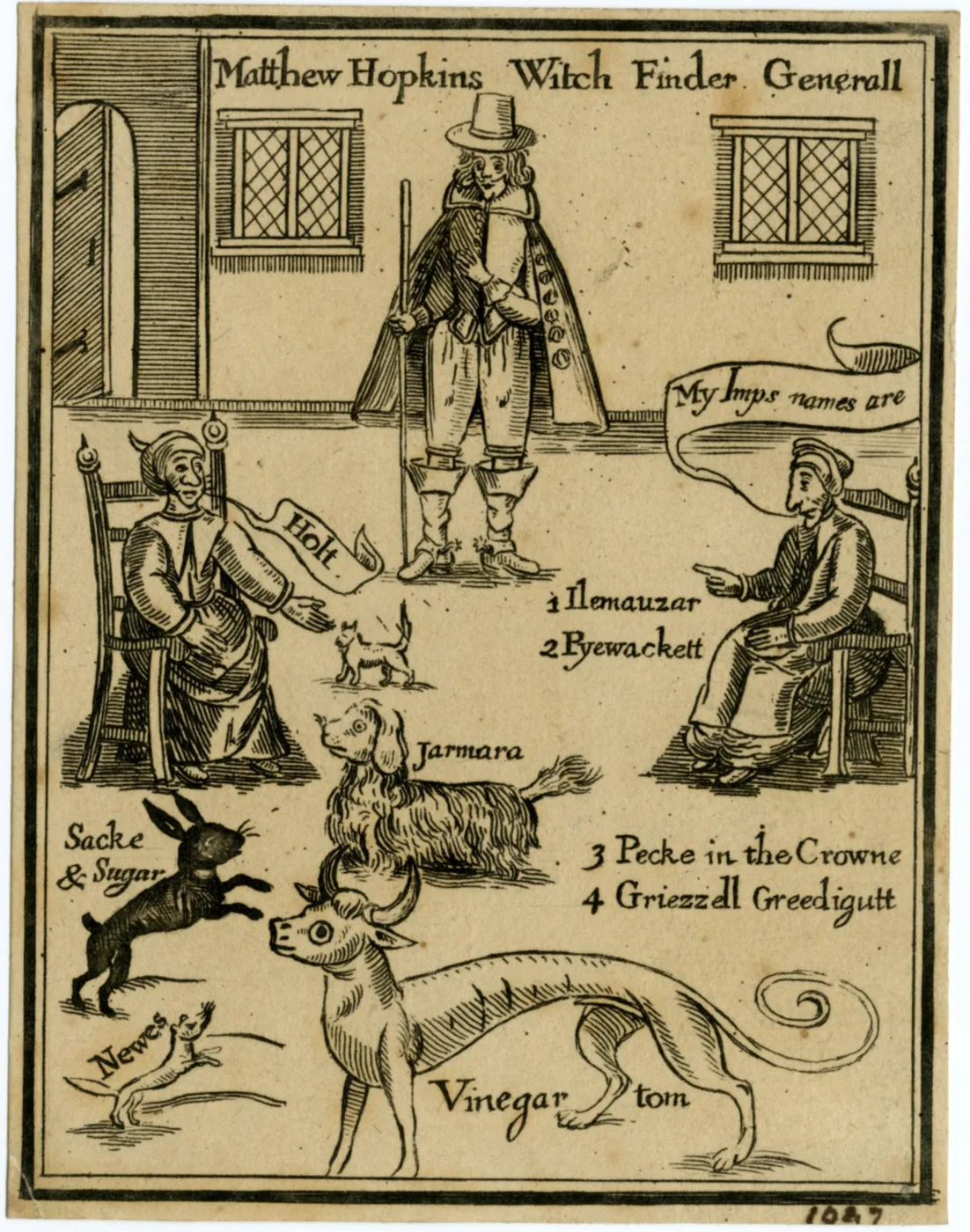
The European witch trials killed, by the most careful modern estimates, between forty and sixty thousand people, most of them women, between the mid-fifteenth and the mid-eighteenth centuries. We usually meet them through the histories written since. This study reads three texts written by the hunters themselves, beside their full text in the Reading Room: the pamphlet Newes from Scotland (1591), King James's Daemonologie (1597), and Matthew Hopkins's The Discovery of Witches (1647).
They are hard reading, and they should be. Read them as a historian does: asking at every line who is speaking, what they wanted, and what the accused might have said if anyone had written it down.
Scotland, 1590: the storm against the King
In 1589 James VI of Scotland married Anne of Denmark. Storms delayed her voyage to Scotland, and when James sailed to fetch her himself, his own ship met contrary winds on the return in 1590. In Denmark, witches were blamed. In Scotland, the following winter, a chain of accusations began that became the North Berwick trials, the first great Scottish witch-hunt, in which dozens of people were accused of raising storms to drown the King.
Newes from Scotland, printed in London in 1591, tells the story for English readers. It begins not with a witch but with a healer:
"Within the towne of Trenent in the Kingdome of Scotland, there dwelleth one Dauid Seaton, who being deputie Bailiffe in the saide Towne, had a maide seruant called Geillis Duncane, who vsed secretly to be absent and to lye foorth of her Maisters house euery other night: this Geillis Duncane took in hand to help all such as were troubled or greeued with any kinde of sicknes or infirmitie…" (Newes from Scotland)
Her cures were her crime. Her master, suspicious, had her tortured "with the torture of the Pilliwinckes vpon her fingers", a vice for crushing the fingers, and searched for the Devil's mark. She named others, and they named others in turn. One of them, Agnes Sampson (the pamphlet's "Agnis Tompson"), an older woman known as a healer and midwife, was examined before the King himself, and the pamphlet records her confession:
"she confessed that vpon the night of Allhollon Euen last, she was accompanied aswell with the persons aforesaide, as also with a great many other witches, to the number of two hundreth: and that all they together went by Sea each one in a Riddle or Ciue…" (Newes from Scotland)
Sailing in sieves to North Berwick kirk on Hallowe'en, where the Devil preached to them from the pulpit: it is one of the most famous images in the history of witchcraft. Read it again knowing how it was obtained. Agnes Sampson was tortured, and she was executed in 1591.
Lesson 6 of 6 · 30 min
READ THE SOURCE
- Malleus Maleficarum · Heinrich Kramer (Institoris) and Jacob Sprenger, c. 1486–87; English 1928 · free in the Reading Room
- The Discoverie of Witchcraft · Reginald Scot, 1584 · free in the Reading Room
- Daemonologie · King James VI of Scotland, 1597 · free in the Reading Room
- The Wonderfull Discoverie of Witches in the Countie of Lancaster · Thomas Potts, 1613 · free in the Reading Room
- The Discovery of Witches · Matthew Hopkins, 1647 · free in the Reading Room
- The Book of Witches · Oliver Madox Hueffer, 1908; this edition 1909 · free in the Reading Room
- Letters on Demonology and Witchcraft · Sir Walter Scott, 1830; this edition 1884 · free in the Reading Room
- Satan’s Invisible World Discovered · George Sinclair, 1685 · free in the Reading Room