Finnish and Slavic Magic · Lesson 7 of 7
Baba Yaga and the Old Ways Today
The great witches of the north-east, and what became of the old ways. Baba Yaga in her hut on chicken legs, from Lomonosov's grammar of 1755 to Afanasyev's tales, Vasilisa and the burning skull, and Propp's reading of her as the guardian of the threshold; Louhi, the Mistress of Pohjola; the Kalevala and the Slavic tales in painting, music and Tolkien; the Mari, who still pray in their sacred groves; and the modern native faiths, with a word of caution.
The last lesson follows two great witches of folk tale and epic, and then the long afterlife of the old ways: in art, in national movements, among the living peoples who never gave them up, and in the new religions that have tried to bring them back.
Baba Yaga
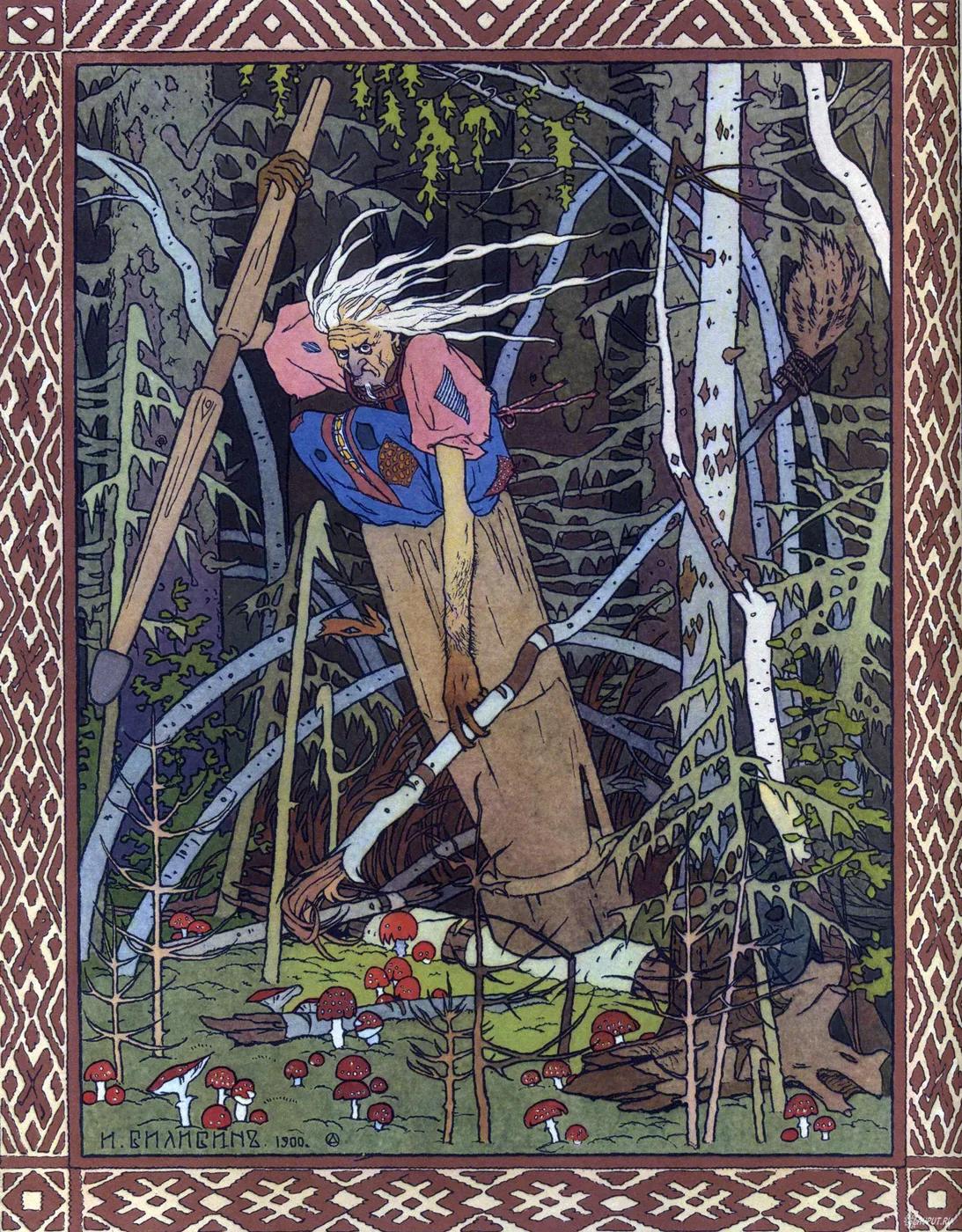
Baba Yaga is the witch of the East Slavic wonder tale: a bony old woman who lives in the deep forest in a hut on chicken legs that turns to face whoever says the right words, inside a fence of bones topped with skulls. She flies in a mortar, rows it with a pestle and sweeps away her tracks with a broom. She smells the "Russian smell" of the living and threatens to cook and eat the children who come to her. Baba means grandmother or old woman; where Yaga comes from, no one knows. The first clear mention of her in writing is in Mikhail Lomonosov's Russian Grammar of 1755, among the beings of Slavic myth. She lives above all in the tales gathered by Aleksandr Afanasyev (1855–1863).
In "Vasilisa the Beautiful", Vasilisa's dying mother gives her a tiny doll, which helps her whenever she feeds it. Her cruel stepmother and stepsisters send her into the forest to fetch fire from Baba Yaga, hoping she will be eaten. On the way she sees three horsemen ride past: one white, one red and one black. They are, Baba Yaga tells her later, her bright day, her red sun and her dark night. With the doll's help Vasilisa does every impossible task the witch sets her. Baba Yaga sends her home with a skull on a stick, its eyes burning, to give the house fire. Its eyes stare at the stepmother and stepsisters until they are burned to ashes.
Baba Yaga can devour or help, test or reward. She is sometimes the villain, sometimes the donor who gives the hero what he needs, a role Vladimir Propp traced through every wonder tale in his Morphology of the Folktale (1928). In Historical Roots of the Wonder Tale (1946), Propp argued that her hut stands at the boundary of the world of the dead, and that her trials preserve the memory of ancient rites of initiation, in which the young were taken into the forest, threatened with being eaten, and came back changed. Andreas Johns, in Baba Yaga: The Ambiguous Mother and Witch (2004), shows how many readings she has borne, and how none of them contains her.
Lesson 7 of 7 · 16 min