IN THIS LESSON
Jewish Magic · Lesson 5 of 7
The Kamea: Jewish Amulets
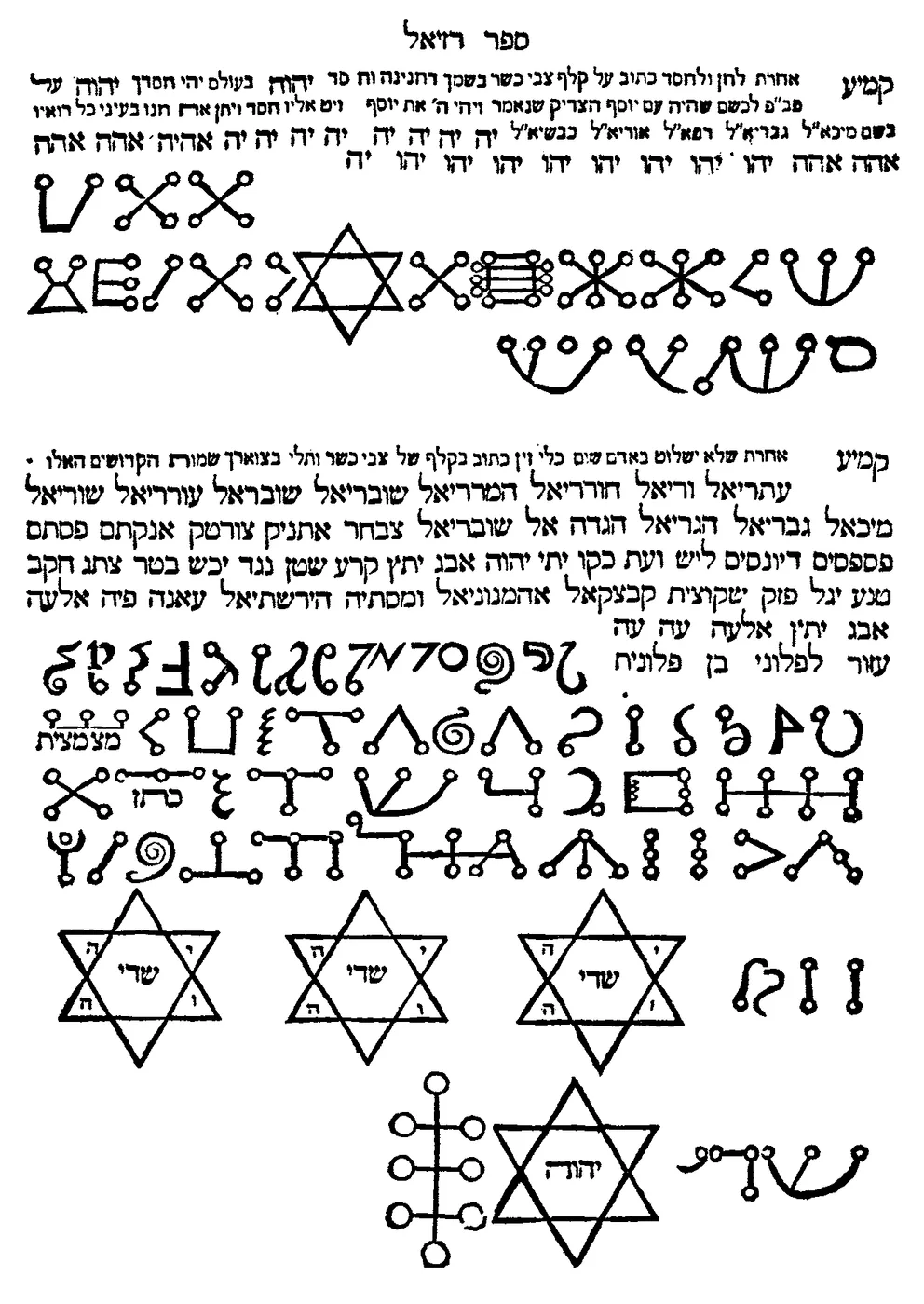
How a Jewish amulet was made and what it says. Parchment, paper and silver; names, angels and verses chosen for what they mean; the 'ring letters'; the person named by their mother; the mezuzah, the Shaddai on its case and the cipher on its back; Sefer Raziel, the book that guarded houses from fire; childbirth sheets, the Shiviti and the hamsa; and the great amulet controversy of 1751.
The most common work of Jewish magic, from the Ketef Hinnom scrolls to the present day, is the amulet, kamea (also spelled qamea). This lesson looks at how amulets were made and what was written on them. The Amulet Writer lets you put one together yourself. (Western magicians later used the same word for the planetary magic squares, which Jewish amulets also sometimes carried (Magic Squares of the Planets).)
Materials
The Talmud speaks of two kinds of amulet: "an amulet of writing and an amulet of roots" (Shabbat 61b). Amulets of roots were herbs, stones and other natural things, worn or carried. Written amulets were made on whatever would take ink or a point:
- Thin sheets of metal in late antiquity: silver, gold, bronze and lead, inscribed with a stylus and rolled into tubes to wear round the neck, like those Joseph Naveh and Shaul Shaked published from Palestine and Syria.
- Parchment (klaf), made from the skin of a kosher animal, as for a Torah scroll, folded small and sewn into cloth or leather, or slipped into a silver case.
- Paper, in the Genizah amulets and in the printed sheets of later centuries.
- Engraved silver plaques, the typical amulets of the Jews of Persia, Kurdistan, Yemen and North Africa, often in the shape of a hand.
Lesson 5 of 7 · 17 min