Tantra and Tibet · Lesson 3 of 7
Mantra, Yantra and Mandala
The sound and the diagram. Mantra as the deity in the form of sound: seed syllables, the alphabet as the body of the Goddess, nyāsa and japa on the beads; Om maṇi padme hūṃ and where it comes from; the yantra as the deity's form, and the Śrī Yantra with its nine enclosures and forty-three triangles; the Buddhist mandala as a palace, with its rings, gates and five Buddha families; and the sand mandala, made over weeks and swept away.
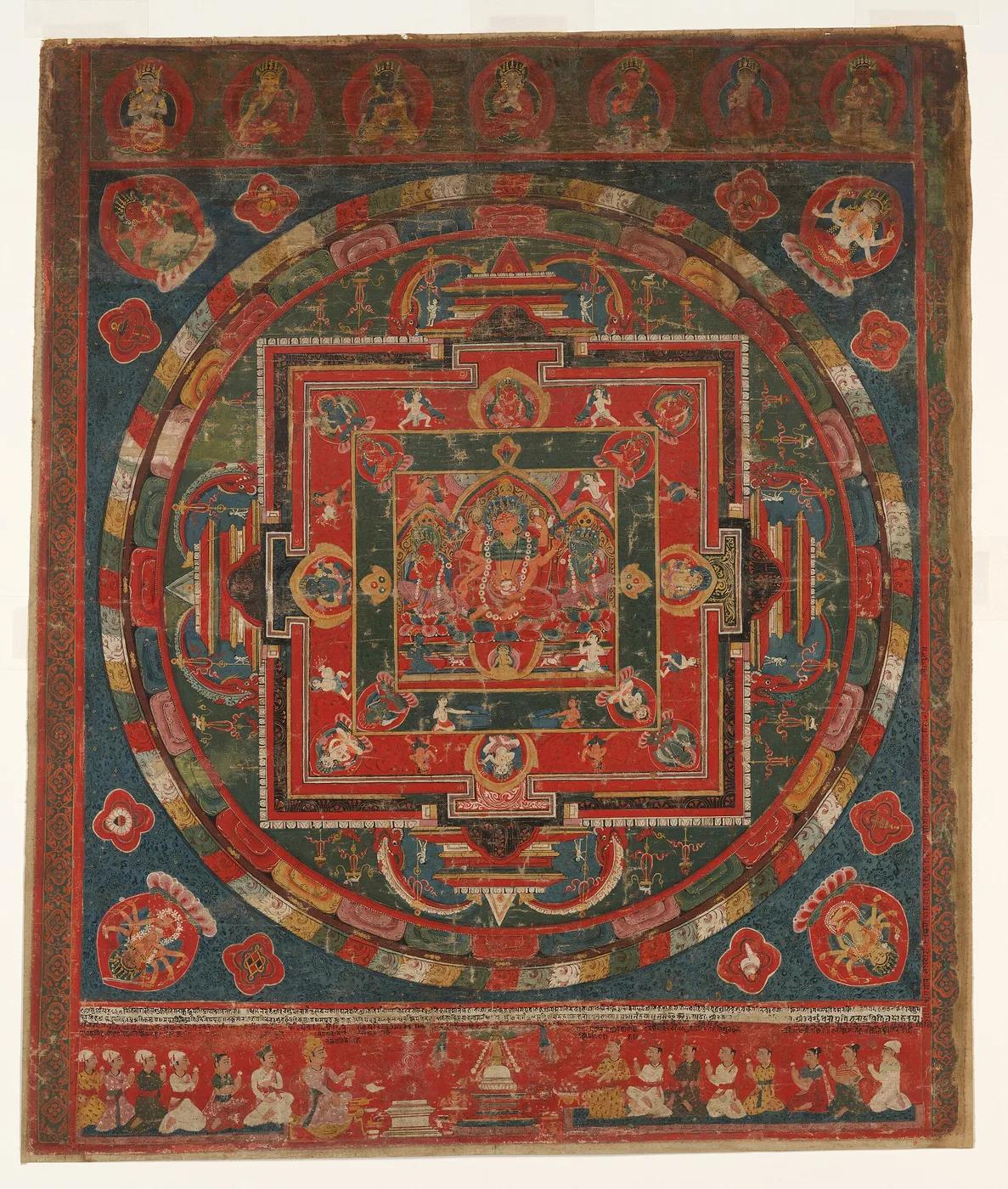
At the heart of tantric ritual are two things that can be carried anywhere: a sound and a shape. The mantra is the deity in the form of sound; the yantra and the mandala are the deity, and their world, in the form of a diagram. You can build and explore both kinds of diagram in the Mandala and the Yantra.
Mantra
A mantra is a formula of sacred sound, from a root meaning "to think", with a suffix meaning "instrument": an instrument of thought. The Vedas were already mantras, and the syllable Om opened and closed their recitation. The tantras took the idea further. For them a mantra is not a prayer to a deity but the deity itself, present as sound, and the most powerful mantras are single "seed" syllables, bīja, that mean nothing in ordinary language: hrīṃ, śrīṃ, krīṃ, aiṃ, hūṃ.
Tantric thinkers built a whole theology of sound. The fifty letters of the Sanskrit alphabet, the mātṛkā, "little mothers", were the body of the Goddess, and the universe was spoken into being through them. In the rite of nyāsa, "placing", the practitioner touches parts of their own body while reciting syllables, installing the deity in the body before worshipping it. And mantras are repeated, japa, often counted on a string of 108 beads (Prayer Beads).
Most tantric mantras are given by a guru in initiation, and the tradition holds that a mantra taken from a book has no power. They are not printed in this course.
Lesson 3 of 7 · 17 min