The English Physician Enlarged · D
Daisies to Dragons
Daisies
These are so well known almost to every child, that I suppose it needless to write any description of them. Take therefore the virtues of them as follows.
Government and virtues.] The herb is under the sign Cancer, and under the dominion of Venus, and therefore excellently good for wounds in the breast, and very fitting to be kept both in oils, ointments, and plaisters, as also in syrup. The greater wild Daisy is a wound herb of good respect, often used in those drinks or salves that are for wounds, either inward or outward. The juice or distilled water of these, or the small Daisy, doth much temper the heat of choler, and refresh the liver, and the other inward parts. A decoction made of them and drank, helps to cure the wounds made in the hollowness of the breast. The same also cures all ulcers and pustules in the mouth or tongue, or in the secret parts. The leaves bruised and applied to the privities, or to any other parts that are swoln and hot, doth dissolve it, and temper the heat. A decoction made thereof, of Wallwort and Agrimony, and the places fomented and bathed therewith warm, gives great ease to them that are troubled with the palsy, sciatica, or the gout. The same also disperses and dissolves the knots or kernels that grow in the flesh of any part of the body, and bruises and hurts that come of falls and blows; they are also used for ruptures, and other inward burnings, with very good success. An ointment made thereof doth wonderfully help all wounds that have inflammations about them, or by reason of moist humours having access unto them, are kept long from healing, and such are those, for the most part, that happen to joints of the arms or legs. The juice of them dropped into the running eyes of any, doth much help them.
Dandelion, Vulgarly Called Piss-a-beds
Descript.] It is well known to have many long and deep gashed leaves, lying on the ground round about the head of the roots; the ends of each gash or jag, on both sides looking downwards towards the roots; the middle rib being white, which being broken, yields abundance of bitter milk, but the root much more; from among the leaves, which always abide green, arise many slender, weak, naked foot-stalks, every one of them bearing at the top one large yellow flower, consisting of many rows of yellow leaves, broad at the points, and nicked in with deep spots of yellow in the middle, which growing ripe, the green husk wherein the flowers stood turns itself down to the stalk, and the head of down becomes as round as a ball: with long seed underneath, bearing a part of the down on the head of every one, which together is blown away with the wind, or may be at once blown away with one’s mouth. The root growing downwards exceedingly deep, which being broken off within the ground, will yet shoot forth again, and will hardly be destroyed where it hath once taken deep root in the ground.
Place.] It grows frequently in all meadows and pasture-grounds.
Time.] It flowers in one place or other almost all the year long.
Government and virtues.] It is under the dominion of Jupiter. It is of an opening and cleansing quality, and therefore very effectual for the obstructions of the liver, gall and spleen, and the diseases that arise from them, as the jaundice and hypocondriac; it opens the passages of the urine both in young and old; powerfully cleanses imposthumes and inward ulcers in the urinary passage, and by its drying and temperate quality doth afterwards heal them; for which purpose the decoction of the roots or leaves in white wine, or the leaves chopped as pot-herbs, with a few Alisanders, and boiled in their broth, are very effectual. And whoever is drawing towards a consumption or an evil disposition of the whole body, called Cachexia, by the use hereof for some time together, shall find a wonderful help. It helps also to procure rest and sleep to bodies distempered by the heat of ague fits, or otherwise: The distilled water is effectual to drink in pestilential fevers, and to wash the sores.
You see here what virtues this common herb hath, and that is the reason the French and Dutch so often eat them in the Spring; and now if you look a little farther, you may see plainly without a pair of spectacles, that foreign physicians are not so selfish as ours are, but more communicative of the virtues of plants to people.
Darnel
It is called Jam and Wray: in Sussex they call it Crop, it being a pestilent enemy among corn.
Descript.] This has all the winter long sundry long, flat, and rough leaves, which, when the stalk rises, which is slender and jointed, are narrower, but rough still; on the top grows a long spike, composed of many heads set one above another, containing two or three husks, with a sharp but short beard of awns at the end; the seed is easily shaken out of the ear, the husk itself being somewhat rough.
Place.] The country husbandmen do know this too well to grow among their corn, or in the borders and pathways of the other fields that are fallow.
Government and virtues.] It is a malicious part of sullen Saturn. As it is not without some vices, so hath it also many virtues. The meal of Darnel is very good to stay gangrenes, and other such like fretting and eating cankers, and putrid sores: It also cleanses the skin of all leprosies, morphews, ringworms, and the like, if it be used with salt and raddish roots. And being used with quick brimstone and vinegar, it dissolves knots and kernels, and breaks those that are hard to be dissolved, being boiled in wine with pigeon’s dung and Linseed: A decoction thereof made with water and honey, and the places bathed therewith, is profitable for the sciatica. Darnel meal applied in a poultice draws forth splinters and broken bones in the flesh: The red Darnel, boiled in red wine and taken, stays the lask and all other fluxes, and women’s bloody issues; and restrains urine that passes away too suddenly.
Dill
Descript.] The common Dill grows up with seldom more than one stalk, neither so high, nor so great usually as Fennel, being round and fewer joints thereon, whose leaves are sadder, and somewhat long, and so like Fennel that it deceives many, but harder in handling, and somewhat thicker, and of a strong unpleasant scent: The tops of the stalks have four branches and smaller umbels of yellow flowers, which turn into small seed, somewhat flatter and thinner than Fennel seed. The root is somewhat small and woody, perishes every year after it hath borne seed: and is also unprofitable, being never put to any use.
Place.] It is most usually sown in gardens and grounds for the purpose, and is also found wild in many places.
Government and virtues.] Mercury has the dominion of this plant, and therefore to be sure it strengthens the brain. The Dill being boiled and drank, is good to ease swellings and pains; it also stays the belly and stomach from casting. The decoction therefore helps women that are troubled with the pains and windiness of the mother, if they sit therein. It stays the hiccough, being boiled in wine, and but smelled unto being tied in a cloth. The seed is of more use than the leaves, and more effectual to digest raw and vicious humours, and is used in medicines that serve to expel wind, and the pains proceeding therefrom. The seed, being roasted or fried, and used in oils or plasters, dissolve the imposthumes in the fundament; and dries up all moist ulcers, especially in the fundament; an oil made of Dill is effectual to warm or dissolve humours and imposthumes, and the pains, and to procure rest. The decoction of Dill, be it herb or seed (only if you boil the seed you must bruise it) in white wine, being drank, it is a gallant expeller of wind, and provoker of the terms.
Devil’s-bit
Descript.] This rises up with a round green smooth stalk, about two feet high, set with divers long and somewhat narrow, smooth, dark green leaves, somewhat nipped about the edges, for the most part, being else all whole, and not divided at all, or but very seldom, even to the tops of the branches, which yet are smaller than those below, with one rib only in the middle. At the end of each branch stands a round head of many flowers set together in the same manner, or more neatly than Scabions, and of a bluish purple colour, which being past, there follows seed which falls away. The root is somewhat thick, but short and blackish, with many strings, abiding after seed time many years. This root was longer, until the devil (as the friars say) bit away the rest of it for spite, envying its usefulness to mankind; for sure he was not troubled with any disease for which it is proper.
There are two other sorts hereof, in nothing unlike the former, save that the one bears white, and the other bluish-coloured flowers.
Place.] The first grows as well in dry meadows and fields as moist, in many places of this land: But the other two are more rare, and hard to be met with, yet they are both found growing wild about Appledore, near Rye in Kent.
Time.] They flower not usually until August.
Government and virtues.] The plant is venereal, pleasing, and harmless. The herb or the root (all that the devil hath left of it) being boiled in wine, and drank, is very powerful against the plague, and all pestilential diseases or fevers, poisons also, and the bitings of venemous beasts: It helps also those that are inwardly bruised by any casuality, or outwardly by falls or blows, dissolving the clotted blood; and the herb or root beaten and outwardly applied, takes away the black and blue marks that remain in the skin. The decoction of the herb, with honey of roses put therein, is very effectual to help the inveterate tumours and swellings of the almonds and throat, by often gargling the mouth therewith. It helps also to procure women’s courses, and eases all pains of the mother and to break and discuss wind therein, and in the bowels. The powder of the root taken in drink, drives forth the worms in the body. The juice or distilled water of the herb, is effectual for green wounds, or old sores, and cleanses the body inwardly, and the seed outwardly, from sores, scurf, itch, pimples, freckles, morphew, or other deformities thereof, especially if a little vitriol be dissolved therein.
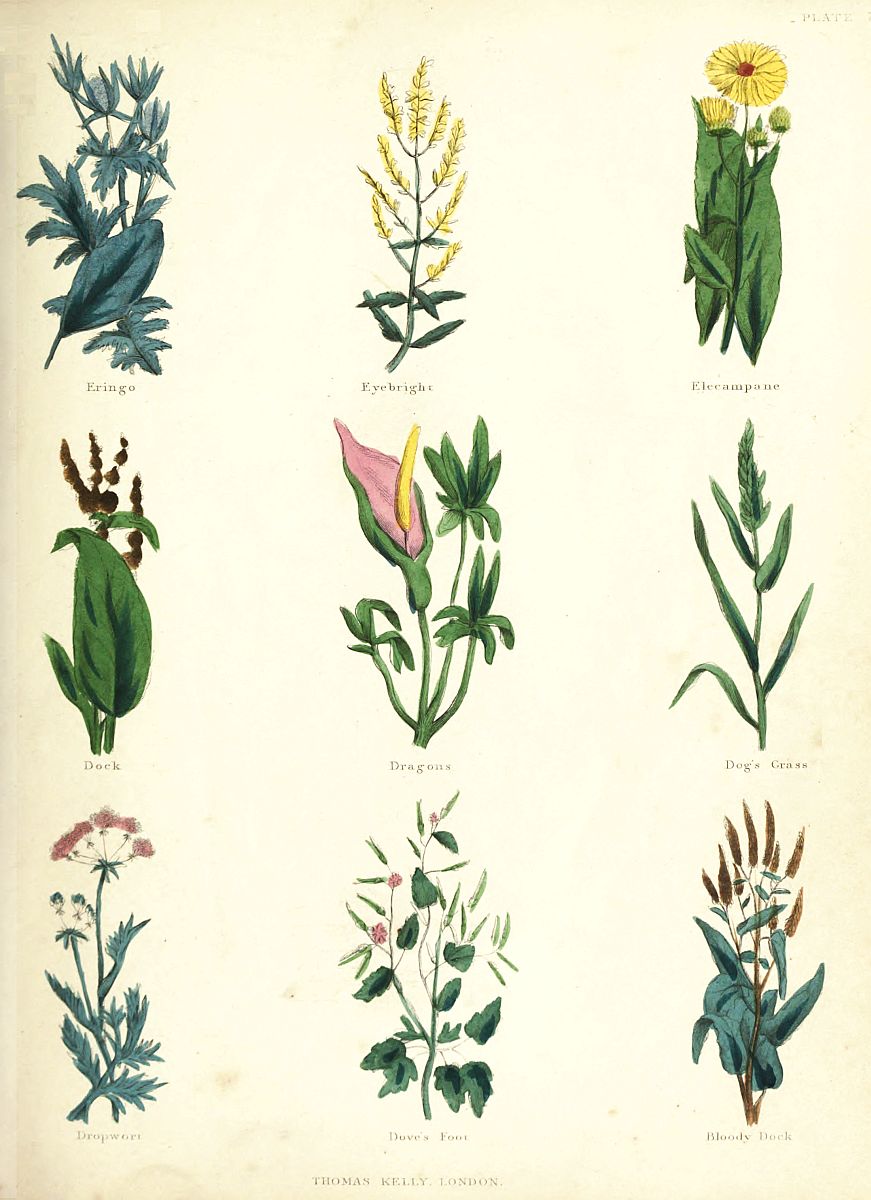
Eringo, Eyebright, Elecampane; Dock, Dragons, Dog’s Grass; Dropwort, Dove’s Foot, Bloody Dock
Dock
Many kinds of these are so well known, that I shall not trouble you with a description of them: My book grows big too fast.
Government and virtues.] All Docks are under Jupiter, of which the Red Dock, which is commonly called Bloodwort, cleanses the blood, and strengthens the liver; but the yellow Dock-root is best to be taken when either the blood or liver is affected by choler. All of them have a kind of cooling (but not all alike) drying quality, the sorrel being most cold, and the Blood-worts most drying. Of the Burdock, I have spoken already by itself. The seed of most of the other kinds, whether the gardens or fields, do stay lasks and fluxes of all sorts, the loathing of the stomach through choler, and is helpful for those that spit blood. The roots boiled in vinegar help the itch, scabs, and breaking out of the skin, if it be bathed therewith. The distilled water of the herb and roots have the same virtue, and cleanses the skin from freckles, morphews, and all other spots and discolourings therein.
All Docks being boiled with meat, make it boil the sooner: Besides Blood-wort is exceeding strengthening to the liver, and procures good blood, being as wholesome a pot herb as any growing in a garden; yet such is the nicety of our times, forsooth, that women will not put it into a pot, because it makes the pottage black; pride and ignorance (a couple of monsters in the creation) preferring nicety before health.
Dodder of Thyme, Epithymum, and Other Dodders
Descript.] This first from seed gives roots in the ground, which shoot forth threads or strings, grosser or finer as the property of the plant wherein it grows, and the climate doth suffer, creeping and spreading on that plant whereon it fastens, be it high or low. The strings have no leaves at all on them, but wind and interlace themselves, so thick upon a small plant, that it takes away all comfort of the sun from it; and is ready to choak or strangle it. After these strings are risen to that height, that they may draw nourishment from that plant, they seem to be broken off from the ground, either by the strength of their rising, or withered by the heat of the Sun. Upon these strings are found clusters of small heads or husks, out of which shoot forth whitish flowers, which afterwards give small pale white coloured seed, somewhat flat, and twice as big as Poppy-seed. It generally participates of the nature of the plant which it climbs upon; but the Dodder of Thyme is accounted the best, and is the only true Epithymum.
Government and virtues.] All Dodders are under Saturn. Tell not me of physicians crying up Epithymum, or that Dodder which grows upon Thyme, (most of which comes from Hemetius in Greece, or Hybla in Sicily, because those mountains abound with Thyme,) he is a physician indeed, that hath wit enough to choose the Dodder according to the nature of the disease and humour peccant. We confess, Thyme is the hottest herb it usually grows upon; and therefore that which grows upon Thyme is hotter than that which grows upon cold herbs; for it draws nourishment from what it grows upon, as well as from the earth where its root is, and thus you see old Saturn is wise enough to have two strings to his bow. This is accounted the most effectual for melancholy diseases, and to purge black or burnt choler, which is the cause of many diseases of the head and brain, as also for the trembling of the heart, faintings and swoonings. It is helpful in all diseases and griefs of the spleen, and melancholy that arises from the windiness of the hypochondria. It purges also the reins or kidneys by urine; it opens obstructions of the gall, whereby it profits them that have the jaundice; as also the leaves, the spleen: Purging the veins of the choleric and phlegmatic humours, and helps children in agues, a little worm seed being put thereto.
The other Dodders do, as I said before, participate of the nature of those plants whereon they grow: As that which hath been found growing upon nettles in the west-country, hath by experience been found very effectual to procure plenty of urine where it hath been stopped or hindered. And so of the rest.
Sympathy and antipathy are two hinges upon which the whole mode of physic turns; and that physician who minds them not, is like a door off from the hooks, more like to do a man mischief, than to secure him. Then all the diseases Saturn causes, this helps by sympathy, and strengthens all the parts of the body he rules; such as be caused by Sol, it helps by antipathy. What those diseases are, see my judgment of diseases by astrology; and if you be pleased to look at the herb Wormwood, you shall find a rational way for it.
Dog’s-grass, or Cough Grass
Descript.] It is well known, that the grass creeps far about under ground, with long white joined roots, and small fibres almost at every joint, very sweet in taste, as the rest of the herb is, and interlacing one another, from whence shoot forth many fair grassy leaves, small at the ends, and cutting or sharp on the edges. The stalks are jointed like corn, with the like leaves on them, and a large spiked head, with a long husk in them, and hard rough seed in them. If you know it not by this description, watch the dogs when they are sick, and they will quickly lead you to it.
Place.] It grows commonly through this land in divers ploughed grounds to the no small trouble of the husbandmen, as also of the gardeners, in gardens, to weed it out, if they can; for it is a constant customer to the place it get footing in.
Government and virtues.] ’Tis under the dominion of Jupiter, and is the most medicinal of all the Quick-grasses. Being boiled and drank, it opens obstructions of the liver and gall, and the stopping of urine, and eases the griping pains of the belly and inflammations; wastes the matter of the stone in the bladder, and the ulcers thereof also. The roots bruised and applied, do consolidate wounds. The seed doth more powerfully expel urine, and stays the lask and vomiting. The distilled water alone, or with a little wormseed, kills the worms in children.
The way of use is to bruise the roots, and having well boiled them in white wine, drink the decoction: ’Tis opening but not purging, very safe: ’Tis a remedy against all diseases coming of stopping, and such are half those that are incident to the body of man; and although a gardener be of another opinion, yet a physician holds half an acre of them to be worth five acres of Carrots twice told over.
Dove’s-foot, or Crane’s-bill
Descript.] This has divers small, round, pale-green leaves, cut in about the edges, much like mallow, standing upon long, reddish, hairy stalks lying in a round compass upon the ground; among which rise up two or three, or more, reddish, jointed, slender, weak, hairy stalks, with some like leaves thereon, but smaller, and more cut in up to the tops, where grow many very small bright red flowers of five leaves a-piece; after which follow small heads, with small short beaks pointed forth, as all other sorts of those herbs do.
Place.] It grows in pasture grounds, and by the path-sides in many places, and will also be in gardens.
Time.] It flowers in June, July, and August, some earlier and some later; and the seed is ripe quickly after.
Government and virtues.] It is a very gentle, though martial plant. It is found by experience to be singularly good for wind cholic, as also to expel the stone and gravel in the kidneys. The decoction thereof in wine, is an excellent good cure for those that have inward wounds, hurts, or bruises, both to stay the bleeding, to dissolve and expel the congealed blood, and to heal the parts, as also to cleanse and heal outward sores, ulcers, and fistulas; and for green wounds, many do only bruise the herb, and apply it to the places, and it heals them quickly. The same decoction in wine fomented to any place pained with the gout, or to joint-aches, or pains of the sinews, gives much ease. The powder or decoction of the herb taken for some time together, is found by experience to be singularly good for ruptures and burstings in people, either young or old.
Duck’s Meat
This is so well known to swim on the tops of standing waters, as ponds, pools, and ditches, that it is needless further to describe it.
Government and virtues.] Cancer claims the herb, and the Moon will be Lady of it; a word is enough to a wise man. It is effectual to help inflammations, and St. Anthony’s Fire, as also the gout, either applied by itself, or in a poultice with Barley meal. The distilled water by some is highly esteemed against all inward inflammations and pestilent fevers; as also to help the redness of the eyes, and swellings of privities, and of the breasts before they be grown too much. The fresh herb applied to the forehead, eases the pains of the head-ache coming of heat.
Down, or Cotton-thistle
Descript.] This has large leaves lying on the ground, somewhat cut in, and as it were crumpled on the edges, of a green colour on the upper side, but covered with long hairy wool, or Cotton Down, set with most sharp and cruel pricks, from the middle of whose head of flowers, thrust forth many purplish crimson threads, and sometimes (although very seldom) white ones. The seed that follows in the heads, lying in a great deal of white down, is somewhat large, long, and round, like the seed of ladies thistle, but paler. The root is great and thick, spreading much, yet it usually dies after seed-time.
Place.] It grows in divers ditches, banks, and in corn-fields, and highways, generally every where throughout the land.
Time.] It flowers and bears seed about the end of Summer, when other thistles do flower and seed.
Government and virtues.] Mars owns the plant, and manifest to the world, that though it may hurt your finger, it will help your body; for I fancy it much for the ensuing virtues. Pliny and Dioscorides write, That the leaves and roots thereof taken in drink, help those that have a crick in their neck; whereby they cannot turn their neck but their whole body must turn also (sure they do not mean those that have got a crick in their neck by being under the hangman’s hand.) Galen saith, that the root and leaves hereof are of a healing quality, and good for such persons as have their bodies drawn together by some spasm or convulsion, as it is with children that have the rickets.
Dragons
They are so well known to every one that plants them in their gardens, they need no description; if not, let them look down to the lower end of the stalks, and see how like a snake they look.
Government and virtues.] The plant is under the dominion of Mars, and therefore it would be a wonder if it should want some obnoxious quality or other: In all herbs of that quality, the safest way is either to distil the herb in an alembick, in what vehicle you please, or else to press out the juice, and distil that in a glass still, in sand. It scours and cleanses the internal parts of the body mightily, and it clears the external parts also, being externally applied, from freckles, morphew, and sun-burning: Your best way to use it externally, is to mix it with vinegar; an ointment of it is held to be good in wounds and ulcers; it consumes cankers, and that flesh growing in the nostrils, which they call Polypus: Also the distilled water being dropped into the eyes, takes away spots there, or the pin and web, and mends the dimness of sight; it is excellently good against pestilence and poison. Pliny and Dioscorides affirm, that no serpent will meddle with him that carries this herb about him.
The end of D: Daisies to Dragons.
Turn the page for Elder Tree to Eyebright.
Tap or click the right-hand side of the book to turn the page, the left to turn back; or use the arrow keys, or swipe. Press F for full screen.
The English Physician Enlarged · D
Daisies to Dragons
Daisies
These are so well known almost to every child, that I suppose it needless to write any description of them. Take therefore the virtues of them as follows.
Government and virtues.] The herb is under the sign Cancer, and under the dominion of Venus, and therefore excellently good for wounds in the breast, and very fitting to be kept both in oils, ointments, and plaisters, as also in syrup. The greater wild Daisy is a wound herb of good respect, often used in those drinks or salves that are for wounds, either inward or outward. The juice or distilled water of these, or the small Daisy, doth much temper the heat of choler, and refresh the liver, and the other inward parts. A decoction made of them and drank, helps to cure the wounds made in the hollowness of the breast. The same also cures all ulcers and pustules in the mouth or tongue, or in the secret parts. The leaves bruised and applied to the privities, or to any other parts that are swoln and hot, doth dissolve it, and temper the heat. A decoction made thereof, of Wallwort and Agrimony, and the places fomented and bathed therewith warm, gives great ease to them that are troubled with the palsy, sciatica, or the gout. The same also disperses and dissolves the knots or kernels that grow in the flesh of any part of the body, and bruises and hurts that come of falls and blows; they are also used for ruptures, and other inward burnings, with very good success. An ointment made thereof doth wonderfully help all wounds that have inflammations about them, or by reason of moist humours having access unto them, are kept long from healing, and such are those, for the most part, that happen to joints of the arms or legs. The juice of them dropped into the running eyes of any, doth much help them.
Dandelion, Vulgarly Called Piss-a-beds
Descript.] It is well known to have many long and deep gashed leaves, lying on the ground round about the head of the roots; the ends of each gash or jag, on both sides looking downwards towards the roots; the middle rib being white, which being broken, yields abundance of bitter milk, but the root much more; from among the leaves, which always abide green, arise many slender, weak, naked foot-stalks, every one of them bearing at the top one large yellow flower, consisting of many rows of yellow leaves, broad at the points, and nicked in with deep spots of yellow in the middle, which growing ripe, the green husk wherein the flowers stood turns itself down to the stalk, and the head of down becomes as round as a ball: with long seed underneath, bearing a part of the down on the head of every one, which together is blown away with the wind, or may be at once blown away with one’s mouth. The root growing downwards exceedingly deep, which being broken off within the ground, will yet shoot forth again, and will hardly be destroyed where it hath once taken deep root in the ground.
Place.] It grows frequently in all meadows and pasture-grounds.
Time.] It flowers in one place or other almost all the year long.
Government and virtues.] It is under the dominion of Jupiter. It is of an opening and cleansing quality, and therefore very effectual for the obstructions of the liver, gall and spleen, and the diseases that arise from them, as the jaundice and hypocondriac; it opens the passages of the urine both in young and old; powerfully cleanses imposthumes and inward ulcers in the urinary passage, and by its drying and temperate quality doth afterwards heal them; for which purpose the decoction of the roots or leaves in white wine, or the leaves chopped as pot-herbs, with a few Alisanders, and boiled in their broth, are very effectual. And whoever is drawing towards a consumption or an evil disposition of the whole body, called Cachexia, by the use hereof for some time together, shall find a wonderful help. It helps also to procure rest and sleep to bodies distempered by the heat of ague fits, or otherwise: The distilled water is effectual to drink in pestilential fevers, and to wash the sores.
You see here what virtues this common herb hath, and that is the reason the French and Dutch so often eat them in the Spring; and now if you look a little farther, you may see plainly without a pair of spectacles, that foreign physicians are not so selfish as ours are, but more communicative of the virtues of plants to people.
Darnel
It is called Jam and Wray: in Sussex they call it Crop, it being a pestilent enemy among corn.
Descript.] This has all the winter long sundry long, flat, and rough leaves, which, when the stalk rises, which is slender and jointed, are narrower, but rough still; on the top grows a long spike, composed of many heads set one above another, containing two or three husks, with a sharp but short beard of awns at the end; the seed is easily shaken out of the ear, the husk itself being somewhat rough.
Place.] The country husbandmen do know this too well to grow among their corn, or in the borders and pathways of the other fields that are fallow.
Government and virtues.] It is a malicious part of sullen Saturn. As it is not without some vices, so hath it also many virtues. The meal of Darnel is very good to stay gangrenes, and other such like fretting and eating cankers, and putrid sores: It also cleanses the skin of all leprosies, morphews, ringworms, and the like, if it be used with salt and raddish roots. And being used with quick brimstone and vinegar, it dissolves knots and kernels, and breaks those that are hard to be dissolved, being boiled in wine with pigeon’s dung and Linseed: A decoction thereof made with water and honey, and the places bathed therewith, is profitable for the sciatica. Darnel meal applied in a poultice draws forth splinters and broken bones in the flesh: The red Darnel, boiled in red wine and taken, stays the lask and all other fluxes, and women’s bloody issues; and restrains urine that passes away too suddenly.
Dill
Descript.] The common Dill grows up with seldom more than one stalk, neither so high, nor so great usually as Fennel, being round and fewer joints thereon, whose leaves are sadder, and somewhat long, and so like Fennel that it deceives many, but harder in handling, and somewhat thicker, and of a strong unpleasant scent: The tops of the stalks have four branches and smaller umbels of yellow flowers, which turn into small seed, somewhat flatter and thinner than Fennel seed. The root is somewhat small and woody, perishes every year after it hath borne seed: and is also unprofitable, being never put to any use.
Place.] It is most usually sown in gardens and grounds for the purpose, and is also found wild in many places.
Government and virtues.] Mercury has the dominion of this plant, and therefore to be sure it strengthens the brain. The Dill being boiled and drank, is good to ease swellings and pains; it also stays the belly and stomach from casting. The decoction therefore helps women that are troubled with the pains and windiness of the mother, if they sit therein. It stays the hiccough, being boiled in wine, and but smelled unto being tied in a cloth. The seed is of more use than the leaves, and more effectual to digest raw and vicious humours, and is used in medicines that serve to expel wind, and the pains proceeding therefrom. The seed, being roasted or fried, and used in oils or plasters, dissolve the imposthumes in the fundament; and dries up all moist ulcers, especially in the fundament; an oil made of Dill is effectual to warm or dissolve humours and imposthumes, and the pains, and to procure rest. The decoction of Dill, be it herb or seed (only if you boil the seed you must bruise it) in white wine, being drank, it is a gallant expeller of wind, and provoker of the terms.
Devil’s-bit
Descript.] This rises up with a round green smooth stalk, about two feet high, set with divers long and somewhat narrow, smooth, dark green leaves, somewhat nipped about the edges, for the most part, being else all whole, and not divided at all, or but very seldom, even to the tops of the branches, which yet are smaller than those below, with one rib only in the middle. At the end of each branch stands a round head of many flowers set together in the same manner, or more neatly than Scabions, and of a bluish purple colour, which being past, there follows seed which falls away. The root is somewhat thick, but short and blackish, with many strings, abiding after seed time many years. This root was longer, until the devil (as the friars say) bit away the rest of it for spite, envying its usefulness to mankind; for sure he was not troubled with any disease for which it is proper.
There are two other sorts hereof, in nothing unlike the former, save that the one bears white, and the other bluish-coloured flowers.
Place.] The first grows as well in dry meadows and fields as moist, in many places of this land: But the other two are more rare, and hard to be met with, yet they are both found growing wild about Appledore, near Rye in Kent.
Time.] They flower not usually until August.
Government and virtues.] The plant is venereal, pleasing, and harmless. The herb or the root (all that the devil hath left of it) being boiled in wine, and drank, is very powerful against the plague, and all pestilential diseases or fevers, poisons also, and the bitings of venemous beasts: It helps also those that are inwardly bruised by any casuality, or outwardly by falls or blows, dissolving the clotted blood; and the herb or root beaten and outwardly applied, takes away the black and blue marks that remain in the skin. The decoction of the herb, with honey of roses put therein, is very effectual to help the inveterate tumours and swellings of the almonds and throat, by often gargling the mouth therewith. It helps also to procure women’s courses, and eases all pains of the mother and to break and discuss wind therein, and in the bowels. The powder of the root taken in drink, drives forth the worms in the body. The juice or distilled water of the herb, is effectual for green wounds, or old sores, and cleanses the body inwardly, and the seed outwardly, from sores, scurf, itch, pimples, freckles, morphew, or other deformities thereof, especially if a little vitriol be dissolved therein.
Eringo, Eyebright, Elecampane; Dock, Dragons, Dog’s Grass; Dropwort, Dove’s Foot, Bloody Dock
Dock
Many kinds of these are so well known, that I shall not trouble you with a description of them: My book grows big too fast.
Government and virtues.] All Docks are under Jupiter, of which the Red Dock, which is commonly called Bloodwort, cleanses the blood, and strengthens the liver; but the yellow Dock-root is best to be taken when either the blood or liver is affected by choler. All of them have a kind of cooling (but not all alike) drying quality, the sorrel being most cold, and the Blood-worts most drying. Of the Burdock, I have spoken already by itself. The seed of most of the other kinds, whether the gardens or fields, do stay lasks and fluxes of all sorts, the loathing of the stomach through choler, and is helpful for those that spit blood. The roots boiled in vinegar help the itch, scabs, and breaking out of the skin, if it be bathed therewith. The distilled water of the herb and roots have the same virtue, and cleanses the skin from freckles, morphews, and all other spots and discolourings therein.
All Docks being boiled with meat, make it boil the sooner: Besides Blood-wort is exceeding strengthening to the liver, and procures good blood, being as wholesome a pot herb as any growing in a garden; yet such is the nicety of our times, forsooth, that women will not put it into a pot, because it makes the pottage black; pride and ignorance (a couple of monsters in the creation) preferring nicety before health.
Dodder of Thyme, Epithymum, and Other Dodders
Descript.] This first from seed gives roots in the ground, which shoot forth threads or strings, grosser or finer as the property of the plant wherein it grows, and the climate doth suffer, creeping and spreading on that plant whereon it fastens, be it high or low. The strings have no leaves at all on them, but wind and interlace themselves, so thick upon a small plant, that it takes away all comfort of the sun from it; and is ready to choak or strangle it. After these strings are risen to that height, that they may draw nourishment from that plant, they seem to be broken off from the ground, either by the strength of their rising, or withered by the heat of the Sun. Upon these strings are found clusters of small heads or husks, out of which shoot forth whitish flowers, which afterwards give small pale white coloured seed, somewhat flat, and twice as big as Poppy-seed. It generally participates of the nature of the plant which it climbs upon; but the Dodder of Thyme is accounted the best, and is the only true Epithymum.
Government and virtues.] All Dodders are under Saturn. Tell not me of physicians crying up Epithymum, or that Dodder which grows upon Thyme, (most of which comes from Hemetius in Greece, or Hybla in Sicily, because those mountains abound with Thyme,) he is a physician indeed, that hath wit enough to choose the Dodder according to the nature of the disease and humour peccant. We confess, Thyme is the hottest herb it usually grows upon; and therefore that which grows upon Thyme is hotter than that which grows upon cold herbs; for it draws nourishment from what it grows upon, as well as from the earth where its root is, and thus you see old Saturn is wise enough to have two strings to his bow. This is accounted the most effectual for melancholy diseases, and to purge black or burnt choler, which is the cause of many diseases of the head and brain, as also for the trembling of the heart, faintings and swoonings. It is helpful in all diseases and griefs of the spleen, and melancholy that arises from the windiness of the hypochondria. It purges also the reins or kidneys by urine; it opens obstructions of the gall, whereby it profits them that have the jaundice; as also the leaves, the spleen: Purging the veins of the choleric and phlegmatic humours, and helps children in agues, a little worm seed being put thereto.
The other Dodders do, as I said before, participate of the nature of those plants whereon they grow: As that which hath been found growing upon nettles in the west-country, hath by experience been found very effectual to procure plenty of urine where it hath been stopped or hindered. And so of the rest.
Sympathy and antipathy are two hinges upon which the whole mode of physic turns; and that physician who minds them not, is like a door off from the hooks, more like to do a man mischief, than to secure him. Then all the diseases Saturn causes, this helps by sympathy, and strengthens all the parts of the body he rules; such as be caused by Sol, it helps by antipathy. What those diseases are, see my judgment of diseases by astrology; and if you be pleased to look at the herb Wormwood, you shall find a rational way for it.
Dog’s-grass, or Cough Grass
Descript.] It is well known, that the grass creeps far about under ground, with long white joined roots, and small fibres almost at every joint, very sweet in taste, as the rest of the herb is, and interlacing one another, from whence shoot forth many fair grassy leaves, small at the ends, and cutting or sharp on the edges. The stalks are jointed like corn, with the like leaves on them, and a large spiked head, with a long husk in them, and hard rough seed in them. If you know it not by this description, watch the dogs when they are sick, and they will quickly lead you to it.
Place.] It grows commonly through this land in divers ploughed grounds to the no small trouble of the husbandmen, as also of the gardeners, in gardens, to weed it out, if they can; for it is a constant customer to the place it get footing in.
Government and virtues.] ’Tis under the dominion of Jupiter, and is the most medicinal of all the Quick-grasses. Being boiled and drank, it opens obstructions of the liver and gall, and the stopping of urine, and eases the griping pains of the belly and inflammations; wastes the matter of the stone in the bladder, and the ulcers thereof also. The roots bruised and applied, do consolidate wounds. The seed doth more powerfully expel urine, and stays the lask and vomiting. The distilled water alone, or with a little wormseed, kills the worms in children.
The way of use is to bruise the roots, and having well boiled them in white wine, drink the decoction: ’Tis opening but not purging, very safe: ’Tis a remedy against all diseases coming of stopping, and such are half those that are incident to the body of man; and although a gardener be of another opinion, yet a physician holds half an acre of them to be worth five acres of Carrots twice told over.
Dove’s-foot, or Crane’s-bill
Descript.] This has divers small, round, pale-green leaves, cut in about the edges, much like mallow, standing upon long, reddish, hairy stalks lying in a round compass upon the ground; among which rise up two or three, or more, reddish, jointed, slender, weak, hairy stalks, with some like leaves thereon, but smaller, and more cut in up to the tops, where grow many very small bright red flowers of five leaves a-piece; after which follow small heads, with small short beaks pointed forth, as all other sorts of those herbs do.
Place.] It grows in pasture grounds, and by the path-sides in many places, and will also be in gardens.
Time.] It flowers in June, July, and August, some earlier and some later; and the seed is ripe quickly after.
Government and virtues.] It is a very gentle, though martial plant. It is found by experience to be singularly good for wind cholic, as also to expel the stone and gravel in the kidneys. The decoction thereof in wine, is an excellent good cure for those that have inward wounds, hurts, or bruises, both to stay the bleeding, to dissolve and expel the congealed blood, and to heal the parts, as also to cleanse and heal outward sores, ulcers, and fistulas; and for green wounds, many do only bruise the herb, and apply it to the places, and it heals them quickly. The same decoction in wine fomented to any place pained with the gout, or to joint-aches, or pains of the sinews, gives much ease. The powder or decoction of the herb taken for some time together, is found by experience to be singularly good for ruptures and burstings in people, either young or old.
Duck’s Meat
This is so well known to swim on the tops of standing waters, as ponds, pools, and ditches, that it is needless further to describe it.
Government and virtues.] Cancer claims the herb, and the Moon will be Lady of it; a word is enough to a wise man. It is effectual to help inflammations, and St. Anthony’s Fire, as also the gout, either applied by itself, or in a poultice with Barley meal. The distilled water by some is highly esteemed against all inward inflammations and pestilent fevers; as also to help the redness of the eyes, and swellings of privities, and of the breasts before they be grown too much. The fresh herb applied to the forehead, eases the pains of the head-ache coming of heat.
Down, or Cotton-thistle
Descript.] This has large leaves lying on the ground, somewhat cut in, and as it were crumpled on the edges, of a green colour on the upper side, but covered with long hairy wool, or Cotton Down, set with most sharp and cruel pricks, from the middle of whose head of flowers, thrust forth many purplish crimson threads, and sometimes (although very seldom) white ones. The seed that follows in the heads, lying in a great deal of white down, is somewhat large, long, and round, like the seed of ladies thistle, but paler. The root is great and thick, spreading much, yet it usually dies after seed-time.
Place.] It grows in divers ditches, banks, and in corn-fields, and highways, generally every where throughout the land.
Time.] It flowers and bears seed about the end of Summer, when other thistles do flower and seed.
Government and virtues.] Mars owns the plant, and manifest to the world, that though it may hurt your finger, it will help your body; for I fancy it much for the ensuing virtues. Pliny and Dioscorides write, That the leaves and roots thereof taken in drink, help those that have a crick in their neck; whereby they cannot turn their neck but their whole body must turn also (sure they do not mean those that have got a crick in their neck by being under the hangman’s hand.) Galen saith, that the root and leaves hereof are of a healing quality, and good for such persons as have their bodies drawn together by some spasm or convulsion, as it is with children that have the rickets.
Dragons
They are so well known to every one that plants them in their gardens, they need no description; if not, let them look down to the lower end of the stalks, and see how like a snake they look.
Government and virtues.] The plant is under the dominion of Mars, and therefore it would be a wonder if it should want some obnoxious quality or other: In all herbs of that quality, the safest way is either to distil the herb in an alembick, in what vehicle you please, or else to press out the juice, and distil that in a glass still, in sand. It scours and cleanses the internal parts of the body mightily, and it clears the external parts also, being externally applied, from freckles, morphew, and sun-burning: Your best way to use it externally, is to mix it with vinegar; an ointment of it is held to be good in wounds and ulcers; it consumes cankers, and that flesh growing in the nostrils, which they call Polypus: Also the distilled water being dropped into the eyes, takes away spots there, or the pin and web, and mends the dimness of sight; it is excellently good against pestilence and poison. Pliny and Dioscorides affirm, that no serpent will meddle with him that carries this herb about him.
6 of 42 · 17 min read