The English Physician Enlarged · C
Cabbages and Coleworts to Cucumbers
Cabbages and Coleworts
I shall spare labour in writing a description of these, since almost every one that can but write at all, may describe them from his own knowledge, they being generally so well known, that descriptions are altogether needless.
Place.] They are generally planted in gardens.
Time.] Their flower time is towards the middle, or end of July, and the seed is ripe in August.
Government and virtues.] The Cabbages or Coleworts boiled gently in broth, and eaten, do open the body, but the second decoction doth bind the body. The juice thereof drank in wine, helps those that are bitten by an adder, and the decoction of the flowers brings down women’s courses: Being taken with honey, it recovers hoarseness, or loss of the voice. The often eating of them well boiled, helps those that are entering into a consumption. The pulp of the middle ribs of Coleworts boiled in almond milk, and made up into an electuary with honey, being taken often, is very profitable for those that are puffy and short winded. Being boiled twice, an old cock boiled in the broth and drank, it helps the pains and the obstructions of the liver and spleen, and the stone in the kidneys. The juice boiled with honey, and dropped into the corner of the eyes, clears the sight, by consuming any film or clouds beginning to dim it; it also consumes the cankers growing therein. They are much commended, being eaten before meat to keep one from surfeiting, as also from being drunk with too much wine, or quickly to make a man sober again that was drunk before. For (as they say) there is such an antipathy or enmity between the Vine and the Coleworts, that the one will die where the other grows. The decoction of Coleworts takes away the pain and ache, and allays the swelling of sores and gouty legs and knees, wherein many gross and watery humours are fallen, the place being bathed therewith warm. It helps also old and filthy sores, being bathed therewith, and heals all small scabs, pushes, and wheals, that break out in the skin. The ashes of Colewort stalks mixed with old hog’s-grease, are very effectual to anoint the sides of those that have had long pains therein, or any other place pained with melancholy and windy humours. This was surely Chrysippus’s God, and therefore he wrote a whole volume on them and their virtues, and that none of the least neither, for he would be no small fool; He appropriates them to every part of the body, and to every disease in every part: and honest old Cato (they say) used no other physic. I know not what metal their bodies were made of; this I am sure, Cabbages are extremely windy, whether you take them as meat or as medicine: yea, as windy meat as can be eaten, unless you eat bag-pipes or bellows, and they are but seldom eaten in our days; and Colewort flowers are something more tolerable, and the wholesomer food of the two. The Moon challenges the dominion of this herb.
The Sea Coleworts
Descript.] This has divers somewhat long and broad large and thick wrinkled leaves, somewhat crumpled about the edges, and growing each upon a thick footstalks very brittle, of a greyish green colour, from among which rises up a strong thick stalk, two feet high and better, with some leaves thereon to the top, where it branches forth much; and on every branch stands a large bush of pale whitish flowers, consisting of four leaves a-piece: The root is somewhat great, shoots forth many branches under ground, keeping the leaves green all the Winter.
Place.] They grow in many places upon the sea-coasts, as well on the Kentish as Essex shores; as at Lid in Kent, Colchester in Essex, and divers other places, and in other counties of this land.
Time.] They flower and seed about the time that other kinds do.
Government and virtues.] The Moon claims the dominion of these also. The broth, or first decoction of the Sea Colewort, doth by the sharp, nitrous, and bitter qualities therein, open the belly, and purge the body; it cleanses and digests more powerfully than the other kind: The seed hereof, bruised and drank, kills worms. The leaves or the juice of them applied to sores or ulcers, cleanses and heals them, and dissolves swellings, and takes away inflammations.
Calamint, or Mountain-mint
Descript.] This is a small herb, seldom rising above a foot high, with square hairy, and woody stalks, and two small hoary leaves set at a joint, about the height of Marjoram, or not much bigger, a little dented about the edges, and of a very fierce or quick scent, as the whole herb is: The flowers stand at several spaces of the stalk, from the middle almost upwards, which are small and gaping like to those of the Mints, of a pale bluish colour: After which follow small, round blackish seed. The root is small and woody, with divers small strings spreading within the ground, and dies not, but abides many years.
Place.] It grows on heaths, and uplands, and dry grounds, in many places of this land.
Time.] They flower in July and their seed is ripe quickly after.
Government and virtues.] It is an herb of Mercury, and a strong one too, therefore excellent good in all afflictions of the brain. The decoction of the herb being drank, brings down women’s courses, and provokes urine. It is profitable for those that are bursten, or troubled with convulsions or cramps, with shortness of breath, or choleric torments and pains in their bellies or stomach; it also helps the yellow-jaundice, and stays vomiting, being taken in wine. Taken with salt and honey, it kills all manner of worms in the body. It helps such as have the leprosy, either taken inwardly, drinking whey after it, or the green herb outwardly applied. It hinders conception in women, but either burned or strewed in the chamber, it drives away venomous serpents. It takes away black and blue marks in the face, and makes black scars become well coloured, if the green herb (not the dry) be boiled in wine, and laid to the place, or the place washed therewith. Being applied to the hucklebone, by continuance of time, it spends the humours, which cause the pain of the sciatica. The juice being dropped into the ears, kills the worms in them. The leaves boiled in wine, and drank, provoke sweat, and open obstructions of the liver and spleen. It helps them that have a tertian ague (the body being first purged) by taking away the cold fits. The decoction hereof, with some sugar put thereto afterwards, is very profitable for those that be troubled with the over-flowing of the gall, and that have an old cough, and that are scarce able to breathe by shortness of their wind; that have any cold distemper in their bowels, and are troubled with the hardness or the spleen, for all which purposes, both the powder, called Diacaluminthes, and the compound Syrup of Calamint are the most effectual. Let no women be too busy with it, for it works very violent upon the feminine part.
Camomile
It is so well known every where, that it is but lost time and labour to describe it. The virtues thereof are as follow.
A decoction made of Camomile, and drank, takes away all pains and stitches in the side. The flowers of Camomile beaten, and made up into balls with Gill, drive away all sorts of agues, if the part grieved be anointed with that oil, taken from the flowers, from the crown of the head to the sole of the foot, and afterwards laid to sweat in his bed, and that he sweats well. This is Nechessor, an Egyptian’s, medicine. It is profitable for all sorts of agues that come either from phlegm, or melancholy, or from an inflammation of the bowels, being applied when the humours causing them shall be concocted; and there is nothing more profitable to the sides and region of the liver and spleen than it. The bathing with a decoction of Camomile takes away weariness, eases pains, to what part of the body soever they be applied. It comforts the sinews that are over-strained, mollifies all swellings: It moderately comforts all parts that have need of warmth, digests and dissolves whatsoever has need thereof, by a wonderful speedy property. It eases all pains of the cholic and stone, and all pains and torments of the belly, and gently provokes urine. The flowers boiled in posset-drink provokes sweat, and helps to expel all colds, aches, and pains whatsoever, and is an excellent help to bring down women’s courses. Syrup made of the juice of Camomile, with the flowers, in white wine, is a remedy against the jaundice and dropsy. The flowers boiled in lye, are good to wash the head, and comfort both it and the brain. The oil made of the flowers of Camomile, is much used against all hard swellings, pains or aches, shrinking of the sinews, or cramps, or pains in the joints, or any other part of the body. Being used in clysters, it helps to dissolve the wind and pains in the belly; anointed also, it helps stitches and pains in the sides.
Nechessor saith, the Egyptians dedicated it to the Sun, because it cured agues, and they were like enough to do it, for they were the arrantest apes in their religion that I ever read of. Bachinus, Bena, and Lobel, commend the syrup made of the juice of it and sugar, taken inwardly, to be excellent for the spleen. Also this is certain, that it most wonderfully breaks the stone: Some take it in syrup or decoction, others inject the juice of it into the bladder with a syringe. My opinion is, that the salt of it, taken half a dram in the morning in a little white or Rhenish wine, is better than either; that it is excellent for the stone, appears in this which I have seen tried, viz., That a stone that has been taken out of the body of a man being wrapped in Camomile, will in time dissolve, and in a little time too.
Water-caltrops
They are called also Tribulus Aquaticus, Tribulus Lacusoris, Tribulus Marinus, Caltrops, Saligos, Water Nuts, and Water Chesnuts.
Descript.] As for the greater sort of Water Caltrop it is not found here, or very rarely. Two other sorts there are which I shall here describe. The first has a long creeping and jointed root, sending forth tufts at each joint, from which joints rise long, flat, slender, knotted stalks, even to the top of the water, divided towards the top into many branches, each carrying two leaves on both sides, being about two inches long, and half an inch broad, thin and almost transparent; they look as though they were torn; the flowers are long, thick, and whitish, set together almost like a bunch of grapes, which being gone, there succeed, for the most part, sharp pointed grains all together, containing a small white kernel in them.
The second differs not much from this, save that it delights in more clean water; its stalks are not flat, but round; its leaves are not so long, but more pointed. As for the place we need not determine, for their name shews they grow in water.
Government and virtues.] They are under the dominion of the Moon, and being made into a poultice, are excellently good for hot inflammations, swellings, cankers, sore mouths and throats, being washed with the decoction; it cleanses and strengthens the neck and throat, and helps those swellings which, when people have, they say the almonds of the ears are fallen down. It is excellently good for the rankness of the gums, a safe and present remedy for the king’s evil. They are excellent for the stone and gravel, especially the nuts, being dried. They also resist poison, and bitings of venomous beasts.
Campion, Wild
Descript.] The wild White Campion has many long and somewhat broad dark green leaves lying upon the ground, and divers ribs therein, somewhat like plantain, but somewhat hairy, broader, but not so long. The hairy stalks rise up in the middle of them three or four feet high, and sometimes more, with divers great white joints at several places thereon, and two such like leaves thereat up to the top, sending forth branches at several joints also; all which bear on several foot-stalks white flowers at the tops of them, consisting of five broad pointed leaves, every one cut in on the end unto the middle, making them seem to be two a-piece, smelling somewhat sweet, and each of them standing in a large green striped hairy husk, large and round below next to the stalk. The seed is small and greyish in the hard heads that come up afterwards. The root is white and long, spreading divers fangs in the ground.
The Red wild Campion grows in the same manner as the White; but its leaves are not so plainly ribbed, somewhat shorter, rounder, and more woolly in handling. The flowers are of the same form and bigness; but in some of a pale, in others of a bright red colour, cut in at the ends more finely, which makes the leaves look more in number than the other. The seeds and the roots are alike, the roots of both sorts abiding many years.
There are forty-five kinds of Campion more, those of them which are of a physical use, having the like virtues with those above described, which I take to be the two chief kinds.
Place.] They grow commonly through this land by fields and hedge-sides, and ditches.
Time.] They flower in Summer, some earlier than others, and some abiding longer than others.
Government and virtues.] They belong to Saturn, and it is found by experience, that the decoction of the herb, either in white or red wine being drank, doth stay inward bleedings, and applied outwardly it does the like; and being drank, helps to expel urine, being stopped, and gravel and stone in the reins and kidneys. Two drams of the seed drank in wine, purges the body of choleric humours, and helps those that are stung by scorpions, or other venomous beasts, and may be as effectual for the plague. It is of very good use in old sores, ulcers, cankers, fistulas, and the like, to cleanse and heat them, by consuming the moist humours falling into them and correcting the putrefaction of humours offending them.
Carduus Benedictus
It is called Carduus Benedictus, or Blessed Thistle, or Holy Thistle. I suppose the name was put upon it by some that had little holiness themselves.
I shall spare a labour in writing a description of this as almost every one that can but write at all, may describe them from his own knowledge.
Time.] They flower in August, and seed not long after.
Government and virtues.] It is an herb of Mars, and under the sign of Aries. Now, in handling this herb, I shall give you a rational pattern of all the rest; and if you please to view them throughout the book, you shall, to your content, find it true. It helps swimming and giddiness of the head, or the disease called vertigo, because Aries is in the house of Mars. It is an excellent remedy against the yellow jaundice and other infirmities of the gall, because Mars governs choler. It strengthens the attractive faculty in man, and clarifies the blood, because the one is ruled by Mars. The continual drinking the decoction of it, helps red faces, tetters, and ring-worms, because Mars causes them. It helps the plague, sores, boils, and itch, the bitings of mad dogs and venomous beasts, all which infirmities are under Mars; thus you see what it doth by sympathy.
By antipathy to other planets it cures the French pox. By antipathy to Venus, who governs it, it strengthens the memory, and cures deafness by antipathy to Saturn, who has his fall in Aries, which rules the head. It cures quartan agues, and other diseases of melancholy, and adust choler, by sympathy to Saturn, Mars being exalted in Capricorn. Also provokes urine, the stopping of which is usually caused by Mars or the Moon.
Carrots
Garden Carrots are so well known, that they need no description; but because they are of less physical use than the wild kind (as indeed almost in all herbs the wild are the most effectual in physic, as being more powerful in operation than the garden kinds,) I shall therefore briefly describe the Wild Carrot.
Descript.] It grows in a manner altogether like the tame, but that the leaves and stalks are somewhat whiter and rougher. The stalks bear large tufts of white flowers, with a deep purple spot in the middle, which are contracted together when the seed begins to ripen, that the middle part being hollow and low, and the outward stalk rising high, makes the whole umbel to show like a bird’s nest. The root small, long, and hard, and unfit for meat, being somewhat sharp and strong.
Place.] The wild kind grows in divers parts of this land plentifully by the field-sides, and untilled places.
Time.] They flower and seed in the end of Summer.
Government and virtues.] Wild Carrots belong to Mercury, and therefore break wind, and remove stitches in the sides, provoke urine and women’s courses, and helps to break and expel the stone; the seed also of the same works the like effect, and is good for the dropsy, and those whose bellies are swelling with wind; helps the cholic, the stone in the kidneys, and rising of the mother; being taken in wine, or boiled in wine and taken, it helps conception. The leaves being applied with honey to running sores or ulcers, do cleanse them.
I suppose the seeds of them perform this better than the roots; and though Galen commended garden Carrots highly to break wind, yet experience teaches they breed it first, and we may thank nature for expelling it, not they; the seeds of them expel wind indeed, and so mend what the root marrs.
Carraway
It is on account of the seeds principally that the Carraway is cultivated.
Descript.] It bears divers stalks of fine cut leaves, lying upon the ground, somewhat like to the leaves of carrots, but not bushing so thick, of a little quick taste in them, from among which rises up a square stalk, not so high as the Carrot, at whose joints are set the like leaves, but smaller and finer, and at the top small open tufts, or umbels of white flowers, which turn into small blackish seed, smaller than the Anniseed, and of a quicker and hotter taste. The root is whitish, small and long, somewhat like unto a parsnip, but with more wrinkled bark, and much less, of a little hot and quick taste, and stronger than the parsnip, and abides after seed-time.
Place.] It is usually sown with us in gardens.
Time.] They flower in June and July, and seed quickly after.
Government and virtues.] This is also a Mercurial plant. Carraway seed has a moderate sharp quality, whereby it breaks wind and provokes urine, which also the herb doth. The root is better food than the parsnip; it is pleasant and comfortable to the stomach, and helps digestion. The seed is conducing to all cold griefs of the head and stomach, bowels, or mother, as also the wind in them, and helps to sharpen the eye-sight. The powder of the seed put into a poultice, takes away black and blue spots of blows and bruises. The herb itself, or with some of the seed bruised and fried, laid hot in a bag or double cloth, to the lower parts of the belly, eases the pains of the wind cholic.
The roots of Carraway eaten as men do parsnips, strengthen the stomach of ancient people exceedingly, and they need not to make a whole meal of them neither, and are fit to be planted in every garden.
Carraway comfits, once only dipped in sugar, and half a spoonful of them eaten in the morning fasting, and as many after each meal, is a most admirable remedy, for those that are troubled with wind.
Celandine
Descript.] This hath divers tender, round, whitish green stalks, with greater joints than ordinary in other herbs as it were knees, very brittle and easy to break, from whence grow branches with large tender broad leaves, divided into many parts, each of them cut in on the edges, set at the joint on both sides of the branches, of a dark blueish green colour, on the upper side like Columbines, and of a more pale blueish green underneath, full of yellow sap, when any is broken, of a bitter taste, and strong scent. At the flowers, of four leaves a-piece, after which come small long pods, with blackish seed therein. The root is somewhat great at the head, shooting forth divers long roots and small strings, reddish on the outside, and yellow within, full of yellow sap therein.
Place.] They grow in many places by old walls, hedges and way-sides in untilled places; and being once planted in a garden, especially some shady places, it will remain there.
Time.] They flower all the Summer, and the seed ripens in the mean time.
Government and virtues.] This is an herb of the Sun, and under the Celestial Lion, and is one of the best cures for the eyes; for, all that know any thing in astrology, know that the eyes are subject to the luminaries; let it then be gathered when the Sun is in Leo, and the Moon in Aries, applying to this time; let Leo arise, then may you make into an oil or ointment, which you please, to anoint your sore eyes with. I can prove it doth both my own experience, and the experience of those to whom I have taught it, that most desperate sore eyes have been cured by this only medicine; and then, I pray, is not this far better than endangering the eyes by the art of the needle? For if this does not absolutely take away the film, it will so facilitate the work, that it might be done without danger. The herb or root boiled in white Wine and drank, a few Anniseeds being boiled therewith, opens obstructions of the liver and gall, helps the yellow jaundice; and often using it, helps the dropsy and the itch, and those who have old sores in their legs, or other parts of the body. The juice thereof taken fasting, is held to be of singularly good use against the pestilence. The distilled water, with a little sugar and a little good treacle mixed therewith (the party upon the taking being laid down to sweat a little) has the same effect. The juice dropped into the eyes, cleanses them from films and cloudiness which darken the sight, but it is best to allay the sharpness of the juice with a little breast milk. It is good in all old filthy corroding creeping ulcers wheresoever, to stay their malignity of fretting and running, and to cause them to heal more speedily: The juice often applied to tetters, ring-worms, or other such like spreading cankers, will quickly heal them, and rubbed often upon warts, will take them away. The herb with the roots bruised and bathed with oil of camomile, and applied to the navel, takes away the griping pains of the belly and bowels, and all the pains of the mother; and applied to women’s breasts stays the overmuch flowing of the courses. The juice or decoction of the herb gargled between the teeth that ach, eases the pain, and the powder of the dried root laid upon any aching, hollow or loose tooth, will cause it to fall out. The juice mixed with some powder of brimstone is not only good against the itch, but takes away all discolourings of the skin whatsoever: and if it chance that in a tender body it causes any itchings or inflammations, by bathing the place with a little vinegar it is helped.
Another ill-favoured trick have physicians got to use to the eye, and that is worse than the needle; which is to take away the films by corroding or gnawing medicine. That I absolutely protest against.
1. Because the tunicles of the eyes are very thin, and therefore soon eaten asunder.
2. The callus or film that they would eat away, is seldom of an equal thickness in every place, and then the tunicle may be eaten asunder in one place, before the film be consumed in another, and so be a readier way to extinguish the sight than to restore it.
It is called Chelidonium, from the Greek word Chelidon, which signifies a swallow; because they say, that if you put out the eyes of young swallows when they are in the nest, the old ones will recover their eyes again with this herb. This I am confident, for I have tried it, that if we mar the very apple of their eyes with a needle, she will recover them again; but whether with this herb or not, I know not.
Also I have read (and it seems to be somewhat probable) that the herb, being gathered as I shewed before, and the elements draw apart from it by art of the alchymist, and after they are drawn apart rectified, the earthly quality, still in rectifying them, added to the Terra damnata (as Alchymists call it) or Terra Sacratisima (as some philosophers call it) the elements so rectified are sufficient for the cure of all diseases, the humours offending being known and the contrary element given: It is an experiment worth the trying, and can do no harm.
The Lesser Celandine, Usually Known by the Name of Pilewort and Fogwort
I wonder what ailed the ancients to give this the name Celandine, which resembles it neather in nature nor form; it acquired the name of Pilewort from its virtues, and it being no great matter where I set it down, so I set it down at all, I humoured Dr. Tradition so much, as to set him down here.
Descript.] This Celandine or Pilewort (which you please) doth spread many round pale green leaves, set on weak and trailing branches which lie upon the ground, and are flat, smooth, and somewhat shining, and in some places (though seldom) marked with black spots, each standing on a long foot-stalk, among which rise small yellow flowers, consisting of nine or ten small narrow leaves, upon slender foot-stalks, very like unto Crowsfoot, whereunto the seed also is not unlike being many small kernels like a grain of corn sometimes twice as long as others, of a whitish colour, with fibres at the end of them.
Place.] It grows for the most part in moist corners of fields and places that are near water sides, yet will abide in drier ground if they be a little shady.
Time.] It flowers betimes, about March or April, is quite gone by May; so it cannot be found till it spring again.
Government and virtues.] It is under the dominion of Mars, and behold here another verification of the learning of the ancients, viz. that the virtue of an herb may be known by its signature, as plainly appears in this; for if you dig up the root of it, you shall perceive the perfect image of the disease which they commonly call the piles. It is certain by good experience, that the decoction of the leaves and roots wonderfully helps piles and hæmorrhoids, also kernels by the ears and throat, called the king’s evil, or any other hard wens or tumours.
Here’s another secret for my countrymen and women, a couple of them together; Pilewort made into an oil, ointment, or plaister, readily cures both the piles, or hæmorrhoids, and the king’s evil: The very herb borne about one’s body next the skin helps in such diseases, though it never touch the place grieved; let poor people make much of it for those uses; with this I cured my own daughter of the king’s evil, broke the sore, drew out a quarter of a pint of corruption, cured without any scar at all in one week’s time.
The Ordinary Small Centaury
Descript.] This grows up most usually but with one round and somewhat crusted stalk, about a foot high or better, branching forth at the top into many sprigs, and some also from the joints of the stalks below; the flowers thus stand at the tops as it were in one umbel or tuft, are of a pale red, tending to carnation colour, consisting of five, sometimes six small leaves, very like those of St. John’s Wort, opening themselves in the day time and closing at night, after which come seeds in little short husk, in forms like unto wheat corn. The leaves are small and somewhat round; the root small and hard, perishing every year. The whole plant is of an exceeding bitter taste.
There is another sort in all things like the former, save only it bears white flowers.
Place.] They grow ordinarily in fields, pastures, and woods, but that with the white flowers not so frequently as the other.
Time.] They flower in July or thereabouts, and seeds within a month after.
Government and virtues.] They are under the dominion of the Sun, as appears in that their flowers open and shut as the Sun, either shews or hides his face. This herb, boiled and drank, purges choleric and gross humours, and helps the sciatica; it opens obstructions of the liver, gall, and spleen, helps the jaundice, and eases the pains in the sides and hardness of the spleen, used outwardly, and is given with very good effect in agues. It helps those that have the dropsy, or the green-sickness, being much used by the Italians in powder for that purpose. It kill the worms in the belly, as is found by experience. The decoction thereof, viz. the tops of the stalks, with the leaves and flowers, is good against the cholic, and to bring down women’s courses, helps to avoid the dead birth, and eases pains of the mother, and is very effectual in all pains of the joints, as the gout, cramps, or convulsions. A dram of the powder taken in wine is a wonderful good help against the biting and poison of an adder. The juice of the herb with a little honey put to it, is good to clear the eyes from dimness, mists and clouds that offend or hinder sight. It is singularly good both for green and fresh wounds, as also for old ulcers and sores, to close up the one and cleanse the other, and perfectly to cure them both, although they are hollow or fistulous; the green herb especially, being bruised and laid thereto. The decoction thereof dropped into the ears, cleanses them from worms, cleanses the foul ulcers and spreading scabs of the head, and takes away all freckles, spots, and marks in the skin, being washed with it; the herb is so safe you cannot fail in the using of it, only giving it inwardly for inward diseases. It is very wholesome, but not very toothsome.
There is beside these, another small Centaury, which bears a yellow flower; in all other respects it is like the former, save that the leaves are larger, and of a darker green, and the stalks pass through the midst of them, as it does in the herb Thorowan. They are all of them, as I told you, under the government of the Sun; yet this, if you observe it, you shall find an excellant truth; in diseases of the blood, use the red Centaury; if of choler, use the yellow; but if phlegm or water, you will find the white best.
The Cherry-tree
I suppose there are few but know this tree, for its fruit’s sake; and therefore I shall spare writing a description thereof.
Place.] For the place of its growth, it is afforded room in every orchard.
Government and virtues.] It is a tree of Venus. Cherries, as they are of different tastes, so they are of different qualities. The sweet pass through the stomach and the belly more speedily, but are of little nourishment; the tart or sour are more pleasing to an hot stomach, procure appetite to meat, to help and cut tough phlegm, and gross humours; but when these are dried, they are more binding to the belly than when they are fresh, being cooling in hot diseases, and welcome to the stomach, and provokes urine. The gum of the Cherry-tree, desolved in wine is good for a cold, cough, and hoarseness of the throat; mends the colour in the face, sharpens the eye-sight, provokes appetite, and helps to break and expel the stone, and dissolved, the water thereof is much used to break the stone, and to expel gravel and wind.
Winter-cherries
Descript.] The Winter Cherry has a running or creeping root in the ground, of the bigness many times one’s little finger, shooting forth at several joints in several places, whereby it quickly spreads a great compass of ground. The stalk rises not above a yard high, whereon are set many broad and long green leaves, somewhat like nightshades, but larger; at the joints, whereof come forth whitish flowers made of five leaves a piece, which afterwards turn into green berries inclosed with thin skins, which change to be reddish when they grow ripe, the berry likewise being reddish, and as large as a cherry; wherein are contained many flat and yellowish seeds lying within the pulp, which being gathered and strung up, are kept all the year to be used upon occasions.
Place.] They grow not naturally in this land, but are cherished in gardens for their virtues.
Time.] They flower not until the middle or latter end of July; and the fruit is ripe about August, or the beginning of September.
Government and virtues.] This also is a plant of Venus. They are of great use in physic: The leaves being cooling, may be used in inflammations, but not opening as the berries and fruit are; which by drawing down the urine provoke it to be voided plentifully when it is stopped or grown hot, sharp, and painful in the passage; it is good also to expel the stone and gravel out of the reins, kidneys and bladder, helping to dissolve the stone, and voiding it by grit or gravel sent forth in the urine; it also helps much to cleanse inward imposthumes or ulcers in the reins of bladder, or in those that void a bloody or foul urine. The distilled water of the fruit, or the leaves together with them, or the berries, green or dry, distilled with a little milk and drank morning and evening with a little sugar, is effectual to all the purposes before specified, and especially against the heat and sharpness of the urine. I shall only mention one way, amongst many others, which might be used for ordering the berries, to be helpful for the urine and the stone; which is this: Take three or four good handfuls of the berries, either green or fresh, or dried, and having bruised them, put them into so many gallons of beer or ale when it is new tunned up: This drink taken daily, has been found to do much good to many, both to ease the pains, and expel urine and the stone, and to cause the stone not to engender. The decoction of the berries in wine and water is the most usual way; but the powder of them taken in drink is more effectual.
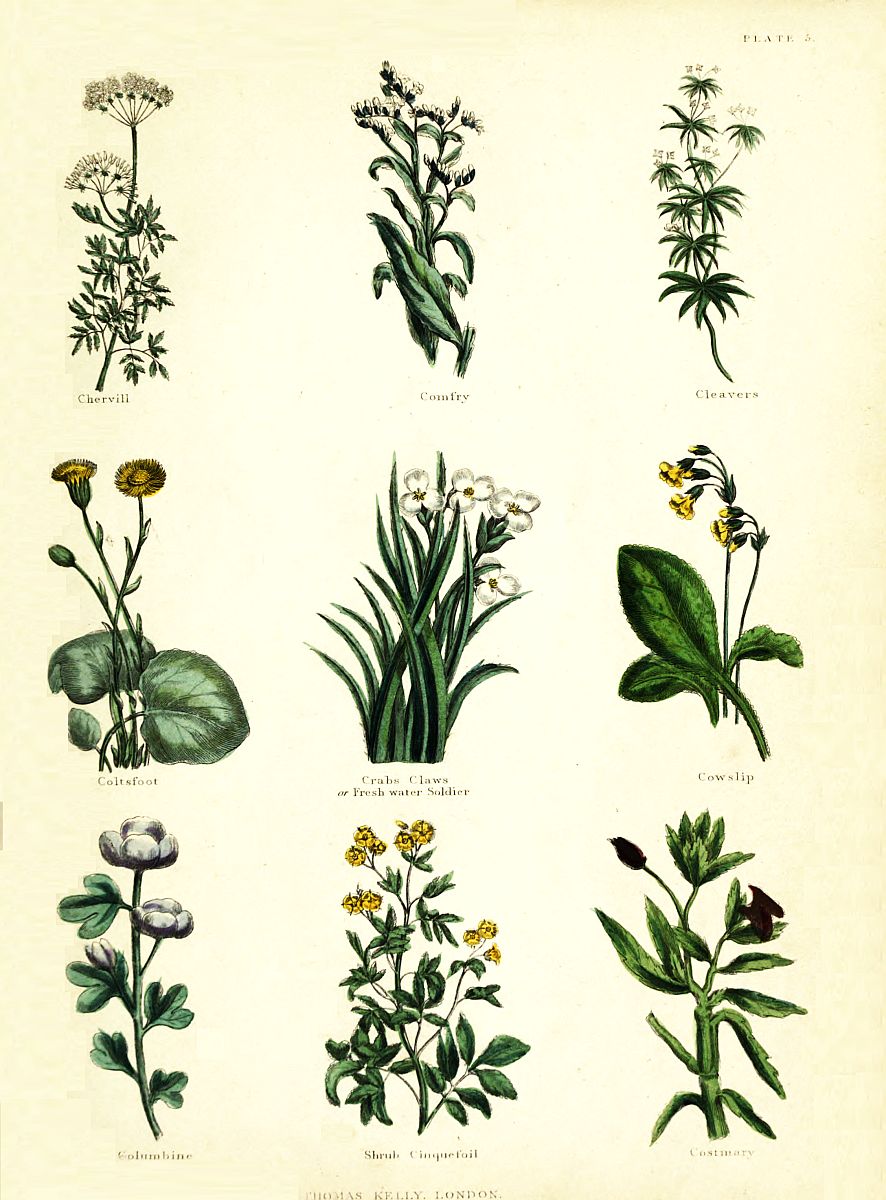
Chervill, Comfry, Cleavers; Coltsfoot, Crabs Claws or Fresh water Soldier, Cowslip; Columbine, Shrub Cinquefoil, Costmary
Chervil
It is called Cerefolium, Mirrhis, and Mirrha, Chervil, Sweet Chervil, and Sweet Cicely.
Descript.] The garden Chervil doth at first somewhat resemble Parsley, but after it is better grown, the leaves are much cut in and jagged, resembling hemlock, being a little hairy and of a whitish green colour, sometimes turning reddish in the Summer, with the stalks also; it rises a little above half a foot high, bearing white flowers in spiked tufts, which turn into long and round seeds pointed at the ends, and blackish when they are ripe; of a sweet taste, but no smell, though the herb itself smells reasonably well. The root is small and long, and perishes every year, and must be sown a-new in spring, for seed after July for Autumn fails.
The wild Chervil grows two or three feet high with yellow stalks and joints, set with broader and more hairy leaves, divided into sundry parts, nicked about the edges, and of a dark green colour, which likewise grow reddish with the stalks; at the tops whereof stands small white tufts, of flowers, afterwards smaller and longer seed. The root is white, hard, and enduring long. This has little or no scent.
Place.] The first is sown in gardens for a sallad herb; the second grows wild in many of the meadows of this land, and by the hedge sides, and on heaths.
Time.] They flower and seed early, and thereupon are sown again in the end of Summer.
Government and virtues.] The garden Chervil being eaten, doth moderately warm the stomach, and is a certain remedy (saith Tragus) to dissolve congealed or clotted blood in the body, or that which is clotted by bruises, falls, &c. The juice or distilled water thereof being drank, and the bruised leaves laid to the place, being taken either in meat or drink, it is good to help to provoke urine, or expel the stone in the kidneys, to send down women’s courses, and to help the pleurisy and pricking of the sides.
The wild Chervil bruised and applied, dissolves swellings in any part, or the marks of congealed blood by bruises or blows, in a little space.
Sweet Chervil, or Sweet Cicely
Descript.] This grows very like the great hemlock, having large spread leaves cut into divers parts, but of a fresher green colour than the Hemlock, tasting as sweet as the Anniseed. The stalks rise up a yard high, or better, being creased or hollow, having leaves at the joints, but lesser; and at the tops of the branched stalks, umbels or tufts of white flowers; after which comes long crested black shining seed, pointed at both ends, tasting quick, yet sweet and pleasant. The root is great and white, growing deep in the ground, and spreading sundry long branches therein, in taste and smell stronger than the leaves or seeds, and continuing many years.
Place.] This grows in gardens.
Government and virtues.] These are all three of them of the nature of Jupiter, and under his dominion. This whole plant, besides its pleasantness in sallads, has its physical virtue. The root boiled, and eaten with oil and vinegar, (or without oil) do much please and warm old and cold stomachs oppressed with wind or phlegm, or those that have the phthisic or consumption of the lungs. The same drank with wine is a preservation from the plague. It provokes women’s courses, and expels the after-birth, procures an appetite to meat, and expels wind. The juice is good to heal the ulcers of the head and face; the candied root hereof are held as effectual as Angelica, to preserve from infection in the time of a plague, and to warm and comfort a cold weak stomach. It is so harmless, you cannot use it amiss.
Chesnut Tree
It were as needless to describe a tree so commonly known as to tell a man he had gotten a mouth; therefore take the government and virtues of them thus:
The tree is abundantly under the dominion of Jupiter, and therefore the fruit must needs breed good blood, and yield commendable nourishment to the body; yet if eaten over-much, they make the blood thick, procure head ache, and bind the body; the inner skin, that covers the nut, is of so binding a quality, that a scruple of it being taken by a man, or ten grains by a child, soon stops any flux whatsoever: The whole nut being dried and beaten into powder, and a dram taken at a time, is a good remedy to stop the terms in women. If you dry Chesnuts, (only the kernels I mean) both the barks being taken away, beat them into powder, and make the powder up into an electuary with honey, so have you an admirable remedy for the cough and spitting of blood.
Earth Chesnuts
They are called Earth-nuts, Earth Chesnuts, Ground Nuts, Ciper-nuts, and in Sussex Pig-nuts. A description of them were needless, for every child knows them.
Government and virtues.] They are something hot and dry in quality, under the dominion of Venus, they provoke lust exceedingly, and stir up to those sports she is mistress of; the seed is excellent good to provoke urine; and so also is the root, but it doth not perform it so forcibly as the seed doth. The root being dried and beaten into powder, and the powder made into an electuary, is as singular a remedy for spitting and pissing of blood, as the former Chesnut was for coughs.
Chickweed
It is so generally known to most people, that I shall not trouble you with the description thereof, nor myself with setting forth the several kinds, since but only two or three are considerable for their usefulness.
Place.] They are usually found in moist and watery places, by wood sides, and elsewhere.
Time.] They flower about June, and their seed is ripe in July.
Government and virtues.] It is a fine soft pleasing herb under the dominion of the Moon. It is found to be effectual as Purslain to all the purposes whereunto it serves, except for meat only. The herb bruised, or the juice applied (with cloths or sponges dipped therein) to the region of the liver, and as they dry, to have it fresh applied, doth wonderfully temperate the heat of the liver, and is effectual for all imposthumes and swellings whatsoever, for all redness in the face, wheals, pushes, itch, scabs; the juice either simply used, or boiled with hog’s grease and applied, helps cramps, convulsions, and palsy. The juice, or distilled water, is of much good use for all heats and redness in the eyes, to drop some thereof into them; as also into the ears, to ease pains in them; and is of good effect to ease pains from the heat and sharpness of the blood in the piles, and generally all pains in the body that arise of heat. It is used also in hot and virulent ulcers and sores in the privy parts of men and women, or on the legs, or elsewhere. The leaves boiled with marsh-mallows, and made into a poultice with fenugreek and linseed, applied to swellings or imposthumes, ripen and break them, or assuage the swellings and ease the pains. It helps the sinews when they are shrunk by cramps, or otherwise, and to extend and make them pliable again by this medicine. Boil a handful of Chickweed, and a handful of red rose leaves dried, in a quart of muscadine, until a fourth part be consumed; then put to them a pint of oil of trotters or sheep’s feet; let them boil a good while, still stirring them well; which being strained, anoint the grieved place therewith, warm against the fire, rubbing it well with one hand: and bind also some of the herb (if you will) to the place, and, with God’s blessing, it will help it in three times dressing.
Chick-pease, or Cicers
Descript.] The garden sorts whether red, black, or white, bring forth stalks a yard long, whereon do grow many small and almost round leaves, dented about the edges, set on both sides of a middle rib; At the joints come forth one or two flowers, upon sharp foot stalks, pease-fashion, either white or whitish, or purplish red, lighter or deeper, according as the pease that follow will be, that are contained in small, thick, and short pods, wherein lie one or two pease, more usually pointed at the lower end, and almost round at the head, yet a little cornered or sharp; the root is small, and perishes yearly.
Place and Time.] They are sown in gardens, or fields as pease, being sown later than pease, and gathered at the same time with them, or presently after.
Government and virtues.] They are both under the dominion of Venus. They are less windy than beans, but nourish more; they provoke urine, and are thought to increase sperm; they have a cleansing faculty, whereby they break the stone in the kidneys. To drink the cream of them, being boiled in water, is the best way. It moves the belly downwards, provokes women’s courses and urine, increases both milk and seed. One ounce of Cicers, two ounces of French barley, and a small handful of Marsh-mallow roots, clean washed and cut, being boiled in the broth of a chicken, and four ounces taken in the morning, and fasting two hours after, is a good medicine for a pain in the sides. The white Cicers are used more for meat than medicine, yet have the same effect, and are thought more powerful to increase milk and seed. The wild Cicers are so much more powerful than the garden kinds, by how much they exceed them in heat and dryness; whereby they do more open obstructions, break the stone, and have all the properties of cutting, opening, digesting, and dissolving; and this more speedily and certainly than the former.
CINQUEFOIL, OR FIVE-LEAVED GRASS; CALLED IN SOME COUNTIES, FIVE-FINGERED GRASS.
Descript.] It spreads and creeps far upon the ground, with long slender strings like straw berries, which take root again, and shoot forth many leaves, made of five parts, and sometimes of seven, dented about the edges, and somewhat hard. The stalks are slender, leaning downwards and bear many small yellow flowers thereon, with some yellow threads in the middle, standing about a smooth green head, which, when it is ripe, is a little rough, and contains small brownish seeds. The root is of a blackish brown colour, as big as one’s little finger, but growing long, with some threads thereat; and by the small string it quickly spreads over the ground.
Place.] It grows by wood sides, hedge sides, the path-way in fields, and in the borders and corners of them almost through all this land.
Time.] It flowers in summer, some sooner, some later.
Government and virtues.] This is an herb of Jupiter, and therefore strengthens the part of the body it rules; let Jupiter be angular and strong when it is gathered; and if you give but a scruple (which is but twenty grains,) of it at a time, either in white wine, or in white wine vinegar, you shall very seldom miss the cure of an ague, be it what ague soever, in three fits, as I have often proved to the admiration both of myself and others; let no man despise it because it is plain and easy, the ways of God are all such. It is an especial herb used in all inflammations and fevers, whether infectious or pestilential; or among other herbs to cool and temper the blood and humours in the body. As also for all lotions, gargles, infections, and the like, for sore mouths, ulcers, cancers, fistulas, and other corrupt, foul, or running sores. The juice hereof drank, about four ounces at a time, for certain days together, cures the quinsey and yellow jaundice; and taken for thirty days together, cures the falling sickness. The roots boiled in milk, and drank, is a most effectual remedy for all fluxes in man or woman, whether the white or red, as also the bloody flux. The roots boiled in vinegar, and the decoction thereof held in the mouth, eases the pains of the toothach. The juice or decoction taken with a little honey, helps the hoarseness of the throat, and is very good for the cough of the lungs. The distilled water of both roots and leaves, is also effectual to all the purposes aforesaid; and if the hands be often washed therein, and suffered at every time to dry in of itself without wiping, it will in a short time help the palsy, or shaking in them. The root boiled in vinegar, helps all knots, kernels, hard swellings, and lumps growing in any part of the flesh, being thereto applied; as also inflammations, and St. Anthony’s fire, all imposthumes, and painful sores with heat and putrefaction, the shingles also, and all other sorts of running and foul scabs, sores and itch. The same also boiled in wine, and applied to any joint full of pain, ache, or the gout in the hands or feet, or the hip gout, called the Sciatica, and the decoction thereof drank the while, doth cure them, and eases much pain in the bowels. The roots are likewise effectual to help ruptures or bursting, being used with other things available to that purpose, taken either inwardly or outwardly, or both; as also bruises or hurts by blows, falls, or the like, and to stay the bleeding of wounds in any parts inward or outward.
Some hold that one leaf cures a quotidian, three a tertain, and four a quartan ague, and a hundred to one if it be not Dioscorides; for he is full of whimsies. The truth is, I never stood so much upon the number of the leaves, nor whether I give it in powder or decoction: If Jupiter were strong, and the Moon applying to him, or his good aspect at the gathering, I never knew it miss the desired effect.
Cives
Called also Rush Leeks, Chives, Civet, and Sweth.
Government and virtues.] I confess I had not added these, had it not been for a country gentleman, who by a letter certified me, that amongst other herbs, I had left these out; they are indeed a kind of leeks, hot and dry in the fourth degree as they are, and so under the dominion of Mars; If they be eaten raw, (I do not mean raw, opposite to roasted or boiled, but raw, opposite to chymical preparation) they send up very hurtful vapours to the brain, causing troublesome sleep, and spoiling the eye-sight, yet of them prepared by the art of the alchymist, may be made an excellent remedy for the stoppage of the urine.
Clary, or More Properly Clear-eye
Descript.] Our ordinary garden Clary has four square stalks, with broad, rough, wrinkled, whitish, or hoary green leaves somewhat evenly cut in on the edges, and of a strong sweet scent, growing some near the ground, and some by couples upon stalks. The flowers grow at certain distances, with two small leaves at the joints under them, somewhat like unto the flowers of Sage, but smaller, and of a whitish blue colour. The seed is brownish, and somewhat flat, or not so round as the wild. The roots are blackish, and spread not far, and perish after the seed time. It is usually sown, for it seldom rises of its own sowing.
Place.] This grows in gardens.
Time.] It flowers in June and July, some a little later than others, and their seed is ripe in August, or thereabouts.
Government and virtues.] It is under the dominion of the Moon. The seed put into the eyes clears them from motes, and such like things gotten within the lids to offend them, as also clears them from white and red spots on them. The mucilage of the seed made with water, and applied to tumours, or swellings, disperses and takes them away; as also draws forth splinters, thorns, or other things gotten into the flesh. The leaves used with vinegar, either by itself, or with a little honey, doth help boils, felons, and the hot inflammation that are gathered by their pains, if applied before it be grown too great. The powder of the dried root put into the nose, provokes sneezing, and thereby purges the head and brain of much rheum and corruption. The seed or leaves taken in wine, provokes to venery. It is of much use both for men and women that have weak backs, and helps to strengthen the reins: used either by itself, or with other herbs conducing to the same effect, and in tansies often. The fresh leaves dipped in a batter of flour, eggs, and a little milk, and fried in butter, and served to the table, is not unpleasant to any, but exceedingly profitable for those that are troubled with weak backs, and the effects thereof. The juice of the herb put into ale or beer, and drank, brings down women’s courses, and expels the after-birth.
Wild Clary
Wild Clary is most blasphemously called Christ’s Eye, because it cures diseases of the eye. I could wish for my soul, blasphemy, ignorance, and tyranny, were ceased among physicians, that they may be happy, and I joyful.
Descript.] It is like the other Clary, but lesser, with many stalks about a foot and a half high. The stalks are square, and somewhat hairy; the flowers of a bluish colour; He that knows the common Clary cannot be ignorant of this.
Place.] It grows commonly in this nation in barren places; you may find it plentifully, if you look in the fields near Gray’s Inn, and near Chelsea.
Time.] They flower from the beginning of June to the latter end of August.
Government and virtues.] It is something hotter and drier than the garden Clary is, yet nevertheless under the dominion of the Moon, as well as that; the seeds of it being beat to powder, and drank with wine, is an admirable help to provoke lust. A decoction of the leaves being drank, warms the stomach, and it is a wonder if it should not, the stomach being under Cancer, the house of the Moon. Also it helps digestion, scatters congealed blood in any part of the body. The distilled water hereof cleanses the eyes of redness, waterishness and heat: It is a gallant remedy for dimness of sight, to take one of the seeds of it, and put into the eyes, and there let it remain till it drops out of itself, (the pain will be nothing to speak on,) it will cleanse the eyes of all filthy and putrified matter; and in often repeating it, will take off a film which covers the sight: a handsomer, safer, and easier remedy by a great deal, than to tear it off with a needle.
Cleavers
It is also called Aperine, Goose-shade, Goose-grass, and Cleavers.
Descript.] The common Cleavers have divers very rough square stalks, not so big as the top of a point, but rising up to be two or three yards high sometimes, if it meet with any tall bushes or trees whereon it may climb, yet without any claspers, or else much lower, and lying on the ground, full of joints, and at every one of them shoots forth a branch, besides the leaves thereat, which are usually six, set in a round compass like a star, or a rowel of a spur: From between the leaves or the joints towards the tops of the branches, come forth very small white flowers, at every end upon small thready foot-stalks, which after they have fallen, there do shew two small round and rough seeds joined together which, when they are ripe, grow hard and whitish, having a little hole on the side, something like unto a navel. Both stalks, leaves, and seeds are so rough, that they will cleave to any thing that will touch them. The root is small and thready spreading much to the ground, but die every year.
Place.] It grows by the hedge and ditch-sides in many places of this land, and is so troublesome an inhabitant in gardens, that it ramps upon, and is ready to choak what ever grows near it.
Time.] It flowers in June or July, and the seed is ripe and falls again in the end of July or August, from whence it springs up again, and not from the old roots.
Government and virtues.] It is under the dominion of the Moon. The juice of the herb and the seed together taken in wine, helps those bitten with an adder, by preserving the heart from the venom. It is familiarly taken in broth to keep them lean and lank, that are apt to grow fat. The distilled water drank twice a day, helps the yellow jaundice, and the decoction of the herb, in experience, is found to do the same, and stays lasks and bloody-fluxes. The juice of the leaves, or they a little bruised, and applied to any bleeding wounds, stays the bleeding. The juice also is very good to close up the lips of green wounds, and the powder of the dried herb strewed thereupon doth the same, and likewise helps old ulcers. Being boiled in hog’s grease, it helps all sorts of hard swellings or kernels in the throat, being anointed therewith. The juice dropped into the ears, takes away the pain of them.
It is a good remedy in the Spring, eaten (being first chopped small, and boiled well) in water-gruel, to cleanse the blood, and strengthen the liver, thereby to keep the body in health, and fitting it for that change of season that is coming.
Clown’s Woods
Descript.] It grows up sometimes to two or three feet high, but usually about two feet, with square green rough stalks, but slender, joined somewhat far asunder, and two very long, somewhat narrow, dark green leaves, bluntly dented about the edges thereof, ending in a long point. The flowers stand towards the tops, compassing the stalks at the joints with the leaves, and end likewise in a spiked top, having long and much gaping hoods of a purplish red colour, with whitish spots in them, standing in somewhat round husks, wherein afterwards stand blackish round seeds. The root is composed of many long strings, with some tuberous long knobs growing among them, of a pale yellowish or whitish colour, yet some times of the year these knobby roots in many places are not seen in this plant. This plant smells somewhat strong.
Place.] It grows in sundry counties of this land, both north and west, and frequently by path-sides in the fields near about London, and within three or four miles distant about it, yet it usually grows in or near ditches.
Time.] It flowers in June or July, and the seed is ripe soon after.
Government and virtues.] It is under the dominion of the planet Saturn. It is singularly effectual in all fresh and green wounds, and therefore bears not this name for nought. And it is very available in staunching of blood and to dry up the fluxes of humours in old fretting ulcers, cankers, &c. that hinder the healing of them.
A syrup made of the juice of it, is inferior to none for inward wounds, ruptures of veins, bloody flux, vessels broken, spitting, urining, or vomiting blood: Ruptures are excellent and speedily, ever to admiration, cured by taking now and then a little of the syrup, and applying an ointment or plaister of this herb to the place. Also, if any vein be swelled or muscle, apply a plaister of this herb to it, and if you add a little Comfrey to it, it will not be amiss. I assure thee the herb deserves commendation, though it has gotten such a clownish name; and whosoever reads this, (if he try it, as I have done,) will commend it; only take notice that it is of a dry earthy quality.
Cock’s Head, Red Fitching, or Medick Fetch
Descript.] This has divers weak but rough stalks, half a yard long, leaning downward, but set with winged leaves, longer and more pointed than those of Lintels, and whitish underneath; from the tops of these stalks arise up other slender stalks, naked without leaves unto the tops, where there grow many small flowers in manner of a spike, of a pale reddish colour with some blueness among them; after which rise up in their places, round, rough, and somewhat flat heads. The root is tough, and somewhat woody, yet lives and shoots a-new every year.
Place.] It grows upon hedges, and sometimes in the open fields, in divers places of this land.
Time.] They flower all the months of July and August, and the seed ripen in the mean while.
Government and virtues.] It is under the dominion of Venus. It has power to rarify and digest, and therefore the green leaves bruised and laid as a plaister, disperse knots, nodes, or kernels in the flesh; and if, when dry, it be taken in wine, it helps the stranguary; and being anointed with oil, it provokes sweat. It is a singular food for cattle, to cause them to give store of milk; and why then may it not do the like, being boiled in ordinary drink, for nurses.
Columbines
These are so well known, growing almost in every garden, that I think I may save the expence of time in writing a description of them.
Time.] They flower in May, and abide not for the most part when June is past, perfecting their seed in the mean time.
Government and virtues.] It is also an herb of Venus. The leaves of Columbines are commonly used in lotions with good success for sore mouths and throats. Tragus saith, that a dram of the seed taken in wine with a little saffron, opens obstructions of the liver, and is good for the yellow jaundice, if the party after the taking thereof be laid to sweat well in bed. The seed also taken in wine causes a speedy delivery of women in childbirth: if one draught suffice not, let her drink the second, and it will be effectual: The Spaniards used to eat a piece of the root thereof in the morning fasting, many days together, to help them when troubled with the stone in the reins or kidneys.
Coltsfoot
Called also Coughwort, Foal’s-foot, Horse-hoof, and Bull’s-foot.
Descript.] This shoots up a slender stalk, with small yellowish flowers somewhat earlier, which fall away quickly, and after they are past, come up somewhat round leaves, sometimes dented about the edges, much lesser, thicker, and greener than those of butter-bur, with a little down or frieze over the green leaf on the upper side, which may be rubbed away, and whitish or meally underneath. The root is small and white, spreading much under ground, so that where it takes it will hardly be driven away again, if any little piece be abiding therein; and from thence spring fresh leaves.
Place.] It grows as well in wet grounds as in drier places.
Time.] And flowers in the end of February, the leaves begin to appear in March.
Government and virtues.] The plant is under Venus, the fresh leaves or juice, or a syrup thereof is good for a hot dry cough, or wheezing, and shortness of breath. The dry leaves are best for those that have thin rheums and distillations upon their lungs, causing a cough, for which also the dried leaves taken as tobacco, or the root is very good. The distilled water hereof simply, or with Elder flowers and Nightshade, is a singularly good remedy against all hot agues, to drink two ounces at a time, and apply cloths wet therein to the head and stomach, which also does much good, being applied to any hot swellings and inflammations: It helps St. Anthony’s fire, and burnings, and is singularly good to take away wheals and small pushes that arise through heat; as also the burning heat of the piles, or privy parts, cloths wet therein being thereunto applied.
Comfrey
This is a very common but a very neglected plant. It contains very great virtues.
Descript.] The common Great Comfrey has divers very large hairy green leaves lying on the ground, so hairy or prickly, that if they touch any tender parts of the hands, face, or body, it will cause it to itch; the stalks that rise from among them, being two or three feet high, hollow and cornered, is very hairy also, having many such like leaves as grow below, but less and less up to the top: At the joints of the stalks it is divided into many branches, with some leaves thereon, and at the ends stand many flowers in order one above another, which are somewhat long and hollow like the finger of a glove, of a pale whitish colour, after which come small black seeds. The roots are great and long, spreading great thick branches under ground, black on the outside, and whitish within, short and easy to break, and full of glutinous or clammy juice, of little or no taste at all.
There is another sort in all things like this, only somewhat less, and bears flowers of a pale purple colour.
Place.] They grow by ditches and water-sides, and in divers fields that are moist, for therein they chiefly delight to grow. The first generally through all the land, and the other but in some places. By the leave of my authors, I know the first grows in dry places.
Time.] They flower in June or July, and give their seed in August.
Government and virtues.] This is an herb of Saturn, and I suppose under the sign Capricorn, cold, dry, and earthy in quality. What was spoken of Clown’s Woundwort may be said of this. The Great Comfrey helps those that spit blood, or make a bloody urine. The root boiled in water or wine, and the decoction drank, helps all inward hurts, bruises, wounds, and ulcer of the lungs, and causes the phlegm that oppresses them to be easily spit forth: It helps the defluction of rheum from the head upon the lungs, the fluxes of blood or humours by the belly, women’s immoderate courses, as well the reds as the whites, and the running of the reins happening by what cause soever. A syrup made thereof is very effectual for all those inward griefs and hurts, and the distilled water for the same purpose also, and for outward wounds and sores in the fleshy or sinewy part of the body whatsoever, as also to take away the fits of agues, and to allay the sharpness of humours. A decoction of the leaves hereof is available to all the purposes, though not so effectual as the roots. The roots being outwardly applied, help fresh wounds or cuts immediately, being bruised and laid thereto; and is special good for ruptures and broken bones; yea, it is said to be so powerful to consolidate and knit together, that if they be boiled with dissevered pieces of flesh in a pot, it will join them together again. It is good to be applied to women’s breasts that grow sore by the abundance of milk coming into them; also to repress the over much bleeding of the hæmorrhoids, to cool the inflammation of the parts thereabouts, and to give ease of pains. The roots of Comfrey taken fresh, beaten small, and spread upon leather, and laid upon any place troubled with the gout, doth presently give ease of the pains; and applied in the same manner, gives ease to pained joints, and profits very much for running and moist ulcers, gangrenes, mortifications, and the like, for which it hath by often experience been found helpful.
Coralwort
It is also called by some Toothwort, Tooth Violet, Dog-Teeth Violet, and Dentaria.
Descript.] Of the many sorts of this herb two of them may be found growing in this nation; the first of which shoots forth one or two winged leaves, upon long brownish foot-stalks, which are doubled down at their first coming out of the ground; when they are fully opened they consist of seven leaves, most commonly of a sad green colour, dented about the edges, set on both sides the middle rib one against another, as the leaves of the ash tree; the stalk bears no leaves on the lower half of it; the upper half bears sometimes three or four, each consisting of five leaves, sometimes of three; on the top stand four or five flowers upon short foot-stalks, with long husks; the flowers are very like the flowers of Stockgilliflowers, of a pale purplish colour, consisting of four leaves a-piece, after which come small pods, which contain the seed; the root is very smooth, white and shining; it does not grow downwards, but creeps along under the upper crust of the ground, and consists of divers small round knobs set together; towards the top of the stalk there grows some single leaves, by each of which comes a small cloven bulb, which when it is ripe, if it be set in the ground, it will grow to be a root.
As for the other Coralwort, which grows in this nation, it is more scarce than this, being a very small plant, much like Crowfoot, therefore some think it to be one of the sorts of Crowfoot. I know not where to direct you to it, therefore I shall forbear the description.
Place.] The first grows in Mayfield in Sussex, in a wood called Highread, and in another wood there also, called Fox-holes.
Time.] They flower from the latter end of April to the middle of May, and before the middle of July they are gone, and not to be found.
Government and virtues.] It is under the dominion of the Moon. It cleanses the bladder, and provokes urine, expels gravel, and the stone; it eases pains in the sides and bowels, is excellently good for inward wounds, especially such as are made in the breast or lungs, by taking a dram of the powder of the root every morning in wine; the same is excellently good for ruptures, as also to stop fluxes; an ointment made of it is exceedingly good for wounds and ulcers, for it soon dries up the watery humours which hinder the cure.
Costmary, or Alcost, or Balsam Herb
This is so frequently known to be an inhabitant in almost every garden, that I suppose it needless to write a description thereof.
Time.] It flowers in June and July.
Government and virtues.] It is under the dominion of Jupiter. The ordinary Costmary, as well as Maudlin, provokes urine abundantly, and moistens the hardness of the mother; it gently purges choler and phlegm, extenuating that which is gross, and cutting that which is tough and glutinous, cleanses that which is foul, and hinders putrefaction and corruption; it dissolves without attraction, opens obstructions, and helps their evil effects, and it is a wonderful help to all sorts of dry agues. It is astringent to the stomach, and strengthens the liver, and all the other inward parts; and taken in whey works more effectually. Taken fasting in the morning, it is very profitable for pains in the head that are continual, and to stay, dry up, and consume all thin rheums or distillations from the head into the stomach, and helps much to digest raw humours that are gathered therein. It is very profitable for those that are fallen into a continual evil disposition of the whole body, called Cachexia, but especially in the beginning of the disease. It is an especial friend and helps to evil, weak and cold livers. The seed is familiarly given to children for the worms, and so is the infusion of the flowers in white wine given them to the quantity of two ounces at a time; it makes an excellent salve to cleanse and heal old ulcers, being boiled with oil of olive, and Adder’s tongue with it, and after it is strained, put a little wax, rosin, and turpentine, to bring it to a convenient body.
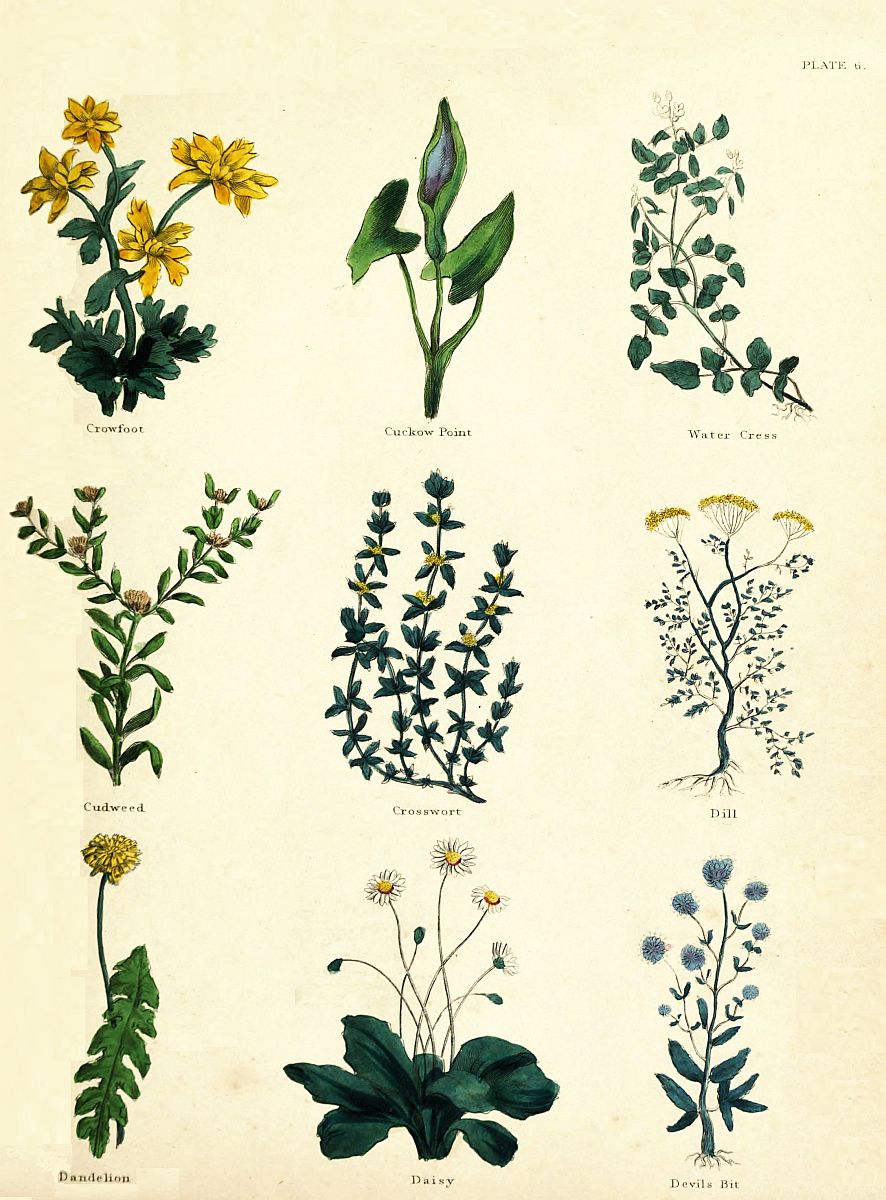
Crowfoot, Cuckow Point, Water Cress; Cudweed, Crosswort, Dill; Dandelion, Daisy, Devils Bit
Cudweed, or Cottonweed
Besides Cudweed and Cottonweed, it is also Called Chaffweed, Dwarf Cotton, and Petty Cotton.
Descript.] The common Cudweed rises up with one stalk sometimes, and sometimes with two or three, thick set on all sides with small, long and narrow whitish or woody leaves, from the middle of the stalk almost up to the top, with every leaf stands small flowers of a dun or brownish yellow colour, or not so yellow as others; in which herbs, after the flowers are fallen, come small seed wrapped up, with the down therein, and is carried away with the wind; the root is small and thready.
There are other sorts hereof, which are somewhat less than the former, not much different, save only that the stalks and leaves are shorter, so that the flowers are paler and more open.
Place.] They grow in dry, barren, sandy, and gravelly grounds, in most places of this land.
Time.] They flower about July, some earlier, some later, and their seed is ripe in August.
Government and virtues.] Venus is Lady of it. The plants are all astringent, binding, or drying, and therefore profitable for defluctions of rheum from the head, and to stay fluxes of blood wheresoever, the decoction being made into red wine and drank, or the powder taken therein. It also helps the bloody-flux, and eases the torments that come thereby, stays the immoderate courses of women, and is also good for inward or outward wounds, hurts, and bruises, and helps children both of bursting and the worms, and being either drank or injected, for the disease called Tenesmus, which is an often provocation to the stool without doing any thing. The green leaves bruised, and laid to any green wound, stays the bleeding, and heals it up quickly. The juice of the herb taken in wine and milk, is, as Pliny saith, a sovereign remedy against the mumps and quinsey; and further saith, That whosoever shall so take it, shall never be troubled with that disease again.
Cowslips, or Peagles
Both the wild and garden Cowslips are so well known, that I neither trouble myself nor the reader with a description of them.
Time.] They flower in April and May.
Government and virtues.] Venus lays claim to this herb as her own, and it is under the sign Aries, and our city dames know well enough the ointment or distilled water of it adds beauty, or at least restores it when it is lost. The flowers are held to be more effectual than the leaves, and the roots of little use. An ointment being made with them, takes away spots and wrinkles of the skin, sun-burning, and freckles, and adds beauty exceedingly; they remedy all infirmities of the head coming of heat and wind, as vertigo, ephialtes, false apparitions, phrensies, falling-sickness, palsies, convulsions, cramps, pains in the nerves; the roots ease pains in the back and bladder, and open the passages of urine. The leaves are good in wounds, and the flowers take away trembling. If the flowers be not well dried, and kept in a warm place, they will soon putrefy and look green: Have a special eye over them; If you let them see the Sun once a month, it will do neither the Sun nor them harm.
Because they strengthen the brain and nerves, and remedy palsies, Greeks gave them the name Paralysis. The flowers preserved or conserved, and the quantity of a nutmeg eaten every morning, is a sufficient dose for inward diseases; but for wounds, spots, wrinkles, and sunburnings, an ointment is made of the leaves, and hog’s grease.
Crab’s Claws
Called also Water Sengreen, Knight’s Pond Water, Water House-leek, Pond Weed, and Fresh-water Soldier.
Descript.] It has sundry long narrow leaves, with sharp prickles on the edges of them, also very sharp pointed; the stalks which bear flowers, seldom grow so high as the leaves, bearing a forked head, like a Crab’s Claw, out of which comes a white flower, consisting of three leaves, with divers yellowish hairy threads in the middle; it takes root in the mud at the bottom of the water.
Place.] It grows plentifully in the fens in Lincolnshire.
Time.] It flowers in June, and usually from thence till August.
Government and virtues.] It is a plant under the dominion of Venus, and therefore a great strengthener of the reins; it is excellently good for inflammation which is commonly called St. Anthony’s Fire; it assuages inflammations, and swellings in wounds: and an ointment made of it is excellently good to heal them; there is scarcely a better remedy growing than this is, for such as have bruised their kidneys, and upon that account discharge blood; a dram of the powder of the herb taken every morning, is a very good remedy to stop the terms.
Black Cresses
Descript.] It has long leaves, deeply cut and jagged on both sides, not much unlike wild mustard; the stalk small, very limber, though very tough: you may twist them round as you may a willow before they break. The flowers are very small and yellow, after which comes small pods, which contains the seed.
Place.] It is a common herb, grows usually by the way-side, and sometimes upon mud walls about London, but it delights to grow most among stones and rubbish.
Time.] It flowers in June and July, and the seed is ripe in August and September.
Government and virtues.] It is a plant of a hot and biting nature, under the dominion of Mars. The seed of Black Cresses strengthens the brain exceedingly, being, in performing that office, little inferior to mustard seed, if at all; they are excellently good to stay those rheums which may fall down from the head upon the lungs; you may beat the seed into powder, if you please, and make it up into an electuary with honey; so you have an excellent remedy by you, not only for the premises, but also for the cough, yellow jaundice and sciatica. This herb boiled into a poultice, is an excellent remedy for inflammations; both in women’s breast, and men’s testicles.
Sciatica Cresses
Descript.] These are of two kinds; The first rises up with a round stalk about two feet high, spreads into divers branches, whose lower leaves are somewhat larger than the upper, yet all of them cut or torn on the edges, somewhat like the garden Cresses, but smaller, the flowers are small and white, growing at the tops of branches, where afterwards grow husks with small brownish seeds therein very strong and sharp in taste, more than the Cresses of the garden; the root is long, white, and woody.
The other has the lower leaves whole somewhat long and broad, not torn at all, but only somewhat deeply dented about the edges towards the ends; but those that grow up higher are smaller. The flowers and seeds are like the former, and so is the root likewise, and both root and seeds as sharp as it.
Place.] They grow in the way-sides in untilled places, and by the sides of old walls.
Time.] They flower in the end of June, and their seed is ripe in July.
Government and virtues.] It is a Saturnine plant. The leaves, but especially the root, taken fresh in Summer-time, beaten or made into a poultice or salve with old hog’s grease, and applied to the places pained with the sciatica, to continue thereon four hours if it be on a man, and two hours on a woman; the place afterwards bathed with wine and oil mixed together, and then wrapped with wool or skins, after they have sweat a little, will assuredly cure not only the same disease in hips, knuckle-bone, or other of the joints, as gout in the hands or feet, but all other old griefs of the head, (as inveterate rheums,) and other parts of the body that are hard to be cured. And if of the former griefs any parts remain, the same medicine after twenty days, is to be applied again. The same is also effectual in the diseases of the spleen; and applied to the skin, takes away the blemish thereof, whether they be scars, leprosy, scabs, or scurf, which although it ulcerate the part, yet that is to be helped afterwards with a salve made of oil and wax. Esteem this as another secret.
Water Cresses
Descript.] Our ordinary Water Cresses spread forth with many weak, hollow, sappy stalks, shooting out fibres at the joints and upwards long winged leaves made of sundry broad sappy almost round leaves, of a brownish colour. The flowers are many and white standing on long foot-stalks after which come small yellow seed, contained in small long pods like horns. The whole plant abides green in the winter, and tastes somewhat hot and sharp.
Place.] They grow, for the most part, in small standing waters, yet sometimes in small rivulets of running water.
Time.] They flower and seed in the beginning of Summer.
Government and virtues.] It is an herb under the dominion of the Moon. They are more powerful against the scurvy, and to cleanse the blood and humours, than Brooklime is, and serve in all the other uses in which Brooklime is available, as to break the stone, and provoke urine and woman’s courses. The decoction thereof cleanses ulcers, by washing them therewith. The leaves bruised, or the juice, is good, to be applied to the face or other parts troubled with freckles, pimples, spots, or the like, at night, and washed away in the morning. The juice mixed with vinegar, and the fore part of the head bathed therewith, is very good for those that are dull and drowsy, or have the lethargy.
Water-cress pottage is a good remedy to cleanse the blood in the spring, and help headaches, and consume the gross humours winter has left behind; those that would live in health, may use it if they please; if they will not, I cannot help it. If any fancy not pottage, they may eat the herb as a sallad.
Crosswort
This herb receives its name from the situation of its leaves.
Descript.] Common Crosswort grows up with square hairy brown stalks a little above a foot high, having four small broad and pointed, hairy yet smooth thin leaves, growing at every joint, each against other one way, which has caused the name. Towards the tops of the stalks at the joints, with the leaves in three or four rows downwards, stand small, pale yellow flowers, after which come small blackish round seeds, four for the most part, set in every husk. The root is very small, and full of fibres, or threads, taking good hold of the ground, and spreading with the branches over a great deal of ground, which perish not in winter, although the leaves die every year and spring again anew.
Place.] It grows in many moist grounds, well in meadows as untilled places, about London, in Hampstead church-yard, at Wye in Kent, and sundry other places.
Time.] It flowers from May all the Summer long, in one place or other, as they are more open to the sun; the seed ripens soon after.
Government and virtues.] It is under the dominion of Saturn. This is a singularly good wound herb, and is used inwardly, not only to stay bleeding of wounds, but to consolidate them, as it doth outwardly any green wound, which it quickly solders up, and heals. The decoction of the herb in wine, helps to expectorate the phlegm out of the chest, and is good for obstructions in the breast, stomach, or bowels, and helps a decayed appetite. It is also good to wash any wound or sore with, to cleanse and heal it. The herb bruised, and then boiled applied outwardly for certain days together, renewing it often: and in the mean time the decoction of the herb in wine, taken inwardly every day, doth certainly cure the rupture in any, so as it be not too inveterate; but very speedily, if it be fresh and lately taken.
Crowfoot
Many are the names this furious biting herb has obtained, almost enough to make up a Welchman’s pedigree, if he fetch no farther than John of Gaunt, or William the Conquerer; for it is called Frog’s-foot, from the Greek name Barrakion: Crowfoot, Gold Knobs, Gold Cups, King’s Knob, Baffiners, Troilflowers, Polts, Locket Gouions, and Butterflowers.
Abundance are the sorts of this herb, that to describe them all would tire the patience of Socrates himself, but because I have not yet attained to the spirit of Socrates, I shall but describe the most usual.
Descript.] The most common Crowfoot has many thin great leaves, cut into divers parts, in taste biting and sharp, biting and blistering the tongue: It bears many flowers, and those of a bright, resplendent, yellow colour. I do not remember, that I ever saw any thing yellower. Virgins, in ancient time, used to make powder of them to furrow bride beds; after which flowers come small heads, some spiked and rugged like a Pine-Apple.
Place.] They grow very common every where; unless you turn your head into a hedge you cannot but see them as you walk.
Time.] They flower in May and June, even till September.
Government and virtues.] This fiery and hot-spirited herb of Mars is no way fit to be given inwardly, but an ointment of the leaves or flowers will draw a blister, and may be so fitly applied to the nape of the neck to draw back rheum from the eyes. The herb being bruised and mixed with a little mustard, draws a blister as well, and as perfectly as Cantharides, and with far less danger to the vessels of urine, which Cantharides naturally delight to wrong; I knew the herb once applied to a pestilential rising that was fallen down, and it saved life even beyond hope; it were good to keep an ointment and plaister of it, if it were but for that.
Cuckow-point
It is called Aron, Janus, Barba-aron, Calve’s-foot, Ramp, Starchwort, Cuckow-point, and Wake Robin.
Descript.] This shoots forth three, four or five leaves at the most, from one root, every one whereof is somewhat large and long, broad at the bottom next the stalk, and forked, but ending in a point, without a cut on the edge, of a full green colour, each standing upon a thick round stalk, of a hand-breadth long, or more, among which, after two or three months that they begin to wither, rises up a bare, round, whitish green stalk, spotted and streaked with purple, somewhat higher than the leaves: At the top whereof stands a long hollow husk close at the bottom, but open from the middle upwards, ending in a point: in the middle whereof stands the small long pestle or clapper, smaller at the bottom than at the top, of a dark purple colour, as the husk is on the inside, though green without; which, after it hath so abided for some time, the husk with the clapper decays, and the foot or bottom thereof grows to be a small long bunch of berries, green at the first, and of a yellowish red colour when they are ripe, of the bigness of a hazel-nut kernel, which abides thereon almost until Winter; the root is round, and somewhat long, for the most part lying along, the leaves shooting forth at the largest end, which, when it bears its berries, are somewhat wrinkled and loose, another growing under it, which is solid and firm, with many small threads hanging thereat. The whole plant is of a very sharp biting taste, pricking the tongue as nettles do the hands, and so abides for a great while without alteration. The root thereof was anciently used instead of starch to starch linen with.
There is another sort of Cuckow-point, with less leaves than the former, and some times harder, having blackish spots upon them, which for the most part abide longer green in Summer than the former, and both leaves and roots are more sharp and fierce than it: In all things else it is like the former.
Place.] These two sorts grow frequently almost under every hedge-side in many places of this land.
Time.] They shoot forth leaves in the Spring, and continue but until the middle of Summer, or somewhat later; their husks appearing before the fall away, and their fruit shewing in April.
Government and virtues.] It is under the dominion of Mars. Tragus reports, that a dram weight, or more, if need be, of the spotted Wake Robin, either fresh and green, or dried, having been eaten and taken, is a present and sure remedy for poison and the plague. The juice of the herb taken to the quantity of a spoonful has the same effect. But if there be a little vinegar added thereto, as well as to the root aforesaid, it somewhat allays the sharp biting taste thereof upon the tongue. The green leaves bruised, and laid upon any boil or plague sore, doth wonderfully help to draw forth the poison: A dram of the powder of the dried root taken with twice so much sugar in the form of a licking electuary, or the green root, doth wonderfully help those that are pursy and short-winded, as also those that have a cough; it breaks, digests, and rids away phlegm from the stomach, chest, and lungs. The milk wherein the root as been boiled is effectual also for the same purpose. The said powder taken in wine or other drink, or the juice of the berries, or the powder of them, or the wine wherein they have been boiled, provokes urine, and brings down women’s courses and purges them effectually after child-bearing, to bring away the after-birth. Taken with sheep’s milk, it heals the inward ulcers of the bowels. The distilled water thereof is effectual to all the purposes aforesaid. A spoonful taken at a time heals the itch; an ounce or more taken a time for some days together, doth help the rupture: The leaves either green or dry, or the juice of them, doth cleanse all manner of rotten and filthy ulcers, in what part of the body soever; and heals the stinking sores in the nose, called Polypus. The water wherein the root has been boiled, dropped into the eyes, cleanses them from any film or skin, cloud or mists, which begin to hinder the sight, and helps the watering and redness of them, or when, by some chance, they become black and blue. The root mixed with bean-flour, and applied to the throat or jaws that are inflamed, helps them. The juice of the berries boiled in oil of roses, or beaten into powder mixed with the oil, and dropped into the ears, eases pains in them. The berries or the roots beaten with the hot ox-dung, and applied, eases the pains of the gout. The leaves and roots boiled in wine with a little oil, and applied to the piles, or the falling down of the fundament, eases them, and so doth sitting over the hot fumes thereof. The fresh roots bruised and distilled with a little milk, yields a most sovereign water to cleanse the skin from scurf, freckles, spots, or blemishes whatsoever therein.
Authors have left large commendations of this herb you see, but for my part, I have neither spoken with Dr. Reason nor Dr. Experience about it.
Cucumbers
Government and virtues.] There is no dispute to be made, but that they are under the dominion of the Moon, though they are so much cried out against for their coldness, and if they were but one degree colder they would be poison. The best of Galenists hold them to be cold and moist in the second degree, and then not so hot as either lettuce or purslain: They are excellently good for a hot stomach, and hot liver; the unmeasurable use of them fills the body full of raw humours, and so indeed the unmeasurable use of any thing else doth harm. The face being washed with their juice, cleanses the skin, and is excellently good for hot rheums in the eyes; the seed is excellently good to provoke urine, and cleanses the passages thereof when they are stopped: there is not a better remedy for ulcers in the bladder growing, than Cucumbers are; The usual course is, to use the seeds in emulsions, as they make almond milk; but a far better way (in my opinion) is this; When the season of the year is, take the Cucumbers and bruise them well, and distil the water from them, and let such as are troubled with ulcers in the bladder drink no other drink. The face being washed with the same water, cures the reddest face that is; it is also excellently good for sun-burning, freckles, and morphew.
The end of C: Cabbages and Coleworts to Cucumbers.
Turn the page for Daisies to Dragons.
Tap or click the right-hand side of the book to turn the page, the left to turn back; or use the arrow keys, or swipe. Press F for full screen.
The English Physician Enlarged · C
Cabbages and Coleworts to Cucumbers
Cabbages and Coleworts
I shall spare labour in writing a description of these, since almost every one that can but write at all, may describe them from his own knowledge, they being generally so well known, that descriptions are altogether needless.
Place.] They are generally planted in gardens.
Time.] Their flower time is towards the middle, or end of July, and the seed is ripe in August.
Government and virtues.] The Cabbages or Coleworts boiled gently in broth, and eaten, do open the body, but the second decoction doth bind the body. The juice thereof drank in wine, helps those that are bitten by an adder, and the decoction of the flowers brings down women’s courses: Being taken with honey, it recovers hoarseness, or loss of the voice. The often eating of them well boiled, helps those that are entering into a consumption. The pulp of the middle ribs of Coleworts boiled in almond milk, and made up into an electuary with honey, being taken often, is very profitable for those that are puffy and short winded. Being boiled twice, an old cock boiled in the broth and drank, it helps the pains and the obstructions of the liver and spleen, and the stone in the kidneys. The juice boiled with honey, and dropped into the corner of the eyes, clears the sight, by consuming any film or clouds beginning to dim it; it also consumes the cankers growing therein. They are much commended, being eaten before meat to keep one from surfeiting, as also from being drunk with too much wine, or quickly to make a man sober again that was drunk before. For (as they say) there is such an antipathy or enmity between the Vine and the Coleworts, that the one will die where the other grows. The decoction of Coleworts takes away the pain and ache, and allays the swelling of sores and gouty legs and knees, wherein many gross and watery humours are fallen, the place being bathed therewith warm. It helps also old and filthy sores, being bathed therewith, and heals all small scabs, pushes, and wheals, that break out in the skin. The ashes of Colewort stalks mixed with old hog’s-grease, are very effectual to anoint the sides of those that have had long pains therein, or any other place pained with melancholy and windy humours. This was surely Chrysippus’s God, and therefore he wrote a whole volume on them and their virtues, and that none of the least neither, for he would be no small fool; He appropriates them to every part of the body, and to every disease in every part: and honest old Cato (they say) used no other physic. I know not what metal their bodies were made of; this I am sure, Cabbages are extremely windy, whether you take them as meat or as medicine: yea, as windy meat as can be eaten, unless you eat bag-pipes or bellows, and they are but seldom eaten in our days; and Colewort flowers are something more tolerable, and the wholesomer food of the two. The Moon challenges the dominion of this herb.
The Sea Coleworts
Descript.] This has divers somewhat long and broad large and thick wrinkled leaves, somewhat crumpled about the edges, and growing each upon a thick footstalks very brittle, of a greyish green colour, from among which rises up a strong thick stalk, two feet high and better, with some leaves thereon to the top, where it branches forth much; and on every branch stands a large bush of pale whitish flowers, consisting of four leaves a-piece: The root is somewhat great, shoots forth many branches under ground, keeping the leaves green all the Winter.
Place.] They grow in many places upon the sea-coasts, as well on the Kentish as Essex shores; as at Lid in Kent, Colchester in Essex, and divers other places, and in other counties of this land.
Time.] They flower and seed about the time that other kinds do.
Government and virtues.] The Moon claims the dominion of these also. The broth, or first decoction of the Sea Colewort, doth by the sharp, nitrous, and bitter qualities therein, open the belly, and purge the body; it cleanses and digests more powerfully than the other kind: The seed hereof, bruised and drank, kills worms. The leaves or the juice of them applied to sores or ulcers, cleanses and heals them, and dissolves swellings, and takes away inflammations.
Calamint, or Mountain-mint
Descript.] This is a small herb, seldom rising above a foot high, with square hairy, and woody stalks, and two small hoary leaves set at a joint, about the height of Marjoram, or not much bigger, a little dented about the edges, and of a very fierce or quick scent, as the whole herb is: The flowers stand at several spaces of the stalk, from the middle almost upwards, which are small and gaping like to those of the Mints, of a pale bluish colour: After which follow small, round blackish seed. The root is small and woody, with divers small strings spreading within the ground, and dies not, but abides many years.
Place.] It grows on heaths, and uplands, and dry grounds, in many places of this land.
Time.] They flower in July and their seed is ripe quickly after.
Government and virtues.] It is an herb of Mercury, and a strong one too, therefore excellent good in all afflictions of the brain. The decoction of the herb being drank, brings down women’s courses, and provokes urine. It is profitable for those that are bursten, or troubled with convulsions or cramps, with shortness of breath, or choleric torments and pains in their bellies or stomach; it also helps the yellow-jaundice, and stays vomiting, being taken in wine. Taken with salt and honey, it kills all manner of worms in the body. It helps such as have the leprosy, either taken inwardly, drinking whey after it, or the green herb outwardly applied. It hinders conception in women, but either burned or strewed in the chamber, it drives away venomous serpents. It takes away black and blue marks in the face, and makes black scars become well coloured, if the green herb (not the dry) be boiled in wine, and laid to the place, or the place washed therewith. Being applied to the hucklebone, by continuance of time, it spends the humours, which cause the pain of the sciatica. The juice being dropped into the ears, kills the worms in them. The leaves boiled in wine, and drank, provoke sweat, and open obstructions of the liver and spleen. It helps them that have a tertian ague (the body being first purged) by taking away the cold fits. The decoction hereof, with some sugar put thereto afterwards, is very profitable for those that be troubled with the over-flowing of the gall, and that have an old cough, and that are scarce able to breathe by shortness of their wind; that have any cold distemper in their bowels, and are troubled with the hardness or the spleen, for all which purposes, both the powder, called Diacaluminthes, and the compound Syrup of Calamint are the most effectual. Let no women be too busy with it, for it works very violent upon the feminine part.
Camomile
It is so well known every where, that it is but lost time and labour to describe it. The virtues thereof are as follow.
A decoction made of Camomile, and drank, takes away all pains and stitches in the side. The flowers of Camomile beaten, and made up into balls with Gill, drive away all sorts of agues, if the part grieved be anointed with that oil, taken from the flowers, from the crown of the head to the sole of the foot, and afterwards laid to sweat in his bed, and that he sweats well. This is Nechessor, an Egyptian’s, medicine. It is profitable for all sorts of agues that come either from phlegm, or melancholy, or from an inflammation of the bowels, being applied when the humours causing them shall be concocted; and there is nothing more profitable to the sides and region of the liver and spleen than it. The bathing with a decoction of Camomile takes away weariness, eases pains, to what part of the body soever they be applied. It comforts the sinews that are over-strained, mollifies all swellings: It moderately comforts all parts that have need of warmth, digests and dissolves whatsoever has need thereof, by a wonderful speedy property. It eases all pains of the cholic and stone, and all pains and torments of the belly, and gently provokes urine. The flowers boiled in posset-drink provokes sweat, and helps to expel all colds, aches, and pains whatsoever, and is an excellent help to bring down women’s courses. Syrup made of the juice of Camomile, with the flowers, in white wine, is a remedy against the jaundice and dropsy. The flowers boiled in lye, are good to wash the head, and comfort both it and the brain. The oil made of the flowers of Camomile, is much used against all hard swellings, pains or aches, shrinking of the sinews, or cramps, or pains in the joints, or any other part of the body. Being used in clysters, it helps to dissolve the wind and pains in the belly; anointed also, it helps stitches and pains in the sides.
Nechessor saith, the Egyptians dedicated it to the Sun, because it cured agues, and they were like enough to do it, for they were the arrantest apes in their religion that I ever read of. Bachinus, Bena, and Lobel, commend the syrup made of the juice of it and sugar, taken inwardly, to be excellent for the spleen. Also this is certain, that it most wonderfully breaks the stone: Some take it in syrup or decoction, others inject the juice of it into the bladder with a syringe. My opinion is, that the salt of it, taken half a dram in the morning in a little white or Rhenish wine, is better than either; that it is excellent for the stone, appears in this which I have seen tried, viz., That a stone that has been taken out of the body of a man being wrapped in Camomile, will in time dissolve, and in a little time too.
Water-caltrops
They are called also Tribulus Aquaticus, Tribulus Lacusoris, Tribulus Marinus, Caltrops, Saligos, Water Nuts, and Water Chesnuts.
Descript.] As for the greater sort of Water Caltrop it is not found here, or very rarely. Two other sorts there are which I shall here describe. The first has a long creeping and jointed root, sending forth tufts at each joint, from which joints rise long, flat, slender, knotted stalks, even to the top of the water, divided towards the top into many branches, each carrying two leaves on both sides, being about two inches long, and half an inch broad, thin and almost transparent; they look as though they were torn; the flowers are long, thick, and whitish, set together almost like a bunch of grapes, which being gone, there succeed, for the most part, sharp pointed grains all together, containing a small white kernel in them.
The second differs not much from this, save that it delights in more clean water; its stalks are not flat, but round; its leaves are not so long, but more pointed. As for the place we need not determine, for their name shews they grow in water.
Government and virtues.] They are under the dominion of the Moon, and being made into a poultice, are excellently good for hot inflammations, swellings, cankers, sore mouths and throats, being washed with the decoction; it cleanses and strengthens the neck and throat, and helps those swellings which, when people have, they say the almonds of the ears are fallen down. It is excellently good for the rankness of the gums, a safe and present remedy for the king’s evil. They are excellent for the stone and gravel, especially the nuts, being dried. They also resist poison, and bitings of venomous beasts.
Campion, Wild
Descript.] The wild White Campion has many long and somewhat broad dark green leaves lying upon the ground, and divers ribs therein, somewhat like plantain, but somewhat hairy, broader, but not so long. The hairy stalks rise up in the middle of them three or four feet high, and sometimes more, with divers great white joints at several places thereon, and two such like leaves thereat up to the top, sending forth branches at several joints also; all which bear on several foot-stalks white flowers at the tops of them, consisting of five broad pointed leaves, every one cut in on the end unto the middle, making them seem to be two a-piece, smelling somewhat sweet, and each of them standing in a large green striped hairy husk, large and round below next to the stalk. The seed is small and greyish in the hard heads that come up afterwards. The root is white and long, spreading divers fangs in the ground.
The Red wild Campion grows in the same manner as the White; but its leaves are not so plainly ribbed, somewhat shorter, rounder, and more woolly in handling. The flowers are of the same form and bigness; but in some of a pale, in others of a bright red colour, cut in at the ends more finely, which makes the leaves look more in number than the other. The seeds and the roots are alike, the roots of both sorts abiding many years.
There are forty-five kinds of Campion more, those of them which are of a physical use, having the like virtues with those above described, which I take to be the two chief kinds.
Place.] They grow commonly through this land by fields and hedge-sides, and ditches.
Time.] They flower in Summer, some earlier than others, and some abiding longer than others.
Government and virtues.] They belong to Saturn, and it is found by experience, that the decoction of the herb, either in white or red wine being drank, doth stay inward bleedings, and applied outwardly it does the like; and being drank, helps to expel urine, being stopped, and gravel and stone in the reins and kidneys. Two drams of the seed drank in wine, purges the body of choleric humours, and helps those that are stung by scorpions, or other venomous beasts, and may be as effectual for the plague. It is of very good use in old sores, ulcers, cankers, fistulas, and the like, to cleanse and heat them, by consuming the moist humours falling into them and correcting the putrefaction of humours offending them.
Carduus Benedictus
It is called Carduus Benedictus, or Blessed Thistle, or Holy Thistle. I suppose the name was put upon it by some that had little holiness themselves.
I shall spare a labour in writing a description of this as almost every one that can but write at all, may describe them from his own knowledge.
Time.] They flower in August, and seed not long after.
Government and virtues.] It is an herb of Mars, and under the sign of Aries. Now, in handling this herb, I shall give you a rational pattern of all the rest; and if you please to view them throughout the book, you shall, to your content, find it true. It helps swimming and giddiness of the head, or the disease called vertigo, because Aries is in the house of Mars. It is an excellent remedy against the yellow jaundice and other infirmities of the gall, because Mars governs choler. It strengthens the attractive faculty in man, and clarifies the blood, because the one is ruled by Mars. The continual drinking the decoction of it, helps red faces, tetters, and ring-worms, because Mars causes them. It helps the plague, sores, boils, and itch, the bitings of mad dogs and venomous beasts, all which infirmities are under Mars; thus you see what it doth by sympathy.
By antipathy to other planets it cures the French pox. By antipathy to Venus, who governs it, it strengthens the memory, and cures deafness by antipathy to Saturn, who has his fall in Aries, which rules the head. It cures quartan agues, and other diseases of melancholy, and adust choler, by sympathy to Saturn, Mars being exalted in Capricorn. Also provokes urine, the stopping of which is usually caused by Mars or the Moon.
Carrots
Garden Carrots are so well known, that they need no description; but because they are of less physical use than the wild kind (as indeed almost in all herbs the wild are the most effectual in physic, as being more powerful in operation than the garden kinds,) I shall therefore briefly describe the Wild Carrot.
Descript.] It grows in a manner altogether like the tame, but that the leaves and stalks are somewhat whiter and rougher. The stalks bear large tufts of white flowers, with a deep purple spot in the middle, which are contracted together when the seed begins to ripen, that the middle part being hollow and low, and the outward stalk rising high, makes the whole umbel to show like a bird’s nest. The root small, long, and hard, and unfit for meat, being somewhat sharp and strong.
Place.] The wild kind grows in divers parts of this land plentifully by the field-sides, and untilled places.
Time.] They flower and seed in the end of Summer.
Government and virtues.] Wild Carrots belong to Mercury, and therefore break wind, and remove stitches in the sides, provoke urine and women’s courses, and helps to break and expel the stone; the seed also of the same works the like effect, and is good for the dropsy, and those whose bellies are swelling with wind; helps the cholic, the stone in the kidneys, and rising of the mother; being taken in wine, or boiled in wine and taken, it helps conception. The leaves being applied with honey to running sores or ulcers, do cleanse them.
I suppose the seeds of them perform this better than the roots; and though Galen commended garden Carrots highly to break wind, yet experience teaches they breed it first, and we may thank nature for expelling it, not they; the seeds of them expel wind indeed, and so mend what the root marrs.
Carraway
It is on account of the seeds principally that the Carraway is cultivated.
Descript.] It bears divers stalks of fine cut leaves, lying upon the ground, somewhat like to the leaves of carrots, but not bushing so thick, of a little quick taste in them, from among which rises up a square stalk, not so high as the Carrot, at whose joints are set the like leaves, but smaller and finer, and at the top small open tufts, or umbels of white flowers, which turn into small blackish seed, smaller than the Anniseed, and of a quicker and hotter taste. The root is whitish, small and long, somewhat like unto a parsnip, but with more wrinkled bark, and much less, of a little hot and quick taste, and stronger than the parsnip, and abides after seed-time.
Place.] It is usually sown with us in gardens.
Time.] They flower in June and July, and seed quickly after.
Government and virtues.] This is also a Mercurial plant. Carraway seed has a moderate sharp quality, whereby it breaks wind and provokes urine, which also the herb doth. The root is better food than the parsnip; it is pleasant and comfortable to the stomach, and helps digestion. The seed is conducing to all cold griefs of the head and stomach, bowels, or mother, as also the wind in them, and helps to sharpen the eye-sight. The powder of the seed put into a poultice, takes away black and blue spots of blows and bruises. The herb itself, or with some of the seed bruised and fried, laid hot in a bag or double cloth, to the lower parts of the belly, eases the pains of the wind cholic.
The roots of Carraway eaten as men do parsnips, strengthen the stomach of ancient people exceedingly, and they need not to make a whole meal of them neither, and are fit to be planted in every garden.
Carraway comfits, once only dipped in sugar, and half a spoonful of them eaten in the morning fasting, and as many after each meal, is a most admirable remedy, for those that are troubled with wind.
Celandine
Descript.] This hath divers tender, round, whitish green stalks, with greater joints than ordinary in other herbs as it were knees, very brittle and easy to break, from whence grow branches with large tender broad leaves, divided into many parts, each of them cut in on the edges, set at the joint on both sides of the branches, of a dark blueish green colour, on the upper side like Columbines, and of a more pale blueish green underneath, full of yellow sap, when any is broken, of a bitter taste, and strong scent. At the flowers, of four leaves a-piece, after which come small long pods, with blackish seed therein. The root is somewhat great at the head, shooting forth divers long roots and small strings, reddish on the outside, and yellow within, full of yellow sap therein.
Place.] They grow in many places by old walls, hedges and way-sides in untilled places; and being once planted in a garden, especially some shady places, it will remain there.
Time.] They flower all the Summer, and the seed ripens in the mean time.
Government and virtues.] This is an herb of the Sun, and under the Celestial Lion, and is one of the best cures for the eyes; for, all that know any thing in astrology, know that the eyes are subject to the luminaries; let it then be gathered when the Sun is in Leo, and the Moon in Aries, applying to this time; let Leo arise, then may you make into an oil or ointment, which you please, to anoint your sore eyes with. I can prove it doth both my own experience, and the experience of those to whom I have taught it, that most desperate sore eyes have been cured by this only medicine; and then, I pray, is not this far better than endangering the eyes by the art of the needle? For if this does not absolutely take away the film, it will so facilitate the work, that it might be done without danger. The herb or root boiled in white Wine and drank, a few Anniseeds being boiled therewith, opens obstructions of the liver and gall, helps the yellow jaundice; and often using it, helps the dropsy and the itch, and those who have old sores in their legs, or other parts of the body. The juice thereof taken fasting, is held to be of singularly good use against the pestilence. The distilled water, with a little sugar and a little good treacle mixed therewith (the party upon the taking being laid down to sweat a little) has the same effect. The juice dropped into the eyes, cleanses them from films and cloudiness which darken the sight, but it is best to allay the sharpness of the juice with a little breast milk. It is good in all old filthy corroding creeping ulcers wheresoever, to stay their malignity of fretting and running, and to cause them to heal more speedily: The juice often applied to tetters, ring-worms, or other such like spreading cankers, will quickly heal them, and rubbed often upon warts, will take them away. The herb with the roots bruised and bathed with oil of camomile, and applied to the navel, takes away the griping pains of the belly and bowels, and all the pains of the mother; and applied to women’s breasts stays the overmuch flowing of the courses. The juice or decoction of the herb gargled between the teeth that ach, eases the pain, and the powder of the dried root laid upon any aching, hollow or loose tooth, will cause it to fall out. The juice mixed with some powder of brimstone is not only good against the itch, but takes away all discolourings of the skin whatsoever: and if it chance that in a tender body it causes any itchings or inflammations, by bathing the place with a little vinegar it is helped.
Another ill-favoured trick have physicians got to use to the eye, and that is worse than the needle; which is to take away the films by corroding or gnawing medicine. That I absolutely protest against.
1. Because the tunicles of the eyes are very thin, and therefore soon eaten asunder.
2. The callus or film that they would eat away, is seldom of an equal thickness in every place, and then the tunicle may be eaten asunder in one place, before the film be consumed in another, and so be a readier way to extinguish the sight than to restore it.
It is called Chelidonium, from the Greek word Chelidon, which signifies a swallow; because they say, that if you put out the eyes of young swallows when they are in the nest, the old ones will recover their eyes again with this herb. This I am confident, for I have tried it, that if we mar the very apple of their eyes with a needle, she will recover them again; but whether with this herb or not, I know not.
Also I have read (and it seems to be somewhat probable) that the herb, being gathered as I shewed before, and the elements draw apart from it by art of the alchymist, and after they are drawn apart rectified, the earthly quality, still in rectifying them, added to the Terra damnata (as Alchymists call it) or Terra Sacratisima (as some philosophers call it) the elements so rectified are sufficient for the cure of all diseases, the humours offending being known and the contrary element given: It is an experiment worth the trying, and can do no harm.
The Lesser Celandine, Usually Known by the Name of Pilewort and Fogwort
I wonder what ailed the ancients to give this the name Celandine, which resembles it neather in nature nor form; it acquired the name of Pilewort from its virtues, and it being no great matter where I set it down, so I set it down at all, I humoured Dr. Tradition so much, as to set him down here.
Descript.] This Celandine or Pilewort (which you please) doth spread many round pale green leaves, set on weak and trailing branches which lie upon the ground, and are flat, smooth, and somewhat shining, and in some places (though seldom) marked with black spots, each standing on a long foot-stalk, among which rise small yellow flowers, consisting of nine or ten small narrow leaves, upon slender foot-stalks, very like unto Crowsfoot, whereunto the seed also is not unlike being many small kernels like a grain of corn sometimes twice as long as others, of a whitish colour, with fibres at the end of them.
Place.] It grows for the most part in moist corners of fields and places that are near water sides, yet will abide in drier ground if they be a little shady.
Time.] It flowers betimes, about March or April, is quite gone by May; so it cannot be found till it spring again.
Government and virtues.] It is under the dominion of Mars, and behold here another verification of the learning of the ancients, viz. that the virtue of an herb may be known by its signature, as plainly appears in this; for if you dig up the root of it, you shall perceive the perfect image of the disease which they commonly call the piles. It is certain by good experience, that the decoction of the leaves and roots wonderfully helps piles and hæmorrhoids, also kernels by the ears and throat, called the king’s evil, or any other hard wens or tumours.
Here’s another secret for my countrymen and women, a couple of them together; Pilewort made into an oil, ointment, or plaister, readily cures both the piles, or hæmorrhoids, and the king’s evil: The very herb borne about one’s body next the skin helps in such diseases, though it never touch the place grieved; let poor people make much of it for those uses; with this I cured my own daughter of the king’s evil, broke the sore, drew out a quarter of a pint of corruption, cured without any scar at all in one week’s time.
The Ordinary Small Centaury
Descript.] This grows up most usually but with one round and somewhat crusted stalk, about a foot high or better, branching forth at the top into many sprigs, and some also from the joints of the stalks below; the flowers thus stand at the tops as it were in one umbel or tuft, are of a pale red, tending to carnation colour, consisting of five, sometimes six small leaves, very like those of St. John’s Wort, opening themselves in the day time and closing at night, after which come seeds in little short husk, in forms like unto wheat corn. The leaves are small and somewhat round; the root small and hard, perishing every year. The whole plant is of an exceeding bitter taste.
There is another sort in all things like the former, save only it bears white flowers.
Place.] They grow ordinarily in fields, pastures, and woods, but that with the white flowers not so frequently as the other.
Time.] They flower in July or thereabouts, and seeds within a month after.
Government and virtues.] They are under the dominion of the Sun, as appears in that their flowers open and shut as the Sun, either shews or hides his face. This herb, boiled and drank, purges choleric and gross humours, and helps the sciatica; it opens obstructions of the liver, gall, and spleen, helps the jaundice, and eases the pains in the sides and hardness of the spleen, used outwardly, and is given with very good effect in agues. It helps those that have the dropsy, or the green-sickness, being much used by the Italians in powder for that purpose. It kill the worms in the belly, as is found by experience. The decoction thereof, viz. the tops of the stalks, with the leaves and flowers, is good against the cholic, and to bring down women’s courses, helps to avoid the dead birth, and eases pains of the mother, and is very effectual in all pains of the joints, as the gout, cramps, or convulsions. A dram of the powder taken in wine is a wonderful good help against the biting and poison of an adder. The juice of the herb with a little honey put to it, is good to clear the eyes from dimness, mists and clouds that offend or hinder sight. It is singularly good both for green and fresh wounds, as also for old ulcers and sores, to close up the one and cleanse the other, and perfectly to cure them both, although they are hollow or fistulous; the green herb especially, being bruised and laid thereto. The decoction thereof dropped into the ears, cleanses them from worms, cleanses the foul ulcers and spreading scabs of the head, and takes away all freckles, spots, and marks in the skin, being washed with it; the herb is so safe you cannot fail in the using of it, only giving it inwardly for inward diseases. It is very wholesome, but not very toothsome.
There is beside these, another small Centaury, which bears a yellow flower; in all other respects it is like the former, save that the leaves are larger, and of a darker green, and the stalks pass through the midst of them, as it does in the herb Thorowan. They are all of them, as I told you, under the government of the Sun; yet this, if you observe it, you shall find an excellant truth; in diseases of the blood, use the red Centaury; if of choler, use the yellow; but if phlegm or water, you will find the white best.
The Cherry-tree
I suppose there are few but know this tree, for its fruit’s sake; and therefore I shall spare writing a description thereof.
Place.] For the place of its growth, it is afforded room in every orchard.
Government and virtues.] It is a tree of Venus. Cherries, as they are of different tastes, so they are of different qualities. The sweet pass through the stomach and the belly more speedily, but are of little nourishment; the tart or sour are more pleasing to an hot stomach, procure appetite to meat, to help and cut tough phlegm, and gross humours; but when these are dried, they are more binding to the belly than when they are fresh, being cooling in hot diseases, and welcome to the stomach, and provokes urine. The gum of the Cherry-tree, desolved in wine is good for a cold, cough, and hoarseness of the throat; mends the colour in the face, sharpens the eye-sight, provokes appetite, and helps to break and expel the stone, and dissolved, the water thereof is much used to break the stone, and to expel gravel and wind.
Winter-cherries
Descript.] The Winter Cherry has a running or creeping root in the ground, of the bigness many times one’s little finger, shooting forth at several joints in several places, whereby it quickly spreads a great compass of ground. The stalk rises not above a yard high, whereon are set many broad and long green leaves, somewhat like nightshades, but larger; at the joints, whereof come forth whitish flowers made of five leaves a piece, which afterwards turn into green berries inclosed with thin skins, which change to be reddish when they grow ripe, the berry likewise being reddish, and as large as a cherry; wherein are contained many flat and yellowish seeds lying within the pulp, which being gathered and strung up, are kept all the year to be used upon occasions.
Place.] They grow not naturally in this land, but are cherished in gardens for their virtues.
Time.] They flower not until the middle or latter end of July; and the fruit is ripe about August, or the beginning of September.
Government and virtues.] This also is a plant of Venus. They are of great use in physic: The leaves being cooling, may be used in inflammations, but not opening as the berries and fruit are; which by drawing down the urine provoke it to be voided plentifully when it is stopped or grown hot, sharp, and painful in the passage; it is good also to expel the stone and gravel out of the reins, kidneys and bladder, helping to dissolve the stone, and voiding it by grit or gravel sent forth in the urine; it also helps much to cleanse inward imposthumes or ulcers in the reins of bladder, or in those that void a bloody or foul urine. The distilled water of the fruit, or the leaves together with them, or the berries, green or dry, distilled with a little milk and drank morning and evening with a little sugar, is effectual to all the purposes before specified, and especially against the heat and sharpness of the urine. I shall only mention one way, amongst many others, which might be used for ordering the berries, to be helpful for the urine and the stone; which is this: Take three or four good handfuls of the berries, either green or fresh, or dried, and having bruised them, put them into so many gallons of beer or ale when it is new tunned up: This drink taken daily, has been found to do much good to many, both to ease the pains, and expel urine and the stone, and to cause the stone not to engender. The decoction of the berries in wine and water is the most usual way; but the powder of them taken in drink is more effectual.
Chervill, Comfry, Cleavers; Coltsfoot, Crabs Claws or Fresh water Soldier, Cowslip; Columbine, Shrub Cinquefoil, Costmary
Chervil
It is called Cerefolium, Mirrhis, and Mirrha, Chervil, Sweet Chervil, and Sweet Cicely.
Descript.] The garden Chervil doth at first somewhat resemble Parsley, but after it is better grown, the leaves are much cut in and jagged, resembling hemlock, being a little hairy and of a whitish green colour, sometimes turning reddish in the Summer, with the stalks also; it rises a little above half a foot high, bearing white flowers in spiked tufts, which turn into long and round seeds pointed at the ends, and blackish when they are ripe; of a sweet taste, but no smell, though the herb itself smells reasonably well. The root is small and long, and perishes every year, and must be sown a-new in spring, for seed after July for Autumn fails.
The wild Chervil grows two or three feet high with yellow stalks and joints, set with broader and more hairy leaves, divided into sundry parts, nicked about the edges, and of a dark green colour, which likewise grow reddish with the stalks; at the tops whereof stands small white tufts, of flowers, afterwards smaller and longer seed. The root is white, hard, and enduring long. This has little or no scent.
Place.] The first is sown in gardens for a sallad herb; the second grows wild in many of the meadows of this land, and by the hedge sides, and on heaths.
Time.] They flower and seed early, and thereupon are sown again in the end of Summer.
Government and virtues.] The garden Chervil being eaten, doth moderately warm the stomach, and is a certain remedy (saith Tragus) to dissolve congealed or clotted blood in the body, or that which is clotted by bruises, falls, &c. The juice or distilled water thereof being drank, and the bruised leaves laid to the place, being taken either in meat or drink, it is good to help to provoke urine, or expel the stone in the kidneys, to send down women’s courses, and to help the pleurisy and pricking of the sides.
The wild Chervil bruised and applied, dissolves swellings in any part, or the marks of congealed blood by bruises or blows, in a little space.
Sweet Chervil, or Sweet Cicely
Descript.] This grows very like the great hemlock, having large spread leaves cut into divers parts, but of a fresher green colour than the Hemlock, tasting as sweet as the Anniseed. The stalks rise up a yard high, or better, being creased or hollow, having leaves at the joints, but lesser; and at the tops of the branched stalks, umbels or tufts of white flowers; after which comes long crested black shining seed, pointed at both ends, tasting quick, yet sweet and pleasant. The root is great and white, growing deep in the ground, and spreading sundry long branches therein, in taste and smell stronger than the leaves or seeds, and continuing many years.
Place.] This grows in gardens.
Government and virtues.] These are all three of them of the nature of Jupiter, and under his dominion. This whole plant, besides its pleasantness in sallads, has its physical virtue. The root boiled, and eaten with oil and vinegar, (or without oil) do much please and warm old and cold stomachs oppressed with wind or phlegm, or those that have the phthisic or consumption of the lungs. The same drank with wine is a preservation from the plague. It provokes women’s courses, and expels the after-birth, procures an appetite to meat, and expels wind. The juice is good to heal the ulcers of the head and face; the candied root hereof are held as effectual as Angelica, to preserve from infection in the time of a plague, and to warm and comfort a cold weak stomach. It is so harmless, you cannot use it amiss.
Chesnut Tree
It were as needless to describe a tree so commonly known as to tell a man he had gotten a mouth; therefore take the government and virtues of them thus:
The tree is abundantly under the dominion of Jupiter, and therefore the fruit must needs breed good blood, and yield commendable nourishment to the body; yet if eaten over-much, they make the blood thick, procure head ache, and bind the body; the inner skin, that covers the nut, is of so binding a quality, that a scruple of it being taken by a man, or ten grains by a child, soon stops any flux whatsoever: The whole nut being dried and beaten into powder, and a dram taken at a time, is a good remedy to stop the terms in women. If you dry Chesnuts, (only the kernels I mean) both the barks being taken away, beat them into powder, and make the powder up into an electuary with honey, so have you an admirable remedy for the cough and spitting of blood.
Earth Chesnuts
They are called Earth-nuts, Earth Chesnuts, Ground Nuts, Ciper-nuts, and in Sussex Pig-nuts. A description of them were needless, for every child knows them.
Government and virtues.] They are something hot and dry in quality, under the dominion of Venus, they provoke lust exceedingly, and stir up to those sports she is mistress of; the seed is excellent good to provoke urine; and so also is the root, but it doth not perform it so forcibly as the seed doth. The root being dried and beaten into powder, and the powder made into an electuary, is as singular a remedy for spitting and pissing of blood, as the former Chesnut was for coughs.
Chickweed
It is so generally known to most people, that I shall not trouble you with the description thereof, nor myself with setting forth the several kinds, since but only two or three are considerable for their usefulness.
Place.] They are usually found in moist and watery places, by wood sides, and elsewhere.
Time.] They flower about June, and their seed is ripe in July.
Government and virtues.] It is a fine soft pleasing herb under the dominion of the Moon. It is found to be effectual as Purslain to all the purposes whereunto it serves, except for meat only. The herb bruised, or the juice applied (with cloths or sponges dipped therein) to the region of the liver, and as they dry, to have it fresh applied, doth wonderfully temperate the heat of the liver, and is effectual for all imposthumes and swellings whatsoever, for all redness in the face, wheals, pushes, itch, scabs; the juice either simply used, or boiled with hog’s grease and applied, helps cramps, convulsions, and palsy. The juice, or distilled water, is of much good use for all heats and redness in the eyes, to drop some thereof into them; as also into the ears, to ease pains in them; and is of good effect to ease pains from the heat and sharpness of the blood in the piles, and generally all pains in the body that arise of heat. It is used also in hot and virulent ulcers and sores in the privy parts of men and women, or on the legs, or elsewhere. The leaves boiled with marsh-mallows, and made into a poultice with fenugreek and linseed, applied to swellings or imposthumes, ripen and break them, or assuage the swellings and ease the pains. It helps the sinews when they are shrunk by cramps, or otherwise, and to extend and make them pliable again by this medicine. Boil a handful of Chickweed, and a handful of red rose leaves dried, in a quart of muscadine, until a fourth part be consumed; then put to them a pint of oil of trotters or sheep’s feet; let them boil a good while, still stirring them well; which being strained, anoint the grieved place therewith, warm against the fire, rubbing it well with one hand: and bind also some of the herb (if you will) to the place, and, with God’s blessing, it will help it in three times dressing.
Chick-pease, or Cicers
Descript.] The garden sorts whether red, black, or white, bring forth stalks a yard long, whereon do grow many small and almost round leaves, dented about the edges, set on both sides of a middle rib; At the joints come forth one or two flowers, upon sharp foot stalks, pease-fashion, either white or whitish, or purplish red, lighter or deeper, according as the pease that follow will be, that are contained in small, thick, and short pods, wherein lie one or two pease, more usually pointed at the lower end, and almost round at the head, yet a little cornered or sharp; the root is small, and perishes yearly.
Place and Time.] They are sown in gardens, or fields as pease, being sown later than pease, and gathered at the same time with them, or presently after.
Government and virtues.] They are both under the dominion of Venus. They are less windy than beans, but nourish more; they provoke urine, and are thought to increase sperm; they have a cleansing faculty, whereby they break the stone in the kidneys. To drink the cream of them, being boiled in water, is the best way. It moves the belly downwards, provokes women’s courses and urine, increases both milk and seed. One ounce of Cicers, two ounces of French barley, and a small handful of Marsh-mallow roots, clean washed and cut, being boiled in the broth of a chicken, and four ounces taken in the morning, and fasting two hours after, is a good medicine for a pain in the sides. The white Cicers are used more for meat than medicine, yet have the same effect, and are thought more powerful to increase milk and seed. The wild Cicers are so much more powerful than the garden kinds, by how much they exceed them in heat and dryness; whereby they do more open obstructions, break the stone, and have all the properties of cutting, opening, digesting, and dissolving; and this more speedily and certainly than the former.
CINQUEFOIL, OR FIVE-LEAVED GRASS; CALLED IN SOME COUNTIES, FIVE-FINGERED GRASS.
Descript.] It spreads and creeps far upon the ground, with long slender strings like straw berries, which take root again, and shoot forth many leaves, made of five parts, and sometimes of seven, dented about the edges, and somewhat hard. The stalks are slender, leaning downwards and bear many small yellow flowers thereon, with some yellow threads in the middle, standing about a smooth green head, which, when it is ripe, is a little rough, and contains small brownish seeds. The root is of a blackish brown colour, as big as one’s little finger, but growing long, with some threads thereat; and by the small string it quickly spreads over the ground.
Place.] It grows by wood sides, hedge sides, the path-way in fields, and in the borders and corners of them almost through all this land.
Time.] It flowers in summer, some sooner, some later.
Government and virtues.] This is an herb of Jupiter, and therefore strengthens the part of the body it rules; let Jupiter be angular and strong when it is gathered; and if you give but a scruple (which is but twenty grains,) of it at a time, either in white wine, or in white wine vinegar, you shall very seldom miss the cure of an ague, be it what ague soever, in three fits, as I have often proved to the admiration both of myself and others; let no man despise it because it is plain and easy, the ways of God are all such. It is an especial herb used in all inflammations and fevers, whether infectious or pestilential; or among other herbs to cool and temper the blood and humours in the body. As also for all lotions, gargles, infections, and the like, for sore mouths, ulcers, cancers, fistulas, and other corrupt, foul, or running sores. The juice hereof drank, about four ounces at a time, for certain days together, cures the quinsey and yellow jaundice; and taken for thirty days together, cures the falling sickness. The roots boiled in milk, and drank, is a most effectual remedy for all fluxes in man or woman, whether the white or red, as also the bloody flux. The roots boiled in vinegar, and the decoction thereof held in the mouth, eases the pains of the toothach. The juice or decoction taken with a little honey, helps the hoarseness of the throat, and is very good for the cough of the lungs. The distilled water of both roots and leaves, is also effectual to all the purposes aforesaid; and if the hands be often washed therein, and suffered at every time to dry in of itself without wiping, it will in a short time help the palsy, or shaking in them. The root boiled in vinegar, helps all knots, kernels, hard swellings, and lumps growing in any part of the flesh, being thereto applied; as also inflammations, and St. Anthony’s fire, all imposthumes, and painful sores with heat and putrefaction, the shingles also, and all other sorts of running and foul scabs, sores and itch. The same also boiled in wine, and applied to any joint full of pain, ache, or the gout in the hands or feet, or the hip gout, called the Sciatica, and the decoction thereof drank the while, doth cure them, and eases much pain in the bowels. The roots are likewise effectual to help ruptures or bursting, being used with other things available to that purpose, taken either inwardly or outwardly, or both; as also bruises or hurts by blows, falls, or the like, and to stay the bleeding of wounds in any parts inward or outward.
Some hold that one leaf cures a quotidian, three a tertain, and four a quartan ague, and a hundred to one if it be not Dioscorides; for he is full of whimsies. The truth is, I never stood so much upon the number of the leaves, nor whether I give it in powder or decoction: If Jupiter were strong, and the Moon applying to him, or his good aspect at the gathering, I never knew it miss the desired effect.
Cives
Called also Rush Leeks, Chives, Civet, and Sweth.
Government and virtues.] I confess I had not added these, had it not been for a country gentleman, who by a letter certified me, that amongst other herbs, I had left these out; they are indeed a kind of leeks, hot and dry in the fourth degree as they are, and so under the dominion of Mars; If they be eaten raw, (I do not mean raw, opposite to roasted or boiled, but raw, opposite to chymical preparation) they send up very hurtful vapours to the brain, causing troublesome sleep, and spoiling the eye-sight, yet of them prepared by the art of the alchymist, may be made an excellent remedy for the stoppage of the urine.
Clary, or More Properly Clear-eye
Descript.] Our ordinary garden Clary has four square stalks, with broad, rough, wrinkled, whitish, or hoary green leaves somewhat evenly cut in on the edges, and of a strong sweet scent, growing some near the ground, and some by couples upon stalks. The flowers grow at certain distances, with two small leaves at the joints under them, somewhat like unto the flowers of Sage, but smaller, and of a whitish blue colour. The seed is brownish, and somewhat flat, or not so round as the wild. The roots are blackish, and spread not far, and perish after the seed time. It is usually sown, for it seldom rises of its own sowing.
Place.] This grows in gardens.
Time.] It flowers in June and July, some a little later than others, and their seed is ripe in August, or thereabouts.
Government and virtues.] It is under the dominion of the Moon. The seed put into the eyes clears them from motes, and such like things gotten within the lids to offend them, as also clears them from white and red spots on them. The mucilage of the seed made with water, and applied to tumours, or swellings, disperses and takes them away; as also draws forth splinters, thorns, or other things gotten into the flesh. The leaves used with vinegar, either by itself, or with a little honey, doth help boils, felons, and the hot inflammation that are gathered by their pains, if applied before it be grown too great. The powder of the dried root put into the nose, provokes sneezing, and thereby purges the head and brain of much rheum and corruption. The seed or leaves taken in wine, provokes to venery. It is of much use both for men and women that have weak backs, and helps to strengthen the reins: used either by itself, or with other herbs conducing to the same effect, and in tansies often. The fresh leaves dipped in a batter of flour, eggs, and a little milk, and fried in butter, and served to the table, is not unpleasant to any, but exceedingly profitable for those that are troubled with weak backs, and the effects thereof. The juice of the herb put into ale or beer, and drank, brings down women’s courses, and expels the after-birth.
Wild Clary
Wild Clary is most blasphemously called Christ’s Eye, because it cures diseases of the eye. I could wish for my soul, blasphemy, ignorance, and tyranny, were ceased among physicians, that they may be happy, and I joyful.
Descript.] It is like the other Clary, but lesser, with many stalks about a foot and a half high. The stalks are square, and somewhat hairy; the flowers of a bluish colour; He that knows the common Clary cannot be ignorant of this.
Place.] It grows commonly in this nation in barren places; you may find it plentifully, if you look in the fields near Gray’s Inn, and near Chelsea.
Time.] They flower from the beginning of June to the latter end of August.
Government and virtues.] It is something hotter and drier than the garden Clary is, yet nevertheless under the dominion of the Moon, as well as that; the seeds of it being beat to powder, and drank with wine, is an admirable help to provoke lust. A decoction of the leaves being drank, warms the stomach, and it is a wonder if it should not, the stomach being under Cancer, the house of the Moon. Also it helps digestion, scatters congealed blood in any part of the body. The distilled water hereof cleanses the eyes of redness, waterishness and heat: It is a gallant remedy for dimness of sight, to take one of the seeds of it, and put into the eyes, and there let it remain till it drops out of itself, (the pain will be nothing to speak on,) it will cleanse the eyes of all filthy and putrified matter; and in often repeating it, will take off a film which covers the sight: a handsomer, safer, and easier remedy by a great deal, than to tear it off with a needle.
Cleavers
It is also called Aperine, Goose-shade, Goose-grass, and Cleavers.
Descript.] The common Cleavers have divers very rough square stalks, not so big as the top of a point, but rising up to be two or three yards high sometimes, if it meet with any tall bushes or trees whereon it may climb, yet without any claspers, or else much lower, and lying on the ground, full of joints, and at every one of them shoots forth a branch, besides the leaves thereat, which are usually six, set in a round compass like a star, or a rowel of a spur: From between the leaves or the joints towards the tops of the branches, come forth very small white flowers, at every end upon small thready foot-stalks, which after they have fallen, there do shew two small round and rough seeds joined together which, when they are ripe, grow hard and whitish, having a little hole on the side, something like unto a navel. Both stalks, leaves, and seeds are so rough, that they will cleave to any thing that will touch them. The root is small and thready spreading much to the ground, but die every year.
Place.] It grows by the hedge and ditch-sides in many places of this land, and is so troublesome an inhabitant in gardens, that it ramps upon, and is ready to choak what ever grows near it.
Time.] It flowers in June or July, and the seed is ripe and falls again in the end of July or August, from whence it springs up again, and not from the old roots.
Government and virtues.] It is under the dominion of the Moon. The juice of the herb and the seed together taken in wine, helps those bitten with an adder, by preserving the heart from the venom. It is familiarly taken in broth to keep them lean and lank, that are apt to grow fat. The distilled water drank twice a day, helps the yellow jaundice, and the decoction of the herb, in experience, is found to do the same, and stays lasks and bloody-fluxes. The juice of the leaves, or they a little bruised, and applied to any bleeding wounds, stays the bleeding. The juice also is very good to close up the lips of green wounds, and the powder of the dried herb strewed thereupon doth the same, and likewise helps old ulcers. Being boiled in hog’s grease, it helps all sorts of hard swellings or kernels in the throat, being anointed therewith. The juice dropped into the ears, takes away the pain of them.
It is a good remedy in the Spring, eaten (being first chopped small, and boiled well) in water-gruel, to cleanse the blood, and strengthen the liver, thereby to keep the body in health, and fitting it for that change of season that is coming.
Clown’s Woods
Descript.] It grows up sometimes to two or three feet high, but usually about two feet, with square green rough stalks, but slender, joined somewhat far asunder, and two very long, somewhat narrow, dark green leaves, bluntly dented about the edges thereof, ending in a long point. The flowers stand towards the tops, compassing the stalks at the joints with the leaves, and end likewise in a spiked top, having long and much gaping hoods of a purplish red colour, with whitish spots in them, standing in somewhat round husks, wherein afterwards stand blackish round seeds. The root is composed of many long strings, with some tuberous long knobs growing among them, of a pale yellowish or whitish colour, yet some times of the year these knobby roots in many places are not seen in this plant. This plant smells somewhat strong.
Place.] It grows in sundry counties of this land, both north and west, and frequently by path-sides in the fields near about London, and within three or four miles distant about it, yet it usually grows in or near ditches.
Time.] It flowers in June or July, and the seed is ripe soon after.
Government and virtues.] It is under the dominion of the planet Saturn. It is singularly effectual in all fresh and green wounds, and therefore bears not this name for nought. And it is very available in staunching of blood and to dry up the fluxes of humours in old fretting ulcers, cankers, &c. that hinder the healing of them.
A syrup made of the juice of it, is inferior to none for inward wounds, ruptures of veins, bloody flux, vessels broken, spitting, urining, or vomiting blood: Ruptures are excellent and speedily, ever to admiration, cured by taking now and then a little of the syrup, and applying an ointment or plaister of this herb to the place. Also, if any vein be swelled or muscle, apply a plaister of this herb to it, and if you add a little Comfrey to it, it will not be amiss. I assure thee the herb deserves commendation, though it has gotten such a clownish name; and whosoever reads this, (if he try it, as I have done,) will commend it; only take notice that it is of a dry earthy quality.
Cock’s Head, Red Fitching, or Medick Fetch
Descript.] This has divers weak but rough stalks, half a yard long, leaning downward, but set with winged leaves, longer and more pointed than those of Lintels, and whitish underneath; from the tops of these stalks arise up other slender stalks, naked without leaves unto the tops, where there grow many small flowers in manner of a spike, of a pale reddish colour with some blueness among them; after which rise up in their places, round, rough, and somewhat flat heads. The root is tough, and somewhat woody, yet lives and shoots a-new every year.
Place.] It grows upon hedges, and sometimes in the open fields, in divers places of this land.
Time.] They flower all the months of July and August, and the seed ripen in the mean while.
Government and virtues.] It is under the dominion of Venus. It has power to rarify and digest, and therefore the green leaves bruised and laid as a plaister, disperse knots, nodes, or kernels in the flesh; and if, when dry, it be taken in wine, it helps the stranguary; and being anointed with oil, it provokes sweat. It is a singular food for cattle, to cause them to give store of milk; and why then may it not do the like, being boiled in ordinary drink, for nurses.
Columbines
These are so well known, growing almost in every garden, that I think I may save the expence of time in writing a description of them.
Time.] They flower in May, and abide not for the most part when June is past, perfecting their seed in the mean time.
Government and virtues.] It is also an herb of Venus. The leaves of Columbines are commonly used in lotions with good success for sore mouths and throats. Tragus saith, that a dram of the seed taken in wine with a little saffron, opens obstructions of the liver, and is good for the yellow jaundice, if the party after the taking thereof be laid to sweat well in bed. The seed also taken in wine causes a speedy delivery of women in childbirth: if one draught suffice not, let her drink the second, and it will be effectual: The Spaniards used to eat a piece of the root thereof in the morning fasting, many days together, to help them when troubled with the stone in the reins or kidneys.
Coltsfoot
Called also Coughwort, Foal’s-foot, Horse-hoof, and Bull’s-foot.
Descript.] This shoots up a slender stalk, with small yellowish flowers somewhat earlier, which fall away quickly, and after they are past, come up somewhat round leaves, sometimes dented about the edges, much lesser, thicker, and greener than those of butter-bur, with a little down or frieze over the green leaf on the upper side, which may be rubbed away, and whitish or meally underneath. The root is small and white, spreading much under ground, so that where it takes it will hardly be driven away again, if any little piece be abiding therein; and from thence spring fresh leaves.
Place.] It grows as well in wet grounds as in drier places.
Time.] And flowers in the end of February, the leaves begin to appear in March.
Government and virtues.] The plant is under Venus, the fresh leaves or juice, or a syrup thereof is good for a hot dry cough, or wheezing, and shortness of breath. The dry leaves are best for those that have thin rheums and distillations upon their lungs, causing a cough, for which also the dried leaves taken as tobacco, or the root is very good. The distilled water hereof simply, or with Elder flowers and Nightshade, is a singularly good remedy against all hot agues, to drink two ounces at a time, and apply cloths wet therein to the head and stomach, which also does much good, being applied to any hot swellings and inflammations: It helps St. Anthony’s fire, and burnings, and is singularly good to take away wheals and small pushes that arise through heat; as also the burning heat of the piles, or privy parts, cloths wet therein being thereunto applied.
Comfrey
This is a very common but a very neglected plant. It contains very great virtues.
Descript.] The common Great Comfrey has divers very large hairy green leaves lying on the ground, so hairy or prickly, that if they touch any tender parts of the hands, face, or body, it will cause it to itch; the stalks that rise from among them, being two or three feet high, hollow and cornered, is very hairy also, having many such like leaves as grow below, but less and less up to the top: At the joints of the stalks it is divided into many branches, with some leaves thereon, and at the ends stand many flowers in order one above another, which are somewhat long and hollow like the finger of a glove, of a pale whitish colour, after which come small black seeds. The roots are great and long, spreading great thick branches under ground, black on the outside, and whitish within, short and easy to break, and full of glutinous or clammy juice, of little or no taste at all.
There is another sort in all things like this, only somewhat less, and bears flowers of a pale purple colour.
Place.] They grow by ditches and water-sides, and in divers fields that are moist, for therein they chiefly delight to grow. The first generally through all the land, and the other but in some places. By the leave of my authors, I know the first grows in dry places.
Time.] They flower in June or July, and give their seed in August.
Government and virtues.] This is an herb of Saturn, and I suppose under the sign Capricorn, cold, dry, and earthy in quality. What was spoken of Clown’s Woundwort may be said of this. The Great Comfrey helps those that spit blood, or make a bloody urine. The root boiled in water or wine, and the decoction drank, helps all inward hurts, bruises, wounds, and ulcer of the lungs, and causes the phlegm that oppresses them to be easily spit forth: It helps the defluction of rheum from the head upon the lungs, the fluxes of blood or humours by the belly, women’s immoderate courses, as well the reds as the whites, and the running of the reins happening by what cause soever. A syrup made thereof is very effectual for all those inward griefs and hurts, and the distilled water for the same purpose also, and for outward wounds and sores in the fleshy or sinewy part of the body whatsoever, as also to take away the fits of agues, and to allay the sharpness of humours. A decoction of the leaves hereof is available to all the purposes, though not so effectual as the roots. The roots being outwardly applied, help fresh wounds or cuts immediately, being bruised and laid thereto; and is special good for ruptures and broken bones; yea, it is said to be so powerful to consolidate and knit together, that if they be boiled with dissevered pieces of flesh in a pot, it will join them together again. It is good to be applied to women’s breasts that grow sore by the abundance of milk coming into them; also to repress the over much bleeding of the hæmorrhoids, to cool the inflammation of the parts thereabouts, and to give ease of pains. The roots of Comfrey taken fresh, beaten small, and spread upon leather, and laid upon any place troubled with the gout, doth presently give ease of the pains; and applied in the same manner, gives ease to pained joints, and profits very much for running and moist ulcers, gangrenes, mortifications, and the like, for which it hath by often experience been found helpful.
Coralwort
It is also called by some Toothwort, Tooth Violet, Dog-Teeth Violet, and Dentaria.
Descript.] Of the many sorts of this herb two of them may be found growing in this nation; the first of which shoots forth one or two winged leaves, upon long brownish foot-stalks, which are doubled down at their first coming out of the ground; when they are fully opened they consist of seven leaves, most commonly of a sad green colour, dented about the edges, set on both sides the middle rib one against another, as the leaves of the ash tree; the stalk bears no leaves on the lower half of it; the upper half bears sometimes three or four, each consisting of five leaves, sometimes of three; on the top stand four or five flowers upon short foot-stalks, with long husks; the flowers are very like the flowers of Stockgilliflowers, of a pale purplish colour, consisting of four leaves a-piece, after which come small pods, which contain the seed; the root is very smooth, white and shining; it does not grow downwards, but creeps along under the upper crust of the ground, and consists of divers small round knobs set together; towards the top of the stalk there grows some single leaves, by each of which comes a small cloven bulb, which when it is ripe, if it be set in the ground, it will grow to be a root.
As for the other Coralwort, which grows in this nation, it is more scarce than this, being a very small plant, much like Crowfoot, therefore some think it to be one of the sorts of Crowfoot. I know not where to direct you to it, therefore I shall forbear the description.
Place.] The first grows in Mayfield in Sussex, in a wood called Highread, and in another wood there also, called Fox-holes.
Time.] They flower from the latter end of April to the middle of May, and before the middle of July they are gone, and not to be found.
Government and virtues.] It is under the dominion of the Moon. It cleanses the bladder, and provokes urine, expels gravel, and the stone; it eases pains in the sides and bowels, is excellently good for inward wounds, especially such as are made in the breast or lungs, by taking a dram of the powder of the root every morning in wine; the same is excellently good for ruptures, as also to stop fluxes; an ointment made of it is exceedingly good for wounds and ulcers, for it soon dries up the watery humours which hinder the cure.
Costmary, or Alcost, or Balsam Herb
This is so frequently known to be an inhabitant in almost every garden, that I suppose it needless to write a description thereof.
Time.] It flowers in June and July.
Government and virtues.] It is under the dominion of Jupiter. The ordinary Costmary, as well as Maudlin, provokes urine abundantly, and moistens the hardness of the mother; it gently purges choler and phlegm, extenuating that which is gross, and cutting that which is tough and glutinous, cleanses that which is foul, and hinders putrefaction and corruption; it dissolves without attraction, opens obstructions, and helps their evil effects, and it is a wonderful help to all sorts of dry agues. It is astringent to the stomach, and strengthens the liver, and all the other inward parts; and taken in whey works more effectually. Taken fasting in the morning, it is very profitable for pains in the head that are continual, and to stay, dry up, and consume all thin rheums or distillations from the head into the stomach, and helps much to digest raw humours that are gathered therein. It is very profitable for those that are fallen into a continual evil disposition of the whole body, called Cachexia, but especially in the beginning of the disease. It is an especial friend and helps to evil, weak and cold livers. The seed is familiarly given to children for the worms, and so is the infusion of the flowers in white wine given them to the quantity of two ounces at a time; it makes an excellent salve to cleanse and heal old ulcers, being boiled with oil of olive, and Adder’s tongue with it, and after it is strained, put a little wax, rosin, and turpentine, to bring it to a convenient body.
Crowfoot, Cuckow Point, Water Cress; Cudweed, Crosswort, Dill; Dandelion, Daisy, Devils Bit
Cudweed, or Cottonweed
Besides Cudweed and Cottonweed, it is also Called Chaffweed, Dwarf Cotton, and Petty Cotton.
Descript.] The common Cudweed rises up with one stalk sometimes, and sometimes with two or three, thick set on all sides with small, long and narrow whitish or woody leaves, from the middle of the stalk almost up to the top, with every leaf stands small flowers of a dun or brownish yellow colour, or not so yellow as others; in which herbs, after the flowers are fallen, come small seed wrapped up, with the down therein, and is carried away with the wind; the root is small and thready.
There are other sorts hereof, which are somewhat less than the former, not much different, save only that the stalks and leaves are shorter, so that the flowers are paler and more open.
Place.] They grow in dry, barren, sandy, and gravelly grounds, in most places of this land.
Time.] They flower about July, some earlier, some later, and their seed is ripe in August.
Government and virtues.] Venus is Lady of it. The plants are all astringent, binding, or drying, and therefore profitable for defluctions of rheum from the head, and to stay fluxes of blood wheresoever, the decoction being made into red wine and drank, or the powder taken therein. It also helps the bloody-flux, and eases the torments that come thereby, stays the immoderate courses of women, and is also good for inward or outward wounds, hurts, and bruises, and helps children both of bursting and the worms, and being either drank or injected, for the disease called Tenesmus, which is an often provocation to the stool without doing any thing. The green leaves bruised, and laid to any green wound, stays the bleeding, and heals it up quickly. The juice of the herb taken in wine and milk, is, as Pliny saith, a sovereign remedy against the mumps and quinsey; and further saith, That whosoever shall so take it, shall never be troubled with that disease again.
Cowslips, or Peagles
Both the wild and garden Cowslips are so well known, that I neither trouble myself nor the reader with a description of them.
Time.] They flower in April and May.
Government and virtues.] Venus lays claim to this herb as her own, and it is under the sign Aries, and our city dames know well enough the ointment or distilled water of it adds beauty, or at least restores it when it is lost. The flowers are held to be more effectual than the leaves, and the roots of little use. An ointment being made with them, takes away spots and wrinkles of the skin, sun-burning, and freckles, and adds beauty exceedingly; they remedy all infirmities of the head coming of heat and wind, as vertigo, ephialtes, false apparitions, phrensies, falling-sickness, palsies, convulsions, cramps, pains in the nerves; the roots ease pains in the back and bladder, and open the passages of urine. The leaves are good in wounds, and the flowers take away trembling. If the flowers be not well dried, and kept in a warm place, they will soon putrefy and look green: Have a special eye over them; If you let them see the Sun once a month, it will do neither the Sun nor them harm.
Because they strengthen the brain and nerves, and remedy palsies, Greeks gave them the name Paralysis. The flowers preserved or conserved, and the quantity of a nutmeg eaten every morning, is a sufficient dose for inward diseases; but for wounds, spots, wrinkles, and sunburnings, an ointment is made of the leaves, and hog’s grease.
Crab’s Claws
Called also Water Sengreen, Knight’s Pond Water, Water House-leek, Pond Weed, and Fresh-water Soldier.
Descript.] It has sundry long narrow leaves, with sharp prickles on the edges of them, also very sharp pointed; the stalks which bear flowers, seldom grow so high as the leaves, bearing a forked head, like a Crab’s Claw, out of which comes a white flower, consisting of three leaves, with divers yellowish hairy threads in the middle; it takes root in the mud at the bottom of the water.
Place.] It grows plentifully in the fens in Lincolnshire.
Time.] It flowers in June, and usually from thence till August.
Government and virtues.] It is a plant under the dominion of Venus, and therefore a great strengthener of the reins; it is excellently good for inflammation which is commonly called St. Anthony’s Fire; it assuages inflammations, and swellings in wounds: and an ointment made of it is excellently good to heal them; there is scarcely a better remedy growing than this is, for such as have bruised their kidneys, and upon that account discharge blood; a dram of the powder of the herb taken every morning, is a very good remedy to stop the terms.
Black Cresses
Descript.] It has long leaves, deeply cut and jagged on both sides, not much unlike wild mustard; the stalk small, very limber, though very tough: you may twist them round as you may a willow before they break. The flowers are very small and yellow, after which comes small pods, which contains the seed.
Place.] It is a common herb, grows usually by the way-side, and sometimes upon mud walls about London, but it delights to grow most among stones and rubbish.
Time.] It flowers in June and July, and the seed is ripe in August and September.
Government and virtues.] It is a plant of a hot and biting nature, under the dominion of Mars. The seed of Black Cresses strengthens the brain exceedingly, being, in performing that office, little inferior to mustard seed, if at all; they are excellently good to stay those rheums which may fall down from the head upon the lungs; you may beat the seed into powder, if you please, and make it up into an electuary with honey; so you have an excellent remedy by you, not only for the premises, but also for the cough, yellow jaundice and sciatica. This herb boiled into a poultice, is an excellent remedy for inflammations; both in women’s breast, and men’s testicles.
Sciatica Cresses
Descript.] These are of two kinds; The first rises up with a round stalk about two feet high, spreads into divers branches, whose lower leaves are somewhat larger than the upper, yet all of them cut or torn on the edges, somewhat like the garden Cresses, but smaller, the flowers are small and white, growing at the tops of branches, where afterwards grow husks with small brownish seeds therein very strong and sharp in taste, more than the Cresses of the garden; the root is long, white, and woody.
The other has the lower leaves whole somewhat long and broad, not torn at all, but only somewhat deeply dented about the edges towards the ends; but those that grow up higher are smaller. The flowers and seeds are like the former, and so is the root likewise, and both root and seeds as sharp as it.
Place.] They grow in the way-sides in untilled places, and by the sides of old walls.
Time.] They flower in the end of June, and their seed is ripe in July.
Government and virtues.] It is a Saturnine plant. The leaves, but especially the root, taken fresh in Summer-time, beaten or made into a poultice or salve with old hog’s grease, and applied to the places pained with the sciatica, to continue thereon four hours if it be on a man, and two hours on a woman; the place afterwards bathed with wine and oil mixed together, and then wrapped with wool or skins, after they have sweat a little, will assuredly cure not only the same disease in hips, knuckle-bone, or other of the joints, as gout in the hands or feet, but all other old griefs of the head, (as inveterate rheums,) and other parts of the body that are hard to be cured. And if of the former griefs any parts remain, the same medicine after twenty days, is to be applied again. The same is also effectual in the diseases of the spleen; and applied to the skin, takes away the blemish thereof, whether they be scars, leprosy, scabs, or scurf, which although it ulcerate the part, yet that is to be helped afterwards with a salve made of oil and wax. Esteem this as another secret.
Water Cresses
Descript.] Our ordinary Water Cresses spread forth with many weak, hollow, sappy stalks, shooting out fibres at the joints and upwards long winged leaves made of sundry broad sappy almost round leaves, of a brownish colour. The flowers are many and white standing on long foot-stalks after which come small yellow seed, contained in small long pods like horns. The whole plant abides green in the winter, and tastes somewhat hot and sharp.
Place.] They grow, for the most part, in small standing waters, yet sometimes in small rivulets of running water.
Time.] They flower and seed in the beginning of Summer.
Government and virtues.] It is an herb under the dominion of the Moon. They are more powerful against the scurvy, and to cleanse the blood and humours, than Brooklime is, and serve in all the other uses in which Brooklime is available, as to break the stone, and provoke urine and woman’s courses. The decoction thereof cleanses ulcers, by washing them therewith. The leaves bruised, or the juice, is good, to be applied to the face or other parts troubled with freckles, pimples, spots, or the like, at night, and washed away in the morning. The juice mixed with vinegar, and the fore part of the head bathed therewith, is very good for those that are dull and drowsy, or have the lethargy.
Water-cress pottage is a good remedy to cleanse the blood in the spring, and help headaches, and consume the gross humours winter has left behind; those that would live in health, may use it if they please; if they will not, I cannot help it. If any fancy not pottage, they may eat the herb as a sallad.
Crosswort
This herb receives its name from the situation of its leaves.
Descript.] Common Crosswort grows up with square hairy brown stalks a little above a foot high, having four small broad and pointed, hairy yet smooth thin leaves, growing at every joint, each against other one way, which has caused the name. Towards the tops of the stalks at the joints, with the leaves in three or four rows downwards, stand small, pale yellow flowers, after which come small blackish round seeds, four for the most part, set in every husk. The root is very small, and full of fibres, or threads, taking good hold of the ground, and spreading with the branches over a great deal of ground, which perish not in winter, although the leaves die every year and spring again anew.
Place.] It grows in many moist grounds, well in meadows as untilled places, about London, in Hampstead church-yard, at Wye in Kent, and sundry other places.
Time.] It flowers from May all the Summer long, in one place or other, as they are more open to the sun; the seed ripens soon after.
Government and virtues.] It is under the dominion of Saturn. This is a singularly good wound herb, and is used inwardly, not only to stay bleeding of wounds, but to consolidate them, as it doth outwardly any green wound, which it quickly solders up, and heals. The decoction of the herb in wine, helps to expectorate the phlegm out of the chest, and is good for obstructions in the breast, stomach, or bowels, and helps a decayed appetite. It is also good to wash any wound or sore with, to cleanse and heal it. The herb bruised, and then boiled applied outwardly for certain days together, renewing it often: and in the mean time the decoction of the herb in wine, taken inwardly every day, doth certainly cure the rupture in any, so as it be not too inveterate; but very speedily, if it be fresh and lately taken.
Crowfoot
Many are the names this furious biting herb has obtained, almost enough to make up a Welchman’s pedigree, if he fetch no farther than John of Gaunt, or William the Conquerer; for it is called Frog’s-foot, from the Greek name Barrakion: Crowfoot, Gold Knobs, Gold Cups, King’s Knob, Baffiners, Troilflowers, Polts, Locket Gouions, and Butterflowers.
Abundance are the sorts of this herb, that to describe them all would tire the patience of Socrates himself, but because I have not yet attained to the spirit of Socrates, I shall but describe the most usual.
Descript.] The most common Crowfoot has many thin great leaves, cut into divers parts, in taste biting and sharp, biting and blistering the tongue: It bears many flowers, and those of a bright, resplendent, yellow colour. I do not remember, that I ever saw any thing yellower. Virgins, in ancient time, used to make powder of them to furrow bride beds; after which flowers come small heads, some spiked and rugged like a Pine-Apple.
Place.] They grow very common every where; unless you turn your head into a hedge you cannot but see them as you walk.
Time.] They flower in May and June, even till September.
Government and virtues.] This fiery and hot-spirited herb of Mars is no way fit to be given inwardly, but an ointment of the leaves or flowers will draw a blister, and may be so fitly applied to the nape of the neck to draw back rheum from the eyes. The herb being bruised and mixed with a little mustard, draws a blister as well, and as perfectly as Cantharides, and with far less danger to the vessels of urine, which Cantharides naturally delight to wrong; I knew the herb once applied to a pestilential rising that was fallen down, and it saved life even beyond hope; it were good to keep an ointment and plaister of it, if it were but for that.
Cuckow-point
It is called Aron, Janus, Barba-aron, Calve’s-foot, Ramp, Starchwort, Cuckow-point, and Wake Robin.
Descript.] This shoots forth three, four or five leaves at the most, from one root, every one whereof is somewhat large and long, broad at the bottom next the stalk, and forked, but ending in a point, without a cut on the edge, of a full green colour, each standing upon a thick round stalk, of a hand-breadth long, or more, among which, after two or three months that they begin to wither, rises up a bare, round, whitish green stalk, spotted and streaked with purple, somewhat higher than the leaves: At the top whereof stands a long hollow husk close at the bottom, but open from the middle upwards, ending in a point: in the middle whereof stands the small long pestle or clapper, smaller at the bottom than at the top, of a dark purple colour, as the husk is on the inside, though green without; which, after it hath so abided for some time, the husk with the clapper decays, and the foot or bottom thereof grows to be a small long bunch of berries, green at the first, and of a yellowish red colour when they are ripe, of the bigness of a hazel-nut kernel, which abides thereon almost until Winter; the root is round, and somewhat long, for the most part lying along, the leaves shooting forth at the largest end, which, when it bears its berries, are somewhat wrinkled and loose, another growing under it, which is solid and firm, with many small threads hanging thereat. The whole plant is of a very sharp biting taste, pricking the tongue as nettles do the hands, and so abides for a great while without alteration. The root thereof was anciently used instead of starch to starch linen with.
There is another sort of Cuckow-point, with less leaves than the former, and some times harder, having blackish spots upon them, which for the most part abide longer green in Summer than the former, and both leaves and roots are more sharp and fierce than it: In all things else it is like the former.
Place.] These two sorts grow frequently almost under every hedge-side in many places of this land.
Time.] They shoot forth leaves in the Spring, and continue but until the middle of Summer, or somewhat later; their husks appearing before the fall away, and their fruit shewing in April.
Government and virtues.] It is under the dominion of Mars. Tragus reports, that a dram weight, or more, if need be, of the spotted Wake Robin, either fresh and green, or dried, having been eaten and taken, is a present and sure remedy for poison and the plague. The juice of the herb taken to the quantity of a spoonful has the same effect. But if there be a little vinegar added thereto, as well as to the root aforesaid, it somewhat allays the sharp biting taste thereof upon the tongue. The green leaves bruised, and laid upon any boil or plague sore, doth wonderfully help to draw forth the poison: A dram of the powder of the dried root taken with twice so much sugar in the form of a licking electuary, or the green root, doth wonderfully help those that are pursy and short-winded, as also those that have a cough; it breaks, digests, and rids away phlegm from the stomach, chest, and lungs. The milk wherein the root as been boiled is effectual also for the same purpose. The said powder taken in wine or other drink, or the juice of the berries, or the powder of them, or the wine wherein they have been boiled, provokes urine, and brings down women’s courses and purges them effectually after child-bearing, to bring away the after-birth. Taken with sheep’s milk, it heals the inward ulcers of the bowels. The distilled water thereof is effectual to all the purposes aforesaid. A spoonful taken at a time heals the itch; an ounce or more taken a time for some days together, doth help the rupture: The leaves either green or dry, or the juice of them, doth cleanse all manner of rotten and filthy ulcers, in what part of the body soever; and heals the stinking sores in the nose, called Polypus. The water wherein the root has been boiled, dropped into the eyes, cleanses them from any film or skin, cloud or mists, which begin to hinder the sight, and helps the watering and redness of them, or when, by some chance, they become black and blue. The root mixed with bean-flour, and applied to the throat or jaws that are inflamed, helps them. The juice of the berries boiled in oil of roses, or beaten into powder mixed with the oil, and dropped into the ears, eases pains in them. The berries or the roots beaten with the hot ox-dung, and applied, eases the pains of the gout. The leaves and roots boiled in wine with a little oil, and applied to the piles, or the falling down of the fundament, eases them, and so doth sitting over the hot fumes thereof. The fresh roots bruised and distilled with a little milk, yields a most sovereign water to cleanse the skin from scurf, freckles, spots, or blemishes whatsoever therein.
Authors have left large commendations of this herb you see, but for my part, I have neither spoken with Dr. Reason nor Dr. Experience about it.
Cucumbers
Government and virtues.] There is no dispute to be made, but that they are under the dominion of the Moon, though they are so much cried out against for their coldness, and if they were but one degree colder they would be poison. The best of Galenists hold them to be cold and moist in the second degree, and then not so hot as either lettuce or purslain: They are excellently good for a hot stomach, and hot liver; the unmeasurable use of them fills the body full of raw humours, and so indeed the unmeasurable use of any thing else doth harm. The face being washed with their juice, cleanses the skin, and is excellently good for hot rheums in the eyes; the seed is excellently good to provoke urine, and cleanses the passages thereof when they are stopped: there is not a better remedy for ulcers in the bladder growing, than Cucumbers are; The usual course is, to use the seeds in emulsions, as they make almond milk; but a far better way (in my opinion) is this; When the season of the year is, take the Cucumbers and bruise them well, and distil the water from them, and let such as are troubled with ulcers in the bladder drink no other drink. The face being washed with the same water, cures the reddest face that is; it is also excellently good for sun-burning, freckles, and morphew.
5 of 42 · 68 min read
