The English Physician Enlarged · T
English Tobacco to Tustan
English Tobacco
Descript.] This rises up with a round thick stalk, about two feet high, whereon do grow thick, flat green leaves, nothing so large as the other Indian kind, somewhat round pointed also, and nothing dented about the edges. The stalk branches forth, and bears at the tops divers flowers set on great husks like the other, but nothing so large: scarce standing above the brims of the husks, round pointed also, and of a greenish yellow colour. The seed that follows is not so bright, but larger, contained in the like great heads. The roots are neither so great nor woody; it perishes every year with the hard frosts in Winter, but rises generally from its own sowing.
Place.] This came from some parts of Brazil, as it is thought, and is more familiar in our country than any of the other sorts; early giving ripe seed, which the others seldom do.
Time.] It flowers from June, sometimes to the end of August, or later, and the seed ripens in the mean time.
Government and virtues.] It is a martial plant. It is found by good experience to be available to expectorate tough phlegm from the stomach, chest, and lungs. The juice thereof made into a syrup, or the distilled water of the herb drank with some sugar, or without, if you will, or the smoak taken by a pipe, as is usual, but fainting, helps to expel worms in the stomach and belly, and to ease the pains in the head, or megrim, and the griping pains in the bowels. It is profitable for those that are troubled with the stone in the kidneys, both to ease the pains by provoking urine, and also to expel gravel and the stone engendered therein, and hath been found very effectual to expel windiness, and other humours, which cause the strangling of the mother. The seed hereof is very effectual to expel the tooth ache, and the ashes of the burnt herb to cleanse the gums, and make the teeth white. The herb bruised and applied to the place grieved with the king’s evil, helps it in nine or ten days effectually. Monardus saith, it is a counter poison against the biting of any venomous creature, the herb also being outwardly applied to the hurt place. The distilled water is often given with some sugar before the fit of an ague, to lessen it, and take it away in three or four times using. If the distilled fæces of the herb, having been bruised before the distillation, and not distilled dry, be set in warm dung for fourteen days, and afterwards be hung in a bag in a wine cellar, the liquor that distills therefrom is singularly good to use in cramps, aches, the gout and sciatica, and to heal itches, scabs, and running ulcers, cankers, and all foul sores whatsoever. The juice is also good for all the said griefs, and likewise to kill lice in children’s heads. The green herb bruised and applied to any green wounds, cures any fresh wound or cut whatsoever: and the juice put into old sores, both cleanses and heals them. There is also made hereof a singularly good salve to help imposthumes, hard tumours, and other swellings by blows and falls.
The Tamarisk Tree
It is so well known in the place where it grows, that it needs no description.
Time.] It flowers about the end of May, or June, and the seed is ripe and blown away in the beginning of September.
Government and virtues.] A gallant Saturnine herb it is. The root, leaves, young branches, or bark boiled in wine, and drank, stays the bleeding of the hæmorrhodical veins, the spitting of blood, the too abounding of women’s courses, the jaundice, the cholic, and the biting of all venomous serpents, except the asp; and outwardly applied, is very powerful against the hardness of the spleen, and the tooth-ache, pains in the ears, red and watering eyes. The decoction, with some honey put thereto, is good to stay gangrenes and fretting ulcers, and to wash those that are subject to nits and lice. Alpinus and Veslingius affirm, That the Egyptians do with good success use the wood of it to cure the French disease, as others do with lignum vitæ or guiacum; and give it also to those who have the leprosy, scabs, ulcers, or the like. Its ashes doth quickly heal blisters raised by burnings or scaldings. It helps the dropsy, arising from the hardness of the spleen, and therefore to drink out of cups made of the wood is good for splenetic persons. It is also helpful for melancholy, and the black jaundice that arise thereof.
Garden Tansy
Garden Tansy is so well known, that it needs no description.
Time.] It flowers in June and July.
Government and virtues.] Dame Venus was minded to pleasure women with child by this herb, for there grows not an herb, fitter for their use than this is; it is just as though it were cut out for the purpose. This herb bruised and applied to the navel, stays miscarriages; I know no herb like it for that use: Boiled in ordinary beer, and the decoction drank, doth the like; and if her womb be not as she would have it, this decoction will make it so. Let those women that desire children love this herb, it is their best companion, their husbands excepted. Also it consumes the phlegmatic humours, the cold and moist constitution of Winter most usually affects the body of man with, and that was the first reason of eating tansies in the Spring. The decoction of the common Tansy, or the juice drank in wine, is a singular remedy for all the griefs that come by slopping of the urine, helps the stranguary and those that have weak reins and kidneys. It is also very profitable to dissolve and expel wind in the stomach, belly, or bowels, to procure women’s courses, and expel windiness in the matrix, if it be bruised and often smelled unto, as also applied to the lower part of the belly. It is also very profitable for such women as are given to miscarry. It is used also against the stone in the reins, especially to men. The herb fried with eggs (as it is the custom in the Spring-time) which is called a Tansy, helps to digest and carry downward those bad humours that trouble the stomach. The seed is very profitably given to children for the worms, and the juice in drink is as effectual. Being boiled in oil, it is good for the sinews shrunk by cramps, or pained with colds, if thereto applied.
Wild Tansy, or Silver Weed
This is also so well known, that it needs no description.
Place.] It grows in every place.
Time.] It flowers in June and July.
Government and virtues.] Now Dame Venus hath fitted women with two herbs of one name, the one to help conception, and the other to maintain beauty, and what more can be expected of her? What now remains for you, but to love your husbands, and not to be wanting to your poor neighbours? Wild Tansy stays the lask, and all the fluxes of blood in men and women, which some say it will do, if the green herb be worn in the shoes, so it be next the skin; and it is true enough, that it will stop the terms, if worn so, and the whites too, for ought I know. It stays also spitting or vomiting of blood. The powder of the herb taken in some of the distilled water, helps the whites in women, but more especially if a little coral and ivory in powder be put to it. It is also recommended to help children that are bursten, and have a rupture, being boiled in water and salt. Being boiled in water and drank, it eases the griping pains of the bowels, and is good for the sciatica and joint-aches. The same boiled in vinegar, with honey and allum, and gargled in the mouth, eases the pains of the tooth-ache, fastens loose teeth, helps the gums that are sore, and settles the palate of the mouth in its place, when it is fallen down. It cleanses and heals ulcers in the mouth, or secret parts, and is very good for inward wounds, and to close the lips of green wounds, and to heal old, moist, and corrupt running sores in the legs or elsewhere. Being bruised and applied to the soles of the feet and hand wrists, it wonderfully cools the hot fits of agues, be they never so violent. The distilled water cleanses the skin of all discolourings therein, as morphew, sun-burnings, &c. as also pimples, freckles, and the like; and dropped into the eyes, or cloths wet therein and applied, takes away the heat and inflammations in them.
Thistles
Of these are many kinds growing here in England which are so well known, that they need no description: Their difference is easily known on the places where they grow, viz.
Place.] Some grow in fields, some in meadows, and some among the corn; others on heaths, greens, and waste grounds in many places.
Time.] They flower in June and August and their seed is ripe quickly after.
Government and virtues.] Surely Mars rules it, it is such a prickly business. All these thistles are good to provoke urine, and to mend the stinking smell thereof; as also the rank smell of the arm-pits, or the whole body; being boiled in wine and drank, and are said to help a stinking breath, and to strengthen the stomach. Pliny saith, That the juice bathed on the place that wants hair, it being fallen off, will cause it to grow speedily.
The Melancholy Thistle
Descript.] It rises up with tender single hoary green stalks, bearing thereon four or five green leaves, dented about the edges; the points thereof are little or nothing prickly, and at the top usually but one head, yet sometimes from the bosom of the uppermost leaves there shoots forth another small head, scaly and prickly, with many reddish thrumbs or threads in the middle, which being gathered fresh, will keep the colour a long time, and fades not from the stalk a long time, while it perfects the seed, which is of a mean bigness, lying in the down. The root hath many strings fastened to the head, or upper part, which is blackish, and perishes not.
There is another sort little differing from the former, but that the leaves are more green above, and more hoary underneath, and the stalk being about two feet high, bears but one scaly head, with threads and seeds as the former.
Place.] They grow in many moist meadows of this land, as well in the southern, as in the northern parts.
Time.] They flower about July or August, and their seed ripens quickly after.
Government and virtues.] It is under Capricorn, and therefore under both Saturn and Mars, one rids melancholy by sympathy, the other by antipathy. Their virtues are but few, but those not to be despised; for the decoction of the thistle in wine being drank, expels superfluous melancholy out of the body, and makes a man as merry as a cricket; superfluous melancholy causes care, fear, sadness, despair, envy, and many evils more besides; but religion teaches to wait upon God’s providence, and cast our care upon him who cares for us. What a fine thing were it if men and women could live so? And yet seven years’ care and fear makes a man never the wiser, nor a farthing richer. Dioscorides saith, the root borne about one doth the like, and removes all diseases of melancholy. Modern writers laugh at him; Let them laugh that win: my opinion is, that it is the best remedy against all melancholy diseases that grows; they that please may use it.
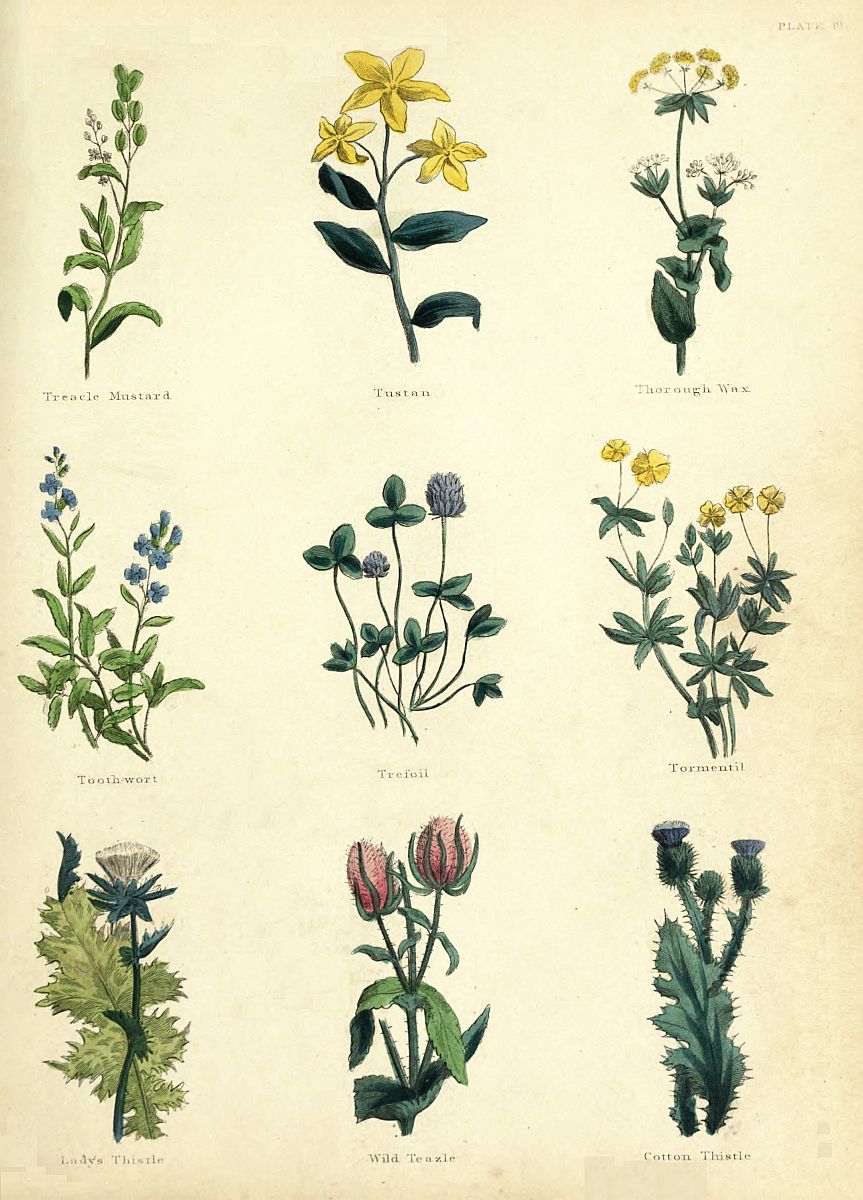
Treacle Mustard, Tustan, Thorough Wax; Tooth-wort, Trefoil, Tormentil; Lady’s Thistle, Wild Teazle, Cotton Thistle
Our Lady’s Thistle
Descript.] Our Lady’s Thistle hath divers very large and broad leaves lying on the ground cut in, and as it were crumpled, but somewhat hairy on the edges, of a white green shining colour, wherein are many lines and streaks of a milk white colour, running all over, and set with many sharp and stiff prickles all about, among which rises up one or more strong, round, and prickly stalks, set full of the like leaves up to the top, where at the end of every branch, comes forth a great prickly Thistle-like head, strongly armed with prickles, and with bright purple thumbs rising out of the middle; after they are past, the seed grows in the said heads, lying in soft white down, which is somewhat flattish in the ground, and many strings and fibres fastened thereunto. All the whole plant is bitter in taste.
Place.] It is frequent on the banks of almost every ditch.
Time.] It flowers and seeds in June, July, and August.
Government and virtues.] Our Lady’s Thistle is under Jupiter, and thought to be as effectual as Carduus Benedictus for agues, and to prevent and cure the infection of the plague: as also to open the obstructions of the liver and spleen, and thereby is good against the jaundice. It provokes urine, breaks and expels the stone, and is good for the dropsy. It is effectual also for the pains in the sides, and many other inward pains and gripings. The seed and distilled water is held powerful to all the purposes aforesaid, and besides, it is often applied both outwardly with cloths or spunges to the region of the liver, to cool the distemper thereof, and to the region of the heart, against swoonings and the passions of it. It cleanses the blood exceedingly: and in Spring, if you please to boil the tender plant (but cut off the prickles, unless you have a mind to choak yourself) it will change your blood as the season changes, and that is the way to be safe.
The Woollen, Or, Cotton Thistle
Descript.] This has many large leaves lying upon the ground, somewhat cut in, and as it were crumpled on the edges, of a green colour on the upper side, but covered over with a long hairy wool or cotton down, set with most sharp and cruel pricks; from the middle of whose heads of flowers come forth many purplish crimson threads, and sometimes white, although but seldom. The seed that follow in those white downy heads, is somewhat large and round, resembling the seed of Lady’s Thistle, but paler. The root is great and thick, spreading much, yet usually dies after seed time.
Place.] It grows on divers ditch-banks, and in the corn-fields, and highways, generally throughout the land, and is often growing in gardens.
Government and virtues.] It is a plant of Mars. Dioscorides and Pliny write, That the leaves and roots hereof taken in drink, help those that have a crick in their neck, that they cannot turn it, unless they turn their whole body. Galen saith, That the roots and leaves hereof are good for such persons that have their bodies drawn together by some spasm or convulsion, or other infirmities; as the rickets (or as the college of physicians would have it, Rachites, about which name they have quarrelled sufficiently) in children, being a disease that hinders their growth, by binding their nerves, ligaments, and whole structure of their body.
The Fuller’s Thistle, or Teasle
It is so well known, that it needs no description, being used with the clothworkers.
The wild Teasle is in all things like the former, but that the prickles are small, soft, and upright, not hooked or stiff, and the flowers of this are of a fine blueish, or pale carnation colour, but of the manured kind, whitish.
Place.] The first grows, being sown in gardens or fields for the use of clothworkers: The other near ditches and rills of water in many places of this land.
Time.] They flower in July, and are ripe in the end of August.
Government and virtues.] It is an herb of Venus. Dioscorides saith, That the root bruised and boiled in wine, till it be thick, and kept in a brazen vessel, and after spread as a salve, and applied to the fundament, doth heal the cleft thereof, cankers and fistulas therein, also takes away warts and wens. The juice of the leaves dropped into the ears, kills worms in them. The distilled water of the leaves dropped into the eyes, takes away redness and mists in them that hinder the sight, and is often used by women to preserve their beauty, and to take away redness and inflammations, and all other heat or discolourings.
Treacle Mustard
Descript.] It rises up with a hard round stalk, about a foot high, parted into some branches, having divers soft green leaves, long and narrow, set thereon, waved, but not cut into the edges, broadest towards the ends, somewhat round pointed; the flowers are white that grow at the tops of the branches, spike-fashion, one above another; after which come round pouches, parted in the middle with a furrow, having one blackish brown seed on either side, somewhat sharp in taste, and smelling of garlick, especially in the fields where it is natural, but not so much in gardens: The roots are small and thready, perishing every year.
Give me leave here to add Mithridate Mustard, although it may seem more properly by the name to belong to M, in the alphabet.
Mithridate Mustard
Descript.] This grows higher than the former, spreading more and higher branches, whose leaves are smaller and narrower, sometimes unevenly dented about the edges. The flowers are small and white, growing on long branches, with much smaller and rounder vessels after them, and parted in the same manner, having smaller brown seeds than the former, and much sharper in taste. The root perishes after seed time, but abides the first Winter after springing.
Place.] They grow in sundry places in this land, as half a mile from Hatfield, by the river side, under a hedge as you go to Hatfield, and in the street of Peckham on Surrey side.
Time.] They flower and seed from May to August.
Government and virtues.] Both of them are herbs of Mars. The Mustards are said to purge the body both upwards and downwards, and procure women’s courses so abundantly, that it suffocates the birth. It breaks inward imposthumes, being taken inwardly; and used in clysters, helps the sciatica. The seed applied, doth the same. It is an especial ingredient in mithridate and treacle, being of itself an antidote resisting poison, venom and putrefaction. It is also available in many cases for which the common Mustard is used, but somewhat weaker.
The Black Thorn, or Sloe-bush
It is so well known, that it needs no description.
Place.] It grows in every county in the hedges and borders of fields.
Time.] It flowers in April, and sometimes in March, but the fruit ripens after all other plums whatsoever, and is not fit to be eaten until the Autumn frost mellow them.
Government and virtues.] All the parts of the Sloe-Bush are binding, cooling, and dry, and all effectual to stay bleeding at the nose and mouth, or any other place; the lask of the belly or stomach, or the bloody flux, the too much abounding of women’s courses, and helps to ease the pains of the sides, and bowels, that come by overmuch scouring, to drink the decoction of the bark of the roots, or more usually the decoction of the berries, either fresh or dried. The conserve also is of very much use, and more familiarly taken for the purposes aforesaid. But the distilled water of the flower first steeped in sack for a night, and drawn therefrom by the heat of Balneum and Anglico, a bath, is a most certain remedy, tried and approved, to ease all manner of gnawings in the stomach, the sides and bowels, or any griping pains in any of them, to drink a small quantity when the extremity of pain is upon them. The leaves also are good to make lotions to gargle and wash the mouth and throat, wherein are swellings, sores, or kernels; and to stay the defluctions of rheum to the eyes, or other parts; as also to cool the heat and inflammations of them, and ease hot pains of the head, to bathe the forehead and temples therewith. The simple distilled water of the flowers is very effectual for the said purposes, and the condensate juice of the Sloes. The distilled water of the green berries is used also for the said effects.
Thorough Wax, or Thorough Leaf
Descript.] Common Thorough-Wax sends forth a strait round stalk, two feet high, or better, whose lower leaves being of a bluish colour, are smaller and narrower than those up higher, and stand close thereto, not compassing it; but as they grow higher, they do not encompass the stalks, until it wholly pass through them, branching toward the top into many parts, where the leaves grow smaller again, every one standing singly, and never two at a joint. The flowers are small and yellow, standing in tufts at the heads of the branches, where afterwards grow the seed, being blackish, many thick thrust together. The root is small, long and woody, perishing every year, after seed-time, and rising again plentifully of its own sowing.
Place.] It is found growing in many corn-fields and pasture grounds in this land.
Time.] It flowers in July, and the seed is ripe in August.
Government and virtues.] Both this and the former are under the influence of Saturn. Thorough-Wax is of singular good use for all sorts of bruises and wounds either inward or outward; and old ulcers and sores likewise, if the decoction of the herb with water and wine be drank, and the place washed therewith, or the juice of the green herb bruised, or boiled, either by itself, or with other herbs, in oil or hog’s grease, to be made into an ointment to serve all the year. The decoction of the herb, or powder of the dried herb, taken inwardly, and the same, or the leaves bruised, and applied outwardly, is singularly good for all ruptures and burstings, especially in children before they be too old. Being applied with a little flour and wax to children’s navels that stick forth, it helps them.
Thyme
It is in vain to describe an herb so commonly known.
Government and virtues.] It is a noble strengthener of the lungs, as notable a one as grows; neither is there scarce a better remedy growing for that disease in children which they commonly call the Chin-cough, than it is. It purges the body of phlegm, and is an excellent remedy for shortness of breath. It kills worms in the belly, and being a notable herb of Venus, provokes the terms, gives safe and speedy delivery to women in travail, and brings away the after birth. It is so harmless you need not fear the use of it. An ointment made of it takes away hot swellings and warts, helps the sciatica and dullness of sight, and takes away pains and hardness of the spleen. ’Tis excellent for those that are troubled with the gout. It eases pains in the loins and hips. The herb taken any way inwardly, comforts the stomach much, and expels wind.
Wild Thyme, or Mother of Thyme
Wild Thyme also is so well known, that it needs no description.
Place.] It may be found commonly in commons, and other barren places throughout the nation.
Government and virtues.] It is under the dominion of Venus, and under the sign Aries, and therefore chiefly appropriated to the head. It provokes urine and the terms, and eases the griping pain of the belly, cramps, ruptures, and inflamation of the liver. If you make a vinegar of the herb, as vinegar of roses is made (you may find out the way in my translation of the London Dispensatory) and anoint the head with it, it presently stops the pains thereof. It is excellently good to be given either in phrenzy or lethargy, although they are two contrary diseases: It helps spitting and voiding of blood, coughing, and vomiting; it comforts and strengthens the head, stomach, reins, and womb, expels wind, and breaks the stone.
Tormentil, or Septfoil
Descript.] This hath reddish, slender, weak branches rising from the root, lying on the ground, rather leaning than standing upright, with many short leaves that stand closer to the stalk than cinquefoil (to which this is very like) with the root-stalk compassing the branches in several places; but those that grow to the ground are set upon long foot stalks, each whereof are like the leaves of cinquefoil, but somewhat long and lesser dented about the edges, many of them divided into five leaves, but most of them into seven, whence it is also called Septfoil; yet some may have six, and some eight, according to the fertility of the soil. At the tops of the branches stand divers small yellow flowers, consisting of five leaves, like those of cinquefoil, but smaller. The root is smaller than bistort, somewhat thick, but blacker without, and not so red within, yet sometimes a little crooked, having blackish fibres thereat.
Place.] It grows as well in woods and shadowy places, as in the open champain country, about the borders of fields in many places of this land, and almost in every broom field in Essex.
Time.] It flowers all the Summer long.
Government and virtues.] This is a gallant herb of the Sun. Tormentil is most excellent to stay all kind of fluxes of blood or humours in man or woman, whether at nose, mouth, or belly. The juice of the herb and root, or the decoction thereof, taken with some Venice treacle, and the person laid to sweat, expels any venom or poison, or the plague, fever, or other contagious diseases, as pox, measles, &c. for it is an ingredient in all antidotes or counter poisons. Andreas Urlesius is of opinion that the decoction of this root is no less effectual to cure the French pox than Guiacum or China; and it is not unlikely, because it so mightily resists putrefaction. The root taken inwardly is most effectual to help any flux of the belly, stomach, spleen, or blood; and the juice wonderfully opens obstructions of the liver and lungs, and thereby helps the yellow jaundice. The powder or decoction drank, or to sit thereon as a bath, is an assured remedy against abortion, if it proceed from the over flexibility or weakness of the inward retentive faculty; as also a plaster made therewith, and vinegar applied to the reins of the back, doth much help not only this, but also those that cannot hold their water, the powder being taken in the juice of plantain, and is also commended against the worms in children. It is very powerful in ruptures and burstings, as also for bruises and falls, to be used as well outwardly as inwardly. The root hereof made up with pellitory of Spain and allum, and put into a hollow tooth, not only assuages the pain, but stays the flux of humours which causes it. Tormentil is no less effectual and powerful a remedy against outward wounds, sores and hurts, than for inward, and is therefore a special ingredient to be used in wound drinks, lotions and injections, for foul corrupt rotten sores and ulcers of the mouth, secrets, or other parts of the body. The juice or powder of the root put in ointments, plaisters, and such things that are to be applied to wounds or sores, is very effectual, as the juice of the leaves and the root bruised and applied to the throat or jaws, heals the king’s evil, and eases the pain of the sciatica; the same used with a little vinegar, is a special remedy against the running sores of the head or other parts; scabs also, and the itch or any such eruptions in the skin, proceeding of salt and sharp humours. The same is also effectual for the piles or hæmorrhoids, if they be washed or bathed therewith, or with the distilled water of the herb and roots. It is found also helpful to dry up any sharp rheum that distills from the head into the eyes, causing redness, pain, waterings, itching, or the like, if a little prepared tutia, or white amber, be used with the distilled water thereof. And here is enough, only remember the Sun challengeth this herb.
Turnsole, or Heliotropium
Descript.] The greater Turnsole rises with one upright stalk, about a foot high, or more, dividing itself almost from the bottom, into divers small branches, of a hoary colour; at each joint of the stalk and branches grow small broad leaves, somewhat white and hairy. At the tops of the stalks and branches stand small white flowers, consisting of four, and sometimes five small leaves, set in order one above another, upon a small crooked spike, which turns inwards like a bowed finger, opening by degrees as the flowers blow open; after which in their place come forth cornered seed, four for the most part standing together; the root is small and thready, perishing every year, and the seed shedding every year, raises it again the next spring.
Place.] It grows in gardens, and flowers and seeds with us, notwithstanding it is not natural to this land, but to Italy, Spain, and France, where it grows plentifully.
Government and virtues.] It is an herb of the Sun, and a good one too. Dioscorides saith, That a good handful of this, which is called the Great Turnsole, boiled in water, and drank, purges both choler and phlegm; and boiled with cummin, helps the stone in the reins, kidneys, or bladder, provokes urine and women’s courses, and causes an easy and speedy delivery in child-birth. The leaves bruised and applied to places pained with the gout, or that have been out of joint and newly set, and full of pain, do give much ease; the seed and juice of the leaves also being rubbed with a little salt upon warts and wens, and other kernels in the face, eye-lids, or any other part of the body, will, by often using, take them away.
Meadow Trefoil, or Honeysuckles
It is so well known, especially by the name of Honeysuckles, white and red, that I need not describe them.
Place.] They grow almost every where in this land.
Government and virtues.] Mercury hath dominion over the common sort. Dodoneus saith, The leaves and flowers are good to ease the griping pains of the gout, the herb being boiled and used in a clyster. If the herb be made into a poultice, and applied to inflammations, it will ease them. The juice dropped in the eyes, is a familiar medicine, with many country people, to take away the pin and web (as they call it) in the eyes; it also allays the heat and blood shooting of them. Country people do also in many places drink the juice thereof against the biting of an adder; and having boiled the herb in water, they first wash the place with the decoction, and then lay some of the herb also to the hurt place. The herb also boiled in swine’s grease, and so made into an ointment, is good to apply to the biting of any venomous creature. The herb also bruised and heated between tiles, and applied hot to the share, causes them to make water who had it stopt before. It is held likewise to be good for wounds, and to take away seed. The decoction of the herb and flowers, with the seed and root, taken for some time, helps women that are troubled with the whites. The seed and flowers boiled in water, and afterwards made into a poultice with some oil, and applied, helps hard swellings and imposthumes.
Heart Trefoil
Besides the ordinary sort of Trefoil, here are two more remarkable, and one of which may be properly called Heart Trefoil, not only because the leaf is triangular, like the heart of a man, but also because each leaf contains the perfection of a heart, and that in its proper colour, viz. a flesh colour.
Place.] It grows between Longford and Bow, and beyond Southwark, by the highway and parts adjacent.
Government and virtues.] It is under the dominion of the Sun, and if it were used, it would be found as great a strengthener of the heart, and cherisher of the vital spirits as grows, relieving the body against fainting and swoonings, fortifying it against poison and pestilence, defending the heart against the noisome vapours of the spleen.
Pearl Trefoil
It differs not from the common sort, save only in this particular, it hath a white spot in the leaf like a pearl. It is particularly under the dominion of the Moon, and its icon shews that it is of a singular virtue against the pearl, or pin and web in the eyes.
Tustan, or Park Leaves
Descript.] It hath brownish shining round stalks, crested the length thereof, rising two by two, and sometimes three feet high, branching forth even from the bottom, having divers joints, and at each of them two fair large leaves standing, of a dark blueish green colour on the upper side, and of a yellowish green underneath, turning reddish toward Autumn. At the top of the stalks stand large yellow flowers, and heads with seed, which being greenish at the first and afterwards reddish, turn to be of a blackish purple colour when they are ripe, with small brownish seed within them, and they yield a reddish juice or liquor, somewhat resinous, and of a harsh and stypick taste, as the leaves also and the flowers be, although much less, but do not yield such a clear claret wine colour, as some say it doth, the root is brownish, somewhat great, hard and woody, spreading well in the ground.
Place.] It grows in many woods, groves, and woody grounds, as parks and forests, and by hedge-sides in many places in this land, as in Hampstead wood, by Ratley in Essex, in the wilds of Kent, and in many other places needless to recite.
Time.] It flowers later than St. John’s or St. Peter’s-wort.
Government and virtues.] It is an herb of Saturn, and a most noble anti-venerean. Tustan purges choleric humours, as St. Peter’s-wort, is said to do, for therein it works the same effects, both to help the sciatica and gout, and to heal burning by fire; it stays all the bleedings of wounds, if either the green herb be bruised, or the powder of the dry be applied thereto. It hath been accounted, and certainly it is, a sovereign herb to heal either wound or sore, either outwardly or inwardly, and therefore always used in drinks, lotions, balms, oils, ointments, or any other sorts of green wounds, ulcers, or old sores, in all which the continual experience of former ages hath confirmed the use thereof to be admirably good, though it be not so much in use now, as when physicians and surgeons were so wise as to use herbs more than now they do.
The end of T: English Tobacco to Tustan.
Turn the page for Garden Valerian to Viper’s Bugloss.
Tap or click the right-hand side of the book to turn the page, the left to turn back; or use the arrow keys, or swipe. Press F for full screen.
The English Physician Enlarged · T
English Tobacco to Tustan
English Tobacco
Descript.] This rises up with a round thick stalk, about two feet high, whereon do grow thick, flat green leaves, nothing so large as the other Indian kind, somewhat round pointed also, and nothing dented about the edges. The stalk branches forth, and bears at the tops divers flowers set on great husks like the other, but nothing so large: scarce standing above the brims of the husks, round pointed also, and of a greenish yellow colour. The seed that follows is not so bright, but larger, contained in the like great heads. The roots are neither so great nor woody; it perishes every year with the hard frosts in Winter, but rises generally from its own sowing.
Place.] This came from some parts of Brazil, as it is thought, and is more familiar in our country than any of the other sorts; early giving ripe seed, which the others seldom do.
Time.] It flowers from June, sometimes to the end of August, or later, and the seed ripens in the mean time.
Government and virtues.] It is a martial plant. It is found by good experience to be available to expectorate tough phlegm from the stomach, chest, and lungs. The juice thereof made into a syrup, or the distilled water of the herb drank with some sugar, or without, if you will, or the smoak taken by a pipe, as is usual, but fainting, helps to expel worms in the stomach and belly, and to ease the pains in the head, or megrim, and the griping pains in the bowels. It is profitable for those that are troubled with the stone in the kidneys, both to ease the pains by provoking urine, and also to expel gravel and the stone engendered therein, and hath been found very effectual to expel windiness, and other humours, which cause the strangling of the mother. The seed hereof is very effectual to expel the tooth ache, and the ashes of the burnt herb to cleanse the gums, and make the teeth white. The herb bruised and applied to the place grieved with the king’s evil, helps it in nine or ten days effectually. Monardus saith, it is a counter poison against the biting of any venomous creature, the herb also being outwardly applied to the hurt place. The distilled water is often given with some sugar before the fit of an ague, to lessen it, and take it away in three or four times using. If the distilled fæces of the herb, having been bruised before the distillation, and not distilled dry, be set in warm dung for fourteen days, and afterwards be hung in a bag in a wine cellar, the liquor that distills therefrom is singularly good to use in cramps, aches, the gout and sciatica, and to heal itches, scabs, and running ulcers, cankers, and all foul sores whatsoever. The juice is also good for all the said griefs, and likewise to kill lice in children’s heads. The green herb bruised and applied to any green wounds, cures any fresh wound or cut whatsoever: and the juice put into old sores, both cleanses and heals them. There is also made hereof a singularly good salve to help imposthumes, hard tumours, and other swellings by blows and falls.
The Tamarisk Tree
It is so well known in the place where it grows, that it needs no description.
Time.] It flowers about the end of May, or June, and the seed is ripe and blown away in the beginning of September.
Government and virtues.] A gallant Saturnine herb it is. The root, leaves, young branches, or bark boiled in wine, and drank, stays the bleeding of the hæmorrhodical veins, the spitting of blood, the too abounding of women’s courses, the jaundice, the cholic, and the biting of all venomous serpents, except the asp; and outwardly applied, is very powerful against the hardness of the spleen, and the tooth-ache, pains in the ears, red and watering eyes. The decoction, with some honey put thereto, is good to stay gangrenes and fretting ulcers, and to wash those that are subject to nits and lice. Alpinus and Veslingius affirm, That the Egyptians do with good success use the wood of it to cure the French disease, as others do with lignum vitæ or guiacum; and give it also to those who have the leprosy, scabs, ulcers, or the like. Its ashes doth quickly heal blisters raised by burnings or scaldings. It helps the dropsy, arising from the hardness of the spleen, and therefore to drink out of cups made of the wood is good for splenetic persons. It is also helpful for melancholy, and the black jaundice that arise thereof.
Garden Tansy
Garden Tansy is so well known, that it needs no description.
Time.] It flowers in June and July.
Government and virtues.] Dame Venus was minded to pleasure women with child by this herb, for there grows not an herb, fitter for their use than this is; it is just as though it were cut out for the purpose. This herb bruised and applied to the navel, stays miscarriages; I know no herb like it for that use: Boiled in ordinary beer, and the decoction drank, doth the like; and if her womb be not as she would have it, this decoction will make it so. Let those women that desire children love this herb, it is their best companion, their husbands excepted. Also it consumes the phlegmatic humours, the cold and moist constitution of Winter most usually affects the body of man with, and that was the first reason of eating tansies in the Spring. The decoction of the common Tansy, or the juice drank in wine, is a singular remedy for all the griefs that come by slopping of the urine, helps the stranguary and those that have weak reins and kidneys. It is also very profitable to dissolve and expel wind in the stomach, belly, or bowels, to procure women’s courses, and expel windiness in the matrix, if it be bruised and often smelled unto, as also applied to the lower part of the belly. It is also very profitable for such women as are given to miscarry. It is used also against the stone in the reins, especially to men. The herb fried with eggs (as it is the custom in the Spring-time) which is called a Tansy, helps to digest and carry downward those bad humours that trouble the stomach. The seed is very profitably given to children for the worms, and the juice in drink is as effectual. Being boiled in oil, it is good for the sinews shrunk by cramps, or pained with colds, if thereto applied.
Wild Tansy, or Silver Weed
This is also so well known, that it needs no description.
Place.] It grows in every place.
Time.] It flowers in June and July.
Government and virtues.] Now Dame Venus hath fitted women with two herbs of one name, the one to help conception, and the other to maintain beauty, and what more can be expected of her? What now remains for you, but to love your husbands, and not to be wanting to your poor neighbours? Wild Tansy stays the lask, and all the fluxes of blood in men and women, which some say it will do, if the green herb be worn in the shoes, so it be next the skin; and it is true enough, that it will stop the terms, if worn so, and the whites too, for ought I know. It stays also spitting or vomiting of blood. The powder of the herb taken in some of the distilled water, helps the whites in women, but more especially if a little coral and ivory in powder be put to it. It is also recommended to help children that are bursten, and have a rupture, being boiled in water and salt. Being boiled in water and drank, it eases the griping pains of the bowels, and is good for the sciatica and joint-aches. The same boiled in vinegar, with honey and allum, and gargled in the mouth, eases the pains of the tooth-ache, fastens loose teeth, helps the gums that are sore, and settles the palate of the mouth in its place, when it is fallen down. It cleanses and heals ulcers in the mouth, or secret parts, and is very good for inward wounds, and to close the lips of green wounds, and to heal old, moist, and corrupt running sores in the legs or elsewhere. Being bruised and applied to the soles of the feet and hand wrists, it wonderfully cools the hot fits of agues, be they never so violent. The distilled water cleanses the skin of all discolourings therein, as morphew, sun-burnings, &c. as also pimples, freckles, and the like; and dropped into the eyes, or cloths wet therein and applied, takes away the heat and inflammations in them.
Thistles
Of these are many kinds growing here in England which are so well known, that they need no description: Their difference is easily known on the places where they grow, viz.
Place.] Some grow in fields, some in meadows, and some among the corn; others on heaths, greens, and waste grounds in many places.
Time.] They flower in June and August and their seed is ripe quickly after.
Government and virtues.] Surely Mars rules it, it is such a prickly business. All these thistles are good to provoke urine, and to mend the stinking smell thereof; as also the rank smell of the arm-pits, or the whole body; being boiled in wine and drank, and are said to help a stinking breath, and to strengthen the stomach. Pliny saith, That the juice bathed on the place that wants hair, it being fallen off, will cause it to grow speedily.
The Melancholy Thistle
Descript.] It rises up with tender single hoary green stalks, bearing thereon four or five green leaves, dented about the edges; the points thereof are little or nothing prickly, and at the top usually but one head, yet sometimes from the bosom of the uppermost leaves there shoots forth another small head, scaly and prickly, with many reddish thrumbs or threads in the middle, which being gathered fresh, will keep the colour a long time, and fades not from the stalk a long time, while it perfects the seed, which is of a mean bigness, lying in the down. The root hath many strings fastened to the head, or upper part, which is blackish, and perishes not.
There is another sort little differing from the former, but that the leaves are more green above, and more hoary underneath, and the stalk being about two feet high, bears but one scaly head, with threads and seeds as the former.
Place.] They grow in many moist meadows of this land, as well in the southern, as in the northern parts.
Time.] They flower about July or August, and their seed ripens quickly after.
Government and virtues.] It is under Capricorn, and therefore under both Saturn and Mars, one rids melancholy by sympathy, the other by antipathy. Their virtues are but few, but those not to be despised; for the decoction of the thistle in wine being drank, expels superfluous melancholy out of the body, and makes a man as merry as a cricket; superfluous melancholy causes care, fear, sadness, despair, envy, and many evils more besides; but religion teaches to wait upon God’s providence, and cast our care upon him who cares for us. What a fine thing were it if men and women could live so? And yet seven years’ care and fear makes a man never the wiser, nor a farthing richer. Dioscorides saith, the root borne about one doth the like, and removes all diseases of melancholy. Modern writers laugh at him; Let them laugh that win: my opinion is, that it is the best remedy against all melancholy diseases that grows; they that please may use it.
Treacle Mustard, Tustan, Thorough Wax; Tooth-wort, Trefoil, Tormentil; Lady’s Thistle, Wild Teazle, Cotton Thistle
Our Lady’s Thistle
Descript.] Our Lady’s Thistle hath divers very large and broad leaves lying on the ground cut in, and as it were crumpled, but somewhat hairy on the edges, of a white green shining colour, wherein are many lines and streaks of a milk white colour, running all over, and set with many sharp and stiff prickles all about, among which rises up one or more strong, round, and prickly stalks, set full of the like leaves up to the top, where at the end of every branch, comes forth a great prickly Thistle-like head, strongly armed with prickles, and with bright purple thumbs rising out of the middle; after they are past, the seed grows in the said heads, lying in soft white down, which is somewhat flattish in the ground, and many strings and fibres fastened thereunto. All the whole plant is bitter in taste.
Place.] It is frequent on the banks of almost every ditch.
Time.] It flowers and seeds in June, July, and August.
Government and virtues.] Our Lady’s Thistle is under Jupiter, and thought to be as effectual as Carduus Benedictus for agues, and to prevent and cure the infection of the plague: as also to open the obstructions of the liver and spleen, and thereby is good against the jaundice. It provokes urine, breaks and expels the stone, and is good for the dropsy. It is effectual also for the pains in the sides, and many other inward pains and gripings. The seed and distilled water is held powerful to all the purposes aforesaid, and besides, it is often applied both outwardly with cloths or spunges to the region of the liver, to cool the distemper thereof, and to the region of the heart, against swoonings and the passions of it. It cleanses the blood exceedingly: and in Spring, if you please to boil the tender plant (but cut off the prickles, unless you have a mind to choak yourself) it will change your blood as the season changes, and that is the way to be safe.
The Woollen, Or, Cotton Thistle
Descript.] This has many large leaves lying upon the ground, somewhat cut in, and as it were crumpled on the edges, of a green colour on the upper side, but covered over with a long hairy wool or cotton down, set with most sharp and cruel pricks; from the middle of whose heads of flowers come forth many purplish crimson threads, and sometimes white, although but seldom. The seed that follow in those white downy heads, is somewhat large and round, resembling the seed of Lady’s Thistle, but paler. The root is great and thick, spreading much, yet usually dies after seed time.
Place.] It grows on divers ditch-banks, and in the corn-fields, and highways, generally throughout the land, and is often growing in gardens.
Government and virtues.] It is a plant of Mars. Dioscorides and Pliny write, That the leaves and roots hereof taken in drink, help those that have a crick in their neck, that they cannot turn it, unless they turn their whole body. Galen saith, That the roots and leaves hereof are good for such persons that have their bodies drawn together by some spasm or convulsion, or other infirmities; as the rickets (or as the college of physicians would have it, Rachites, about which name they have quarrelled sufficiently) in children, being a disease that hinders their growth, by binding their nerves, ligaments, and whole structure of their body.
The Fuller’s Thistle, or Teasle
It is so well known, that it needs no description, being used with the clothworkers.
The wild Teasle is in all things like the former, but that the prickles are small, soft, and upright, not hooked or stiff, and the flowers of this are of a fine blueish, or pale carnation colour, but of the manured kind, whitish.
Place.] The first grows, being sown in gardens or fields for the use of clothworkers: The other near ditches and rills of water in many places of this land.
Time.] They flower in July, and are ripe in the end of August.
Government and virtues.] It is an herb of Venus. Dioscorides saith, That the root bruised and boiled in wine, till it be thick, and kept in a brazen vessel, and after spread as a salve, and applied to the fundament, doth heal the cleft thereof, cankers and fistulas therein, also takes away warts and wens. The juice of the leaves dropped into the ears, kills worms in them. The distilled water of the leaves dropped into the eyes, takes away redness and mists in them that hinder the sight, and is often used by women to preserve their beauty, and to take away redness and inflammations, and all other heat or discolourings.
Treacle Mustard
Descript.] It rises up with a hard round stalk, about a foot high, parted into some branches, having divers soft green leaves, long and narrow, set thereon, waved, but not cut into the edges, broadest towards the ends, somewhat round pointed; the flowers are white that grow at the tops of the branches, spike-fashion, one above another; after which come round pouches, parted in the middle with a furrow, having one blackish brown seed on either side, somewhat sharp in taste, and smelling of garlick, especially in the fields where it is natural, but not so much in gardens: The roots are small and thready, perishing every year.
Give me leave here to add Mithridate Mustard, although it may seem more properly by the name to belong to M, in the alphabet.
Mithridate Mustard
Descript.] This grows higher than the former, spreading more and higher branches, whose leaves are smaller and narrower, sometimes unevenly dented about the edges. The flowers are small and white, growing on long branches, with much smaller and rounder vessels after them, and parted in the same manner, having smaller brown seeds than the former, and much sharper in taste. The root perishes after seed time, but abides the first Winter after springing.
Place.] They grow in sundry places in this land, as half a mile from Hatfield, by the river side, under a hedge as you go to Hatfield, and in the street of Peckham on Surrey side.
Time.] They flower and seed from May to August.
Government and virtues.] Both of them are herbs of Mars. The Mustards are said to purge the body both upwards and downwards, and procure women’s courses so abundantly, that it suffocates the birth. It breaks inward imposthumes, being taken inwardly; and used in clysters, helps the sciatica. The seed applied, doth the same. It is an especial ingredient in mithridate and treacle, being of itself an antidote resisting poison, venom and putrefaction. It is also available in many cases for which the common Mustard is used, but somewhat weaker.
The Black Thorn, or Sloe-bush
It is so well known, that it needs no description.
Place.] It grows in every county in the hedges and borders of fields.
Time.] It flowers in April, and sometimes in March, but the fruit ripens after all other plums whatsoever, and is not fit to be eaten until the Autumn frost mellow them.
Government and virtues.] All the parts of the Sloe-Bush are binding, cooling, and dry, and all effectual to stay bleeding at the nose and mouth, or any other place; the lask of the belly or stomach, or the bloody flux, the too much abounding of women’s courses, and helps to ease the pains of the sides, and bowels, that come by overmuch scouring, to drink the decoction of the bark of the roots, or more usually the decoction of the berries, either fresh or dried. The conserve also is of very much use, and more familiarly taken for the purposes aforesaid. But the distilled water of the flower first steeped in sack for a night, and drawn therefrom by the heat of Balneum and Anglico, a bath, is a most certain remedy, tried and approved, to ease all manner of gnawings in the stomach, the sides and bowels, or any griping pains in any of them, to drink a small quantity when the extremity of pain is upon them. The leaves also are good to make lotions to gargle and wash the mouth and throat, wherein are swellings, sores, or kernels; and to stay the defluctions of rheum to the eyes, or other parts; as also to cool the heat and inflammations of them, and ease hot pains of the head, to bathe the forehead and temples therewith. The simple distilled water of the flowers is very effectual for the said purposes, and the condensate juice of the Sloes. The distilled water of the green berries is used also for the said effects.
Thorough Wax, or Thorough Leaf
Descript.] Common Thorough-Wax sends forth a strait round stalk, two feet high, or better, whose lower leaves being of a bluish colour, are smaller and narrower than those up higher, and stand close thereto, not compassing it; but as they grow higher, they do not encompass the stalks, until it wholly pass through them, branching toward the top into many parts, where the leaves grow smaller again, every one standing singly, and never two at a joint. The flowers are small and yellow, standing in tufts at the heads of the branches, where afterwards grow the seed, being blackish, many thick thrust together. The root is small, long and woody, perishing every year, after seed-time, and rising again plentifully of its own sowing.
Place.] It is found growing in many corn-fields and pasture grounds in this land.
Time.] It flowers in July, and the seed is ripe in August.
Government and virtues.] Both this and the former are under the influence of Saturn. Thorough-Wax is of singular good use for all sorts of bruises and wounds either inward or outward; and old ulcers and sores likewise, if the decoction of the herb with water and wine be drank, and the place washed therewith, or the juice of the green herb bruised, or boiled, either by itself, or with other herbs, in oil or hog’s grease, to be made into an ointment to serve all the year. The decoction of the herb, or powder of the dried herb, taken inwardly, and the same, or the leaves bruised, and applied outwardly, is singularly good for all ruptures and burstings, especially in children before they be too old. Being applied with a little flour and wax to children’s navels that stick forth, it helps them.
Thyme
It is in vain to describe an herb so commonly known.
Government and virtues.] It is a noble strengthener of the lungs, as notable a one as grows; neither is there scarce a better remedy growing for that disease in children which they commonly call the Chin-cough, than it is. It purges the body of phlegm, and is an excellent remedy for shortness of breath. It kills worms in the belly, and being a notable herb of Venus, provokes the terms, gives safe and speedy delivery to women in travail, and brings away the after birth. It is so harmless you need not fear the use of it. An ointment made of it takes away hot swellings and warts, helps the sciatica and dullness of sight, and takes away pains and hardness of the spleen. ’Tis excellent for those that are troubled with the gout. It eases pains in the loins and hips. The herb taken any way inwardly, comforts the stomach much, and expels wind.
Wild Thyme, or Mother of Thyme
Wild Thyme also is so well known, that it needs no description.
Place.] It may be found commonly in commons, and other barren places throughout the nation.
Government and virtues.] It is under the dominion of Venus, and under the sign Aries, and therefore chiefly appropriated to the head. It provokes urine and the terms, and eases the griping pain of the belly, cramps, ruptures, and inflamation of the liver. If you make a vinegar of the herb, as vinegar of roses is made (you may find out the way in my translation of the London Dispensatory) and anoint the head with it, it presently stops the pains thereof. It is excellently good to be given either in phrenzy or lethargy, although they are two contrary diseases: It helps spitting and voiding of blood, coughing, and vomiting; it comforts and strengthens the head, stomach, reins, and womb, expels wind, and breaks the stone.
Tormentil, or Septfoil
Descript.] This hath reddish, slender, weak branches rising from the root, lying on the ground, rather leaning than standing upright, with many short leaves that stand closer to the stalk than cinquefoil (to which this is very like) with the root-stalk compassing the branches in several places; but those that grow to the ground are set upon long foot stalks, each whereof are like the leaves of cinquefoil, but somewhat long and lesser dented about the edges, many of them divided into five leaves, but most of them into seven, whence it is also called Septfoil; yet some may have six, and some eight, according to the fertility of the soil. At the tops of the branches stand divers small yellow flowers, consisting of five leaves, like those of cinquefoil, but smaller. The root is smaller than bistort, somewhat thick, but blacker without, and not so red within, yet sometimes a little crooked, having blackish fibres thereat.
Place.] It grows as well in woods and shadowy places, as in the open champain country, about the borders of fields in many places of this land, and almost in every broom field in Essex.
Time.] It flowers all the Summer long.
Government and virtues.] This is a gallant herb of the Sun. Tormentil is most excellent to stay all kind of fluxes of blood or humours in man or woman, whether at nose, mouth, or belly. The juice of the herb and root, or the decoction thereof, taken with some Venice treacle, and the person laid to sweat, expels any venom or poison, or the plague, fever, or other contagious diseases, as pox, measles, &c. for it is an ingredient in all antidotes or counter poisons. Andreas Urlesius is of opinion that the decoction of this root is no less effectual to cure the French pox than Guiacum or China; and it is not unlikely, because it so mightily resists putrefaction. The root taken inwardly is most effectual to help any flux of the belly, stomach, spleen, or blood; and the juice wonderfully opens obstructions of the liver and lungs, and thereby helps the yellow jaundice. The powder or decoction drank, or to sit thereon as a bath, is an assured remedy against abortion, if it proceed from the over flexibility or weakness of the inward retentive faculty; as also a plaster made therewith, and vinegar applied to the reins of the back, doth much help not only this, but also those that cannot hold their water, the powder being taken in the juice of plantain, and is also commended against the worms in children. It is very powerful in ruptures and burstings, as also for bruises and falls, to be used as well outwardly as inwardly. The root hereof made up with pellitory of Spain and allum, and put into a hollow tooth, not only assuages the pain, but stays the flux of humours which causes it. Tormentil is no less effectual and powerful a remedy against outward wounds, sores and hurts, than for inward, and is therefore a special ingredient to be used in wound drinks, lotions and injections, for foul corrupt rotten sores and ulcers of the mouth, secrets, or other parts of the body. The juice or powder of the root put in ointments, plaisters, and such things that are to be applied to wounds or sores, is very effectual, as the juice of the leaves and the root bruised and applied to the throat or jaws, heals the king’s evil, and eases the pain of the sciatica; the same used with a little vinegar, is a special remedy against the running sores of the head or other parts; scabs also, and the itch or any such eruptions in the skin, proceeding of salt and sharp humours. The same is also effectual for the piles or hæmorrhoids, if they be washed or bathed therewith, or with the distilled water of the herb and roots. It is found also helpful to dry up any sharp rheum that distills from the head into the eyes, causing redness, pain, waterings, itching, or the like, if a little prepared tutia, or white amber, be used with the distilled water thereof. And here is enough, only remember the Sun challengeth this herb.
Turnsole, or Heliotropium
Descript.] The greater Turnsole rises with one upright stalk, about a foot high, or more, dividing itself almost from the bottom, into divers small branches, of a hoary colour; at each joint of the stalk and branches grow small broad leaves, somewhat white and hairy. At the tops of the stalks and branches stand small white flowers, consisting of four, and sometimes five small leaves, set in order one above another, upon a small crooked spike, which turns inwards like a bowed finger, opening by degrees as the flowers blow open; after which in their place come forth cornered seed, four for the most part standing together; the root is small and thready, perishing every year, and the seed shedding every year, raises it again the next spring.
Place.] It grows in gardens, and flowers and seeds with us, notwithstanding it is not natural to this land, but to Italy, Spain, and France, where it grows plentifully.
Government and virtues.] It is an herb of the Sun, and a good one too. Dioscorides saith, That a good handful of this, which is called the Great Turnsole, boiled in water, and drank, purges both choler and phlegm; and boiled with cummin, helps the stone in the reins, kidneys, or bladder, provokes urine and women’s courses, and causes an easy and speedy delivery in child-birth. The leaves bruised and applied to places pained with the gout, or that have been out of joint and newly set, and full of pain, do give much ease; the seed and juice of the leaves also being rubbed with a little salt upon warts and wens, and other kernels in the face, eye-lids, or any other part of the body, will, by often using, take them away.
Meadow Trefoil, or Honeysuckles
It is so well known, especially by the name of Honeysuckles, white and red, that I need not describe them.
Place.] They grow almost every where in this land.
Government and virtues.] Mercury hath dominion over the common sort. Dodoneus saith, The leaves and flowers are good to ease the griping pains of the gout, the herb being boiled and used in a clyster. If the herb be made into a poultice, and applied to inflammations, it will ease them. The juice dropped in the eyes, is a familiar medicine, with many country people, to take away the pin and web (as they call it) in the eyes; it also allays the heat and blood shooting of them. Country people do also in many places drink the juice thereof against the biting of an adder; and having boiled the herb in water, they first wash the place with the decoction, and then lay some of the herb also to the hurt place. The herb also boiled in swine’s grease, and so made into an ointment, is good to apply to the biting of any venomous creature. The herb also bruised and heated between tiles, and applied hot to the share, causes them to make water who had it stopt before. It is held likewise to be good for wounds, and to take away seed. The decoction of the herb and flowers, with the seed and root, taken for some time, helps women that are troubled with the whites. The seed and flowers boiled in water, and afterwards made into a poultice with some oil, and applied, helps hard swellings and imposthumes.
Heart Trefoil
Besides the ordinary sort of Trefoil, here are two more remarkable, and one of which may be properly called Heart Trefoil, not only because the leaf is triangular, like the heart of a man, but also because each leaf contains the perfection of a heart, and that in its proper colour, viz. a flesh colour.
Place.] It grows between Longford and Bow, and beyond Southwark, by the highway and parts adjacent.
Government and virtues.] It is under the dominion of the Sun, and if it were used, it would be found as great a strengthener of the heart, and cherisher of the vital spirits as grows, relieving the body against fainting and swoonings, fortifying it against poison and pestilence, defending the heart against the noisome vapours of the spleen.
Pearl Trefoil
It differs not from the common sort, save only in this particular, it hath a white spot in the leaf like a pearl. It is particularly under the dominion of the Moon, and its icon shews that it is of a singular virtue against the pearl, or pin and web in the eyes.
Tustan, or Park Leaves
Descript.] It hath brownish shining round stalks, crested the length thereof, rising two by two, and sometimes three feet high, branching forth even from the bottom, having divers joints, and at each of them two fair large leaves standing, of a dark blueish green colour on the upper side, and of a yellowish green underneath, turning reddish toward Autumn. At the top of the stalks stand large yellow flowers, and heads with seed, which being greenish at the first and afterwards reddish, turn to be of a blackish purple colour when they are ripe, with small brownish seed within them, and they yield a reddish juice or liquor, somewhat resinous, and of a harsh and stypick taste, as the leaves also and the flowers be, although much less, but do not yield such a clear claret wine colour, as some say it doth, the root is brownish, somewhat great, hard and woody, spreading well in the ground.
Place.] It grows in many woods, groves, and woody grounds, as parks and forests, and by hedge-sides in many places in this land, as in Hampstead wood, by Ratley in Essex, in the wilds of Kent, and in many other places needless to recite.
Time.] It flowers later than St. John’s or St. Peter’s-wort.
Government and virtues.] It is an herb of Saturn, and a most noble anti-venerean. Tustan purges choleric humours, as St. Peter’s-wort, is said to do, for therein it works the same effects, both to help the sciatica and gout, and to heal burning by fire; it stays all the bleedings of wounds, if either the green herb be bruised, or the powder of the dry be applied thereto. It hath been accounted, and certainly it is, a sovereign herb to heal either wound or sore, either outwardly or inwardly, and therefore always used in drinks, lotions, balms, oils, ointments, or any other sorts of green wounds, ulcers, or old sores, in all which the continual experience of former ages hath confirmed the use thereof to be admirably good, though it be not so much in use now, as when physicians and surgeons were so wise as to use herbs more than now they do.
21 of 42 · 26 min read