The English Physician Enlarged · S
Saffron to Stone-crop
Saffron
The herb needs no description, it being known generally where it grows.
Place.] It grows frequently at Walden in Essex, and in Cambridgeshire.
Government and virtues.] It is an herb of the Sun, and under the Lion, and therefore you need not demand a reason why it strengthens the heart so exceedingly. Let not above ten grains be given at one time, for the Sun, which is the fountain of light, may dazzle the eyes, and make them blind; a cordial being taken in an immoderate quantity, hurts the heart instead of helping it. It quickens the brain, for the Sun is exalted in Aries, as he hath his house in Leo. It helps consumptions of the lungs, and difficulty of breathing. It is excellent in epidemical diseases, as pestilence, small-pox, and measles. It is a notable expulsive medicine, and a notable remedy for the yellow jaundice. My opinion is, (but I have no author for it) that hermodactyls are nothing else but the roots of Saffron dried; and my reason is, that the roots of all crocus, both white and yellow, purge phlegm as hermodactyls do; and if you please to dry the roots of any crocus, neither your eyes nor your taste shall distinguish them from hermodactyls.
Sage
Our ordinary garden Sage needs no description.
Time.] It flowers in or about July.
Government and virtues.] Jupiter claims this, and bids me tell you, it is good for the liver, and to breed blood. A decoction of the leaves and branches of Sage made and drank, saith Dioscorides, provokes urine, brings down women’s courses, helps to expel the dead child, and causes the hair to become black. It stays the bleeding of wounds, and cleanses foul ulcers. Three spoonfuls of the juice of Sage taken fasting, with a little honey, doth presently stay the spitting or casting of blood of them that are in a consumption. These pills are much commended; Take of spikenard, ginger, of each two drams; of the seed of Sage toasted at the fire, eight drams; of long pepper, twelve drams; all these being brought into powder, put thereto so much juice of Sage as may make them into a mass of pills, taking a dram of them every morning fasting, and so likewise at night, drinking a little pure water after them. Matthiolus saith, it is very profitable for all manner of pains in the head coming of cold and rheumatic humours: as also for all pains of the joints, whether inwardly or outwardly, and therefore helps the falling-sickness, the lethargy, such as are dull and heavy of spirit, the palsy; and is of much use in all defluctions of rheum from the head, and for the diseases of the chest or breast. The leaves of Sage and nettles bruised together, and laid upon the imposthume that rises behind the ears, doth assuage it much. The juice of Sage taken in warm water, helps a hoarseness and a cough. The leaves sodden in wine, and laid upon the place affected with the palsy, helps much, if the decoction be drank; Also Sage taken with wormwood is good for the bloody-flux. Pliny saith, it procures women’s courses, and stays them coming down too fast: helps the stinging and biting of serpents, and kills the worms that breed in the ear, and in sores. Sage is of excellent use to help the memory, warming and quickening the senses; and the conserve made of the flowers is used to the same purpose, and also for all the former recited diseases. The juice of Sage drank with vinegar, hath been of good use in time of the plague at all times. Gargles likewise are made with Sage, rosemary, honey-suckles, and plantain, boiled in wine or water, with some honey or allum put thereto, to wash sore mouths and throats, cankers, or the secret parts of man or woman, as need requires. And with other hot and comfortable herbs, Sage is boiled to bathe the body and the legs in the Summer time, especially to warm cold joints, or sinews, troubled with the palsy and cramp, and to comfort and strengthen the parts. It is much commended against the stitch, or pains in the side coming of wind, if the place be fomented warm with the decoction thereof in wine, and the herb also after boiling be laid warm thereunto.
Wood-sage
Descript.] Wood-sage rises up with square hoary stalks, two feet high at the least, with two leaves set at every joint, somewhat like other Sage leaves, but smaller, softer, whiter, and rounder, and a little dented about the edges, and smelling somewhat stronger. At the tops of the stalks and branches stand the flowers, on a slender like spike, turning themselves all one way when they blow, and are of a pale and whitish colour, smaller than Sage, but hooded and gaping like unto them. The seed is blackish and round; four usually seem in a husk together: the root is long and stringy, with divers fibres thereat, and abides many years.
Place.] It grows in woods, and by wood-sides; as also in divers fields and bye-lanes in the land.
Time.] It flowers in June, July, and August.
Government and virtues.] The herb is under Venus. The decoction of the Wood Sage provokes urine and women’s courses: It also provokes sweat, digests humours, and discusses swellings and nodes in the flesh, and is therefore thought to be good against the French pox. The decoction of the green herb, made with wine, is a safe and sure remedy for those who by falls, bruises, or blows, suspect some vein to be inwardly broken, to disperse and void the congealed blood, and to consolidate the veins. The drink used inwardly, and the herb used outwardly, is good for such as are inwardly or outwardly bursten, and is found to be a sure remedy for the palsy. The juice of the herb, or the powder thereof dried, is good for moist ulcers and sores in the legs, and other parts, to dry them, and cause them to heal more speedily. It is no less effectual also in green wounds, to be used upon any occasion.
Solomon’s Seal
Descript.] The common Solomon’s Seal rises up with a round stalk half a yard high, bowing or bending down to the ground, set with single leaves one above another, somewhat large, and like the leaves of the lily-convally, or May-lily, with an eye of bluish upon the green, with some ribs therein, and more yellowish underneath. At the foot of every leaf, almost from the bottom up to the top of the stalk, come forth small, long, white and hollow pendulous flowers, somewhat like the flowers of May-lily, but ending in five long points, for the most part two together, at the end of a long foot-stalk, and sometimes but one, and sometimes also two stalks, and flowers at the foot of a leaf, which are without any scent at all, and stand on the top of the stalk. After they are past, come in their places small round berries great at the first, and blackish green, tending to blueness when they are ripe, wherein lie small, white, hard, and stony seeds. The root is of the thickness of one’s finger or thumb, white and knotted in some places, a flat round circle representing a Seal, whereof it took the name, lying along under the upper crust of the earth, and not growing downward, but with many fibres underneath.
Place.] It is frequent in divers places of this land; as, namely in a wood two miles from Canterbury, by Fish-Pool Hill, as also in Bushy Close belonging to the parsonage of Alderbury, near Clarendon, two miles from Salisbury: in Cheffon wood, on Chesson Hill, between Newington and Sittingbourn in Kent, and divers other places in Essex, and other counties.
Time.] It flowers about May: The root abides and shoots a-new every year.
Government and virtues.] Saturn owns the plant, for he loves his bones well. The root of Solomon’s Seal is found by experience to be available in wounds, hurts, and outward sores, to heal and close up the lips of those that are green, and to dry up and restrain the flux of humours to those that are old. It is singularly good to stay vomitings and bleeding wheresoever, as also all fluxes in man or woman; also, to knit any joint, which by weakness uses to be often out of place, or will not stay in long when it is set; also to knit and join broken bones in any part of the body, the roots being bruised and applied to the places; yea, it hath been found by experience, and the decoction of the root in wine, or the bruised root put into wine or other drink, and after a night’s infusion, strained forth hard and drank, hath helped both man and beast, whose bones hath been broken by any occasion, which is the most assured refuge of help to people of divers counties of the land that they can have. It is no less effectual to help ruptures and burstings, the decoction in wine, or the powder in broth or drink, being inwardly taken, and outwardly applied to the place. The same is also available for inward or outward bruises, falls or blows, both to dispel the congealed blood, and to take away both the pains and the black and blue marks that abide after the hurt. The same also, or the distilled water of the whole plant, used to the face, or other parts of the skin, cleanses it from morphew, freckles, spots, or marks whatsoever, leaving the place fresh, fair, and lovely; for which purpose it is much used by the Italian Dames.
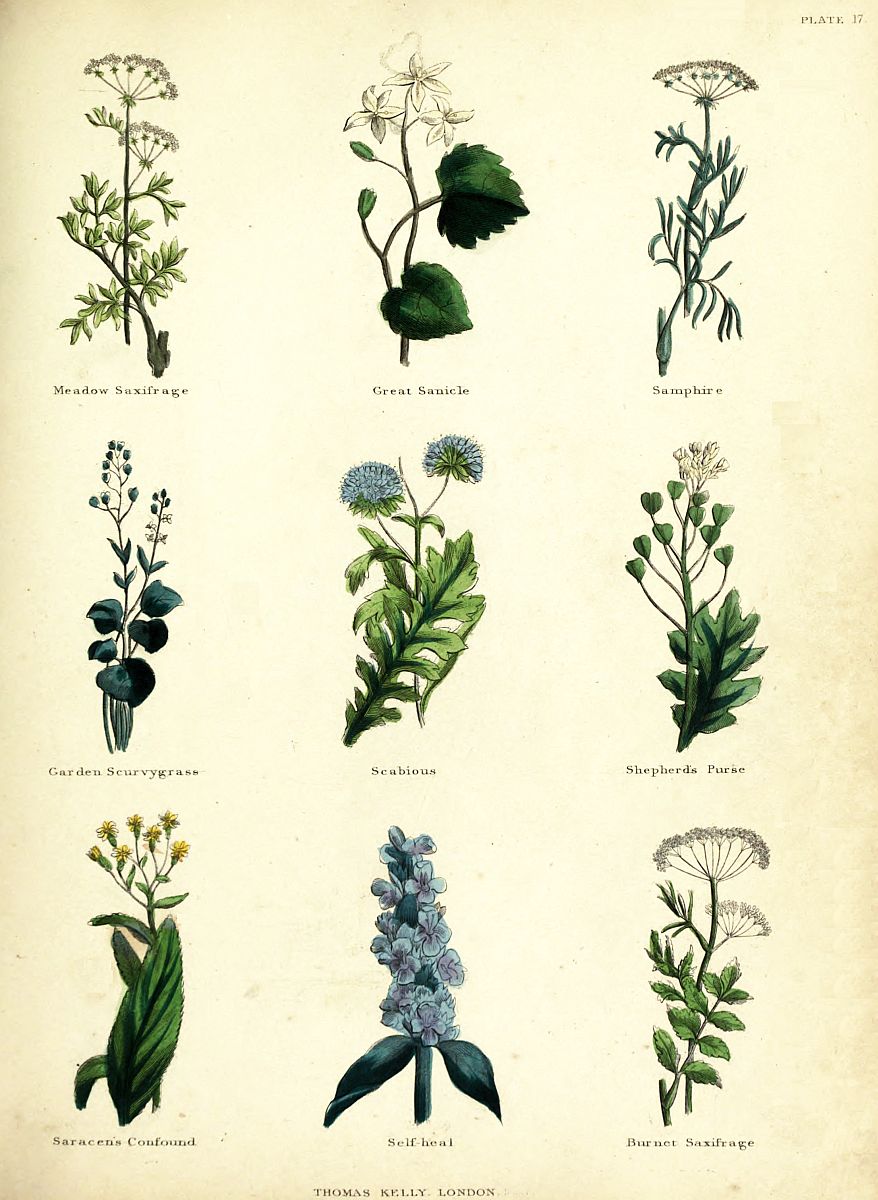
Meadow Saxifrage, Great Sanicle, Samphire; Garden Scurvygrass, Scabious, Shepherd’s Purse; Saracen’s Confound, Self-heal, Burnet Saxifrage
Samphire
Descript.] Rock Samphire grows up with a tender green stalk about half a yard, or two feet high at the most, branching forth almost from the very bottom, and stored with sundry thick and almost round (somewhat long) leaves of a deep green colour, sometimes two together, and sometimes more on a stalk, and sappy, and of a pleasant, hot, and spicy taste. At the top of the stalks and branches stand umbels of white flowers, and after them come large seed, bigger than fennel seed, yet somewhat like it. The root is great, white, and long, continuing many years, and is of an hot and spicy taste likewise.
Place.] It grows on the rocks that are often moistened at the least, if not overflowed with the sea water.
Time.] And it flowers and seeds in the end of July and August.
Government and virtues.] It is an herb of Jupiter, and was in former times wont to be used more than now it is; the more is the pity. It is well known almost to every body, that ill digestions and obstructions are the cause of most of the diseases which the frail nature of man is subject to; both which might be remedied by a more frequent use of this herb. If people would have sauce to their meat, they may take some for profit as well as for pleasure. It is a safe herb, very pleasant both to taste and stomach, helps digestion, and in some sort opening obstructions of the liver and spleen: provokes urine, and helps thereby to wash away the gravel and stone engendered in the kidneys or bladder.
Sanicle
This herb is by many called Butter-wort.
Descript.] Ordinary Sanicle sends forth many great round leaves, standing upon long brownish stalks, every one somewhat deeply cut or divided into five or six parts, and some of these also cut in somewhat like the leaf of crow’s-foot, or dove’s-foot, and finely dented about the edges, smooth, and of a dark shining colour, and somewhat reddish about the brims; from among which arise up small, round green stalks, without any joint or leaf thereon, saving at the top, where it branches forth into flowers, having a leaf divided into three or four parts at that joint with the flowers, which are small and white, starting out of small round greenish yellow heads, many standing together in a tuft, in which afterwards are the seeds contained, which are small round burs, somewhat like the leaves of clevers, and stick in the same manner upon any thing that they touch. The root is composed of many blackish strings or fibres, set together at a little long head, which abides with green leaves all the Winter, and perishes not.
Place.] It is found in many shadowy woods, and other places of this land.
Time.] It flowers in June, and the seed is ripe shortly after.
Government and virtues.] This is one of Venus’s herbs, to cure the wounds or mischiefs Mars inflicts upon the body of man. It heals green wounds speedily, or any ulcers, imposthumes, or bleedings inward, also tumours in any part of the body; for the decoction or powder in drink taken, and the juice used outwardly, dissipates the humours: and there is not found any herb that can give such present help either to man or beast, when the disease falleth upon the lungs or throat, and to heal up putrid malignant ulcers in the mouth, throat, and privities, by gargling or washing with the decoction of the leaves and roots made in water, and a little honey put thereto. It helps to stay women’s courses, and all other fluxes of blood, either by the mouth, urine, or stool, and lasks of the belly; the ulcerations of the kidneys also, and the pains in the bowels, and gonorrhea, being boiled in wine or water, and drank. The same also is no less powerful to help any ruptures or burstings, used both inwardly and outwardly: And briefly, it is as effectual in binding, restraining, consolidating, heating, drying and healing, as comfrey, bugle, self-heal, or any other of the vulnerary herbs whatsoever.
Saracen’s Confound, or Saracen’s Woundwort
Descript.] This grows sometimes, with brownish stalks, and other whiles with green, to a man’s height, having narrow green leaves snipped about the edges, somewhat like those of the peach-tree, or willow leaves, but not of such a white green colour. The tops of the stalks are furnished with many yellow star-like flowers, standing in green heads, which when they are fallen, and the seed ripe, which is somewhat long, small and of a brown colour, wrapped in down, is therefore carried away with the wind. The root is composed of fibres set together at a head, which perishes not in Winter, although the stalks dry away and no leaf appears in the Winter. The taste hereof is strong and unpleasant; and so is the smell also.
Place.] It grows in moist and wet grounds, by wood-sides, and sometimes in moist places of shadowy groves, as also by the water side.
Time.] It flowers in July, and the seed is soon ripe, and carried away with the wind.
Government and virtues.] Saturn owns the herb, and it is of a sober condition, like him. Among the Germans, this wound herb is preferred before all others of the same quality. Being boiled in wine, and drank, it helps the indisposition of the liver, and freeth the gall from obstructions; whereby it is good for the yellow jaundice and for the dropsy in the beginning of it; for all inward ulcers of the reins, mouth or throat, and inward wounds and bruises, likewise for such sores as happen in the privy parts of men and women; being steeped in wine, and then distilled, the water thereof drank, is singularly good to ease all gnawings in the stomach, or other pains of the body, as also the pains of the mother: and being boiled in water, it helps continual agues; and the said water, or the simple water of the herb distilled, or the juice or decoction, are very effectual to heal any green wound, or old sore or ulcer whatsoever, cleansing them from corruption, and quickly healing them up: Briefly, whatsoever hath been said of bugle or sanicle, may be found herein.
Sauce-alone, or Jack-by-the-hedge-side
Descript.] The lower leaves of this are rounder than those that grow towards the top of the stalks, and are set singly on a joint being somewhat round and broad, pointed at the ends, dented also about the edges, somewhat resembling nettle leaves for the form, but of a fresher green colour, not rough or pricking: The flowers are white, growing at the top of the stalks one above another, which being past, follow small round pods, wherein are contained round seed somewhat blackish. The root stringy and thready, perishes every year after it hath given seed, and raises itself again of its own sowing. The plant, or any part thereof, being bruised, smells of garlic, but more pleasantly, and tastes somewhat hot and sharp, almost like unto rocket.
Place.] It grows under walls, and by hedge-sides, and path-ways in fields in many places.
Time.] It flowers in June, July, and August.
Government and virtues.] It is an herb of Mercury. This is eaten by many country people as sauce to their salt fish, and helps well to digest the crudities and other corrupt humours engendered thereby. It warms also the stomach, and causes digestion. The juice thereof boiled with honey is accounted to be as good as hedge mustard for the cough, to cut and expectorate the tough phlegm. The seed bruised and boiled in wine, is a singularly good remedy for the wind colic, or the stone, being drank warm: It is also given to women troubled with the mother, both to drink, and the seed put into a cloth, and applied while it is warm, is of singularly good use. The leaves also, or the seed boiled, is good to be used in clysters to ease the pains of the stone. The green leaves are held to be good to heal the ulcers in the legs.
Winter and Summer Savoury
Both these are so well known (being entertained as constant inhabitants in our gardens) that they need no description.
Government and virtues.] Mercury claims dominion over this herb, neither is there a better remedy against the colic and iliac passion, than this herb; keep it dry by you all the year, if you love yourself and your ease, and it is a hundred pounds to a penny if you do not; keep it dry, make conserves and syrups of it for your use, and withal, take notice that the Summer kind is the best. They are both of them hot and dry, especially the Summer kind, which is both sharp and quick in taste, expelling wind in the stomach and bowels, and is a present help for the rising of the mother procured by wind; provokes urine and women’s courses, and is much commended for women with child to take inwardly, and to smell often unto. It cures tough phlegm in the chest and lungs, and helps to expectorate it the more easily; quickens the dull spirits in the lethargy, the juice thereof being snuffed up into the nostrils. The juice dropped into the eyes, clears a dull sight, if it proceed of thin cold humours distilled from the brain. The juice heated with the oil of Roses, and dropped into the ears, eases them of the noise and singing in them, and of deafness also. Outwardly applied with wheat flour, in manner of a poultice, it gives ease to the sciatica and palsied members, heating and warming them, and takes away their pains. It also takes away the pain that comes by stinging of bees, wasps, &c.
Savine
To describe a plant so well known is needless, it being nursed up almost in every garden, and abides green all the Winter.
Government and virtues.] It is under the dominion of Mars, being hot and dry in the third degree, and being of exceeding clean parts, is of a very digesting quality. If you dry the herb into powder, and mix it with honey, it is an excellent remedy to cleanse old filthy ulcers and fistulas; but it hinders them from healing. The same is excellently good to break carbuncles and plague-sores; also helps the king’s evil, being applied to the place. Being spread over a piece of leather, and applied to the navel, kills the worms in the belly, helps scabs and itch, running sores, cankers, tetters, and ringworms; and being applied to the place, may haply cure venereal sores. This I thought good to speak of, as it may be safely used outwardly, for inwardly it cannot be taken without manifest danger.
The Common White Saxifrage
Descript.] This hath a few small reddish kernels of roots covered with some skins, lying among divers small blackish fibres, which send forth divers round, faint or yellow green leaves, and greyish underneath, lying above the grounds, unevenly dented about the edges, and somewhat hairy, every one upon a little foot-stalk, from whence rises up round, brownish, hairy, green stalks, two or three feet high, with a few such like round leaves as grow below, but smaller, and somewhat branched at the top, whereon stand pretty large white flowers of five leaves a-piece, with some yellow threads in the middle, standing in a long crested, brownish green husk. After the flowers are past, there arises sometimes a round hard head, forked at the top, wherein is contained small black seed, but usually they fall away without any seed, and it is the kernels or grains of the root which are usually called the White Saxifrage-seed, and so used.
Place.] It grows in many places of our land, as well in the lower-most, as in the upper dry corners of meadows, and grassy sandy places. It used to grow near Lamb’s conduit, on the backside of Gray’s Inn.
Time.] It flowers in May, and then gathered, as well for that which is called the seed, as to distil, for it quickly perishes down to the ground when any hot weather comes.
Government and virtues.] It is very effectual to cleanse the reins and bladder, and to dissolve the stone engendered in them, and to expel it and the gravel by urine; to help the stranguary; for which purpose the decoction of the herb or roots in white wine, is most usual, or the powder of the small kernelly root, which is called the seed, taken in white wine, or in the same decoction made with white wine, is most usual. The distilled water of the whole herb, root and flowers, is most familiar to be taken. It provokes also women’s courses, and frees and cleanses the stomach and lungs from thick and tough phlegm that trouble them. There are not many better medicines to break the stone than this.
Burnet Saxifrage
Descript.] The greater sort of our English Burnet Saxifrage grows up with divers long stalks of winged leaves, set directly opposite one to another on both sides, each being somewhat broad, and a little pointed and dented about the edges, of a sad green colour. At the top of the stalks stand umbels of white flowers, after which come small and blackish seed. The root is long and whitish, abiding long. Our lesser Burnet Saxifrage hath much finer leaves than the former, and very small, and set one against another, deeply jagged about the edges, and of the same colour as the former. The umbels of the flowers are white, and the seed very small, and so is the root, being also somewhat hot and quick in taste.
Place.] These grow in moist meadows of this land, and are easy to be found being well sought for among the grass, wherein many times they lay hid scarcely to be discerned.
Time.] They flower about July, and their seed is ripe in August.
Government and virtues.] They are both of them herbs of the Moon. The Saxifrages are hot as pepper; and Tragus saith, by his experience, that they are wholesome. They have the same properties the parsleys have, but in provoking urine, and causing the pains thereof, and of the wind and colic, are much more effectual, the roots or seed being used either in powder, or in decoctions, or any other way; and likewise helps the windy pains of the mother, and to procure their courses, and to break and void the stone in the kidneys, to digest cold, viscous, and tough phlegm in the stomach, and is an especial remedy against all kind of venom. Castoreum being boiled in the distilled water thereof, is singularly good to be given to those that are troubled with cramps and convulsions. Some do use to make the seeds into comfits (as they do carraway seeds) which is effectual to all the purposes aforesaid. The juice of the herb dropped into the most grievous wounds of the head, dries up their moisture, and heals them quickly. Some women use the distilled water to take away freckles or spots in the skin or face; and to drink the same sweetened with sugar for all the purposes aforesaid.
Scabious, Three Sorts
Descript.] Common field Scabious grows up with many hairy, soft, whitish green leaves, some whereof are very little, if at all jagged on the edges, others very much rent and torn on the sides, and have threads in them, which upon breaking may be plainly seen; from among which rise up divers hairy green stalks, three or four feet high, with such like hairy green leaves on them, but more deeply and finely divided and branched forth a little: At the tops thereof, which are naked and bare of leaves for a good space, stand round heads of flowers, of a pale blueish colour, set together in a head, the outermost whereof are larger than the inward, with many threads also in the middle, somewhat flat at the top, as the head with the seed is likewise; the root is great, white and thick, growing down deep into the ground, and abides many years.
There is another sort of Field Scabious different in nothing from the former, but only it is smaller in all respects.
The Corn Scabious differs little from the first, but that it is greater in all respects, and the flowers more inclining to purple, and the root creeps under the upper crust of the earth, and runs not deep into the ground as the first doth.
Place.] The first grows more usually in meadows, especially about London every where.
The second in some of the dry fields about this city, but not so plentifully as the former.
The third in standing corn, or fallow fields, and the borders of such like fields.
Time.] They flower in June and July, and some abide flowering until it be late in August, and the seed is ripe in the mean time.
There are many other sorts of Scabious, but I take these which I have here described to be most familiar with us. The virtues of both these and the rest, being much alike, take them as follow.
Government and virtues.] Mercury owns the plant. Scabious is very effectual for all sorts of coughs, shortness of breath, and all other diseases of the breast and lungs, ripening and digesting cold phlegm, and other tough humours, voids them forth by coughing and spitting: It ripens also all sorts of inward ulcers and imposthumes; pleurisy also, if the decoction of the herb dry or green be made in wine, and drank for some time together. Four ounces of the clarified juice of Scabious taken in the morning fasting, with a dram of mithridate, or Venice treacle, frees the heart from any infection of pestilence, if after the taking of it the party sweat two hours in bed, and this medicine be again and again repeated, if need require. The green herb bruised and applied to any carbuncle or plague sore, is found by certain experience to dissolve and break it in three hours space. The same decoction also drank, helps the pains and stitches in the side. The decoction of the roots taken for forty days together, or a dram of the powder of them taken at a time in whey, doth (as Matthiolus saith) wonderfully help those that are troubled with running of spreading scabs, tetters, ringworms, yea, although they proceed from the French pox, which, he saith he hath tried by experience. The juice or decoction drank, helps also scabs and breakings-out of the itch, and the like. The juice also made up into an ointment and used, is effectual for the same purpose. The same also heals all inward wounds by the drying, cleansing, and healing quality therein: And a syrup made of the juice and sugar, is very effectual to all the purposes aforesaid, and so is the distilled water of the herb and flowers made in due season, especially to be used when the green herb is not in force to be taken. The decoction of the herb and roots outwardly applied, doth wonderfully help all sorts of hard or cold swellings in any part of the body, is effectual for shrunk sinews or veins, and heals green wounds, old sores, and ulcers. The juice of Scabious, made up with the powder of Borax and Samphire, cleanses the skin of the face, or other parts of the body, not only from freckles and pimples, but also from morphew and leprosy; the head washed with the decoction, cleanses it from dandriff, scurf, sores, itch, and the like, used warm. The herb bruised and applied, doth in a short time loosen, and draw forth any splinter, broken bone, arrow head, or other such like thing lying in the flesh.
Scurvygrass
Descript.] The ordinary English Scurvygrass hath many thick flat leaves, more long than broad, and sometimes longer and narrower; sometimes also smooth on the edges, and sometimes a little waved; sometimes plain, smooth and pointed, of a sad green, and sometimes a blueish colour, every one standing by itself upon a long foot-stalk, which is brownish or greenish also, from among which arise many slender stalks, bearing few leaves thereon like the other, but longer and less for the most part: At the tops whereof grow many whitish flowers, with yellow threads in the middle, standing about a green head, which becomes the seed vessel, which will be somewhat flat when it is ripe, wherein is contained reddish seed, tasting somewhat hot. The root is made of many white strings, which stick deeply into the mud, wherein it chiefly delights, yet it will well abide in the more upland and drier ground, and tastes a little brackish and salt even there, but not so much as where it hath the salt water to feed upon.
Place.] It grows all along the Thames sides, both on the Essex and Kentish shores, from Woolwich round about the sea coasts to Dover, Portsmouth, and even to Bristol, where it is had in plenty; the other with round leaves grows in the marshes in Holland, in Lincolnshire, and other places of Lincolnshire by the sea side.
Descript.] There is also another sort called Dutch Scurvygrass, which is most known, and frequent in gardens, which has fresh, green, and almost round leaves rising from the root, not so thick as the former, yet in some rich ground, very large, even twice as big as in others, not dented about the edges, or hollow in the middle, standing on a long foot-stalk; from among these rise long, slender stalks, higher than the former, with more white flowers at the tops of them, which turn into small pods, and smaller brownish seed than the former. The root is white, small and thready. The taste is nothing salt at all; it hath a hot, aromatical spicy taste.
Time.] It flowers in April and May, and gives seed ripe quickly after.
Government and virtues.] It is an herb of Jupiter. The English Scurvy grass is more used for the salt taste it bears, which doth somewhat open and cleanse; but the Dutch Scurvygrass is of better effect, and chiefly used (if it may be had) by those that have the scurvy, and is of singular good effect to cleanse the blood, liver, and spleen, taking the juice in the Spring every morning fasting in a cup of drink. The decoction is good for the same purpose, and opens obstructions, evacuating cold, clammy and phlegmatic humours both from the liver and the spleen, and bringing the body to a more lively colour. The juice also helps all foul ulcers and sores in the mouth, gargled therewith; and used outwardly, cleanses the skin from spots, marks, or scars that happen therein.
Self-heal
Descript.] The common Self-heal which is called also Prunel, Carpenter’s Herb, Hook-heal, and Sickle-wort, is a small, low, creeping herb, having many small, roundish pointed leaves, like leaves of wild mints, of a dark green colour, without dents on the edges; from among which rise square hairy stalks, scarce a foot high, which spread sometimes into branches with small leaves set thereon, up to the top, where stand brown spiked heads of small brownish leaves like scales and flowers set together, almost like the heads of Cassidony, which flowers are gaping, and of a blueish purple, or more pale blue, in some places sweet, but not so in others. The root consists of many fibres downward, and spreading strings also whereby it increases. The small stalks, with the leaves creeping on the ground, shoot forth fibres taking hold on the ground, whereby it is made a great tuft in a short time.
Place.] It is found in woods and fields every where.
Time.] It flowers in May, and sometimes in April.
Government and virtues.] Here is another herb of Venus, Self-heal, whereby when you are hurt you may heal yourself: It is a special herb for inward and outward wounds. Take it inwardly in syrups for inward wounds: outwardly in unguents, and plaisters for outward. As Self-heal is like Bugle in form, so also in the qualities and virtues, serving for all the purposes whereto Bugle is applied to with good success, either inwardly or outwardly, for inward wounds or ulcers whatsoever within the body, for bruises or falls, and such like hurts. If it be accompanied with Bugle, Sanicle, and other the like wound herbs, it will be more effectual to wash or inject into ulcers in the parts outwardly. Where there is cause to repress the heat and sharpness of humours flowing to any sore, ulcers, inflammations, swellings, or the like, or to stay the fluxes of blood in any wound or part, this is used with some good success; as also to cleanse the foulness of sores, and cause them more speedily to be healed. It is an especial remedy for all green wounds, to solder the lips of them, and to keep the place from any further inconveniencies. The juice hereof used with oil of roses to anoint the temples and forehead, is very effectual to remove head ache, and the same mixed with honey of roses, cleanses and heals all ulcers, in the mouth, and throat, and those also in the secret parts. And the proverb of the Germans, French, and others, is verified in this, That he needs neither physician nor surgeon that hath Self-heal and Sanicle to help himself.
The Service-tree
It is so well known in the place where it grows, that it needs no description.
Time.] It flowers before the end of May, and the fruit is ripe in October.
Government and virtues.] Services, when they are mellow, are fit to be taken to stay fluxes, scouring, and casting, yet less than medlers. If they be dried before they be mellow, and kept all the year, they may be used in decoctions for the said purpose, either to drink, or to bathe the parts requiring it; and are profitably used in that manner to stay the bleeding of wounds, and of the mouth or nose, to be applied to the forehead and nape of the neck; and are under the dominion of Saturn.
Shepherd’s Purse
It is called Whoreman’s Permacety, Shepherd’s Scrip, Shepherd’s Pounce, Toy-wort, Pickpurse, and Casewort.
Descript.] The root is small, white, and perishes every year. The leaves are small and long, of a pale green colour, and deeply cut in on both sides, among which spring up a stalk which is small and round, containing small leaves upon it even to the top. The flowers are white and very small; after which come the little cases which hold the seed, which are flat, almost in the form of a heart.
Place.] They are frequent in this nation, almost by every path-side.
Time.] They flower all the Summer long; nay some of them are so fruitful, that they flower twice a year.
Government and virtues.] It is under the dominion of Saturn, and of a cold, dry, and binding nature, like to him. It helps all fluxes of blood, either caused by inward or outward wounds; as also flux of the belly, and bloody flux, spitting blood, and bloody urine, stops the terms in women; being bound to the wrists of the hands, and the soles of the feet, it helps the yellow jaundice. The herb being made into a poultice, helps inflammations and St. Anthony’s fire. The juice being dropped into the ears, heals the pains, noise, and mutterings thereof. A good ointment may be made of it for all wounds, especially wounds in the head.
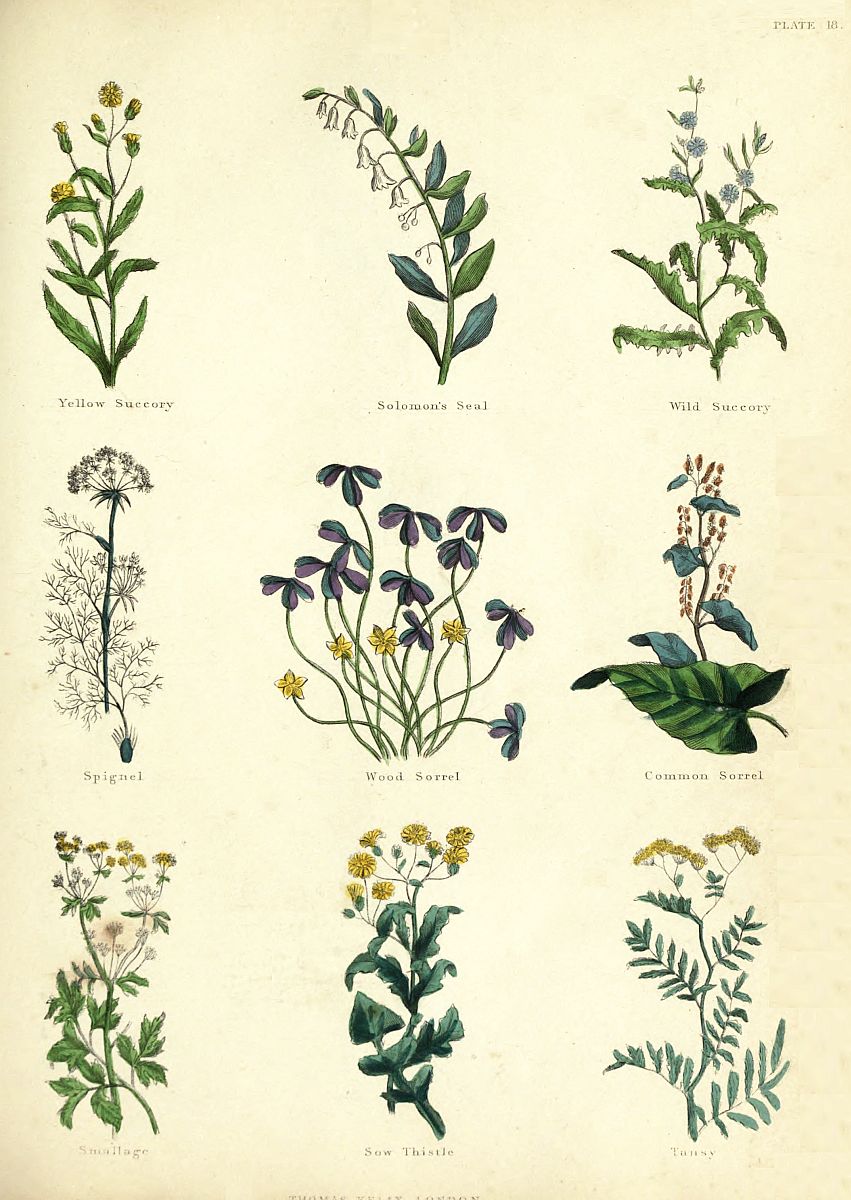
Yellow Succory, Solomon’s Seal, Wild Succory; Spignel, Wood Sorrel, Common Sorrel; Smallage, Sow Thistle, Tansy
Smallage
This is also very well known, and therefore I shall not trouble the reader with any description thereof.
Place.] It grows naturally in dry and marshy ground; but if it be sown in gardens, it there prospers very well.
Time.] It abides green all the Winter, and seeds in August.
Government and virtues.] It is an herb of Mercury. Smallage is hotter, drier, and much more medicinal than parsley, for it much more opens obstructions of the liver and spleen, rarefies thick phlegm, and cleanses it and the blood withal. It provokes urine and women’s courses, and is singularly good against the yellow jaundice, tertian and quartan agues, if the juice thereof be taken, but especially made up into a syrup. The juice also put to honey of roses, and barley-water, is very good to gargle the mouth and throat of those that have sores and ulcers in them, and will quickly heal them. The same lotion also cleanses and heals all other foul ulcers and cankers elsewhere, if they be washed therewith. The seed is especially used to break and expel wind, to kill worms, and to help a stinking breath. The root is effectual to all the purposes aforesaid, and is held to be stronger in operation than the herb, but especially to open obstructions, and to rid away any ague, if the juice thereof be taken in wine, or the decoction thereof in wine used.
Sopewort, or Bruisewort
Descript.] The roots creep under ground far and near, with many joints therein, of a brown colour on the outside and yellowish within, shooting forth in divers places weak round stalks, full of joints, set with two leaves a-piece at every one of them on a contrary side, which are ribbed somewhat like to plantain, and fashioned like the common field white campion leaves, seldom having any branches from the sides of the stalks, but set with flowers at the top, standing in long husks like the wild campions, made of five leaves a-piece, round at the ends, and dented in the middle, of a rose colour, almost white, sometimes deeper, sometimes paler; of a reasonable scent.
Place.] It grows wild in many low and wet grounds of this land, by brooks and the sides of running waters.
Time.] It flowers usually in July, and so continues all August, and part of September, before they be quite spent.
Government and virtues.] Venus owns it. The country people in divers places do use to bruise the leaves of Sopewort, and lay it to their fingers, hands or legs, when they are cut, to heal them up again. Some make great boast thereof, that it is diuretical to provoke urine, and thereby to expel gravel and the stone in the reins or kidneys, and do also account it singularly good to void hydropical waters: and they no less extol it to perform an absolute cure in the French pox, more than either sarsaparilla, guiacum, or China can do; which, how true it is, I leave others to judge.
Sorrel
Our ordinary Sorrel, which grows in gardens, and also wild in the fields, is so well known, that it needs no description.
Government and virtues.] It is under the dominion of Venus. Sorrel is prevalent in all hot diseases, to cool any inflammation and heat of blood in agues pestilential or choleric, or sickness and fainting, arising from heat, and to refresh the overspent spirits with the violence of furious or fiery fits of agues; to quench thirst, and procure an appetite in fainting or decaying stomachs: For it resists the putrefaction of the blood, kills worms, and is a cordial to the heart, which the seed doth more effectually, being more drying and binding, and thereby stays the hot fluxes of women’s courses, or of humours in the bloody flux, or flux of the stomach. The root also in a decoction, or in powder, is effectual for all the said purposes. Both roots and seeds, as well as the herb, are held powerful to resist the poison of the scorpion. The decoction of the roots is taken to help the jaundice, and to expel the gravel and the stone in the reins or kidneys. The decoction of the flowers made with wine and drank, helps the black jaundice, as also the inward ulcers of the body and bowels. A syrup made with the juice of Sorrel and fumitory, is a sovereign help to kill those sharp humours that cause the itch. The juice thereof, with a little vinegar, serves well to be used outwardly for the same cause, and is also profitable for tetters, ringworms, &c. It helps also to discuss the kernels in the throat; and the juice gargled in the mouth, helps the sores therein. The leaves wrapt in a colewort leaf and roasted in the embers, and applied to a hard imposthume, botch, boil, or plague sore, doth both ripen and break it. The distilled water of the herb is of much good use for all the purposes aforesaid.
Wood Sorrel
Descript.] This grows upon the ground, having a number of leaves coming from the root made of three leaves, like a trefoil, but broad at the ends, and cut in the middle, of a yellowish green colour, every one standing on a long foot-stalk, which at their first coming up are close folded together to the stalk, but opening themselves afterwards, and are of a fine sour relish, and yielding a juice which will turn red when it is clarified, and makes a most dainty clear syrup. Among these leaves rise up divers slender, weak foot-stalks, with every one of them a flower at the top, consisting of five small pointed leaves, star-fashion, of a white colour, in most places, and in some dashed over with a small show of blueish, on the back side only. After the flowers are past, follow small round heads, with small yellowish seed in them. The roots are nothing but small strings fastened to the end of a small long piece; all of them being of a yellowish colour.
Place.] It grows in many places of our land, in woods and wood-sides, where they be moist and shadowed, and in other places not too much upon the Sun.
Time.] It flowers in April and May.
Government and virtues.] Venus owns it. Wood Sorrel serves to all the purposes that the other Sorrels do, and is more effectual in hindering putrefaction of blood, and ulcers in the mouth and body, and to quench thirst, to strengthen a weak stomach, to procure an appetite, to stay vomiting, and very excellent in any contagious sickness or pestilential fevers. The syrup made of the juice, is effectual in all the cases aforesaid, and so is the distilled water of the herb. Sponges or linen cloths wet in the juice and applied outwardly to any hot swelling or inflammations, doth much cool and help them. The same juice taken and gargled in the mouth, and after it is spit forth, taken afresh, doth wonderfully help a foul stinking canker or ulcer therein. It is singularly good to heal wounds, or to stay the bleeding of thrusts or scabs in the body.
Sow Thistle
Sow Thistles are generally so well known, that they need no description.
Place.] They grow in gardens and manured grounds, sometimes by old walls, pathsides of fields, and high ways.
Government and virtues.] This and the former are under the influence of Venus. Sow Thistles are cooling, and somewhat binding, and are very fit to cool a hot stomach, and ease the pains thereof. The herb boiled in wine, is very helpful to stay the dissolution of the stomach, and the milk that is taken from the stalks when they are broken, given in drink, is beneficial to those that are short winded, and have a wheezing. Pliny saith, That it hath caused the gravel and stone to be voided by urine, and that the eating thereof helps a stinking breath. The decoction of the leaves and stalks causes abundance of milk in nurses, and their children to be well coloured. The juice or distilled water is good for all hot inflammations, wheals, and eruptions or heat in the skin, itching of the hæmorrhoids. The juice boiled or thoroughly heated in a little oil of bitter almonds in the peel of a pomegranate, and dropped into the ears, is a sure remedy for deafness, singings, &c. Three spoonfuls of the juice taken, warmed in white wine, and some wine put thereto, causes women in travail to have so easy and speedy a delivery, that they may be able to walk presently after. It is wonderful good for women to wash their faces with, to clear the skin, and give it a lustre.
Southern Wood
Southern Wood is so well known to be an ordinary inhabitant in our gardens, that I shall not need to trouble you with any description thereof.
Time.] It flowers for the most part in July and August.
Government and virtues.] It is a gallant mercurial plant, worthy of more esteem than it hath. Dioscorides saith, That the seed bruised, heated in warm water, and drank, helps those that are bursten, or troubled with cramps or convulsions of the sinews, the sciatica, or difficulty in making water, and bringing down women’s courses. The same taken in wine is an antidote, or counter-poison against all deadly poison, and drives away serpents and other venomous creatures; as also the smell of the herb, being burnt, doth the same. The oil thereof anointed on the back-bone before the fits of agues come, takes them away: It takes away inflammations in the eyes, if it be put with some part of a roasted quince, and boiled with a few crumbs of bread, and applied. Boiled with barley-meal it takes away pimples, pushes or wheals that arise in the face, or other parts of the body. The seed as well as the dried herb, is often given to kill the worms in children: The herb bruised and laid to, helps to draw forth splinters and thorns out of the flesh. The ashes thereof dries up and heals old ulcers, that are without inflammation, although by the sharpness thereof it bites sore, and puts them to sore pains; as also the sores in the privy parts of man or woman. The ashes mingled with old sallad oil, helps those that have hair fallen, and are bald, causing the hair to grow again either on the head or beard. Daranters saith, That the oil made of Southern-wood, and put among the ointments that are used against the French disease, is very effectual, and likewise kills lice in the head. The distilled water of the herb is said to help them much that are troubled with the stone, as also for the diseases of the spleen and mother. The Germans commend it for a singular wound herb, and therefore call it Stabwort. It is held by all writers, ancient and modern, to be more offensive to the stomach than worm-wood.
Spignel, or Spikenard
Descript.] The roots of common Spignel do spread much and deep in the ground, many strings or branches growing from one head, which is hairy at the top, of a blackish brown colour on the outside, and white within, smelling well, and of an aromatical taste from whence rise sundry long stalks of most fine cut leaves like hair, smaller than dill, set thick on both sides of the stalks, and of a good scent. Among these leaves rise up round stiff stalks, with a few joints and leaves on them, and at the tops an umbel of pure white flowers; at the edges whereof sometimes will be seen a shew of the reddish blueish colour, especially before they be full blown, and are succeeded by small, somewhat round seeds, bigger than the ordinary fennel, and of a brown colour, divided into two parts, and crusted on the back, as most of the umbelliferous seeds are.
Place.] It grows wild in Lancashire, Yorkshire, and other northern counties, and is also planted in gardens.
Government and virtues.] It is an herb of Venus. Galen saith, The roots of Spignel are available to provoke urine, and women’s courses; but if too much thereof be taken, it causes head-ache. The roots boiled in wine or water, and drank, helps the stranguary and stoppings of the urine, the wind, swellings and pains in the stomach, pains of the mother, and all joint-aches. If the powder of the root be mixed with honey, and the same taken as a licking medicine, it breaks tough phlegm, and dries up the rheum that falls on the lungs. The roots are accounted very effectual against the stinging or biting of any venomous creature.
Spleenwort, Ceterach, or Heart’s Tongue
Descript.] The smooth Spleenwort, from a black, thready and bushy root, sends forth many long single leaves, cut in on both sides into round dents almost to the middle, which is not so hard as that of polypody, each division being not always set opposite unto the other, cut between each, smooth, and of a light green on the upper side, and a dark yellowish roughness on the back, folding or rolling itself inward at the first springing up.
Place.] It grows as well upon stone walls, as moist and shadowy places, about Bristol, and other west parts plentifully; as also on Framlingham Castle, on Beaconsfield church in Berkshire, at Stroud in Kent, and elsewhere, and abides green all the Winter.
Government and virtues.] Saturn owns it. It is generally used against infirmities of the Spleen: It helps the stranguary, and wasteth the stone in the bladder, and is good against the yellow jaundice and the hiccough; but the juice of it in women hinders conception. Matthiolus saith, That if a dram of the dust that is on the backside of the leaves be mixed with half a dram of amber in powder, and taken with the juice of purslain or plantain, it helps the gonorrhea speedily, and that the herb and root being boiled and taken, helps all melancholy diseases, and those especially that arise from the French diseases. Camerarius saith, That the distilled water thereof being drank, is very effectual against the stone in the reins and bladder; and that the lye that is made of the ashes thereof being drank for some time together, helps splenetic persons. It is used in outward remedies for the same purpose.
Star Thistle
Descript.] A common Star Thistle has divers narrow leaves lying next the ground, cut on the edges somewhat deeply into many parts, soft or a little wooly, all over green, among which rise up divers weak stalks, parted into many branches: all lying down to the ground, that it seems a pretty bush, set with divers the like divided leaves up to the tops, where severally do stand small whitish green heads, set with sharp white pricks (no part of the plant else being prickly) which are somewhat yellowish; out of the middle whereof rises the flowers, composed of many small reddish purple threads; and in the heads, after the flowers are past, come small whitish round seed, lying down as others do. The root is small, long and woody, perishing every year, and rising again of its own sowing.
Place.] It grows wild in the fields about London in many places, as at Mile-End green, and many other places.
Time.] It flowers early, and seeds in July, and sometimes in August.
Government and virtues.] This, as almost all Thistles are, is under Mars. The seed of this Star Thistle made into powder, and drank in wine, provokes urine, and helps to break the stone, and drives it forth. The root in powder, and given in wine and drank, is good against the plague and pestilence; and drank in the morning fasting for some time together, it is very profitable for fistulas in any part of the body. Baptista Sardas doth much commend the distilled water thereof, being drank, to help the French disease, to open the obstructions of the liver, and cleanse the blood from corrupted humours, and is profitable against the quotidian or tertian ague.
Strawberries
These are so well known through this land, that they need no description.
Time.] They flower in May ordinarily, and the fruit is ripe shortly after.
Government and virtues.] Venus owns the herb. Strawberries, when they are green, are cool and dry; but when they are ripe, they are cool and moist: The berries are excellently good to cool the liver, the blood, and the spleen, or an hot choleric stomach; to refresh and comfort the fainting spirits, and quench thirst: They are good also for other inflammations; yet it is not amiss to refrain from them in a fever, lest by their putrifying in the stomach they increase the fits. The leaves and roots boiled in wine and water, and drank, do likewise cool the liver and blood, and assuage all inflammations in the reins and bladder, provoke urine, and allay the heat and sharpness thereof. The same also being drank stays the bloody flux and women’s courses, and helps the swelling of the spleen. The water of the Berries carefully distilled, is a sovereign remedy and cordial in the panting and beating of the heart, and is good for the yellow jaundice. The juice dropped into foul ulcers, or they washed therewith, or the decoction of the herb and root, doth wonderfully cleanse and help to cure them. Lotions and gargles for sore mouths, or ulcers therein, or in the privy parts or elsewhere, are made with the leaves and roots thereof; which is also good to fasten loose teeth, and to heal spungy foul gums. It helps also to stay catarrhs, or defluctions of rheum in the mouth, throat, teeth, or eyes. The juice or water is singularly good for hot and red inflamed eyes, if dropped into them, or they bathed therewith. It is also of excellent property for all pushes, wheals and other breakings forth of hot and sharp humours in the face and hands, and other parts of the body, to bathe them therewith, and to take away any redness in the face, or spots, or other deformities in the skin, and to make it clear and smooth. Some use this medicine, Take so many Strawberries as you shall think fitting, and put them into a distillatory, or body of glass fit for them, which being well closed, set it in a bed of horse dung for your use. It is an excellent water for hot inflamed eyes, and to take away a film or skin that begins to grow over them, and for such other defects in them as may be helped by any outward medicine.
Succory, or Chicory
Descript.] The garden Succory hath long and narrower leaves than the Endive, and more cut in or torn on the edges, and the root abides many years. It bears also blue flowers like Endive, and the seed is hardly distinguished from the seed of the smooth or ordinary Endive.
The wild Succory hath divers long leaves lying on the ground, very much cut in or torn on the edges, on both sides, even to the middle rib, ending in a point; sometimes it hath a rib down to the middle of the leaves, from among which rises up a hard, round, woody stalk, spreading into many branches, set with smaller and less divided leaves on them up to the tops, where stand the flowers, which are like the garden kind, and the seed is also (only take notice that the flowers of the garden kind are gone in on a sunny day, they being so cold, that they are not able to endure the beams of the sun, and therefore more delight in the shade) the root is white, but more hard and woody than the garden kind. The whole plant is exceedingly bitter.
Place.] This grows in many places of our land in waste untilled and barren fields. The other only in gardens.
Government and virtues.] It is an herb of Jupiter. Garden Succory, as it is more dry and less cold than Endive, so it opens more. An handful of the leaves, or roots boiled in wine or water, and a draught thereof drank fasting, drives forth choleric and phlegmatic humours, opens obstructions of the liver, gall and spleen; helps the yellow jaundice, the heat of the reins, and of the urine; the dropsy also; and those that have an evil disposition in their bodies, by reason of long sickness, evil diet, &c. which the Greeks call Cachexia. A decoction thereof made with wine, and drank, is very effectual against long lingering agues; and a dram of the seed in powder, drank in wine, before the fit of the ague, helps to drive it away. The distilled water of the herb and flowers (if you can take them in time) hath the like properties, and is especially good for hot stomachs, and in agues, either pestilential or of long continuance; for swoonings and passions of the heart, for the heat and head-ache in children, and for the blood and liver. The said water, or the juice, or the bruised leaves applied outwardly, allay swellings, inflammations, St. Anthony’s fire, pushes, wheals, and pimples, especially used with a little vinegar; as also to wash pestiferous sores. The said water is very effectual for sore eyes that are inflamed with redness, for nurses’ breasts that are pained by the abundance of milk.
The wild Succory, as it is more bitter, so it is more strengthening to the stomach and liver.
Stone-crop, Prick-madam, or Small-houseleek
Descript.] It grows with divers trailing branches upon the ground, set with many thick, flat, roundish, whitish green leaves, pointed at the ends. The flowers stand many of them together, somewhat loosely. The roots are small, and run creeping under ground.
Place.] It grows upon the stone walls and mud walls, upon the tiles of houses and pent-houses, and amongst rubbish, and in other gravelly places.
Time.] It flowers in June and July, and the leaves are green all the Winter.
Government and virtues.] It is under the dominion of the Moon, cold in quality, and something binding, and therefore very good to stay defluctions, especially such as fall upon the eyes. It stops bleeding, both inward and outward, helps cankers, and all fretting sores and ulcers; it abates the heat of choler, thereby preventing diseases arising from choleric humours. It expels poison much, resists pestilential fevers, being exceeding good also for tertian agues: You may drink the decoction of it, if you please, for all the foregoing infirmities. It is so harmless an herb, you can scarce use it amiss: Being bruised and applied to the place, it helps the king’s evil, and any other knots or kernels in the flesh; as also the piles.
The end of S: Saffron to Stone-crop.
Turn the page for English Tobacco to Tustan.
Tap or click the right-hand side of the book to turn the page, the left to turn back; or use the arrow keys, or swipe. Press F for full screen.
The English Physician Enlarged · S
Saffron to Stone-crop
Saffron
The herb needs no description, it being known generally where it grows.
Place.] It grows frequently at Walden in Essex, and in Cambridgeshire.
Government and virtues.] It is an herb of the Sun, and under the Lion, and therefore you need not demand a reason why it strengthens the heart so exceedingly. Let not above ten grains be given at one time, for the Sun, which is the fountain of light, may dazzle the eyes, and make them blind; a cordial being taken in an immoderate quantity, hurts the heart instead of helping it. It quickens the brain, for the Sun is exalted in Aries, as he hath his house in Leo. It helps consumptions of the lungs, and difficulty of breathing. It is excellent in epidemical diseases, as pestilence, small-pox, and measles. It is a notable expulsive medicine, and a notable remedy for the yellow jaundice. My opinion is, (but I have no author for it) that hermodactyls are nothing else but the roots of Saffron dried; and my reason is, that the roots of all crocus, both white and yellow, purge phlegm as hermodactyls do; and if you please to dry the roots of any crocus, neither your eyes nor your taste shall distinguish them from hermodactyls.
Sage
Our ordinary garden Sage needs no description.
Time.] It flowers in or about July.
Government and virtues.] Jupiter claims this, and bids me tell you, it is good for the liver, and to breed blood. A decoction of the leaves and branches of Sage made and drank, saith Dioscorides, provokes urine, brings down women’s courses, helps to expel the dead child, and causes the hair to become black. It stays the bleeding of wounds, and cleanses foul ulcers. Three spoonfuls of the juice of Sage taken fasting, with a little honey, doth presently stay the spitting or casting of blood of them that are in a consumption. These pills are much commended; Take of spikenard, ginger, of each two drams; of the seed of Sage toasted at the fire, eight drams; of long pepper, twelve drams; all these being brought into powder, put thereto so much juice of Sage as may make them into a mass of pills, taking a dram of them every morning fasting, and so likewise at night, drinking a little pure water after them. Matthiolus saith, it is very profitable for all manner of pains in the head coming of cold and rheumatic humours: as also for all pains of the joints, whether inwardly or outwardly, and therefore helps the falling-sickness, the lethargy, such as are dull and heavy of spirit, the palsy; and is of much use in all defluctions of rheum from the head, and for the diseases of the chest or breast. The leaves of Sage and nettles bruised together, and laid upon the imposthume that rises behind the ears, doth assuage it much. The juice of Sage taken in warm water, helps a hoarseness and a cough. The leaves sodden in wine, and laid upon the place affected with the palsy, helps much, if the decoction be drank; Also Sage taken with wormwood is good for the bloody-flux. Pliny saith, it procures women’s courses, and stays them coming down too fast: helps the stinging and biting of serpents, and kills the worms that breed in the ear, and in sores. Sage is of excellent use to help the memory, warming and quickening the senses; and the conserve made of the flowers is used to the same purpose, and also for all the former recited diseases. The juice of Sage drank with vinegar, hath been of good use in time of the plague at all times. Gargles likewise are made with Sage, rosemary, honey-suckles, and plantain, boiled in wine or water, with some honey or allum put thereto, to wash sore mouths and throats, cankers, or the secret parts of man or woman, as need requires. And with other hot and comfortable herbs, Sage is boiled to bathe the body and the legs in the Summer time, especially to warm cold joints, or sinews, troubled with the palsy and cramp, and to comfort and strengthen the parts. It is much commended against the stitch, or pains in the side coming of wind, if the place be fomented warm with the decoction thereof in wine, and the herb also after boiling be laid warm thereunto.
Wood-sage
Descript.] Wood-sage rises up with square hoary stalks, two feet high at the least, with two leaves set at every joint, somewhat like other Sage leaves, but smaller, softer, whiter, and rounder, and a little dented about the edges, and smelling somewhat stronger. At the tops of the stalks and branches stand the flowers, on a slender like spike, turning themselves all one way when they blow, and are of a pale and whitish colour, smaller than Sage, but hooded and gaping like unto them. The seed is blackish and round; four usually seem in a husk together: the root is long and stringy, with divers fibres thereat, and abides many years.
Place.] It grows in woods, and by wood-sides; as also in divers fields and bye-lanes in the land.
Time.] It flowers in June, July, and August.
Government and virtues.] The herb is under Venus. The decoction of the Wood Sage provokes urine and women’s courses: It also provokes sweat, digests humours, and discusses swellings and nodes in the flesh, and is therefore thought to be good against the French pox. The decoction of the green herb, made with wine, is a safe and sure remedy for those who by falls, bruises, or blows, suspect some vein to be inwardly broken, to disperse and void the congealed blood, and to consolidate the veins. The drink used inwardly, and the herb used outwardly, is good for such as are inwardly or outwardly bursten, and is found to be a sure remedy for the palsy. The juice of the herb, or the powder thereof dried, is good for moist ulcers and sores in the legs, and other parts, to dry them, and cause them to heal more speedily. It is no less effectual also in green wounds, to be used upon any occasion.
Solomon’s Seal
Descript.] The common Solomon’s Seal rises up with a round stalk half a yard high, bowing or bending down to the ground, set with single leaves one above another, somewhat large, and like the leaves of the lily-convally, or May-lily, with an eye of bluish upon the green, with some ribs therein, and more yellowish underneath. At the foot of every leaf, almost from the bottom up to the top of the stalk, come forth small, long, white and hollow pendulous flowers, somewhat like the flowers of May-lily, but ending in five long points, for the most part two together, at the end of a long foot-stalk, and sometimes but one, and sometimes also two stalks, and flowers at the foot of a leaf, which are without any scent at all, and stand on the top of the stalk. After they are past, come in their places small round berries great at the first, and blackish green, tending to blueness when they are ripe, wherein lie small, white, hard, and stony seeds. The root is of the thickness of one’s finger or thumb, white and knotted in some places, a flat round circle representing a Seal, whereof it took the name, lying along under the upper crust of the earth, and not growing downward, but with many fibres underneath.
Place.] It is frequent in divers places of this land; as, namely in a wood two miles from Canterbury, by Fish-Pool Hill, as also in Bushy Close belonging to the parsonage of Alderbury, near Clarendon, two miles from Salisbury: in Cheffon wood, on Chesson Hill, between Newington and Sittingbourn in Kent, and divers other places in Essex, and other counties.
Time.] It flowers about May: The root abides and shoots a-new every year.
Government and virtues.] Saturn owns the plant, for he loves his bones well. The root of Solomon’s Seal is found by experience to be available in wounds, hurts, and outward sores, to heal and close up the lips of those that are green, and to dry up and restrain the flux of humours to those that are old. It is singularly good to stay vomitings and bleeding wheresoever, as also all fluxes in man or woman; also, to knit any joint, which by weakness uses to be often out of place, or will not stay in long when it is set; also to knit and join broken bones in any part of the body, the roots being bruised and applied to the places; yea, it hath been found by experience, and the decoction of the root in wine, or the bruised root put into wine or other drink, and after a night’s infusion, strained forth hard and drank, hath helped both man and beast, whose bones hath been broken by any occasion, which is the most assured refuge of help to people of divers counties of the land that they can have. It is no less effectual to help ruptures and burstings, the decoction in wine, or the powder in broth or drink, being inwardly taken, and outwardly applied to the place. The same is also available for inward or outward bruises, falls or blows, both to dispel the congealed blood, and to take away both the pains and the black and blue marks that abide after the hurt. The same also, or the distilled water of the whole plant, used to the face, or other parts of the skin, cleanses it from morphew, freckles, spots, or marks whatsoever, leaving the place fresh, fair, and lovely; for which purpose it is much used by the Italian Dames.
Meadow Saxifrage, Great Sanicle, Samphire; Garden Scurvygrass, Scabious, Shepherd’s Purse; Saracen’s Confound, Self-heal, Burnet Saxifrage
Samphire
Descript.] Rock Samphire grows up with a tender green stalk about half a yard, or two feet high at the most, branching forth almost from the very bottom, and stored with sundry thick and almost round (somewhat long) leaves of a deep green colour, sometimes two together, and sometimes more on a stalk, and sappy, and of a pleasant, hot, and spicy taste. At the top of the stalks and branches stand umbels of white flowers, and after them come large seed, bigger than fennel seed, yet somewhat like it. The root is great, white, and long, continuing many years, and is of an hot and spicy taste likewise.
Place.] It grows on the rocks that are often moistened at the least, if not overflowed with the sea water.
Time.] And it flowers and seeds in the end of July and August.
Government and virtues.] It is an herb of Jupiter, and was in former times wont to be used more than now it is; the more is the pity. It is well known almost to every body, that ill digestions and obstructions are the cause of most of the diseases which the frail nature of man is subject to; both which might be remedied by a more frequent use of this herb. If people would have sauce to their meat, they may take some for profit as well as for pleasure. It is a safe herb, very pleasant both to taste and stomach, helps digestion, and in some sort opening obstructions of the liver and spleen: provokes urine, and helps thereby to wash away the gravel and stone engendered in the kidneys or bladder.
Sanicle
This herb is by many called Butter-wort.
Descript.] Ordinary Sanicle sends forth many great round leaves, standing upon long brownish stalks, every one somewhat deeply cut or divided into five or six parts, and some of these also cut in somewhat like the leaf of crow’s-foot, or dove’s-foot, and finely dented about the edges, smooth, and of a dark shining colour, and somewhat reddish about the brims; from among which arise up small, round green stalks, without any joint or leaf thereon, saving at the top, where it branches forth into flowers, having a leaf divided into three or four parts at that joint with the flowers, which are small and white, starting out of small round greenish yellow heads, many standing together in a tuft, in which afterwards are the seeds contained, which are small round burs, somewhat like the leaves of clevers, and stick in the same manner upon any thing that they touch. The root is composed of many blackish strings or fibres, set together at a little long head, which abides with green leaves all the Winter, and perishes not.
Place.] It is found in many shadowy woods, and other places of this land.
Time.] It flowers in June, and the seed is ripe shortly after.
Government and virtues.] This is one of Venus’s herbs, to cure the wounds or mischiefs Mars inflicts upon the body of man. It heals green wounds speedily, or any ulcers, imposthumes, or bleedings inward, also tumours in any part of the body; for the decoction or powder in drink taken, and the juice used outwardly, dissipates the humours: and there is not found any herb that can give such present help either to man or beast, when the disease falleth upon the lungs or throat, and to heal up putrid malignant ulcers in the mouth, throat, and privities, by gargling or washing with the decoction of the leaves and roots made in water, and a little honey put thereto. It helps to stay women’s courses, and all other fluxes of blood, either by the mouth, urine, or stool, and lasks of the belly; the ulcerations of the kidneys also, and the pains in the bowels, and gonorrhea, being boiled in wine or water, and drank. The same also is no less powerful to help any ruptures or burstings, used both inwardly and outwardly: And briefly, it is as effectual in binding, restraining, consolidating, heating, drying and healing, as comfrey, bugle, self-heal, or any other of the vulnerary herbs whatsoever.
Saracen’s Confound, or Saracen’s Woundwort
Descript.] This grows sometimes, with brownish stalks, and other whiles with green, to a man’s height, having narrow green leaves snipped about the edges, somewhat like those of the peach-tree, or willow leaves, but not of such a white green colour. The tops of the stalks are furnished with many yellow star-like flowers, standing in green heads, which when they are fallen, and the seed ripe, which is somewhat long, small and of a brown colour, wrapped in down, is therefore carried away with the wind. The root is composed of fibres set together at a head, which perishes not in Winter, although the stalks dry away and no leaf appears in the Winter. The taste hereof is strong and unpleasant; and so is the smell also.
Place.] It grows in moist and wet grounds, by wood-sides, and sometimes in moist places of shadowy groves, as also by the water side.
Time.] It flowers in July, and the seed is soon ripe, and carried away with the wind.
Government and virtues.] Saturn owns the herb, and it is of a sober condition, like him. Among the Germans, this wound herb is preferred before all others of the same quality. Being boiled in wine, and drank, it helps the indisposition of the liver, and freeth the gall from obstructions; whereby it is good for the yellow jaundice and for the dropsy in the beginning of it; for all inward ulcers of the reins, mouth or throat, and inward wounds and bruises, likewise for such sores as happen in the privy parts of men and women; being steeped in wine, and then distilled, the water thereof drank, is singularly good to ease all gnawings in the stomach, or other pains of the body, as also the pains of the mother: and being boiled in water, it helps continual agues; and the said water, or the simple water of the herb distilled, or the juice or decoction, are very effectual to heal any green wound, or old sore or ulcer whatsoever, cleansing them from corruption, and quickly healing them up: Briefly, whatsoever hath been said of bugle or sanicle, may be found herein.
Sauce-alone, or Jack-by-the-hedge-side
Descript.] The lower leaves of this are rounder than those that grow towards the top of the stalks, and are set singly on a joint being somewhat round and broad, pointed at the ends, dented also about the edges, somewhat resembling nettle leaves for the form, but of a fresher green colour, not rough or pricking: The flowers are white, growing at the top of the stalks one above another, which being past, follow small round pods, wherein are contained round seed somewhat blackish. The root stringy and thready, perishes every year after it hath given seed, and raises itself again of its own sowing. The plant, or any part thereof, being bruised, smells of garlic, but more pleasantly, and tastes somewhat hot and sharp, almost like unto rocket.
Place.] It grows under walls, and by hedge-sides, and path-ways in fields in many places.
Time.] It flowers in June, July, and August.
Government and virtues.] It is an herb of Mercury. This is eaten by many country people as sauce to their salt fish, and helps well to digest the crudities and other corrupt humours engendered thereby. It warms also the stomach, and causes digestion. The juice thereof boiled with honey is accounted to be as good as hedge mustard for the cough, to cut and expectorate the tough phlegm. The seed bruised and boiled in wine, is a singularly good remedy for the wind colic, or the stone, being drank warm: It is also given to women troubled with the mother, both to drink, and the seed put into a cloth, and applied while it is warm, is of singularly good use. The leaves also, or the seed boiled, is good to be used in clysters to ease the pains of the stone. The green leaves are held to be good to heal the ulcers in the legs.
Winter and Summer Savoury
Both these are so well known (being entertained as constant inhabitants in our gardens) that they need no description.
Government and virtues.] Mercury claims dominion over this herb, neither is there a better remedy against the colic and iliac passion, than this herb; keep it dry by you all the year, if you love yourself and your ease, and it is a hundred pounds to a penny if you do not; keep it dry, make conserves and syrups of it for your use, and withal, take notice that the Summer kind is the best. They are both of them hot and dry, especially the Summer kind, which is both sharp and quick in taste, expelling wind in the stomach and bowels, and is a present help for the rising of the mother procured by wind; provokes urine and women’s courses, and is much commended for women with child to take inwardly, and to smell often unto. It cures tough phlegm in the chest and lungs, and helps to expectorate it the more easily; quickens the dull spirits in the lethargy, the juice thereof being snuffed up into the nostrils. The juice dropped into the eyes, clears a dull sight, if it proceed of thin cold humours distilled from the brain. The juice heated with the oil of Roses, and dropped into the ears, eases them of the noise and singing in them, and of deafness also. Outwardly applied with wheat flour, in manner of a poultice, it gives ease to the sciatica and palsied members, heating and warming them, and takes away their pains. It also takes away the pain that comes by stinging of bees, wasps, &c.
Savine
To describe a plant so well known is needless, it being nursed up almost in every garden, and abides green all the Winter.
Government and virtues.] It is under the dominion of Mars, being hot and dry in the third degree, and being of exceeding clean parts, is of a very digesting quality. If you dry the herb into powder, and mix it with honey, it is an excellent remedy to cleanse old filthy ulcers and fistulas; but it hinders them from healing. The same is excellently good to break carbuncles and plague-sores; also helps the king’s evil, being applied to the place. Being spread over a piece of leather, and applied to the navel, kills the worms in the belly, helps scabs and itch, running sores, cankers, tetters, and ringworms; and being applied to the place, may haply cure venereal sores. This I thought good to speak of, as it may be safely used outwardly, for inwardly it cannot be taken without manifest danger.
The Common White Saxifrage
Descript.] This hath a few small reddish kernels of roots covered with some skins, lying among divers small blackish fibres, which send forth divers round, faint or yellow green leaves, and greyish underneath, lying above the grounds, unevenly dented about the edges, and somewhat hairy, every one upon a little foot-stalk, from whence rises up round, brownish, hairy, green stalks, two or three feet high, with a few such like round leaves as grow below, but smaller, and somewhat branched at the top, whereon stand pretty large white flowers of five leaves a-piece, with some yellow threads in the middle, standing in a long crested, brownish green husk. After the flowers are past, there arises sometimes a round hard head, forked at the top, wherein is contained small black seed, but usually they fall away without any seed, and it is the kernels or grains of the root which are usually called the White Saxifrage-seed, and so used.
Place.] It grows in many places of our land, as well in the lower-most, as in the upper dry corners of meadows, and grassy sandy places. It used to grow near Lamb’s conduit, on the backside of Gray’s Inn.
Time.] It flowers in May, and then gathered, as well for that which is called the seed, as to distil, for it quickly perishes down to the ground when any hot weather comes.
Government and virtues.] It is very effectual to cleanse the reins and bladder, and to dissolve the stone engendered in them, and to expel it and the gravel by urine; to help the stranguary; for which purpose the decoction of the herb or roots in white wine, is most usual, or the powder of the small kernelly root, which is called the seed, taken in white wine, or in the same decoction made with white wine, is most usual. The distilled water of the whole herb, root and flowers, is most familiar to be taken. It provokes also women’s courses, and frees and cleanses the stomach and lungs from thick and tough phlegm that trouble them. There are not many better medicines to break the stone than this.
Burnet Saxifrage
Descript.] The greater sort of our English Burnet Saxifrage grows up with divers long stalks of winged leaves, set directly opposite one to another on both sides, each being somewhat broad, and a little pointed and dented about the edges, of a sad green colour. At the top of the stalks stand umbels of white flowers, after which come small and blackish seed. The root is long and whitish, abiding long. Our lesser Burnet Saxifrage hath much finer leaves than the former, and very small, and set one against another, deeply jagged about the edges, and of the same colour as the former. The umbels of the flowers are white, and the seed very small, and so is the root, being also somewhat hot and quick in taste.
Place.] These grow in moist meadows of this land, and are easy to be found being well sought for among the grass, wherein many times they lay hid scarcely to be discerned.
Time.] They flower about July, and their seed is ripe in August.
Government and virtues.] They are both of them herbs of the Moon. The Saxifrages are hot as pepper; and Tragus saith, by his experience, that they are wholesome. They have the same properties the parsleys have, but in provoking urine, and causing the pains thereof, and of the wind and colic, are much more effectual, the roots or seed being used either in powder, or in decoctions, or any other way; and likewise helps the windy pains of the mother, and to procure their courses, and to break and void the stone in the kidneys, to digest cold, viscous, and tough phlegm in the stomach, and is an especial remedy against all kind of venom. Castoreum being boiled in the distilled water thereof, is singularly good to be given to those that are troubled with cramps and convulsions. Some do use to make the seeds into comfits (as they do carraway seeds) which is effectual to all the purposes aforesaid. The juice of the herb dropped into the most grievous wounds of the head, dries up their moisture, and heals them quickly. Some women use the distilled water to take away freckles or spots in the skin or face; and to drink the same sweetened with sugar for all the purposes aforesaid.
Scabious, Three Sorts
Descript.] Common field Scabious grows up with many hairy, soft, whitish green leaves, some whereof are very little, if at all jagged on the edges, others very much rent and torn on the sides, and have threads in them, which upon breaking may be plainly seen; from among which rise up divers hairy green stalks, three or four feet high, with such like hairy green leaves on them, but more deeply and finely divided and branched forth a little: At the tops thereof, which are naked and bare of leaves for a good space, stand round heads of flowers, of a pale blueish colour, set together in a head, the outermost whereof are larger than the inward, with many threads also in the middle, somewhat flat at the top, as the head with the seed is likewise; the root is great, white and thick, growing down deep into the ground, and abides many years.
There is another sort of Field Scabious different in nothing from the former, but only it is smaller in all respects.
The Corn Scabious differs little from the first, but that it is greater in all respects, and the flowers more inclining to purple, and the root creeps under the upper crust of the earth, and runs not deep into the ground as the first doth.
Place.] The first grows more usually in meadows, especially about London every where.
The second in some of the dry fields about this city, but not so plentifully as the former.
The third in standing corn, or fallow fields, and the borders of such like fields.
Time.] They flower in June and July, and some abide flowering until it be late in August, and the seed is ripe in the mean time.
There are many other sorts of Scabious, but I take these which I have here described to be most familiar with us. The virtues of both these and the rest, being much alike, take them as follow.
Government and virtues.] Mercury owns the plant. Scabious is very effectual for all sorts of coughs, shortness of breath, and all other diseases of the breast and lungs, ripening and digesting cold phlegm, and other tough humours, voids them forth by coughing and spitting: It ripens also all sorts of inward ulcers and imposthumes; pleurisy also, if the decoction of the herb dry or green be made in wine, and drank for some time together. Four ounces of the clarified juice of Scabious taken in the morning fasting, with a dram of mithridate, or Venice treacle, frees the heart from any infection of pestilence, if after the taking of it the party sweat two hours in bed, and this medicine be again and again repeated, if need require. The green herb bruised and applied to any carbuncle or plague sore, is found by certain experience to dissolve and break it in three hours space. The same decoction also drank, helps the pains and stitches in the side. The decoction of the roots taken for forty days together, or a dram of the powder of them taken at a time in whey, doth (as Matthiolus saith) wonderfully help those that are troubled with running of spreading scabs, tetters, ringworms, yea, although they proceed from the French pox, which, he saith he hath tried by experience. The juice or decoction drank, helps also scabs and breakings-out of the itch, and the like. The juice also made up into an ointment and used, is effectual for the same purpose. The same also heals all inward wounds by the drying, cleansing, and healing quality therein: And a syrup made of the juice and sugar, is very effectual to all the purposes aforesaid, and so is the distilled water of the herb and flowers made in due season, especially to be used when the green herb is not in force to be taken. The decoction of the herb and roots outwardly applied, doth wonderfully help all sorts of hard or cold swellings in any part of the body, is effectual for shrunk sinews or veins, and heals green wounds, old sores, and ulcers. The juice of Scabious, made up with the powder of Borax and Samphire, cleanses the skin of the face, or other parts of the body, not only from freckles and pimples, but also from morphew and leprosy; the head washed with the decoction, cleanses it from dandriff, scurf, sores, itch, and the like, used warm. The herb bruised and applied, doth in a short time loosen, and draw forth any splinter, broken bone, arrow head, or other such like thing lying in the flesh.
Scurvygrass
Descript.] The ordinary English Scurvygrass hath many thick flat leaves, more long than broad, and sometimes longer and narrower; sometimes also smooth on the edges, and sometimes a little waved; sometimes plain, smooth and pointed, of a sad green, and sometimes a blueish colour, every one standing by itself upon a long foot-stalk, which is brownish or greenish also, from among which arise many slender stalks, bearing few leaves thereon like the other, but longer and less for the most part: At the tops whereof grow many whitish flowers, with yellow threads in the middle, standing about a green head, which becomes the seed vessel, which will be somewhat flat when it is ripe, wherein is contained reddish seed, tasting somewhat hot. The root is made of many white strings, which stick deeply into the mud, wherein it chiefly delights, yet it will well abide in the more upland and drier ground, and tastes a little brackish and salt even there, but not so much as where it hath the salt water to feed upon.
Place.] It grows all along the Thames sides, both on the Essex and Kentish shores, from Woolwich round about the sea coasts to Dover, Portsmouth, and even to Bristol, where it is had in plenty; the other with round leaves grows in the marshes in Holland, in Lincolnshire, and other places of Lincolnshire by the sea side.
Descript.] There is also another sort called Dutch Scurvygrass, which is most known, and frequent in gardens, which has fresh, green, and almost round leaves rising from the root, not so thick as the former, yet in some rich ground, very large, even twice as big as in others, not dented about the edges, or hollow in the middle, standing on a long foot-stalk; from among these rise long, slender stalks, higher than the former, with more white flowers at the tops of them, which turn into small pods, and smaller brownish seed than the former. The root is white, small and thready. The taste is nothing salt at all; it hath a hot, aromatical spicy taste.
Time.] It flowers in April and May, and gives seed ripe quickly after.
Government and virtues.] It is an herb of Jupiter. The English Scurvy grass is more used for the salt taste it bears, which doth somewhat open and cleanse; but the Dutch Scurvygrass is of better effect, and chiefly used (if it may be had) by those that have the scurvy, and is of singular good effect to cleanse the blood, liver, and spleen, taking the juice in the Spring every morning fasting in a cup of drink. The decoction is good for the same purpose, and opens obstructions, evacuating cold, clammy and phlegmatic humours both from the liver and the spleen, and bringing the body to a more lively colour. The juice also helps all foul ulcers and sores in the mouth, gargled therewith; and used outwardly, cleanses the skin from spots, marks, or scars that happen therein.
Self-heal
Descript.] The common Self-heal which is called also Prunel, Carpenter’s Herb, Hook-heal, and Sickle-wort, is a small, low, creeping herb, having many small, roundish pointed leaves, like leaves of wild mints, of a dark green colour, without dents on the edges; from among which rise square hairy stalks, scarce a foot high, which spread sometimes into branches with small leaves set thereon, up to the top, where stand brown spiked heads of small brownish leaves like scales and flowers set together, almost like the heads of Cassidony, which flowers are gaping, and of a blueish purple, or more pale blue, in some places sweet, but not so in others. The root consists of many fibres downward, and spreading strings also whereby it increases. The small stalks, with the leaves creeping on the ground, shoot forth fibres taking hold on the ground, whereby it is made a great tuft in a short time.
Place.] It is found in woods and fields every where.
Time.] It flowers in May, and sometimes in April.
Government and virtues.] Here is another herb of Venus, Self-heal, whereby when you are hurt you may heal yourself: It is a special herb for inward and outward wounds. Take it inwardly in syrups for inward wounds: outwardly in unguents, and plaisters for outward. As Self-heal is like Bugle in form, so also in the qualities and virtues, serving for all the purposes whereto Bugle is applied to with good success, either inwardly or outwardly, for inward wounds or ulcers whatsoever within the body, for bruises or falls, and such like hurts. If it be accompanied with Bugle, Sanicle, and other the like wound herbs, it will be more effectual to wash or inject into ulcers in the parts outwardly. Where there is cause to repress the heat and sharpness of humours flowing to any sore, ulcers, inflammations, swellings, or the like, or to stay the fluxes of blood in any wound or part, this is used with some good success; as also to cleanse the foulness of sores, and cause them more speedily to be healed. It is an especial remedy for all green wounds, to solder the lips of them, and to keep the place from any further inconveniencies. The juice hereof used with oil of roses to anoint the temples and forehead, is very effectual to remove head ache, and the same mixed with honey of roses, cleanses and heals all ulcers, in the mouth, and throat, and those also in the secret parts. And the proverb of the Germans, French, and others, is verified in this, That he needs neither physician nor surgeon that hath Self-heal and Sanicle to help himself.
The Service-tree
It is so well known in the place where it grows, that it needs no description.
Time.] It flowers before the end of May, and the fruit is ripe in October.
Government and virtues.] Services, when they are mellow, are fit to be taken to stay fluxes, scouring, and casting, yet less than medlers. If they be dried before they be mellow, and kept all the year, they may be used in decoctions for the said purpose, either to drink, or to bathe the parts requiring it; and are profitably used in that manner to stay the bleeding of wounds, and of the mouth or nose, to be applied to the forehead and nape of the neck; and are under the dominion of Saturn.
Shepherd’s Purse
It is called Whoreman’s Permacety, Shepherd’s Scrip, Shepherd’s Pounce, Toy-wort, Pickpurse, and Casewort.
Descript.] The root is small, white, and perishes every year. The leaves are small and long, of a pale green colour, and deeply cut in on both sides, among which spring up a stalk which is small and round, containing small leaves upon it even to the top. The flowers are white and very small; after which come the little cases which hold the seed, which are flat, almost in the form of a heart.
Place.] They are frequent in this nation, almost by every path-side.
Time.] They flower all the Summer long; nay some of them are so fruitful, that they flower twice a year.
Government and virtues.] It is under the dominion of Saturn, and of a cold, dry, and binding nature, like to him. It helps all fluxes of blood, either caused by inward or outward wounds; as also flux of the belly, and bloody flux, spitting blood, and bloody urine, stops the terms in women; being bound to the wrists of the hands, and the soles of the feet, it helps the yellow jaundice. The herb being made into a poultice, helps inflammations and St. Anthony’s fire. The juice being dropped into the ears, heals the pains, noise, and mutterings thereof. A good ointment may be made of it for all wounds, especially wounds in the head.
Yellow Succory, Solomon’s Seal, Wild Succory; Spignel, Wood Sorrel, Common Sorrel; Smallage, Sow Thistle, Tansy
Smallage
This is also very well known, and therefore I shall not trouble the reader with any description thereof.
Place.] It grows naturally in dry and marshy ground; but if it be sown in gardens, it there prospers very well.
Time.] It abides green all the Winter, and seeds in August.
Government and virtues.] It is an herb of Mercury. Smallage is hotter, drier, and much more medicinal than parsley, for it much more opens obstructions of the liver and spleen, rarefies thick phlegm, and cleanses it and the blood withal. It provokes urine and women’s courses, and is singularly good against the yellow jaundice, tertian and quartan agues, if the juice thereof be taken, but especially made up into a syrup. The juice also put to honey of roses, and barley-water, is very good to gargle the mouth and throat of those that have sores and ulcers in them, and will quickly heal them. The same lotion also cleanses and heals all other foul ulcers and cankers elsewhere, if they be washed therewith. The seed is especially used to break and expel wind, to kill worms, and to help a stinking breath. The root is effectual to all the purposes aforesaid, and is held to be stronger in operation than the herb, but especially to open obstructions, and to rid away any ague, if the juice thereof be taken in wine, or the decoction thereof in wine used.
Sopewort, or Bruisewort
Descript.] The roots creep under ground far and near, with many joints therein, of a brown colour on the outside and yellowish within, shooting forth in divers places weak round stalks, full of joints, set with two leaves a-piece at every one of them on a contrary side, which are ribbed somewhat like to plantain, and fashioned like the common field white campion leaves, seldom having any branches from the sides of the stalks, but set with flowers at the top, standing in long husks like the wild campions, made of five leaves a-piece, round at the ends, and dented in the middle, of a rose colour, almost white, sometimes deeper, sometimes paler; of a reasonable scent.
Place.] It grows wild in many low and wet grounds of this land, by brooks and the sides of running waters.
Time.] It flowers usually in July, and so continues all August, and part of September, before they be quite spent.
Government and virtues.] Venus owns it. The country people in divers places do use to bruise the leaves of Sopewort, and lay it to their fingers, hands or legs, when they are cut, to heal them up again. Some make great boast thereof, that it is diuretical to provoke urine, and thereby to expel gravel and the stone in the reins or kidneys, and do also account it singularly good to void hydropical waters: and they no less extol it to perform an absolute cure in the French pox, more than either sarsaparilla, guiacum, or China can do; which, how true it is, I leave others to judge.
Sorrel
Our ordinary Sorrel, which grows in gardens, and also wild in the fields, is so well known, that it needs no description.
Government and virtues.] It is under the dominion of Venus. Sorrel is prevalent in all hot diseases, to cool any inflammation and heat of blood in agues pestilential or choleric, or sickness and fainting, arising from heat, and to refresh the overspent spirits with the violence of furious or fiery fits of agues; to quench thirst, and procure an appetite in fainting or decaying stomachs: For it resists the putrefaction of the blood, kills worms, and is a cordial to the heart, which the seed doth more effectually, being more drying and binding, and thereby stays the hot fluxes of women’s courses, or of humours in the bloody flux, or flux of the stomach. The root also in a decoction, or in powder, is effectual for all the said purposes. Both roots and seeds, as well as the herb, are held powerful to resist the poison of the scorpion. The decoction of the roots is taken to help the jaundice, and to expel the gravel and the stone in the reins or kidneys. The decoction of the flowers made with wine and drank, helps the black jaundice, as also the inward ulcers of the body and bowels. A syrup made with the juice of Sorrel and fumitory, is a sovereign help to kill those sharp humours that cause the itch. The juice thereof, with a little vinegar, serves well to be used outwardly for the same cause, and is also profitable for tetters, ringworms, &c. It helps also to discuss the kernels in the throat; and the juice gargled in the mouth, helps the sores therein. The leaves wrapt in a colewort leaf and roasted in the embers, and applied to a hard imposthume, botch, boil, or plague sore, doth both ripen and break it. The distilled water of the herb is of much good use for all the purposes aforesaid.
Wood Sorrel
Descript.] This grows upon the ground, having a number of leaves coming from the root made of three leaves, like a trefoil, but broad at the ends, and cut in the middle, of a yellowish green colour, every one standing on a long foot-stalk, which at their first coming up are close folded together to the stalk, but opening themselves afterwards, and are of a fine sour relish, and yielding a juice which will turn red when it is clarified, and makes a most dainty clear syrup. Among these leaves rise up divers slender, weak foot-stalks, with every one of them a flower at the top, consisting of five small pointed leaves, star-fashion, of a white colour, in most places, and in some dashed over with a small show of blueish, on the back side only. After the flowers are past, follow small round heads, with small yellowish seed in them. The roots are nothing but small strings fastened to the end of a small long piece; all of them being of a yellowish colour.
Place.] It grows in many places of our land, in woods and wood-sides, where they be moist and shadowed, and in other places not too much upon the Sun.
Time.] It flowers in April and May.
Government and virtues.] Venus owns it. Wood Sorrel serves to all the purposes that the other Sorrels do, and is more effectual in hindering putrefaction of blood, and ulcers in the mouth and body, and to quench thirst, to strengthen a weak stomach, to procure an appetite, to stay vomiting, and very excellent in any contagious sickness or pestilential fevers. The syrup made of the juice, is effectual in all the cases aforesaid, and so is the distilled water of the herb. Sponges or linen cloths wet in the juice and applied outwardly to any hot swelling or inflammations, doth much cool and help them. The same juice taken and gargled in the mouth, and after it is spit forth, taken afresh, doth wonderfully help a foul stinking canker or ulcer therein. It is singularly good to heal wounds, or to stay the bleeding of thrusts or scabs in the body.
Sow Thistle
Sow Thistles are generally so well known, that they need no description.
Place.] They grow in gardens and manured grounds, sometimes by old walls, pathsides of fields, and high ways.
Government and virtues.] This and the former are under the influence of Venus. Sow Thistles are cooling, and somewhat binding, and are very fit to cool a hot stomach, and ease the pains thereof. The herb boiled in wine, is very helpful to stay the dissolution of the stomach, and the milk that is taken from the stalks when they are broken, given in drink, is beneficial to those that are short winded, and have a wheezing. Pliny saith, That it hath caused the gravel and stone to be voided by urine, and that the eating thereof helps a stinking breath. The decoction of the leaves and stalks causes abundance of milk in nurses, and their children to be well coloured. The juice or distilled water is good for all hot inflammations, wheals, and eruptions or heat in the skin, itching of the hæmorrhoids. The juice boiled or thoroughly heated in a little oil of bitter almonds in the peel of a pomegranate, and dropped into the ears, is a sure remedy for deafness, singings, &c. Three spoonfuls of the juice taken, warmed in white wine, and some wine put thereto, causes women in travail to have so easy and speedy a delivery, that they may be able to walk presently after. It is wonderful good for women to wash their faces with, to clear the skin, and give it a lustre.
Southern Wood
Southern Wood is so well known to be an ordinary inhabitant in our gardens, that I shall not need to trouble you with any description thereof.
Time.] It flowers for the most part in July and August.
Government and virtues.] It is a gallant mercurial plant, worthy of more esteem than it hath. Dioscorides saith, That the seed bruised, heated in warm water, and drank, helps those that are bursten, or troubled with cramps or convulsions of the sinews, the sciatica, or difficulty in making water, and bringing down women’s courses. The same taken in wine is an antidote, or counter-poison against all deadly poison, and drives away serpents and other venomous creatures; as also the smell of the herb, being burnt, doth the same. The oil thereof anointed on the back-bone before the fits of agues come, takes them away: It takes away inflammations in the eyes, if it be put with some part of a roasted quince, and boiled with a few crumbs of bread, and applied. Boiled with barley-meal it takes away pimples, pushes or wheals that arise in the face, or other parts of the body. The seed as well as the dried herb, is often given to kill the worms in children: The herb bruised and laid to, helps to draw forth splinters and thorns out of the flesh. The ashes thereof dries up and heals old ulcers, that are without inflammation, although by the sharpness thereof it bites sore, and puts them to sore pains; as also the sores in the privy parts of man or woman. The ashes mingled with old sallad oil, helps those that have hair fallen, and are bald, causing the hair to grow again either on the head or beard. Daranters saith, That the oil made of Southern-wood, and put among the ointments that are used against the French disease, is very effectual, and likewise kills lice in the head. The distilled water of the herb is said to help them much that are troubled with the stone, as also for the diseases of the spleen and mother. The Germans commend it for a singular wound herb, and therefore call it Stabwort. It is held by all writers, ancient and modern, to be more offensive to the stomach than worm-wood.
Spignel, or Spikenard
Descript.] The roots of common Spignel do spread much and deep in the ground, many strings or branches growing from one head, which is hairy at the top, of a blackish brown colour on the outside, and white within, smelling well, and of an aromatical taste from whence rise sundry long stalks of most fine cut leaves like hair, smaller than dill, set thick on both sides of the stalks, and of a good scent. Among these leaves rise up round stiff stalks, with a few joints and leaves on them, and at the tops an umbel of pure white flowers; at the edges whereof sometimes will be seen a shew of the reddish blueish colour, especially before they be full blown, and are succeeded by small, somewhat round seeds, bigger than the ordinary fennel, and of a brown colour, divided into two parts, and crusted on the back, as most of the umbelliferous seeds are.
Place.] It grows wild in Lancashire, Yorkshire, and other northern counties, and is also planted in gardens.
Government and virtues.] It is an herb of Venus. Galen saith, The roots of Spignel are available to provoke urine, and women’s courses; but if too much thereof be taken, it causes head-ache. The roots boiled in wine or water, and drank, helps the stranguary and stoppings of the urine, the wind, swellings and pains in the stomach, pains of the mother, and all joint-aches. If the powder of the root be mixed with honey, and the same taken as a licking medicine, it breaks tough phlegm, and dries up the rheum that falls on the lungs. The roots are accounted very effectual against the stinging or biting of any venomous creature.
Spleenwort, Ceterach, or Heart’s Tongue
Descript.] The smooth Spleenwort, from a black, thready and bushy root, sends forth many long single leaves, cut in on both sides into round dents almost to the middle, which is not so hard as that of polypody, each division being not always set opposite unto the other, cut between each, smooth, and of a light green on the upper side, and a dark yellowish roughness on the back, folding or rolling itself inward at the first springing up.
Place.] It grows as well upon stone walls, as moist and shadowy places, about Bristol, and other west parts plentifully; as also on Framlingham Castle, on Beaconsfield church in Berkshire, at Stroud in Kent, and elsewhere, and abides green all the Winter.
Government and virtues.] Saturn owns it. It is generally used against infirmities of the Spleen: It helps the stranguary, and wasteth the stone in the bladder, and is good against the yellow jaundice and the hiccough; but the juice of it in women hinders conception. Matthiolus saith, That if a dram of the dust that is on the backside of the leaves be mixed with half a dram of amber in powder, and taken with the juice of purslain or plantain, it helps the gonorrhea speedily, and that the herb and root being boiled and taken, helps all melancholy diseases, and those especially that arise from the French diseases. Camerarius saith, That the distilled water thereof being drank, is very effectual against the stone in the reins and bladder; and that the lye that is made of the ashes thereof being drank for some time together, helps splenetic persons. It is used in outward remedies for the same purpose.
Star Thistle
Descript.] A common Star Thistle has divers narrow leaves lying next the ground, cut on the edges somewhat deeply into many parts, soft or a little wooly, all over green, among which rise up divers weak stalks, parted into many branches: all lying down to the ground, that it seems a pretty bush, set with divers the like divided leaves up to the tops, where severally do stand small whitish green heads, set with sharp white pricks (no part of the plant else being prickly) which are somewhat yellowish; out of the middle whereof rises the flowers, composed of many small reddish purple threads; and in the heads, after the flowers are past, come small whitish round seed, lying down as others do. The root is small, long and woody, perishing every year, and rising again of its own sowing.
Place.] It grows wild in the fields about London in many places, as at Mile-End green, and many other places.
Time.] It flowers early, and seeds in July, and sometimes in August.
Government and virtues.] This, as almost all Thistles are, is under Mars. The seed of this Star Thistle made into powder, and drank in wine, provokes urine, and helps to break the stone, and drives it forth. The root in powder, and given in wine and drank, is good against the plague and pestilence; and drank in the morning fasting for some time together, it is very profitable for fistulas in any part of the body. Baptista Sardas doth much commend the distilled water thereof, being drank, to help the French disease, to open the obstructions of the liver, and cleanse the blood from corrupted humours, and is profitable against the quotidian or tertian ague.
Strawberries
These are so well known through this land, that they need no description.
Time.] They flower in May ordinarily, and the fruit is ripe shortly after.
Government and virtues.] Venus owns the herb. Strawberries, when they are green, are cool and dry; but when they are ripe, they are cool and moist: The berries are excellently good to cool the liver, the blood, and the spleen, or an hot choleric stomach; to refresh and comfort the fainting spirits, and quench thirst: They are good also for other inflammations; yet it is not amiss to refrain from them in a fever, lest by their putrifying in the stomach they increase the fits. The leaves and roots boiled in wine and water, and drank, do likewise cool the liver and blood, and assuage all inflammations in the reins and bladder, provoke urine, and allay the heat and sharpness thereof. The same also being drank stays the bloody flux and women’s courses, and helps the swelling of the spleen. The water of the Berries carefully distilled, is a sovereign remedy and cordial in the panting and beating of the heart, and is good for the yellow jaundice. The juice dropped into foul ulcers, or they washed therewith, or the decoction of the herb and root, doth wonderfully cleanse and help to cure them. Lotions and gargles for sore mouths, or ulcers therein, or in the privy parts or elsewhere, are made with the leaves and roots thereof; which is also good to fasten loose teeth, and to heal spungy foul gums. It helps also to stay catarrhs, or defluctions of rheum in the mouth, throat, teeth, or eyes. The juice or water is singularly good for hot and red inflamed eyes, if dropped into them, or they bathed therewith. It is also of excellent property for all pushes, wheals and other breakings forth of hot and sharp humours in the face and hands, and other parts of the body, to bathe them therewith, and to take away any redness in the face, or spots, or other deformities in the skin, and to make it clear and smooth. Some use this medicine, Take so many Strawberries as you shall think fitting, and put them into a distillatory, or body of glass fit for them, which being well closed, set it in a bed of horse dung for your use. It is an excellent water for hot inflamed eyes, and to take away a film or skin that begins to grow over them, and for such other defects in them as may be helped by any outward medicine.
Succory, or Chicory
Descript.] The garden Succory hath long and narrower leaves than the Endive, and more cut in or torn on the edges, and the root abides many years. It bears also blue flowers like Endive, and the seed is hardly distinguished from the seed of the smooth or ordinary Endive.
The wild Succory hath divers long leaves lying on the ground, very much cut in or torn on the edges, on both sides, even to the middle rib, ending in a point; sometimes it hath a rib down to the middle of the leaves, from among which rises up a hard, round, woody stalk, spreading into many branches, set with smaller and less divided leaves on them up to the tops, where stand the flowers, which are like the garden kind, and the seed is also (only take notice that the flowers of the garden kind are gone in on a sunny day, they being so cold, that they are not able to endure the beams of the sun, and therefore more delight in the shade) the root is white, but more hard and woody than the garden kind. The whole plant is exceedingly bitter.
Place.] This grows in many places of our land in waste untilled and barren fields. The other only in gardens.
Government and virtues.] It is an herb of Jupiter. Garden Succory, as it is more dry and less cold than Endive, so it opens more. An handful of the leaves, or roots boiled in wine or water, and a draught thereof drank fasting, drives forth choleric and phlegmatic humours, opens obstructions of the liver, gall and spleen; helps the yellow jaundice, the heat of the reins, and of the urine; the dropsy also; and those that have an evil disposition in their bodies, by reason of long sickness, evil diet, &c. which the Greeks call Cachexia. A decoction thereof made with wine, and drank, is very effectual against long lingering agues; and a dram of the seed in powder, drank in wine, before the fit of the ague, helps to drive it away. The distilled water of the herb and flowers (if you can take them in time) hath the like properties, and is especially good for hot stomachs, and in agues, either pestilential or of long continuance; for swoonings and passions of the heart, for the heat and head-ache in children, and for the blood and liver. The said water, or the juice, or the bruised leaves applied outwardly, allay swellings, inflammations, St. Anthony’s fire, pushes, wheals, and pimples, especially used with a little vinegar; as also to wash pestiferous sores. The said water is very effectual for sore eyes that are inflamed with redness, for nurses’ breasts that are pained by the abundance of milk.
The wild Succory, as it is more bitter, so it is more strengthening to the stomach and liver.
Stone-crop, Prick-madam, or Small-houseleek
Descript.] It grows with divers trailing branches upon the ground, set with many thick, flat, roundish, whitish green leaves, pointed at the ends. The flowers stand many of them together, somewhat loosely. The roots are small, and run creeping under ground.
Place.] It grows upon the stone walls and mud walls, upon the tiles of houses and pent-houses, and amongst rubbish, and in other gravelly places.
Time.] It flowers in June and July, and the leaves are green all the Winter.
Government and virtues.] It is under the dominion of the Moon, cold in quality, and something binding, and therefore very good to stay defluctions, especially such as fall upon the eyes. It stops bleeding, both inward and outward, helps cankers, and all fretting sores and ulcers; it abates the heat of choler, thereby preventing diseases arising from choleric humours. It expels poison much, resists pestilential fevers, being exceeding good also for tertian agues: You may drink the decoction of it, if you please, for all the foregoing infirmities. It is so harmless an herb, you can scarce use it amiss: Being bruised and applied to the place, it helps the king’s evil, and any other knots or kernels in the flesh; as also the piles.
20 of 42 · 44 min read
