The English Physician Enlarged · V
Garden Valerian to Viper’s Bugloss
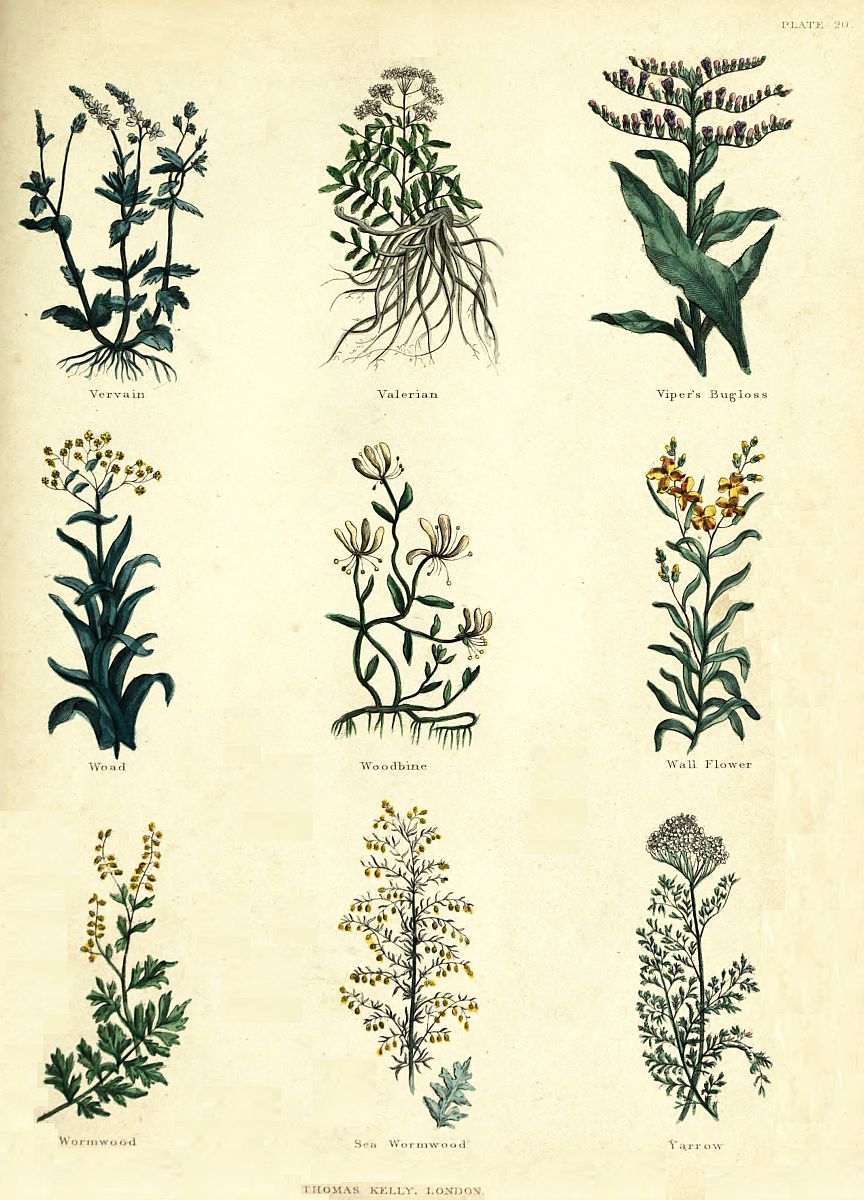
Vervain, Valerian, Viper’s Bugloss; Woad, Woodbine, Wall Flower; Wormwood, Sea Wormwood, Yarrow
Garden Valerian
Descript.] This hath a thick short greyish root, lying for the most part above ground, shooting forth on all other sides such like small pieces of roots, which have all of them many long green strings and fibres under them in the ground, whereby it draws nourishment. From the head of these roots spring up many green leaves, which at first are somewhat broad and long, without any divisions at all in them, or denting on the edges; but those that rise up after are more and more divided on each side, some to the middle rib, being winged, as made of many leaves together on a stalk, and those upon a stalk, in like manner more divided, but smaller towards the top than below; the stalk rises to be a yard high or more, sometimes branched at the top, with many small whitish flowers, sometimes dashed over at the edges with a pale purplish colour, of a little scent, which passing away, there follows small brownish white seed, that is easily carried away with the wind. The root smells more strong than either leaf or flower, and is of more use in medicines.
Place.] It is generally kept with us in gardens.
Time.] It flowers in June and July, and continues flowering until the frost pull it down.
Government and virtues.] This is under the influence of Mercury. Dioscorides saith, That the Garden Valerian hath a warming faculty, and that being dried and given to drink it provokes urine, and helps the stranguary. The decoction thereof taken, doth the like also, and takes away pains of the sides, provokes women’s courses, and is used in antidotes. Pliny saith, That the powder of the root given in drink, or the decoction thereof taken, helps all stoppings and stranglings in any part of the body, whether they proceed of pains in the chest or sides, and takes them away. The root of Valerian boiled with liquorice, raisins, and anniseed, is singularly good for those that are short-winded, and for those that are troubled with the cough, and helps to open the passages, and to expectorate phlegm easily. It is given to those that are bitten or stung by any venomous creature, being boiled in wine. It is of a special virtue against the plague, the decoction thereof being drank, and the root being used to smell to. It helps to expel the wind in the belly. The green herb with the root taken fresh, being bruised and applied to the head, takes away the pains and prickings there, stays rheum and thin distillation, and being boiled in white wine, and a drop thereof put into the eyes, takes away the dimness of the sight, or any pin or web therein. It is of excellent property to heal any inward sores or wounds, and also for outward hurts or wounds, and drawing away splinters or thorns out of the flesh.
Vervain
Descript.] The common Vervain hath somewhat long broad leaves next the ground deeply gashed about the edges, and some only deeply dented, or cut all alike, of a blackish green colour on the upper side, somewhat grey underneath. The stalk is square, branched into several parts, rising about two feet high, especially if you reckon the long spike of flowers at the tops of them, which are set on all sides one above another, and sometimes two or three together, being small and gaping, of a blue colour and white intermixed, after which come small round seed, in small and somewhat long heads. The root is small and long.
Place.] It grows generally throughout this land in divers places of the hedges and way-sides, and other waste grounds.
Time.] It flowers in July, and the seed is ripe soon after.
Government and virtues.] This is an herb of Venus, and excellent for the womb to strengthen and remedy all the cold griefs of it, as Plantain doth the hot. Vervain is hot and dry, opening obstructions, cleansing and healing. It helps the yellow jaundice, the dropsy and the gout; it kills and expels worms in the belly, and causes a good colour in the face and body, strengthens as well as corrects the diseases of the stomach, liver, and spleen; helps the cough, wheezings, and shortness of breath, and all the defects of the reins and bladder, expelling the gravel and stone. It is held to be good against the biting of serpents, and other venomous beasts, against the plague, and both tertian and quartan agues. It consolidates and heals also all wounds, both inward and outward, stays bleedings, and used with some honey, heals all old ulcers and fistulas in the legs or other parts of the body; as also those ulcers that happen in the mouth; or used with hog’s grease, it helps the swellings and pains of the secret parts in man or woman, also for the piles or hæmorrhoids; applied with some oil of roses and vinegar unto the forehead and temples, it eases the inveterate pains and ache of the head, and is good for those that are frantic. The leaves bruised, or the juice of them mixed with some vinegar, doth wonderfully cleanse the skin, and takes away morphew, freckles, fistulas, and other such like inflamations and deformities of the skin in any parts of the body. The distilled water of the herb when it is in full strength, dropped into the eyes, cleanses them from films, clouds, or mists, that darken the sight, and wonderfully strengthens the optic nerves. The said water is very powerful in all the diseases aforesaid, either inward or outward, whether they be old corroding sores, or green wounds. The dried root, and peeled, is known to be excellently good against all scrophulous and scorbutic habits of body, by being tied to the pit of the stomach, by a piece of white ribband round the neck.
The Vine
The leaves of the English vine (I do not mean to send you to the Canaries for a medicine) being boiled, makes a good lotion for sore mouths; being boiled with barley meal into a poultice, it cools inflammations of wounds; the dropping of the vine, when it is cut in the Spring, which country people call Tears, being boiled in a syrup, with sugar, and taken inwardly, is excellent to stay women’s longings after every thing they see, which is a disease many women with child are subject to. The decoction of Vine leaves in white wine doth the like. Also the tears of the Vine, drank two or three spoonfuls at a time, breaks the stone in the bladder. This is a very good remedy, and it is discreetly done, to kill a Vine to cure a man, but the salt of the leaves are held to be better. The ashes of the burnt branches will make teeth that are as black as a coal, to be as white as snow, if you but every morning rub them with it. It is a most gallant Tree of the Sun, very sympathetical with the body of men, and that is the reason spirit of wine is the greatest cordial among all vegetables.
Violets
Both the tame and the wild are so well known, that they need no description.
Time.] They flower until the end of July, but are best in March, and the beginning of April.
Government and virtues.] They are a fine pleasing plant of Venus, of a mild nature, no way harmful. All the Violets are cold and moist while they are fresh and green, and are used to cool any heat, or distemperature of the body, either inwardly or outwardly, as inflammations in the eyes, in the matrix or fundament, in imposthumes also, and hot swellings, to drink the decoction of the leaves and flowers made with water in wine, or to apply them poultice-wise to the grieved places: it likewise eases pains in the head, caused through want of sleep; or any other pains arising of heat, being applied in the same manner, or with oil of roses. A dram weight of the dried leaves or flower of Violets, but the leaves more strongly, doth purge the body of choleric humours, and assuages the heat, being taken in a draught of wine, or any other drink; the powder of the purple leaves of the flowers, only picked and dried and drank in water, is said to help the quinsy, and the falling-sickness in children, especially in the beginning of the disease. The flowers of the white Violets ripen and dissolve swellings. The herb or flowers, while they are fresh, or the flowers when they are dry, are effectual in the pleurisy, and all diseases of the lungs, to lenify the sharpness in hot rheums, and the hoarseness of the throat, the heat also and sharpness of urine, and all the pains of the back or reins, and bladder. It is good also for the liver and the jaundice, and all hot agues, to cool the heat, and quench the thirst; but the syrup of Violets is of most use, and of better effect, being taken in some convenient liquor: and if a little of the juice or syrup of lemons be put to it, or a few drops of the oil of vitriol, it is made thereby the more powerful to cool the heat, and quench the thirst, and gives to the drink a claret wine colour, and a fine tart relish, pleasing to the taste. Violets taken, or made up with honey, do more cleanse and cool, and with sugar contrary-wise. The dried flower of Violets are accounted amongst the cordial drinks, powders, and other medicines, especially where cooling cordials are necessary. The green leaves are used with other herbs to make plaisters and poultices to inflammations and swellings, and to ease all pains whatsoever, arising of heat, and for the piles also, being fried with yolks of eggs, and applied thereto.
Viper’s Bugloss
Descript.] This hath many long rough leaves lying on the ground, from among which rises up divers hard round stalks, very rough, as if they were thick set with prickles or hairs, whereon are set such like rough, hairy, or prickly sad green leaves, somewhat narrow; the middle rib for the most part being white. The flowers stand at the top of the stalk, branched forth in many long spiked leaves of flowers bowing or turning like the turnsole, all opening for the most part on the one side, which are long and hollow, turning up the brims a little, of a purplish violet colour in them that are fully blown, but more reddish while they are in the bud, as also upon their decay and withering; but in some places of a paler purplish colour, with a long pointel in the middle, feathered or parted at the top. After the flowers are fallen, the seeds growing to be ripe, are blackish, cornered and pointed somewhat like the head of a viper. The root is somewhat great and blackish, and woolly, when it grows toward seed-time, and perishes in the Winter.
There is another sort, little differing from the former, only in this, that it bears white flowers.
Place.] The first grows wild almost every where. That with white flowers about the castle-walls at Lewis in Sussex.
Time.] They flower in Summer, and their seed is ripe quickly after.
Government and virtues.] It is a most gallant herb of the Sun; it is a pity it is no more in use than it is. It is an especial remedy against the biting of the Viper, and all other venomous beasts, or serpents; as also against poison, or poisonous herbs. Dioscorides and others say, That whosoever shall take of the herb or root before they be bitten, shall not be hurt by the poison of any serpent. The root or seed is thought to be most effectual to comfort the heart, and expel sadness, or causeless melancholy; it tempers the blood, and allays hot fits of agues. The seed drank in wine, procures abundance of milk in women’s breasts. The same also being taken, eases the pains in the loins, back, and kidneys. The distilled water of the herb when it is in flower, or its chief strength, is excellent to be applied either inwardly or outwardly, for all the griefs aforesaid. There is a syrup made hereof very effectual for the comforting the heart, and expelling sadness and melancholy.
The end of V: Garden Valerian to Viper’s Bugloss.
Turn the page for Wall Flowers to Wormwood.
Tap or click the right-hand side of the book to turn the page, the left to turn back; or use the arrow keys, or swipe. Press F for full screen.
The English Physician Enlarged · V
Garden Valerian to Viper’s Bugloss
Vervain, Valerian, Viper’s Bugloss; Woad, Woodbine, Wall Flower; Wormwood, Sea Wormwood, Yarrow
Garden Valerian
Descript.] This hath a thick short greyish root, lying for the most part above ground, shooting forth on all other sides such like small pieces of roots, which have all of them many long green strings and fibres under them in the ground, whereby it draws nourishment. From the head of these roots spring up many green leaves, which at first are somewhat broad and long, without any divisions at all in them, or denting on the edges; but those that rise up after are more and more divided on each side, some to the middle rib, being winged, as made of many leaves together on a stalk, and those upon a stalk, in like manner more divided, but smaller towards the top than below; the stalk rises to be a yard high or more, sometimes branched at the top, with many small whitish flowers, sometimes dashed over at the edges with a pale purplish colour, of a little scent, which passing away, there follows small brownish white seed, that is easily carried away with the wind. The root smells more strong than either leaf or flower, and is of more use in medicines.
Place.] It is generally kept with us in gardens.
Time.] It flowers in June and July, and continues flowering until the frost pull it down.
Government and virtues.] This is under the influence of Mercury. Dioscorides saith, That the Garden Valerian hath a warming faculty, and that being dried and given to drink it provokes urine, and helps the stranguary. The decoction thereof taken, doth the like also, and takes away pains of the sides, provokes women’s courses, and is used in antidotes. Pliny saith, That the powder of the root given in drink, or the decoction thereof taken, helps all stoppings and stranglings in any part of the body, whether they proceed of pains in the chest or sides, and takes them away. The root of Valerian boiled with liquorice, raisins, and anniseed, is singularly good for those that are short-winded, and for those that are troubled with the cough, and helps to open the passages, and to expectorate phlegm easily. It is given to those that are bitten or stung by any venomous creature, being boiled in wine. It is of a special virtue against the plague, the decoction thereof being drank, and the root being used to smell to. It helps to expel the wind in the belly. The green herb with the root taken fresh, being bruised and applied to the head, takes away the pains and prickings there, stays rheum and thin distillation, and being boiled in white wine, and a drop thereof put into the eyes, takes away the dimness of the sight, or any pin or web therein. It is of excellent property to heal any inward sores or wounds, and also for outward hurts or wounds, and drawing away splinters or thorns out of the flesh.
Vervain
Descript.] The common Vervain hath somewhat long broad leaves next the ground deeply gashed about the edges, and some only deeply dented, or cut all alike, of a blackish green colour on the upper side, somewhat grey underneath. The stalk is square, branched into several parts, rising about two feet high, especially if you reckon the long spike of flowers at the tops of them, which are set on all sides one above another, and sometimes two or three together, being small and gaping, of a blue colour and white intermixed, after which come small round seed, in small and somewhat long heads. The root is small and long.
Place.] It grows generally throughout this land in divers places of the hedges and way-sides, and other waste grounds.
Time.] It flowers in July, and the seed is ripe soon after.
Government and virtues.] This is an herb of Venus, and excellent for the womb to strengthen and remedy all the cold griefs of it, as Plantain doth the hot. Vervain is hot and dry, opening obstructions, cleansing and healing. It helps the yellow jaundice, the dropsy and the gout; it kills and expels worms in the belly, and causes a good colour in the face and body, strengthens as well as corrects the diseases of the stomach, liver, and spleen; helps the cough, wheezings, and shortness of breath, and all the defects of the reins and bladder, expelling the gravel and stone. It is held to be good against the biting of serpents, and other venomous beasts, against the plague, and both tertian and quartan agues. It consolidates and heals also all wounds, both inward and outward, stays bleedings, and used with some honey, heals all old ulcers and fistulas in the legs or other parts of the body; as also those ulcers that happen in the mouth; or used with hog’s grease, it helps the swellings and pains of the secret parts in man or woman, also for the piles or hæmorrhoids; applied with some oil of roses and vinegar unto the forehead and temples, it eases the inveterate pains and ache of the head, and is good for those that are frantic. The leaves bruised, or the juice of them mixed with some vinegar, doth wonderfully cleanse the skin, and takes away morphew, freckles, fistulas, and other such like inflamations and deformities of the skin in any parts of the body. The distilled water of the herb when it is in full strength, dropped into the eyes, cleanses them from films, clouds, or mists, that darken the sight, and wonderfully strengthens the optic nerves. The said water is very powerful in all the diseases aforesaid, either inward or outward, whether they be old corroding sores, or green wounds. The dried root, and peeled, is known to be excellently good against all scrophulous and scorbutic habits of body, by being tied to the pit of the stomach, by a piece of white ribband round the neck.
The Vine
The leaves of the English vine (I do not mean to send you to the Canaries for a medicine) being boiled, makes a good lotion for sore mouths; being boiled with barley meal into a poultice, it cools inflammations of wounds; the dropping of the vine, when it is cut in the Spring, which country people call Tears, being boiled in a syrup, with sugar, and taken inwardly, is excellent to stay women’s longings after every thing they see, which is a disease many women with child are subject to. The decoction of Vine leaves in white wine doth the like. Also the tears of the Vine, drank two or three spoonfuls at a time, breaks the stone in the bladder. This is a very good remedy, and it is discreetly done, to kill a Vine to cure a man, but the salt of the leaves are held to be better. The ashes of the burnt branches will make teeth that are as black as a coal, to be as white as snow, if you but every morning rub them with it. It is a most gallant Tree of the Sun, very sympathetical with the body of men, and that is the reason spirit of wine is the greatest cordial among all vegetables.
Violets
Both the tame and the wild are so well known, that they need no description.
Time.] They flower until the end of July, but are best in March, and the beginning of April.
Government and virtues.] They are a fine pleasing plant of Venus, of a mild nature, no way harmful. All the Violets are cold and moist while they are fresh and green, and are used to cool any heat, or distemperature of the body, either inwardly or outwardly, as inflammations in the eyes, in the matrix or fundament, in imposthumes also, and hot swellings, to drink the decoction of the leaves and flowers made with water in wine, or to apply them poultice-wise to the grieved places: it likewise eases pains in the head, caused through want of sleep; or any other pains arising of heat, being applied in the same manner, or with oil of roses. A dram weight of the dried leaves or flower of Violets, but the leaves more strongly, doth purge the body of choleric humours, and assuages the heat, being taken in a draught of wine, or any other drink; the powder of the purple leaves of the flowers, only picked and dried and drank in water, is said to help the quinsy, and the falling-sickness in children, especially in the beginning of the disease. The flowers of the white Violets ripen and dissolve swellings. The herb or flowers, while they are fresh, or the flowers when they are dry, are effectual in the pleurisy, and all diseases of the lungs, to lenify the sharpness in hot rheums, and the hoarseness of the throat, the heat also and sharpness of urine, and all the pains of the back or reins, and bladder. It is good also for the liver and the jaundice, and all hot agues, to cool the heat, and quench the thirst; but the syrup of Violets is of most use, and of better effect, being taken in some convenient liquor: and if a little of the juice or syrup of lemons be put to it, or a few drops of the oil of vitriol, it is made thereby the more powerful to cool the heat, and quench the thirst, and gives to the drink a claret wine colour, and a fine tart relish, pleasing to the taste. Violets taken, or made up with honey, do more cleanse and cool, and with sugar contrary-wise. The dried flower of Violets are accounted amongst the cordial drinks, powders, and other medicines, especially where cooling cordials are necessary. The green leaves are used with other herbs to make plaisters and poultices to inflammations and swellings, and to ease all pains whatsoever, arising of heat, and for the piles also, being fried with yolks of eggs, and applied thereto.
Viper’s Bugloss
Descript.] This hath many long rough leaves lying on the ground, from among which rises up divers hard round stalks, very rough, as if they were thick set with prickles or hairs, whereon are set such like rough, hairy, or prickly sad green leaves, somewhat narrow; the middle rib for the most part being white. The flowers stand at the top of the stalk, branched forth in many long spiked leaves of flowers bowing or turning like the turnsole, all opening for the most part on the one side, which are long and hollow, turning up the brims a little, of a purplish violet colour in them that are fully blown, but more reddish while they are in the bud, as also upon their decay and withering; but in some places of a paler purplish colour, with a long pointel in the middle, feathered or parted at the top. After the flowers are fallen, the seeds growing to be ripe, are blackish, cornered and pointed somewhat like the head of a viper. The root is somewhat great and blackish, and woolly, when it grows toward seed-time, and perishes in the Winter.
There is another sort, little differing from the former, only in this, that it bears white flowers.
Place.] The first grows wild almost every where. That with white flowers about the castle-walls at Lewis in Sussex.
Time.] They flower in Summer, and their seed is ripe quickly after.
Government and virtues.] It is a most gallant herb of the Sun; it is a pity it is no more in use than it is. It is an especial remedy against the biting of the Viper, and all other venomous beasts, or serpents; as also against poison, or poisonous herbs. Dioscorides and others say, That whosoever shall take of the herb or root before they be bitten, shall not be hurt by the poison of any serpent. The root or seed is thought to be most effectual to comfort the heart, and expel sadness, or causeless melancholy; it tempers the blood, and allays hot fits of agues. The seed drank in wine, procures abundance of milk in women’s breasts. The same also being taken, eases the pains in the loins, back, and kidneys. The distilled water of the herb when it is in flower, or its chief strength, is excellent to be applied either inwardly or outwardly, for all the griefs aforesaid. There is a syrup made hereof very effectual for the comforting the heart, and expelling sadness and melancholy.
22 of 42 · 9 min read
