THE GOETIA · SPIRIT 29 OF 72 · DUKE
Astaroth
Listening to an account of a fall
Duke Venus · 40 legions
HOW IT APPEARS
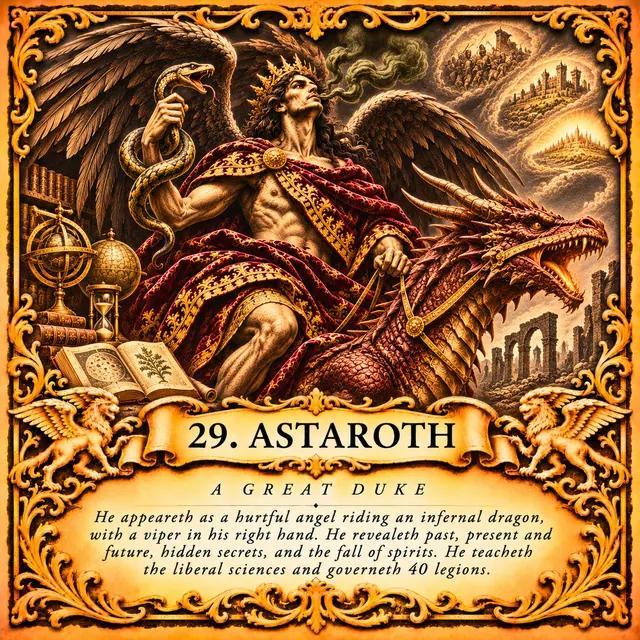
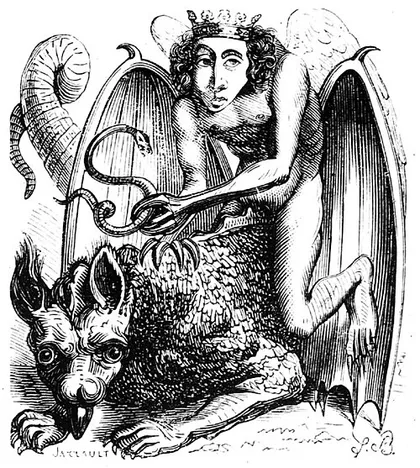
A hurtful angel riding an infernal dragon, with a viper in his right hand; his breath is noisome.
WHAT IT DOES
Answers truly about past, present, future and secrets; tells how the spirits fell; teaches the liberal sciences.
Past & futureTeaching & knowledge
His name descends from the goddess Astarte. The magician must hold the magic ring to his face against the spirit's breath.
Astaroth joins extensive knowledge with a narrative of lost status, inviting reflection on the explanations people give for their own history.
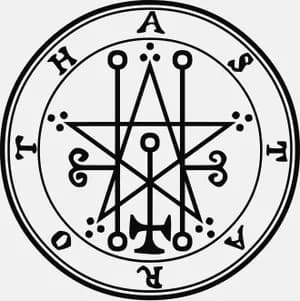
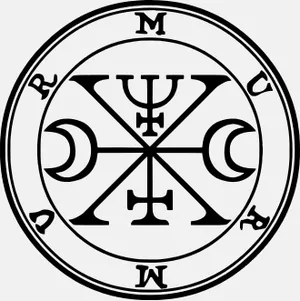
The seal of Astaroth
The seal, or sigil, as the 1904 edition printed it, to be worn before the magician as a lamen. The Goetia asks for each seal to be made in the metal of the spirit's rank: for a duke, copper.
In the Sloane manuscript
The Goetia describes Astaroth as a fallen angelic figure riding a dragon-like creature and carrying a viper. He reveals secrets, teaches liberal sciences and explains the fall of spirits, including his own; the text also warns about his breath. Goetia, spirit 29, Sloane MS 3825
A seventeenth-century manuscript of the Goetia, which can differ in spelling and detail from the 1904 edition given above.
Rank, legions and the angel against it
- RANK, PLANET AND SEAL
Duke: ♀ Venus, its seal made in copper
- LEGIONS UNDER IT
- 40Paimon has the most, 200.
- WHEN THE GOETIA SAYS TO CALL IT
Dukes: sunrise to noon, in clear weather
- THE ANGEL SET AGAINST IT
- Reiaiel רייאל, the 29th of the 72 angels of the Shem ha-Mephorash, of the Dominions. In Dr Rudd's Goetia each spirit is bound by the angel of the same number.
- IN THE OLDER LISTS
- In Weyer's Pseudomonarchia Daemonum (1577).
WRITTEN FOR OCCULTUM
A reading of Astaroth
A SYMBOLIC READING
A symbolic reading can examine how an account of failure is shaped by the person telling it. Astaroth invites both attention and distance: the story may contain useful knowledge while leaving motives, omissions or self-justification unresolved. Understanding an explanation does not require accepting it as the only possible account.
A PRACTICE
Choose a story you tell about a setback. Identify the events, your interpretation and the part played by your own choices. Ask what a fair-minded witness might add. Preserve the useful lesson while allowing the account to become less protective of your pride.
AN ORIGINAL INVOCATION
Astaroth, as I consider the telling of a fall, let me hear what is revealing and recognise what the teller may leave unexplained.
A line for contemplation, newly written: not a conjuration from the Goetia.
TO REFLECT ON
Which part of my explanation protects my image more than it clarifies the event?
Historical description after Joseph H. Peterson's digital edition of the Lemegeton, Part 1: Goetia, a transcription of British Library Sloane MS 3825, offered under CC BY 4.0; the English here is a new paraphrase. Heading, summary, symbolic reading, practice, invocation and question: original editorial writing for Occultum.
Spirits of like office
The spirits that share most of what Astaroth is said to do.
Learn more in the lessons
- Demonology — A Short History · 17 min
- The Grand Grimoire and the Red Dragon · 16 min
- The Goetia — The 72 Spirits of Solomon · 18 min
- Discernment & Protection · to read before any practical spirit work
The Goetia asks for each seal to be made in the metal of the spirit's rank. Given here as history and symbolism, not as instructions.