MAJOR ARCANA · TRUMP I
The Magician
Tarot card meaning
UPRIGHT
Skill, willpower, resourcefulness — you have the tools you need.
REVERSED
Manipulation, scattered energy, untapped talent.
The card
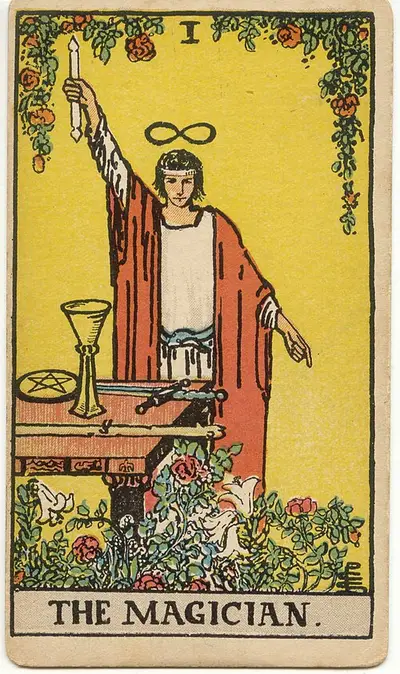
A figure raises a wand to the sky and points to the earth — as above, so below. Before him lie the four suit emblems; a lemniscate (∞) floats over his head.
The Magician is trump I of the twenty-two trumps of the Major Arcana.
In the Golden Dawn's attributions it carries the Hebrew letter Beth (ב), “house”, and the planet Mercury. On the Tree of Life it is path 12, joining Kether and Binah.
In Aleister Crowley's Thoth tarot: The Magus, I.
In Waite's words
Arthur Edward Waite designed the deck that Pamela Colman Smith drew, and explained it in The Pictorial Key to the Tarot (1911). His text, with his spelling:
DIVINATORY MEANINGS Skill, diplomacy, address, subtlety; sickness, pain, loss, disaster, snares of enemies; self-confidence, will; the Querent, if male.
REVERSED Physician, Magus, mental disease, disgrace, disquiet.
The picture and its symbolism
A youthful figure in the robe of a magician, having the countenance of divine Apollo, with smile of confidence and shining eyes. Above his head is the mysterious sign of the Holy Spirit, the sign of life, like an endless cord, forming the figure 8 in a horizontal position ∞. About his waist is a serpent-cincture, the serpent appearing to devour its own tail. This is familiar to most as a conventional symbol of eternity, but here it indicates more especially the eternity of attainment in the spirit. In the Magician's right hand is a wand raised towards heaven, while the left hand is pointing to the earth. This dual sign is known in very high grades of the Instituted Mysteries; it shews the descent of grace, virtue and light, drawn from things above and derived to
things below. The suggestion throughout is therefore the possession and communication of the Powers and Gifts of the Spirit. On the table in front of the Magician are the symbols of the four Tarot suits, signifying the elements of natural life, which lie like counters before the adept, and he adapts them as he wills. Beneath are roses and lilies, the flos campi and lilium convallium, changed into garden flowers, to shew the culture of aspiration. This card signifies the divine motive in man, reflecting God, the will in the liberation of its union with that which is above. It is also the unity of individual being on all planes, and in a very high sense it is thought, in the fixation thereof. With further reference to what I have called the sign of life and its connexion with the number 8, it may be remembered that Christian Gnosticism speaks of rebirth in Christ as a change "unto the Ogdoad." The mystic number is termed Jerusalem above, the Land flowing with Milk and Honey, the Holy Spirit and the Land of the Lord. According to Martinism, 8 is the number of Christ.
A. E. Waite, The Pictorial Key to the Tarot (London: William Rider & Son, 1911), Part II § 2 and Part III § 3. Public domain; text from the 1922 printing on Wikisource.
Related cards
The numbered cards it governs
Eight of Wands: a decan ruled by Mercury · Three of Cups: a decan ruled by Mercury · Six of Swords: a decan ruled by Mercury · Five of Pentacles: a decan ruled by Mercury · Ten of Pentacles: a decan ruled by Mercury
In three historical decks
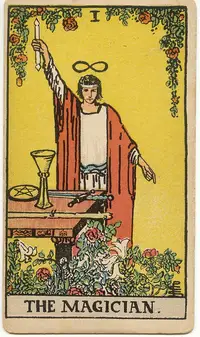
The same card as it was painted in fifteenth-century Milan, printed in the French pattern of the Tarot de Marseille, and drawn by Pamela Colman Smith for the Rider–Waite–Smith deck.
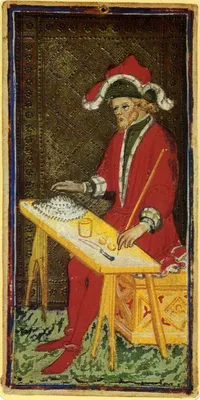
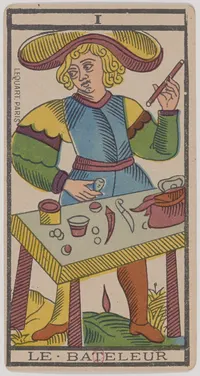
In the Tarot de Marseille: Le Bateleur, I.
Learn more in the lessons
- The Twenty-Two Paths & the Tarot · 18 min
- The Major Arcana Journey · 18 min
- The Thoth Tarot · 12 min
Images: Pamela Colman Smith, 1909 (public domain); the RWS1909 scans on Wikimedia Commons. Lequart, Paris, c. 1890 (public domain); scans from the Bibliothèque nationale de France (Gallica), via Wikimedia Commons. Attributed to Bonifacio Bembo, mid-15th century (public domain); scans by David Madore, via Wikimedia Commons.