MAJOR ARCANA · TRUMP II
The High Priestess
Tarot card meaning
UPRIGHT
Intuition, hidden knowledge, the inner voice, mystery.
REVERSED
Secrets withheld, ignoring intuition, surface thinking.
The card
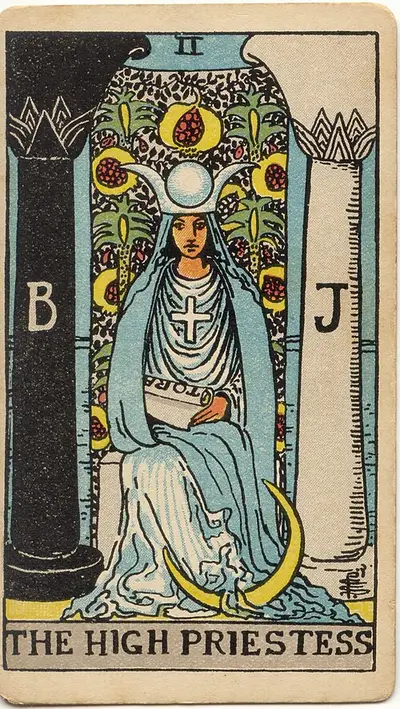
A veiled priestess sits between a black pillar (B, Boaz) and a white pillar (J, Jachin), holding a scroll marked TORA. A crescent moon lies at her feet; pomegranates decorate the veil behind.
The High Priestess is trump II of the twenty-two trumps of the Major Arcana.
In the Golden Dawn's attributions it carries the Hebrew letter Gimel (ג), “camel”, and the Moon. On the Tree of Life it is path 13, joining Kether and Tiphareth.
In Aleister Crowley's Thoth tarot: The Priestess, II.
In Waite's words
Arthur Edward Waite designed the deck that Pamela Colman Smith drew, and explained it in The Pictorial Key to the Tarot (1911). His text, with his spelling:
DIVINATORY MEANINGS Secrets, mystery, the future as yet unrevealed; the woman who interests the Querent, if male; the Querent herself, if female; silence, tenacity; mystery, wisdom, science.
REVERSED Passion, moral or physical ardour, conceit, surface knowledge.
The picture and its symbolism
She has the lunar crescent at her feet, a horned diadem on her head, with a globe in the middle place, and a large solar cross on her breast. The scroll in her hands is inscribed with the word Tora, signifying the Greater Law, the Secret Law and the second sense of the Word. It is partly covered by her mantle, to shew that some things are implied and some spoken. She is seated between the white and black pillars—J. and B.—of the mystic Temple and the veil of the Temple is behind her: it is embroidered with palms and pomegranates. The vestments are flowing and gauzy, and the mantle suggests light—a shimmering radiance. She has been called Occult Science on the threshold of the Sanctuary of Isis, but she is really the Secret Church, the House which is of God and man. She represents also the Second Marriage of the Prince who is no longer of this world; she is the spiritual Bride and Mother, the daughter of the stars
and the Higher Garden of Eden. She is, in fine, the Queen of the borrowed light, but this is the light of all. She is the Moon nourished by the milk of the Supernal Mother.
In a manner, she is also the Supernal Mother herself—that is to say, she is the bright reflection. It is in this sense of reflection that her truest and highest name in bolism is Shekinah—the co-habiting glory. According to Kabalism, there is a Shekinah both above and below. In the superior world it is called Binah, the Supernal Understanding which reflects to the emanations that are beneath. In the lower world it is Malkuth—that world being, for this purpose, understood as a blessed Kingdom—that with which it is made blessed being the Indwelling Glory. Mystically speaking, the Shekinah is the Spiritual Bride of the just man, and when he reads the Law she gives the Divine meaning. There are some respects in which this card is the highest and holiest of the Greater Arcana.
A. E. Waite, The Pictorial Key to the Tarot (London: William Rider & Son, 1911), Part II § 2 and Part III § 3. Public domain; text from the 1922 printing on Wikisource.
Related cards
The numbered cards it governs
Nine of Wands: a decan ruled by Moon · Four of Cups: a decan ruled by Moon · Two of Swords: a decan ruled by Moon · Seven of Swords: a decan ruled by Moon · Six of Pentacles: a decan ruled by Moon
In three historical decks
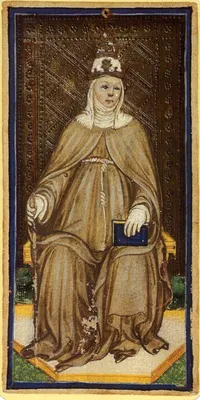
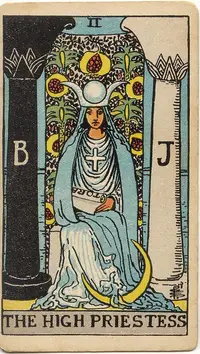
The same card as it was painted in fifteenth-century Milan, printed in the French pattern of the Tarot de Marseille, and drawn by Pamela Colman Smith for the Rider–Waite–Smith deck.
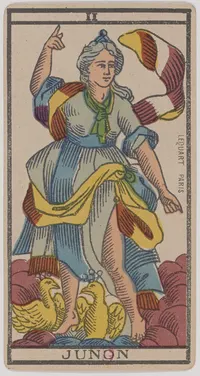
In the Tarot de Marseille: La Papesse, II.
Learn more in the lessons
- The Twenty-Two Paths & the Tarot · 18 min
- The Major Arcana Journey · 18 min
- The Thoth Tarot · 12 min
Images: Pamela Colman Smith, 1909 (public domain); the RWS1909 scans on Wikimedia Commons. Lequart, Paris, c. 1890 (public domain); scans from the Bibliothèque nationale de France (Gallica), via Wikimedia Commons. Attributed to Bonifacio Bembo, mid-15th century (public domain); scans by David Madore, via Wikimedia Commons.