THE I CHING · HEXAGRAM 23 OF 64
Hexagram 23: Splitting Apart
剝 Bō
☶ Mountain above, ☷ Earth below · its trigrams ↓
A mountain on the earth: it wears away and falls.
Five yin lines press out the last yang. Inferior forces advance. It is no time to go forward: keep still and keep the seed.
COUNSEL Do not move ahead; keep still and conserve.
The Judgment and the lines
In James Legge's translation of 1882. Tradition gives the Judgment, the text on the whole figure, to King Wen, and the texts of the six lines to his son, the Duke of Zhou. The words in brackets are Legge's own, filling out the terse Chinese.
THE JUDGMENT
Po indicates that (in the state which it symbolises) it will not be advantageous to make a movement in any direction whatever.
THE SIX LINES, FROM THE BOTTOM UP
LINE 1 · THE BEGINNING · BROKEN
The first SIX, divided, shows one overturning the couch by injuring its legs. (The injury will go on to) the destruction of (all) firm correctness, and there will be evil.
Changing, it becomes 27. Nourishment.
LINE 2 · THE INNER PLACE · BROKEN
The second SIX, divided, shows one overthrowing the couch by injuring its frame. (The injury will go on to) the destruction of (all) firm correctness, and there will be evil.
Changing, it becomes 4. Youthful Inexperience.
LINE 3 · THE THRESHOLD · BROKEN
The third SIX, divided, shows its subject among the overthrowers; but there will be no error.
Changing, it becomes 52. Keeping Still.
LINE 4 · THE APPROACH · BROKEN
The fourth SIX, divided, shows its subject having overthrown the couch, and (going to injure) the skin (of him who lies on it). There will be evil.
Changing, it becomes 35. Progress.
LINE 5 · THE RULER · BROKEN
The fifth SIX, divided, shows (its subject leading on the others like) a string of fishes, and (obtaining for them) the favour that lights on the inmates of the palace. There will be advantage in every way.
Changing, it becomes 20. Contemplation.
LINE 6 · THE END · SOLID
The topmost NINE, undivided, shows its subject (as) a great fruit which has not been eaten. The superior man finds (the people again) as a chariot carrying him. The small men (by their course) overthrow their own dwellings.
Changing, it becomes 2. The Receptive.
In a cast, a line's text is read when that line changes, and the hexagram it changes into shows where the matter is going; when several lines change, Zhu Xi's rules choose which texts to read, and the I Ching tool follows them. Legge's translation, volume XVI of The Sacred Books of the East (1882), as the Reading Room has it: hexagram 23, his Po. Read it there with his note →
Its two trigrams
Mountain above Earth. The lower trigram is the inner situation and the upper the outer, and the hexagram's image is read from the two of them.

ABOVE☶ Mountain 艮 Gèn
Mountain, stone; still, stopping. In the family of the Shuogua it is the youngest son.
The still mountain
THE EIGHT WITH MOUNTAIN ABOVE
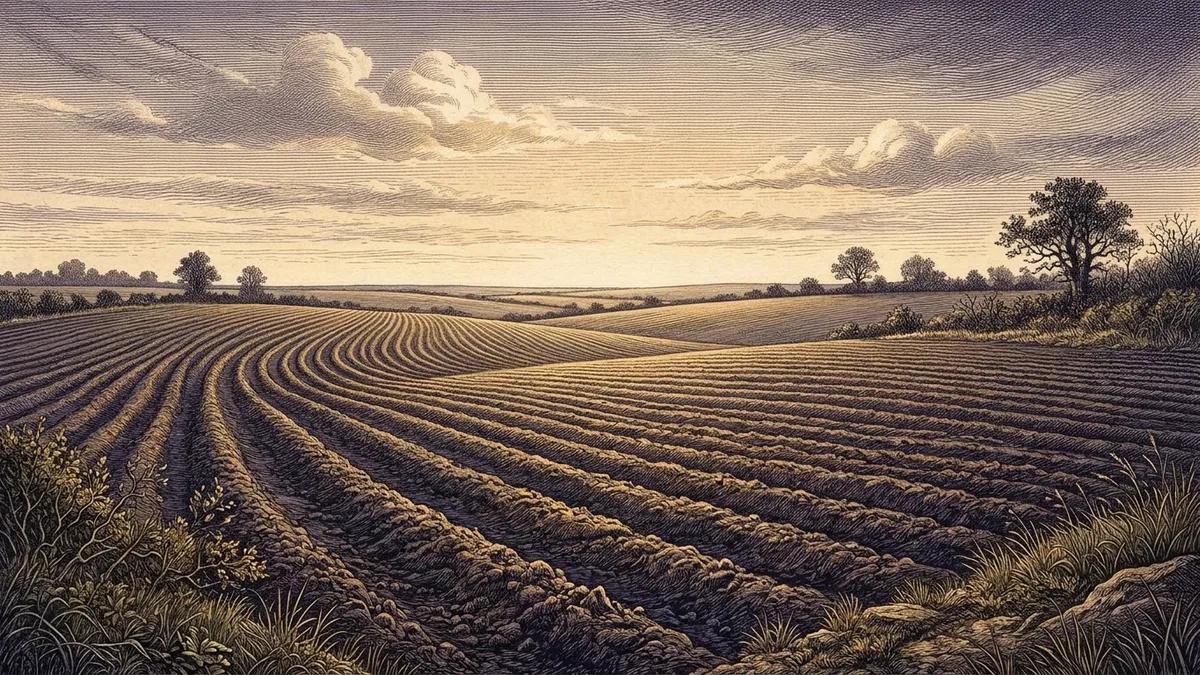
BELOW☷ Earth 坤 Kūn
Ground, the field; yielding, receptive. In the family of the Shuogua it is the mother.
The ploughed earth
THE EIGHT WITH EARTH BELOW
Pictures: original AI illustration created for Occultum.
Its pair, its opposite and its core
King Wen's order sets the hexagrams in pairs, each the other turned upside down or, where that changes nothing, with every line changed. Inside each lies a third, its hidden core, made of its lines 2 to 4 and 3 to 5.
In binary, a solid line 1 and a broken 0, read from the bottom line: 000001, which is 1, its place in the order Shao Yong set out and Leibniz saw his binary arithmetic in.
One of the twelve sovereign hexagrams: Splitting Apart holds the ninth month, 戌 xū, in the tide of the year. The Sovereign Hexagrams and the Tide of the Year →
Learn more in the lessons
- The Sovereign Hexagrams and the Tide of the Year · 14 min
- The Book of Changes · 18 min
- Yin, Yang and the Five Phases · 13 min · free
The English name is the common title. The image, sense and counsel are short plain-words summaries of the Judgment and the Image, written for Occultum's I Ching tool, not translations; the Judgment and lines are James Legge's, from The Sacred Books of the East, vol. XVI (1882). Given here as history and symbolism; see the lesson The Book of Changes for how the book grew.