THE I CHING · HEXAGRAM 27 OF 64
Hexagram 27: Nourishment
頤 Yí
☶ Mountain above, ☳ Thunder below · its trigrams ↓
Thunder under the mountain: the jaws, taking in and giving out.
Attention to what you feed, in body, mind and speech. Watch what you take in and what you let out.
COUNSEL Mind what you feed yourself and others.
The Judgment and the lines
In James Legge's translation of 1882. Tradition gives the Judgment, the text on the whole figure, to King Wen, and the texts of the six lines to his son, the Duke of Zhou. The words in brackets are Legge's own, filling out the terse Chinese.
THE JUDGMENT
Î indicates that with firm correctness there will be good fortune (in what is denoted by it). We must look at what we are seeking to nourish, and by the exercise of our thoughts seek for the proper aliment.
THE SIX LINES, FROM THE BOTTOM UP
LINE 1 · THE BEGINNING · SOLID
The first NINE, undivided, (seems to be thus addressed), 'You leave your efficacious tortoise, and look at me till your lower jaw hangs down.' There will be evil.
Changing, it becomes 23. Splitting Apart.
LINE 2 · THE INNER PLACE · BROKEN
The second SIX, divided, shows one looking downwards for nourishment, which is contrary to what is proper; or seeking it from the height (above), advance towards which will lead to evil.
Changing, it becomes 41. Decrease.
LINE 3 · THE THRESHOLD · BROKEN
The third SIX, divided, shows one acting contrary to the method of nourishing. However firm he may be, there will be evil. For ten years let him not take any action, (for) it will not be in any way advantageous.
Changing, it becomes 22. Grace.
LINE 4 · THE APPROACH · BROKEN
The fourth SIX, divided, shows one looking downwards for (the power to) nourish. There will be good fortune. Looking with a tiger's downward unwavering glare, and with his desire that impels him to spring after spring, he will fall into no error.
Changing, it becomes 21. Biting Through.
LINE 5 · THE RULER · BROKEN
The fifth SIX, divided, shows one acting contrary to what is regular and proper; but if he abide in firmness, there will be good fortune. He should not, (however, try to) cross the great stream.
Changing, it becomes 42. Increase.
LINE 6 · THE END · SOLID
The sixth NINE, undivided, shows him from whom comes the nourishing. His position is perilous, but there will be good fortune. It will be advantageous to cross the great stream.
Changing, it becomes 24. Return.
In a cast, a line's text is read when that line changes, and the hexagram it changes into shows where the matter is going; when several lines change, Zhu Xi's rules choose which texts to read, and the I Ching tool follows them. Legge's translation, volume XVI of The Sacred Books of the East (1882), as the Reading Room has it: hexagram 27, his I. Read it there with his note →
Its two trigrams
Mountain above Thunder. The lower trigram is the inner situation and the upper the outer, and the hexagram's image is read from the two of them.

ABOVE☶ Mountain 艮 Gèn
Mountain, stone; still, stopping. In the family of the Shuogua it is the youngest son.
The still mountain
THE EIGHT WITH MOUNTAIN ABOVE
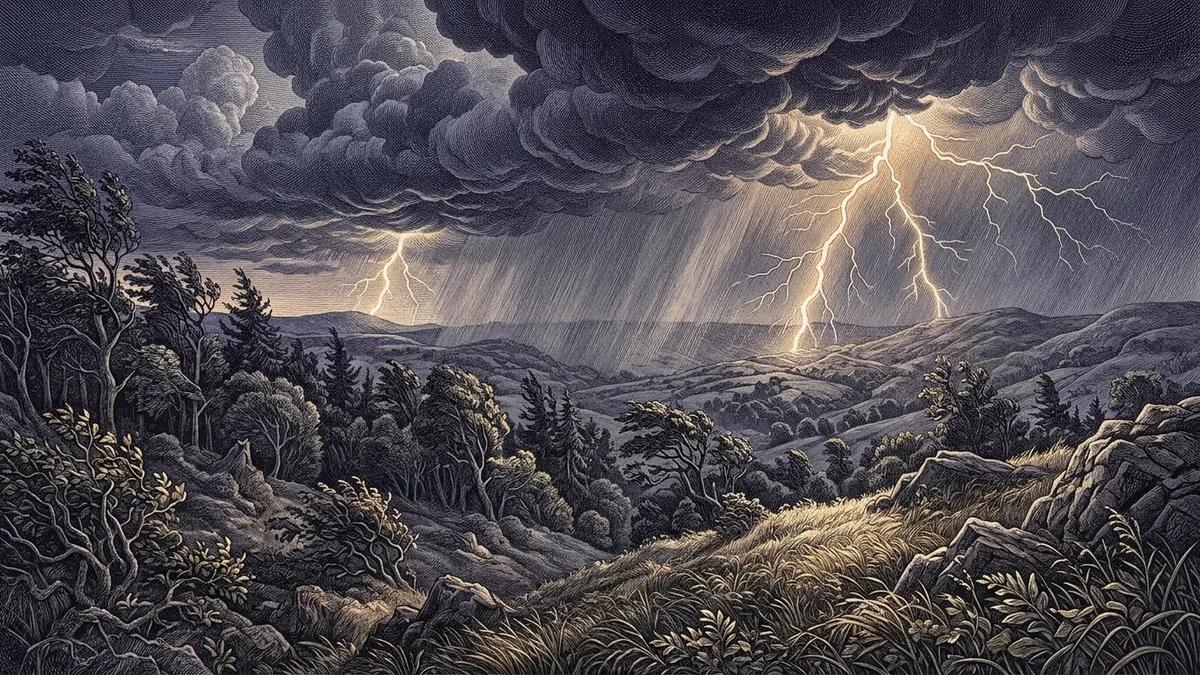
BELOW☳ Thunder 震 Zhèn
Thunder, quake; arousing, moving. In the family of the Shuogua it is the eldest son.
The breaking storm
THE EIGHT WITH THUNDER BELOW
Pictures: original AI illustration created for Occultum.
Its pair, its opposite and its core
King Wen's order sets the hexagrams in pairs, each the other turned upside down or, where that changes nothing, with every line changed. Inside each lies a third, its hidden core, made of its lines 2 to 4 and 3 to 5.
In binary, a solid line 1 and a broken 0, read from the bottom line: 100001, which is 33, its place in the order Shao Yong set out and Leibniz saw his binary arithmetic in.
Learn more in the lessons
- The Book of Changes · 18 min
- Yin, Yang and the Five Phases · 13 min · free
- The Sovereign Hexagrams and the Tide of the Year · 14 min
The English name is the common title. The image, sense and counsel are short plain-words summaries of the Judgment and the Image, written for Occultum's I Ching tool, not translations; the Judgment and lines are James Legge's, from The Sacred Books of the East, vol. XVI (1882). Given here as history and symbolism; see the lesson The Book of Changes for how the book grew.