THE I CHING · HEXAGRAM 46 OF 64
Hexagram 46: Pushing Upward
升 Shēng
☷ Earth above, ☴ Wind below · its trigrams ↓
A tree growing in the earth: slow, steady rising.
Rising by small steps and gradual accumulation. Seek out the person of influence and go forward without fear.
COUNSEL Rise steadily, in small steps.
The Judgment and the lines
In James Legge's translation of 1882. Tradition gives the Judgment, the text on the whole figure, to King Wen, and the texts of the six lines to his son, the Duke of Zhou. The words in brackets are Legge's own, filling out the terse Chinese.
THE JUDGMENT
Shăng indicates that (under its conditions) there will be great progress and success. Seeking by (the qualities implied in it) to meet with the great man, its subject need have no anxiety. Advance to the south will be fortunate.
THE SIX LINES, FROM THE BOTTOM UP
LINE 1 · THE BEGINNING · BROKEN
The first SIX, divided, shows its subject advancing upwards with the welcome (of those above him). There will be great good fortune.
Changing, it becomes 11. Peace.
LINE 2 · THE INNER PLACE · SOLID
The second NINE, undivided, shows its subject with that sincerity which will make even the (small) offerings of the vernal sacrifice acceptable. There will be no error.
Changing, it becomes 15. Modesty.
LINE 3 · THE THRESHOLD · SOLID
The third NINE, undivided, shows its subject ascending upwards (as into) an empty city.
Changing, it becomes 7. The Army.
LINE 4 · THE APPROACH · BROKEN
The fourth SIX, divided, shows its subject employed by the king to present his offerings on mount Khî. There will be good fortune; there will be no mistake.
Changing, it becomes 32. Duration.
LINE 5 · THE RULER · BROKEN
The fifth six, divided, shows its subject firmly correct, and therefore enjoying good fortune. He ascends the stairs (with all due ceremony).
Changing, it becomes 48. The Well.
LINE 6 · THE END · BROKEN
The sixth six, divided, shows its subject advancing upwards blindly. Advantage will be found in a ceaseless maintenance of firm correctness.
Changing, it becomes 18. Work on the Spoiled.
In a cast, a line's text is read when that line changes, and the hexagram it changes into shows where the matter is going; when several lines change, Zhu Xi's rules choose which texts to read, and the I Ching tool follows them. Legge's translation, volume XVI of The Sacred Books of the East (1882), as the Reading Room has it: hexagram 46, his Shăng. Read it there with his note →
Its two trigrams
Earth above Wind. The lower trigram is the inner situation and the upper the outer, and the hexagram's image is read from the two of them.
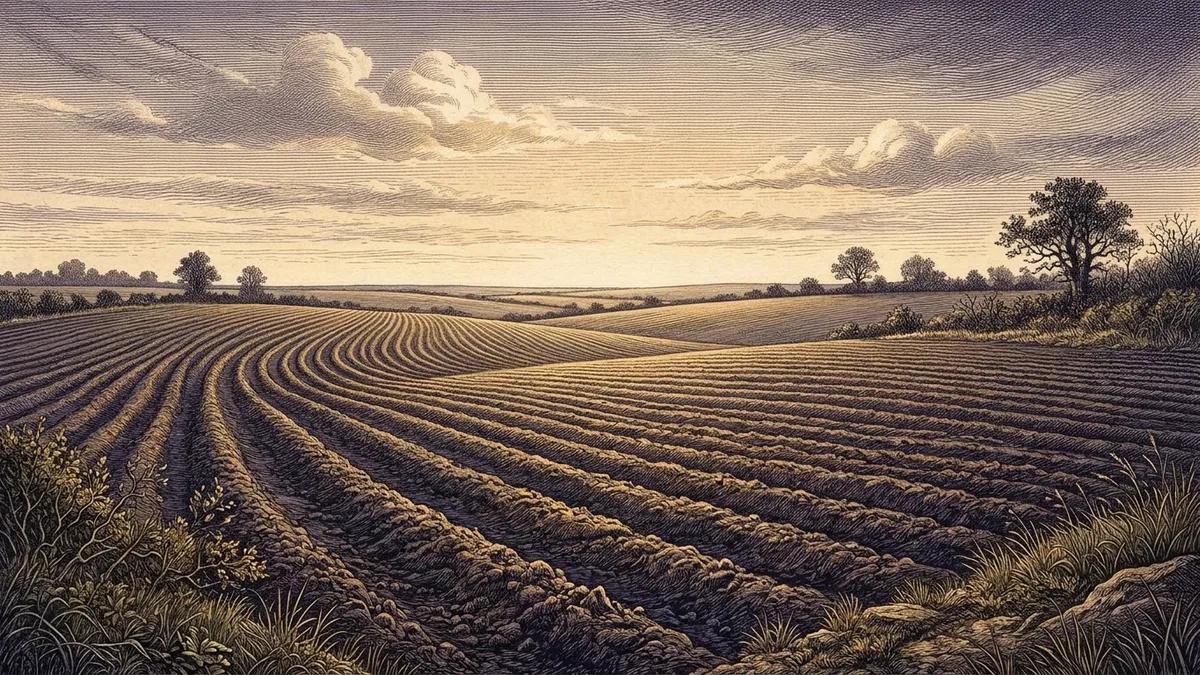
ABOVE☷ Earth 坤 Kūn
Ground, the field; yielding, receptive. In the family of the Shuogua it is the mother.
The ploughed earth
THE EIGHT WITH EARTH ABOVE

BELOW☴ Wind 巽 Xùn
Wind, wood; gentle, penetrating. In the family of the Shuogua it is the eldest daughter.
The wind in the wood
THE EIGHT WITH WIND BELOW
Pictures: original AI illustration created for Occultum.
Its pair, its opposite and its core
King Wen's order sets the hexagrams in pairs, each the other turned upside down or, where that changes nothing, with every line changed. Inside each lies a third, its hidden core, made of its lines 2 to 4 and 3 to 5.
In binary, a solid line 1 and a broken 0, read from the bottom line: 011000, which is 24, its place in the order Shao Yong set out and Leibniz saw his binary arithmetic in.
Learn more in the lessons
- The Book of Changes · 18 min
- Yin, Yang and the Five Phases · 13 min · free
- The Sovereign Hexagrams and the Tide of the Year · 14 min
The English name is the common title. The image, sense and counsel are short plain-words summaries of the Judgment and the Image, written for Occultum's I Ching tool, not translations; the Judgment and lines are James Legge's, from The Sacred Books of the East, vol. XVI (1882). Given here as history and symbolism; see the lesson The Book of Changes for how the book grew.