THE I CHING · HEXAGRAM 63 OF 64
Hexagram 63: After Completion
既濟 Jì Jì
☵ Water above, ☲ Fire below · its trigrams ↓
Water over fire: everything is in its place.
Order established. Good at the start, and at risk of disorder if care is relaxed. Keep watch even when things have succeeded.
COUNSEL Stay alert when things are in order.
The Judgment and the lines
In James Legge's translation of 1882. Tradition gives the Judgment, the text on the whole figure, to King Wen, and the texts of the six lines to his son, the Duke of Zhou. The words in brackets are Legge's own, filling out the terse Chinese.
THE JUDGMENT
Kî Žî intimates progress and success in small matters. There will be advantage in being firm and correct. There has been good fortune in the beginning; there may be disorder in the end.
THE SIX LINES, FROM THE BOTTOM UP
LINE 1 · THE BEGINNING · SOLID
The first NINE, undivided, (shows its subject as a driver) who drags back his wheel, (or as a fox) which has wet his tail. There will be no error.
Changing, it becomes 39. Obstruction.
LINE 2 · THE INNER PLACE · BROKEN
The second SIX, divided, (shows its subject as) a wife who has lost her (carriage-)screen. There is no occasion to go in pursuit of it. In seven days she will find it.
Changing, it becomes 5. Waiting.
LINE 3 · THE THRESHOLD · SOLID
The third NINE, undivided, (suggests the case of) Kâo Žung, who attacked the Demon region, but was three years in subduing it. Small men should not be employed (in such enterprises).
Changing, it becomes 3. Difficulty at the Beginning.
LINE 4 · THE APPROACH · BROKEN
The fourth SIX, divided, shows its subject with rags provided against any leak (in his boat), and on his guard all day long.
Changing, it becomes 49. Revolution.
LINE 5 · THE RULER · SOLID
The fifth NINE, undivided, shows its subject (as) the neighbour in the east who slaughters an ox (for his sacrifice); but this is not equal to the (small) spring sacrifice of the neighbour in the west, whose sincerity receives the blessing.
Changing, it becomes 36. Darkening of the Light.
LINE 6 · THE END · BROKEN
The topmost SIX, divided, shows its subject with (even) his head immersed. The position is perilous.
Changing, it becomes 37. The Family.
In a cast, a line's text is read when that line changes, and the hexagram it changes into shows where the matter is going; when several lines change, Zhu Xi's rules choose which texts to read, and the I Ching tool follows them. Legge's translation, volume XVI of The Sacred Books of the East (1882), as the Reading Room has it: hexagram 63, his Kî Žî. Read it there with his note →
Its two trigrams
Water above Fire. The lower trigram is the inner situation and the upper the outer, and the hexagram's image is read from the two of them.

ABOVE☵ Water 坎 Kǎn
Rain, rivers, the abyss; dangerous, deep. In the family of the Shuogua it is the middle son.
The gorge in the rain
THE EIGHT WITH WATER ABOVE
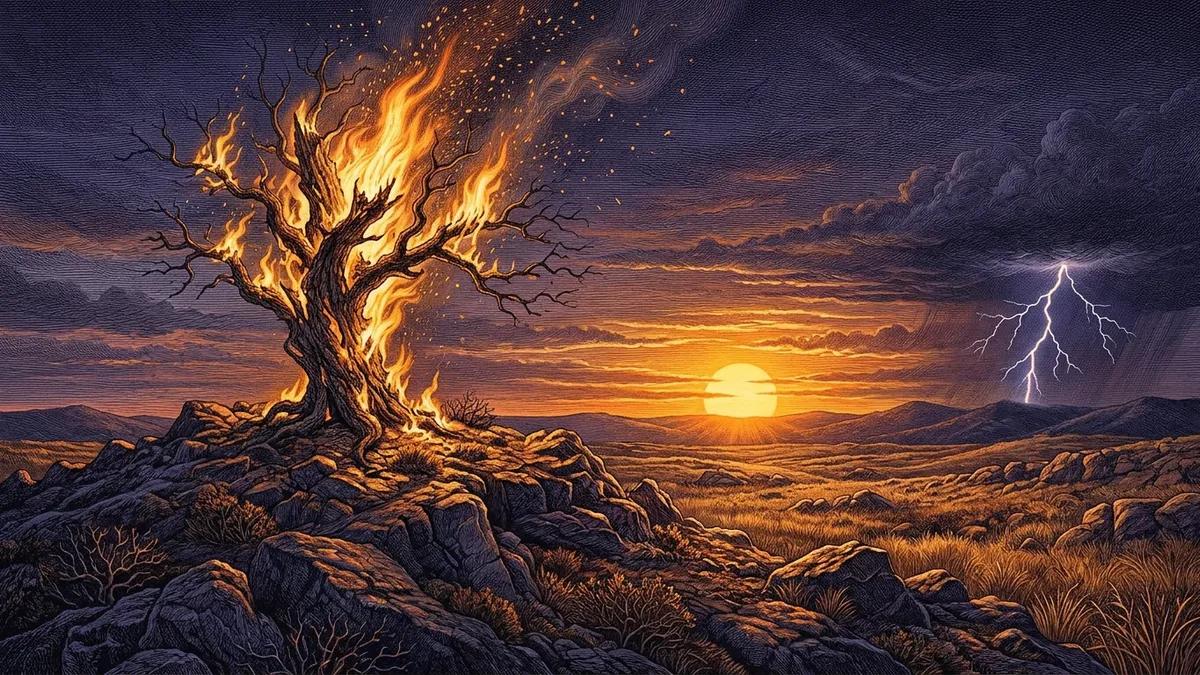
BELOW☲ Fire 離 Lí
Flame, sun, lightning; clinging, bright. In the family of the Shuogua it is the middle daughter.
The burning tree
THE EIGHT WITH FIRE BELOW
Pictures: original AI illustration created for Occultum.
Its pair, its opposite and its core
King Wen's order sets the hexagrams in pairs, each the other turned upside down or, where that changes nothing, with every line changed. Inside each lies a third, its hidden core, made of its lines 2 to 4 and 3 to 5.
In binary, a solid line 1 and a broken 0, read from the bottom line: 101010, which is 42, its place in the order Shao Yong set out and Leibniz saw his binary arithmetic in.
Learn more in the lessons
- The Book of Changes · 18 min
- Yin, Yang and the Five Phases · 13 min · free
- The Sovereign Hexagrams and the Tide of the Year · 14 min
The English name is the common title. The image, sense and counsel are short plain-words summaries of the Judgment and the Image, written for Occultum's I Ching tool, not translations; the Judgment and lines are James Legge's, from The Sacred Books of the East, vol. XVI (1882). Given here as history and symbolism; see the lesson The Book of Changes for how the book grew.