Three thousand years of magic written on clay, from Sumer to the last Babylonian scribes; the āšipu, the exorcist, beside the asû, the physician; Ea, the god of the deep waters, and Marduk his son; the Exorcist's Manual; the holy water, the tamarisk and the circle of flour; and the library of Ashurbanipal at Nineveh.
Magic in Mesopotamia — the land between the Tigris and the Euphrates, today mostly Iraq — is the best-documented magic of the ancient world. For three thousand years, from the Sumerians to the last Babylonian scribes under the Parthians, people wrote spells, rituals, omens and diagnoses on clay tablets, and the clay survived. The History of Magic gave it a few paragraphs. This course goes into the tablets themselves.
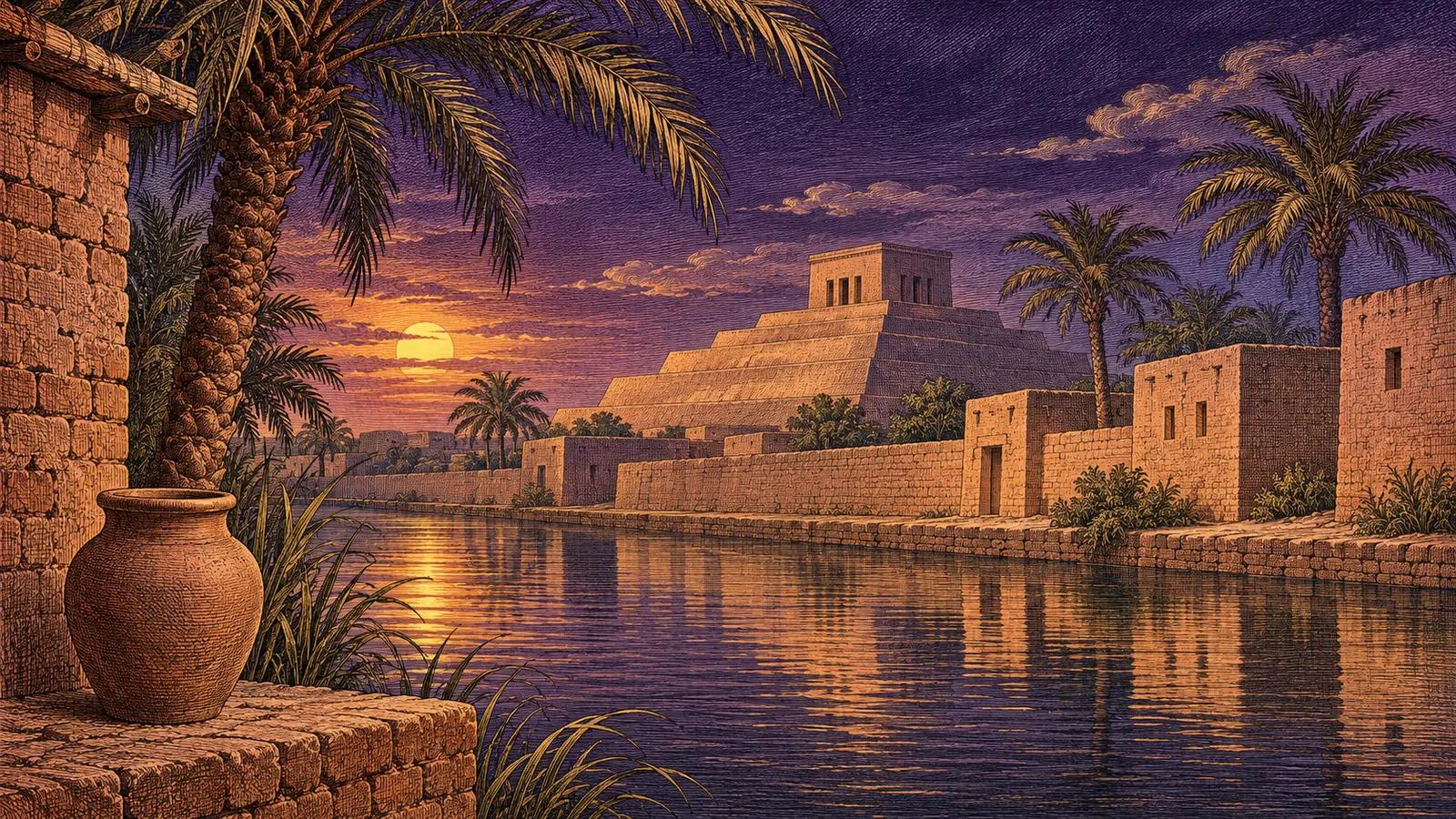
Original AI illustration created for Occultum: an imagined city, not a reconstruction of Babylon or any other site.A stone amulet against Lamashtu, early 1st millennium BC. Metropolitan Museum of Art. · CC0 · Source
A land of many peoples
Mesopotamia was never one kingdom. The Sumerians of the south built the first cities and invented writing before 3000 BCE; the Akkadians, who spoke a Semitic language, ruled after them; then came the great states of Babylon in the south and Assyria in the north, until Persia took Babylon in 539 BCE. Their writing was cuneiform, wedge-shaped signs pressed into wet clay with a reed. Sumerian died as a spoken language early in the second millennium BCE but lived on as the sacred language of ritual, like Latin in the medieval Church, so many incantations were copied in Sumerian with an Akkadian translation line by line.
Lesson 1 of 7 · 15 min
The letter at dawn. Original AI illustration created for Occultum.
This week in magic
One email each Thursday morning: the Moon and the festivals of the week, the angel of each day, and a free lesson to read. Free, and you can stop it in one click.
We use your address only for this email. See our privacy policy.
Magic in Mesopotamia — the land between the Tigris and the Euphrates, today mostly Iraq — is the best-documented magic of the ancient world. For three thousand years, from the Sumerians to the last Babylonian scribes under the Parthians, people wrote spells, rituals, omens and diagnoses on clay tablets, and the clay survived. The History of Magic gave it a few paragraphs. This course goes into the tablets themselves.
Original AI illustration created for Occultum: an imagined city, not a reconstruction of Babylon or any other site.A stone amulet against Lamashtu, early 1st millennium BC. Metropolitan Museum of Art. · CC0 · Source
A land of many peoples
Mesopotamia was never one kingdom. The Sumerians of the south built the first cities and invented writing before 3000 BCE; the Akkadians, who spoke a Semitic language, ruled after them; then came the great states of Babylon in the south and Assyria in the north, until Persia took Babylon in 539 BCE. Their writing was cuneiform, wedge-shaped signs pressed into wet clay with a reed. Sumerian died as a spoken language early in the second millennium BCE but lived on as the sacred language of ritual, like Latin in the medieval Church, so many incantations were copied in Sumerian with an Akkadian translation line by line.
The exorcist and the physician
The magician of Mesopotamia was a learned professional. The āšipu (also called mašmaššu), usually translated exorcist, was trained for years in the scribal schools. When someone fell ill or met with misfortune, he worked out its hidden cause — a god's anger, a demon, a ghost, a curse or a witch — and performed the rite to remove it. Beside him worked the asû, the physician, who used plant, mineral and animal remedies, salves and bandages. They were not rivals: a patient might be treated by both, and their methods overlapped.
What the āšipu had to know is set out in the Exorcist's Manual, a catalogue of his craft attributed to Esagil-kīn-apli, chief scholar to a Babylonian king of the eleventh century BCE. It lists the series he must master: incantations against demons, rites for purifying a house, for consecrating a temple, for undoing witchcraft, for healing every part of the body, for averting the evil of omens. The art was called āšipūtu, exorcism, and it was secret knowledge, to be kept among the learned.
The gods of magic
Every spell was, in principle, the gods' own. The patron of magic was Ea (in Sumerian Enki), god of wisdom and of the Apsû, the fresh waters beneath the earth. His son Marduk, the god of Babylon, also called Asalluhi, was the divine exorcist.
Hundreds of incantations contain a little scene that explains why they work. Marduk sees a man afflicted, goes to his father Ea, and tells him the trouble. Ea answers: my son, what do you not know? What can I add? — and then tells him exactly what to do: take this water, this plant, make this figure, say these words. The human exorcist then does it, speaking as Marduk's representative. The fire god Girra (or Gibil) burns away evil; Šamaš, the Sun, judges between the patient and his tormentor; Gula heals.
Water, plants, fire and flour
The exorcist's rituals were built from a handful of elements, used again and again:
Water: holy water in a basin, water from the river or from Ea's deep, poured, sprinkled, drunk or washed in.
Plants: the tamarisk, the date palm's heart, cedar, soapwort and many more, used to wipe and purify.
Fire and smoke: the torch and the censer, and the fire into which figures and objects were thrown.
Figurines: images of demons, ghosts, witches or the patient, made of clay, dough, wax or tallow, then burned, drowned, buried or sent away on a boat.
Knots and cords, tied and untied over the patient.
The circle of flour. The zisurrû was a circle drawn on the ground with flour around a sick person's bed, a house or the figures of a rite, to keep out the demons and ghosts. It is one of the oldest magic circles we can name (The Circle and the Working Tools).
The spoken words were what made the materials act. A typical incantation begins by naming the evil, tells the little story of Marduk and Ea, describes the rite and ends with a command: be gone, be released, and the closing formula én, which marks an incantation, as amen marks a prayer.
The library at Nineveh
Most of what we know comes from one place. In the seventh century BCE the Assyrian king Ashurbanipal gathered a library at Nineveh, sending agents to copy or seize tablets across his empire. When the city fell in 612 BCE the palaces burned, and the fire baked the clay hard. In the 1850s Austen Henry Layard and Hormuzd Rassam dug out more than 30,000 fragments — perhaps 10,000 texts — now in the British Museum. A great part of them is magic and divination: incantation series, omen collections, rituals and the letters of the king's exorcists, diviners and astrologers.
Magic as a profession
Mesopotamian magic was neither forbidden nor marginal. Kings employed teams of exorcists, diviners and astrologers; temples kept them; ordinary families paid them, or used simpler amulets and household rites. What the law punished was harmful magic, witchcraft, as the third lesson shows. For the āšipu, magic was a branch of learning, like medicine or law, practised for the good of the patient and the order of the world.
Exercise
Draw a circle of flour, in the old way, around something you want to protect — a seed in a pot, a candle, a letter you are waiting to send — on a tray or a plate. As you draw it, say plainly what it is to keep out. Leave it for a day, then sweep it up and throw the flour away outside, as the exorcist would after the rite. Note in your journal how it felt to make a boundary so small and so plain.
TRY IT NOW
Walk through The Burning once, as the tablets prescribe.
Reading once is not remembering. Study Cards bring each fact back just before you would forget it, until it is yours.
☉This lesson's 5 questionsNot practised yet · they join your daily review when you mark the lesson completeQuiz me on them →
Ask the tutor
Members can ask questions about any lesson and get an answer grounded in the lesson and its sources — explanations, practical guidance and what to study next.